


The first time I saw Naples from the sea, it was a blur of curves and color: the long arc of the bay, the dark cone of Vesuvius, a skyline pricked with church domes and antennae. It looked beautiful, but also chaotic, almost impossible to read. It was only when I walked out to Castel dell’Ovo, the seafront fortress planted on its rocky peninsula, that the city’s coastline finally came into focus. From its ramparts and tiny fishermen’s lanes, Naples stopped being a jumble and became a story you could trace with your feet and your eyes.
Get the latest updates straight to your inbox!
Finding Your Way to the Castle on the Water
Castel dell’Ovo rises from what was once the island of Megaride, now linked to the mainland by a short causeway at the eastern end of the Lungomare Caracciolo. Today it is an easy, flat walk from central areas like Piazza del Plebiscito or the port. Standing at the busy traffic circle of Piazza Vittoria, for example, you only have to follow the curve of the waterfront along Via Partenope to see the castle gradually separate itself from the line of hotels and apartment blocks, like a ship that never quite left shore.
Approaching on foot is the best way to understand how the castle anchors the modern waterfront. The pedestrianized seafront begins to feel calmer as you leave the honking taxis of Via Chiatamone behind. One side of the promenade is all sea, with low stone walls where teenagers sit and dangle their legs above the waves. The other side is a line of grand hotels and historic cafes. It is only a ten to fifteen minute stroll from Piazza del Plebiscito, but during that short walk the city’s frantic energy thins out and the castle grows larger, turning from postcard icon into a piece of lived architecture.
Practical details matter in a city as intense as Naples. Castel dell’Ovo remains one of its most accessible major sights. Entrance is typically free, though temporary exhibitions in the interior halls may request a small fee. Opening hours vary slightly by season, but late morning to early evening is a safe window; arriving around 10 a.m. or from about 4 p.m. avoids both tour groups and the midday glare that can flatten the shoreline. If you are staying nearby in Santa Lucia or Chiaia, the walk may be as simple as crossing one or two streets, and it is feasible even with a stroller or small suitcase thanks to the castle’s gentle ramps.
The closer you come, the more the modern city falls away. At the base of the access bridge, the noise of scooters is replaced by the slap of water against hulls and the clink of halyards on masts in the small marina of Borgo Marinari. Already the coastline looks different: no longer just a busy Italian city, but a place where fortifications, fishermen and pleasure boats have shared the same small strip of stone for centuries.
Stepping Inside: Ramps, Arches and Echoes of the Sea
Once you cross the narrow bridge onto Megaride, time compresses. The entrance to Castel dell’Ovo is surprisingly modest: a stone gatehouse, heavy wooden doors and a ramp that curls upward between ashlar walls the color of old sand. There is no drawbridge or theatrical portcullis, just a slow climb where your footsteps echo against centuries of military engineering. It is in that echo that many visitors begin to feel the coast differently, not as a thin recreational edge but as a line that has been defended, watched and worked for over two millennia.
As you climb, small openings in the walls give you sideways glances of the bay. One slit frames the cruise ships docked near Stazione Marittima; another captures only water and the soft outline of Capri on a clear day. These peeks are a reminder that the castle’s relationship with the sea has always been practical as much as picturesque. Long before the promenade below filled with joggers and gelato stalls, these embrasures were watching points for fleets, storms and possible invaders.
Inside the upper courtyards the architecture opens up. Low, blocky bastions spread towards the water, and the flooring underfoot shifts from smooth ramps to rough stone and uneven steps. There are minimal interpretive panels and very few barriers, which can feel startling if you are used to heavily mediated heritage sites. In practice, this relative simplicity encourages you to read the coastline for yourself. Many visitors wander freely from one corner to another, comparing views and trying to reconcile what they see with mental maps drawn from guidebooks.
It is worth pausing here not only for photos but for small details: the way salty air whitens stone, the tufts of grass that have found a foothold in mortared joints, the rusty anchors and coils of rope in the adjacent marina below. These textures underscore a crucial lesson that Castel dell’Ovo teaches about Naples. The coastline is not just scenic backdrop. It is an active element that gnaws at buildings, sustains livelihoods and perfumes every breath with a mix of seaweed, fuel and frying fish.
New Vistas: How the Castle Reorders Naples’ Coastline
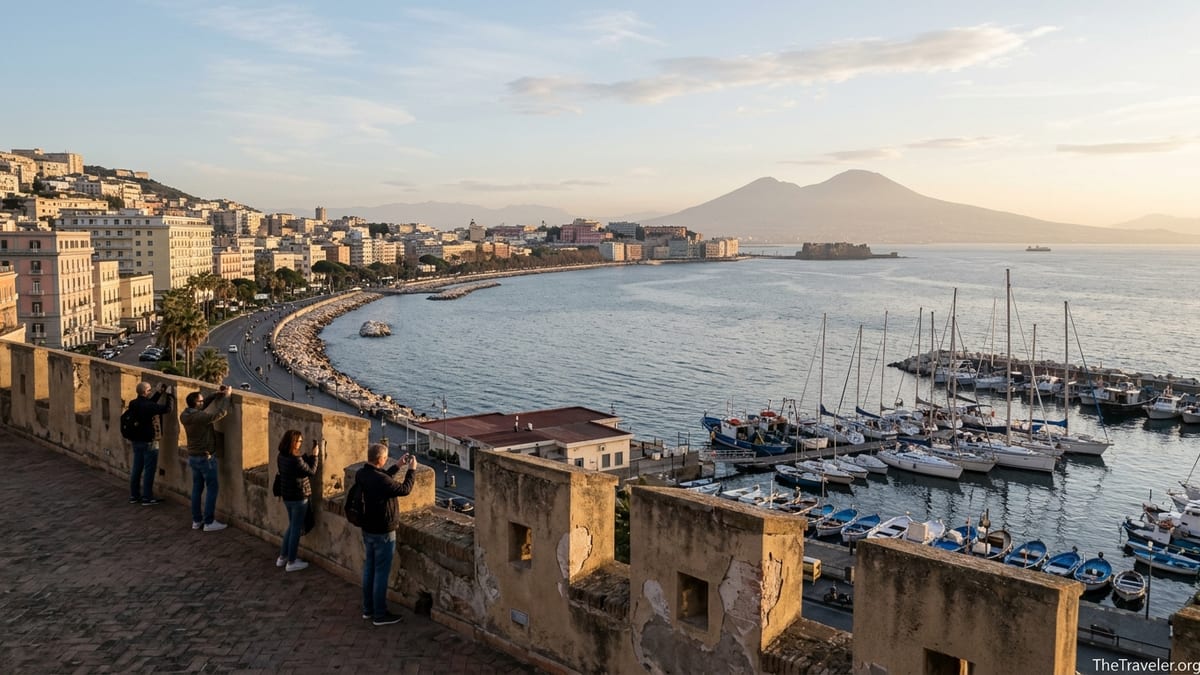
The real revelation comes when you step onto the highest accessible terraces. Here, Naples rearranges itself around you. Turn north and the historic center draws a jagged line: the cupola of the Galleria Umberto I, the bulk of Castel Nuovo and Palazzo Reale, the tangle of streets disappearing uphill towards the Spanish Quarter. Turn west and the arc of the Lungomare Caracciolo unrolls towards Mergellina, backed by the orderly grid of Chiaia and, further up, the hill of Vomero punctured by Castel Sant’Elmo. For the first time, the bay’s curve is something you can see in a single sweep rather than stitch together one promenade at a time.
This change in perspective has practical consequences for travelers. Many people arrive in Naples with a mental map dominated by the historic center: Spaccanapoli, San Gregorio Armeno, the Archaeological Museum. From Castel dell’Ovo you realize just how deeply the city is oriented towards the water. You can trace the route of the seafront tram and bus lines, imagine a morning jog along the lungomare, or simply see how close the supposedly distant neighborhoods really are. That hotel you considered in Chiaia suddenly looks walkable from the port. The marina where you plan to catch a boat to Capri seems tightly stitched into the urban fabric rather than an outlying excursion.
Looking inland from the castle also sharpens Naples’ vertical drama. Vesuvius dominates many postcard views, but from here you see how the volcano aligns with the built shore. The neat forest of masts in the marina foregrounds that famous silhouette, while the terraced buildings of Posillipo step between sea and sky. On a hazy afternoon the volcano can appear as soft as chalk dust, but the line of the coast remains firm, a reminder that cities choose where to face and how to frame their horizons.
In my own case, this view reoriented how I planned the rest of my stay. What had been a list of scattered sights became a sequence along a visible curve. I sketched a route that would follow the shoreline on foot from the castle through Santa Lucia and Chiaia, then up toward Posillipo, always keeping the fortress within sight for as long as topography allowed. The castle ceased to be a single attraction and became a reference point, a stone compass needle lodged permanently in the bay.
Borgo Marinari: A Living Link Between Fortress and Sea
Descending from the ramparts back to sea level, you emerge into Borgo Marinari, the small marina village that hugs the base of Castel dell’Ovo. It is a tight knot of low buildings, boatyards and sailing clubs that grew in the nineteenth century as a fishermen’s settlement and is still animated by maritime life. Tables from waterfront restaurants spill almost onto the quays, and locals in boat shoes and sun-faded polo shirts move between workshops and yacht club offices with the casual efficiency of people who measure time in tides more than in hours.
For visitors, the borgo offers one of the clearest windows into how Naples’ coastline is both stage and workplace. You might see a crew hosing down the deck of a small racing sailboat beside a fisherman untangling nets, while at the next table a family out for Sunday lunch spreads plates of spaghetti alle vongole and fried anchovies. Prices here are higher than in the backstreets of the historic center, but still reasonable by European waterfront standards. A plate of seafood pasta might run to the mid-teens in euros, an espresso will likely cost under two, and you are paying as much for the view of Vesuvius as for what is on the plate.
Walking around the tiny harbor takes only a few minutes, yet each side offers a different reading of the shore. From one edge you look back at the sleek façade of the seafront hotels on Via Partenope, their terraces lined with sun umbrellas. From another you see the apartment blocks of Santa Lucia stepping uphill, laundry fluttering from wrought-iron balconies. From yet another, the lungomare extends west in a long curve of stone and pavement, dotted with joggers, street vendors and families out for an evening passeggiata. The presence of the castle in the background knits these scenes together into a single coastal narrative.
Because cars are largely kept at bay here, Borgo Marinari is also one of the few places where you can hear the subtler sounds of the Neapolitan shore: the creak of fenders between hull and pier, the slap of wake against stone, the murmur of conversation rising and falling with the clink of cutlery. Spend even half an hour on a bench or at a café table and you begin to sense that the coastline is not only something to be looked at. It is a soundscape and a social space, and Castel dell’Ovo is its stone guardian.
Following the Lungomare: Extending the Lesson of the View
Leaving the borgo and turning right, you rejoin the Lungomare Caracciolo, the long seafront promenade that runs nearly four kilometers towards Mergellina. Many visitors come here for the views without realizing that the perspective they most admire was first taught to them by Castel dell’Ovo. Once you have seen the bay from the castle’s terrace, walking along the lungomare feels like entering the frame of a photograph you have just studied from above.
The section closest to the castle, along Via Partenope, is where visitors and locals mingle most densely. Here, grand hotels occupy historic palazzi and rows of restaurants serve everything from wood-fired pizza to grilled fish. The prices increase in proportion to the view, but you can still experience the coast on a budget by grabbing a slice of pizza a portafoglio from a side-street bakery and eating it on the sea wall while watching kayakers cut long strokes across the bay.
Continue further west and the promenade widens and relaxes. Near the Rotonda Diaz, scooters thin out and the atmosphere becomes more local. There is a small free beach where children leap into the water from rocks, watched by grandparents sitting in folding chairs under striped umbrellas. Joggers pass by at dusk when the heat has eased, and couples sit on the low wall facing the castle, now a squat silhouette glowing softly as the floodlights come on.
From here, looking back, you can see how Castel dell’Ovo acts as the hinge between the built city and the bay. The fortress appears almost modest compared with the high-rise hotels and apartment blocks behind it, yet it continues to command the eye. Seen from this angle, the lesson of the walk is clear: Naples’ modern waterfront amenities, from bike lanes to beach clubs, are layered over a much older coastline that the castle still defines.
Planning Your Own Walk: Practical Tips and Subtle Rewards
Turning a visit to Castel dell’Ovo into a meaningful coastal walk requires only modest planning but rewards a bit of thought. Time of day is crucial. Morning visits often bring clearer air and calmer seas, making distant islands like Capri more visible from the ramparts. Late afternoon, on the other hand, bathes the city in warm light and is ideal if you want to continue along the lungomare for sunset views. In high summer, midday sun on the stone terraces can be intense, so a hat, water and sunscreen are not optional luxuries.
Footwear makes a bigger difference than many expect. The approach to the castle is smooth and accessible, but once inside you will encounter uneven cobbles, ramps and occasional steps without handrails. Comfortable walking shoes or sturdy sandals are far better than flip-flops, especially if you plan to explore every corner of the outer walls. Parents with small children should be prepared to hold hands near low parapets and steep drops, although much of the main route is secure and stroller friendly.
Budget-conscious travelers will appreciate that a walk centered on Castel dell’Ovo can be one of Naples’ best low-cost experiences. The castle’s general admission is typically free, strolling the lungomare costs nothing, and you can keep food expenses low with simple pleasures. A takeaway coffee sipped on the sea wall, a paper cone of frittura di mare from a street stall near Piazza Municipio, or a single scoop of gelato as you circle Borgo Marinari all turn the coastline into a rolling picnic rather than an expensive outing.
Perhaps the most subtle planning tip is to allow unstructured time. Set aside an hour not tied to museum closing times or restaurant bookings and simply drift between the castle, the marina and the promenade. Sit on different benches, lean on different sections of parapet and watch how the coastline changes as ferries come and go, as the wind shifts, as locals transition from work mode to evening stroll. It is in these unscheduled moments that Castel dell’Ovo most effectively reshapes your understanding of Naples’ shore, teaching you that this is not a single view but a living, shifting edge between stone and sea.
The Takeaway
Before I walked through Castel dell’Ovo, Naples’ coastline felt like a backdrop: a beautiful, somewhat chaotic sweep of sea and city that I admired without really grasping. The castle, with its worn ramps, open terraces and working marina, turned that backdrop into a story. From its walls I could see how neighborhoods linked together along the curve of the bay. From Borgo Marinari I understood that the shore remains a place of work as well as leisure. From the lungomare extending westward, I watched the fortress shrink back into a landmark that silently organizes the view.
For travelers, the lesson is simple but profound. Do not treat Castel dell’Ovo as just another box to tick on a list of monuments. Treat it as the key that unlocks the shape of Naples itself. Give it a morning or an afternoon, walk slowly up and around its terraces, linger in the fishermen’s quarter at its feet and then follow the promenade until your legs are pleasantly tired. By the time you return to your hotel inland, the city’s coastline will no longer be a blur. It will be a curve you have walked, a map you carry not on paper but in the new way your eyes follow the sea.
FAQ
Q1. Is Castel dell’Ovo free to visit?
The castle is generally free to enter, though temporary exhibitions inside specific halls may charge a modest fee. Always check locally for any changes.
Q2. How long should I plan for a visit to Castel dell’Ovo?
Most visitors spend about one to two hours exploring the ramps, terraces and courtyards, plus extra time in Borgo Marinari or on the nearby promenade.
Q3. What is the best time of day to walk around the castle and waterfront?
Morning offers clearer views and cooler temperatures, while late afternoon and early evening provide softer light and a lively atmosphere along the lungomare.
Q4. Is the walk to Castel dell’Ovo suitable for children and older travelers?
The approach is flat and accessible, and many areas inside are reached via ramps, but there are uneven surfaces and some low walls, so supervision and care are important.
Q5. Can I combine a visit to Castel dell’Ovo with other nearby sights?
Yes. The castle is within walking distance of Piazza del Plebiscito, the Royal Palace, the San Carlo Opera House and the seafront promenade towards Chiaia and Mergellina.
Q6. Are there places to eat near Castel dell’Ovo?
Borgo Marinari at the castle’s base has several waterfront restaurants, and Via Partenope offers many more options, from simple pizzerias to upscale hotel dining rooms.
Q7. Do I need a guided tour to appreciate the coastline views from the castle?
A guide can add historical context, but many travelers are satisfied exploring independently, using the ramps and terraces as open-air viewing platforms over the bay.
Q8. What should I wear for a coastal walk including Castel dell’Ovo?
Comfortable walking shoes, sun protection and a light layer for breezes are recommended, especially in summer or if you plan to stay for sunset on the lungomare.
Q9. Is Castel dell’Ovo open in the evening?
Hours vary by season, but the castle usually closes before late night; however, the surrounding promenade and Borgo Marinari remain pleasant for evening strolls.
Q10. How does visiting Castel dell’Ovo change the way I see Naples’ coastline?
From its terraces you can read how neighborhoods, ports and the promenade fit together, transforming the bay from a postcard view into a coherent, walkable landscape.