


Cedar Run in Virginia’s Shenandoah National Park has a reputation that makes many first-time hikers pause. It shares billing with Whiteoak Canyon on some of the park’s most celebrated waterfall loops, yet regulars talk about Cedar Run in almost hushed tones: steep, rocky, relentless. If you are looking at a map and wondering whether this is the right trail for your first serious Shenandoah hike, it helps to understand what “difficult” really means here, and how to decide whether Cedar Run is an inspiring challenge or an unnecessary sufferfest for your current fitness and experience level.
Get the latest updates straight to your inbox!
Where Exactly Is Cedar Run, And What Are Your Options?
Cedar Run Trail sits in the Central District of Shenandoah National Park, beginning at Hawksbill Gap parking on Skyline Drive around mile 45.6. Many hikers connect it with Whiteoak Canyon to create one of the park’s classic waterfall circuits, but you can also hike Cedar Run on its own as an out-and-back to the waterfalls and natural water slide. The trail follows a rugged mountain stream down the east side of the Blue Ridge, which means that every step you take downhill from the road must eventually be earned back on the climb out.
The National Park Service describes the Cedar Run – Whiteoak Circuit as “very strenuous,” an 8.1-mile loop with roughly 2,700 to 2,800 feet of elevation gain and an average hiking time of 6 to 7 hours. That rating is aimed at reasonably fit adults, not elite trail runners, and is a good starting benchmark if you are planning your first visit. Shorter versions exist, including a 3.4-mile out-and-back on Cedar Run that drops to the main falls and returns the same way. That shorter hike still packs about 1,500 feet of climbing into less than 2 miles on the way back, which surprises many first-timers who assume that “short” means “easy.”
Because the Cedar Run corridor connects to multiple trails, you will see a range of numbers: AllTrails lists a popular Whiteoak Canyon and Cedar Run loop at about 8.5 miles with around 2,300 feet of gain, while trail running groups describe longer combinations exceeding 10 or even 11 miles that link Cedar Run, Whiteoak Canyon, Hawksbill, and the Appalachian Trail. When evaluating difficulty, it is important to know which version you are actually planning instead of just telling friends you are “doing Cedar Run” and assuming everyone means the same route.
For a first-time hiker who is reasonably active but new to serious mountain trails, the realistic choices are either the shorter Cedar Run out-and-back or the 8 to 9 mile Cedar Run – Whiteoak loop. Anything longer that adds Hawksbill or additional side trips is better saved for when you have a few Shenandoah hikes under your belt and know how your body responds to sustained climbs and rocky descents.
How Difficult Is Cedar Run Compared With Other Shenandoah Hikes?
Shenandoah National Park is full of climbs, but Cedar Run stands out for how steep and sustained it is. Experienced local hikers often mention it in the same breath as Old Rag and Whiteoak Canyon when listing the park’s hardest day hikes. On discussion boards devoted to the park, several hikers go as far as to call Cedar Run the steepest sustained incline they have done in Shenandoah, noting that while Old Rag’s rock scrambles feel more adventurous, Cedar Run’s grade can be more punishing on the lungs and legs.
To put this in context, imagine two hikes. First, an easier Skyline Drive overlook walk such as Little Stony Man, where you might climb 700 to 800 feet over a couple of miles on a relatively smooth, well-benchmarked path. You can chat with friends while climbing and still feel fresh at the top. Now compare that with Cedar Run, where the “short” 3.4-mile round trip compresses around 1,500 feet of gain into only 1.7 uphill miles. Many people unfamiliar with mountain terrain discover that they need frequent breaks, especially in summer humidity, even if they can comfortably jog a 5K at home.
Compared with Whiteoak Canyon, Cedar Run generally has fewer crowds but feels more rugged. The waterfalls along Whiteoak Canyon are taller and more famous, while Cedar Run’s charm is in its stacked pools, small cascades, and a sense of wildness. The trade-off is that footing can be trickier, with more loose rock and steeper pitches. If you have already managed a full day on Old Rag, with its rock scrambles and around 2,500 feet of gain, you will likely find Cedar Run challenging but manageable. If your only hiking experience has been shorter, rolling trails in local parks, expect Cedar Run to feel like a big step up.
An important nuance is that difficulty is not only about numbers on a sign. Weather, trail conditions, and your own preparation can make Cedar Run either a type-two-fun adventure or a dangerous slog. For example, doing the Cedar Run – Whiteoak loop in early October on a cool, dry day with 60-degree highs is a very different experience from tackling it on a humid July afternoon when thunderstorms are in the forecast and every rock is slick.
What Does the Trail Actually Feel Like Underfoot?
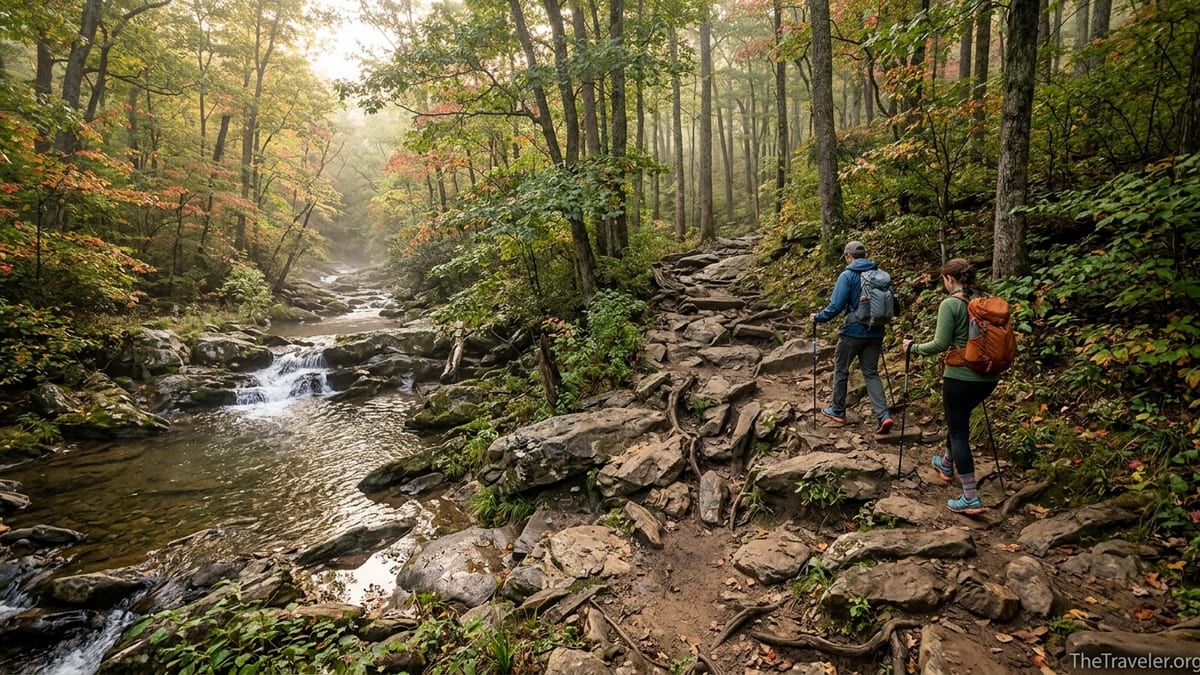
From the Hawksbill Gap parking area, Cedar Run Trail drops almost immediately into forest, losing elevation rapidly. The first mile or so is often described by hikers as deceptively pleasant: shaded, with the sound of the creek growing louder, and occasional glimpses of small pools and cascades. But under your boots, the tread is already telling a story. Expect sections of loose stones, fist-sized rocks embedded in the path, and short rocky ledges where you will place your feet carefully, especially when they are wet from recent rain.
As you continue down, the grade steepens and the creek becomes a constant companion. Several sections involve stepping over rocks and roots on uneven ground, and in wetter seasons you may encounter muddy patches or water trickling over the trail itself. Near the lower falls, you will find one of the route’s signature features: a natural water slide carved into the rock, with a small plunge pool below. On warm summer weekends, this spot can look like a mountain swimming hole party, with hikers in bathing suits, daypacks scattered on boulders, and kids taking turns sliding down the smooth chute into the pool.
The terrain that makes Cedar Run so beautiful also makes it demanding. Rock slabs near the main falls can be extremely slick, especially where algae grows in the spray zone. There are stream crossings where hikers hop from stone to stone; in low water these are straightforward, but after heavy rain or during spring runoff, you may find that some rocks are underwater or that you need to wade knee-deep to cross safely. Trekking poles are helpful here, not as a fashion accessory but as real tools that add stability on wet, uneven surfaces.
On the climb back out, every loose rock you stepped around on the descent becomes a potential ankle-twister as your legs tire. Many first-timers report that their quads and calves burn on the sustained grade, and that the last half-mile to the parking lot feels longer than it looks on the map. This is why good footwear is not optional. Trail runners with grippy soles or mid-height hiking boots are strongly recommended; lightweight sneakers with flat, worn treads are a recipe for slips, especially if you are tempted to detour to the pools.
How Long Will It Take, And Who Is It Suitable For?
The National Park Service estimates 6 to 7 hours for the full Cedar Run – Whiteoak Canyon circuit, which includes both the steep Cedar Run descent and the long climb out via Whiteoak Canyon and the connecting fire road. Many hikers complete it faster, particularly those who are fit and keep breaks short, but first-timers should plan their day around that more conservative number. This means starting no later than late morning in summer and earlier in spring and fall when daylight is shorter, to avoid finishing in the dark.
To get a sense of what this looks like on the ground, imagine a mid-May Saturday where you arrive at Hawksbill Gap around 9:30 a.m. After sorting gear, you hit the Cedar Run Trail at 9:45, reaching the main falls and water slide just before 11. You spend 45 minutes snacking, taking photos, and maybe wading in the chilly water. At noon, you decide to continue on to complete the loop. By the time you intersect the Whiteoak Canyon Trail, climb past its series of six waterfalls, and return via the fire road and horse trail, it is late afternoon. Many parties report finishing between 3:30 and 5 p.m., pleasantly exhausted.
For the shorter Cedar Run out-and-back to the falls, a typical first-time hiker might take 45 to 60 minutes descending to the main falls and then 75 to 90 minutes climbing back out, plus time spent at the water. Planning on 3 to 4 hours total, including rest breaks, is reasonable for moderately fit adults who are moving carefully but steadily. Families with younger children or groups that like long breaks at the pools should add another hour.
As for who should attempt Cedar Run, a good rule of thumb is that you should be comfortable walking 6 to 8 miles on rolling terrain without issues before tackling the full loop. If you currently only walk short distances on flat sidewalks, consider starting with easier Shenandoah hikes such as Dark Hollow Falls or Stony Man before stepping up to Cedar Run. People with knee or ankle problems should be particularly cautious, as the constant steep grade during the descent can aggravate joints even when you feel stable. If you are bringing a dog, remember that while leashed pets are technically allowed on Cedar Run, the sharp rocks, slick slabs, and crowds at the water holes mean the trail is not ideal for every animal.
Seasonal Conditions, Crowds, And Safety Considerations
Cedar Run is technically a year-round trail, but the season you choose has a major impact on both difficulty and enjoyment. In early spring, usually March and April, the stream is often running high and the waterfalls are at their most powerful. Temperatures are cooler, which makes the climbs more comfortable, but patches of ice can linger on shady rocks and stream crossings after cold snaps. Waterproof boots and microspikes can turn a potentially sketchy crossing into a manageable one in these shoulder seasons.
Summer, from late May through August, brings the crowds. On hot weekends, parking at Hawksbill Gap can fill by mid-morning, and the pools near the water slide feel more like a backcountry swimming hole than a quiet forest stream. This is when Cedar Run is most tempting for first-time hikers, because the idea of a swim after a hot climb is so appealing. However, heat and humidity significantly increase the difficulty of the trail. Expect to sweat heavily and drink more water than you might on a cooler day. Carrying at least 2 liters per person for the shorter out-and-back and 3 liters for the full loop is a realistic baseline; adding an electrolyte drink mix can help ward off cramping during the long climb out.
Autumn, especially late September through October, is arguably the best time for a first Cedar Run attempt. The waterfalls still flow, temperatures are lower, and fall foliage adds color to the canyon walls. Trails are still busy on peak foliage weekends, but the combination of crisp air and drier rocks makes the physical challenge feel more manageable. Winter is the quietest season and can deliver magical views of frozen cascades, but it also brings hidden ice on rocks, cold stream crossings, and short daylight. Unless you already have winter hiking experience and traction gear, it is better to aim for spring through fall for your first visit.
Regardless of season, a few safety basics apply. Afternoon thunderstorms are common in warm months, and the canyon’s steep walls mean that lightning and flash flooding are real considerations. If the forecast calls for storms, start early, keep an eye on the sky, and be prepared to turn around if water levels rise or thunder moves in. Slippery rocks near the pools and slides cause twisted ankles and occasional more serious injuries; resist the urge to jump into unknown pools and always test footing before committing your weight. Finally, remember that cell service is patchy. Do not rely on your phone alone for navigation, and let someone know your plan and expected return time before you set off.
Practical Tips For First-Time Hikers On Cedar Run
Preparation is what turns Cedar Run from an intimidating question mark into a hard but rewarding day out. Start with route planning: decide whether you are doing the Cedar Run out-and-back or the full Cedar Run – Whiteoak circuit, and study a map before you go. The park service offers downloadable maps that show key junctions such as the intersection with Whiteoak Canyon Trail and the fire road. Many hikers also carry an offline map on their phone through popular navigation apps, but it is wise to have a paper backup in case batteries die or the app glitches.
Next, think about gear. At minimum you want sturdy, broken-in shoes with good traction; 2 to 3 liters of water in bottles or a hydration reservoir; snacks with a balance of carbohydrates and salt, like trail mix, energy bars, or peanut butter sandwiches; and a small first-aid kit that includes blister treatment. Trekking poles are strongly recommended, especially for the descent and the climb back out, and a lightweight rain jacket is a smart addition even on sunny mornings, because mountain weather can change quickly. In summer, pack a small microfibre towel and a dry shirt if you plan to swim at the falls or slide; hiking uphill in wet cotton is a quick route to chafing.
Time management is another key piece. Aim to hit the trail early, especially on weekends and holidays. Arriving at Hawksbill Gap by 8 or 8:30 a.m. dramatically increases your chances of finding parking and enjoying quieter stretches of trail. Build in time for unplanned pauses: a long line at the park entrance station, a slow group ahead of you on a steep section, or extra minutes at a particularly photogenic cascade. If you find yourself halfway through your planned time and still far from your intended turnaround point, be honest about how you are feeling and do not hesitate to shorten the outing.
Finally, set expectations for your group. If you are bringing friends who are new to hiking, explain that Cedar Run is not a casual stroll to a roadside overlook. Describe the sustained elevation, rocky footing, and the need to watch each step in certain places. Encourage everyone to speak up early if they feel uncomfortable, low on energy, or dizzy; most mishaps on steep trails occur when people push to “just make it to the next bend” when they really should have turned around an hour earlier. Choosing a conservative goal, such as reaching only the main falls instead of completing the entire loop on your first attempt, is not a failure. It is smart mountain judgment.
The Takeaway
Cedar Run is not the most famous trail in Shenandoah National Park, but among those who know the park well, it is one of the most respected. Its combination of sustained steepness, rocky terrain, and cascading water makes it both physically demanding and visually rewarding. For a first-time hiker who has only experienced shorter, gentler trails, Cedar Run can feel surprisingly hard. For someone who already enjoys challenging day hikes with significant elevation gain, it will likely register as tough but well within reach.
Whether Cedar Run is “too hard” for you right now depends less on a number printed on a trail sign and more on your preparation, expectations, and conditions on the day you go. Choose the right variation for your fitness level, carry the water and gear you need, start early, and give yourself permission to turn around if the trail feels like more than you bargained for. Approach it that way, and Cedar Run is not just a test of endurance; it is an apprenticeship in reading mountain terrain, your own limits, and the subtle difference between a good challenge and unnecessary risk.
If this is your first serious mountain hike, consider using Cedar Run as a long-term goal rather than an immediate leap. Build up with a few easier Shenandoah routes, learn how you handle climbs and rocky footing, and then come back to Cedar Run ready for the challenge. When you finally stand back at the Hawksbill Gap parking lot after climbing out of the canyon, legs tired, face flushed, and the sound of the creek fading behind you, you will understand why so many hikers consider it one of the most satisfying days you can have in this corner of the Blue Ridge.
FAQ
Q1. Is Cedar Run Trail suitable for beginners?
For absolute beginners, especially those not used to hills, Cedar Run is generally too demanding. If you already walk or hike 6 to 8 miles on rolling terrain and are comfortable with rocky footing, the shorter Cedar Run out-and-back can be a challenging but reasonable first “big” mountain hike. Total newcomers to hiking should start with easier Shenandoah trails before attempting Cedar Run.
Q2. How long does it take to hike Cedar Run for a first-timer?
For the 3.4-mile out-and-back to the main falls, many first-time hikers take around 3 to 4 hours including breaks. For the full Cedar Run – Whiteoak Canyon loop of roughly 8 to 9 miles, a cautious estimate for first-timers is 6 to 7 hours, depending on fitness, weather, and how long you spend at viewpoints and swimming holes.
Q3. Which direction should I hike the Cedar Run – Whiteoak Canyon loop?
Many hikers prefer to descend Cedar Run first and climb out via Whiteoak Canyon and the fire road, starting from Hawksbill Gap. This puts the steepest, rockiest descent at the beginning of the day when your legs are fresh, and saves the more gradual but longer climb for later. Others start from the lower Whiteoak parking area and do the loop in the opposite direction; both are strenuous, but starting high often feels more manageable for first-timers.
Q4. Do I need special gear for Cedar Run?
You do not need mountaineering equipment, but you should have sturdy footwear with good traction, sufficient water, snacks, and a small first-aid kit. Trekking poles are strongly recommended, especially for the steep sections and stream crossings. In cooler or shoulder seasons, a light insulating layer and a rain jacket are wise, and in summer, swimwear and a quick-dry towel are useful if you plan to enjoy the pools.
Q5. Is Cedar Run safe for children?
It depends on the child’s age, experience, and comfort with rough terrain. Older kids and teens who are already used to hiking and listening closely to adult instructions may enjoy the challenge and the water features. Younger children, or those unused to steep, rocky paths, may find the trail frustrating or unsafe, especially near the slick rocks around the falls and water slide. If you bring children, choose conservative turnaround points and keep them close at stream crossings and drop-offs.
Q6. Can I swim at Cedar Run, and is the water slide safe?
Many visitors do swim in the pools and use the natural rock slide near the main falls in warm weather. However, these activities are inherently risky. Rocks are slick, water levels and currents change with recent rain, and submerged obstacles may not be visible. If you decide to swim or slide, do so cautiously, avoid diving, check depth before jumping, and be prepared for very cold mountain water even in midsummer.
Q7. What is the best season for a first hike on Cedar Run?
Late spring through mid-fall is generally best. Early spring often has strong flows and cooler air, but can bring icy patches and cold water. Summer offers warm swimming weather but adds heat, humidity, and larger crowds. Autumn combines milder temperatures, usually drier rocks, and colorful foliage, making it a popular and comfortable season for a first attempt.
Q8. How crowded is Cedar Run compared with other Shenandoah trails?
Cedar Run is less crowded than nearby Whiteoak Canyon and far less crowded than Old Rag, but it is not a secret. On pleasant weekends, expect to see a steady stream of hikers, especially near the falls and swimming holes. Starting early in the morning, choosing weekdays, or visiting outside peak summer and foliage weekends can significantly reduce crowding.
Q9. Do I need a permit or reservation to hike Cedar Run?
As of now, you do not need a special day-use permit or reservation specifically for Cedar Run, but you do need to pay the standard Shenandoah National Park entrance fee or use a valid park or interagency pass. Check current park regulations and any temporary closures or advisories before your trip, as policies can change.
Q10. What if I get partway down Cedar Run and realize it is too hard?
Turning around is always an acceptable and often the smartest choice. Because Cedar Run is an out-and-back or loop that starts and ends at the road, you can retrace your steps uphill to return to your car at almost any point. If you feel overly tired, unsteady on the rocks, or uncomfortable with conditions such as rising water or approaching storms, stop, rest briefly, and then head back the way you came while you still have plenty of daylight and energy.