


Cedar Run, a tiny village tucked into Pennsylvania’s Pine Creek Gorge, looks exactly like the kind of place where you should be able to spend a hot afternoon wading, swimming, and watching the water slide past. Between Pine Creek and the smaller trout stream also called Cedar Run, there are plenty of places to get your feet wet. But this is not a lifeguarded lake or a resort pool. If you are wondering whether you can actually swim at Cedar Run, the answer is yes, with important caveats. Here is what visitors should understand before packing swimsuits and heading for this quiet corner of the PA Wilds.
Get the latest updates straight to your inbox!
Where Exactly Is Cedar Run, and What Kind of Water Is It?
Cedar Run is a tiny unincorporated community in Lycoming County, Pennsylvania, set where Cedar Run Creek flows into Pine Creek along the famous Pine Creek Gorge, sometimes called Pennsylvania’s Grand Canyon. The Pine Creek Rail Trail, a popular multi day cycling route, passes right through the village, and the valley floor is a mix of private campgrounds, a small general store, and access points to both the creek and the river. This is remote country by East Coast standards, with the nearest larger towns such as Wellsboro and Jersey Shore more than half an hour away by winding two lane roads.
The water people talk about when they say “swimming at Cedar Run” is not a designated state park beach. You are dealing with two free flowing, cold water streams. Pine Creek is a broad, fast moving river sized creek that attracts canoeists, kayakers, and tubers in spring and early summer. Cedar Run itself is a smaller, clear trout stream about 11 miles long, shaded by forest and known among anglers for wild trout rather than for casual swimming.
Most visitors who swim do so in Pine Creek along the stretch by private campgrounds like Pettecote Junction, or in deeper roadside pools and informal swimming holes on Cedar Run and other nearby tributaries. Expect natural rock bottoms, uneven depths, and variable currents instead of buoys, docks, or sand beaches. That is part of the appeal for many travelers, but it also means you need to come prepared.
Because these waters cut through a steep sided gorge, conditions can change quickly with weather. After heavy rain upstream, the character of Pine Creek in particular can shift from lazy family float to powerful current in a matter of hours. Before you plan an afternoon of swimming, it is wise to understand how this river system works and where your own comfort level lies.
Can You Legally Swim at Cedar Run?
There is no law that outright forbids swimming in Pine Creek or Cedar Run near the village, and locals and campers do routinely get in the water in summer. In fact, descriptions of campgrounds in the Cedar Run area commonly mention swimming and tubing in Pine Creek as warm weather activities, especially at spots like Pettecote Junction, which sits directly on the riverbank and notes that swimming is popular there when water levels drop in July and August.
However, this is almost always at your own risk. You are not in a state park lake with a roped off beach and lifeguards. Pennsylvania’s general approach to inland water recreation is that outside designated swimming beaches and pools, there are very few amenities and little formal oversight. In practice, that means you can wade and swim where public access is allowed and where landowners permit it, but you are responsible for your own safety, and parents are solely responsible for supervising children.
Property boundaries matter. Much of the riverfront near Cedar Run is either private land or part of private campgrounds. Swimming is typically allowed for registered guests, but non guests walking in from the Rail Trail or road should not assume that every inviting gravel bar or deep pool is open to the public. For example, a family cycling the Pine Creek Rail Trail might be tempted to scramble down to the water behind a riverside cabin. Doing so without permission could mean trespassing even if there is no fence.
If you are not staying at a campground with signed river access, the most straightforward and respectful way to reach the water is to use public access points associated with the Rail Trail or Pine Creek water trail, or to ask locally at places like Cedar Run Inn, Wolfe’s General Store in nearby Slate Run, or Pine Creek Outfitters upriver which areas are traditionally used by the public for swimming and river access.
What the Water Is Really Like: Depth, Current, and Temperature
People who have only swum in lakes or the ocean are sometimes surprised by how a mountain creek behaves. In summer, Pine Creek near Cedar Run can look almost lazy from the Rail Trail, but up close you will usually notice a steady current, especially in the main channel. Depth varies widely. At low to moderate flows, gravel bars and rocky shallows may be ankle to knee deep for many yards, then drop abruptly into deeper runs that can be over a person’s head.
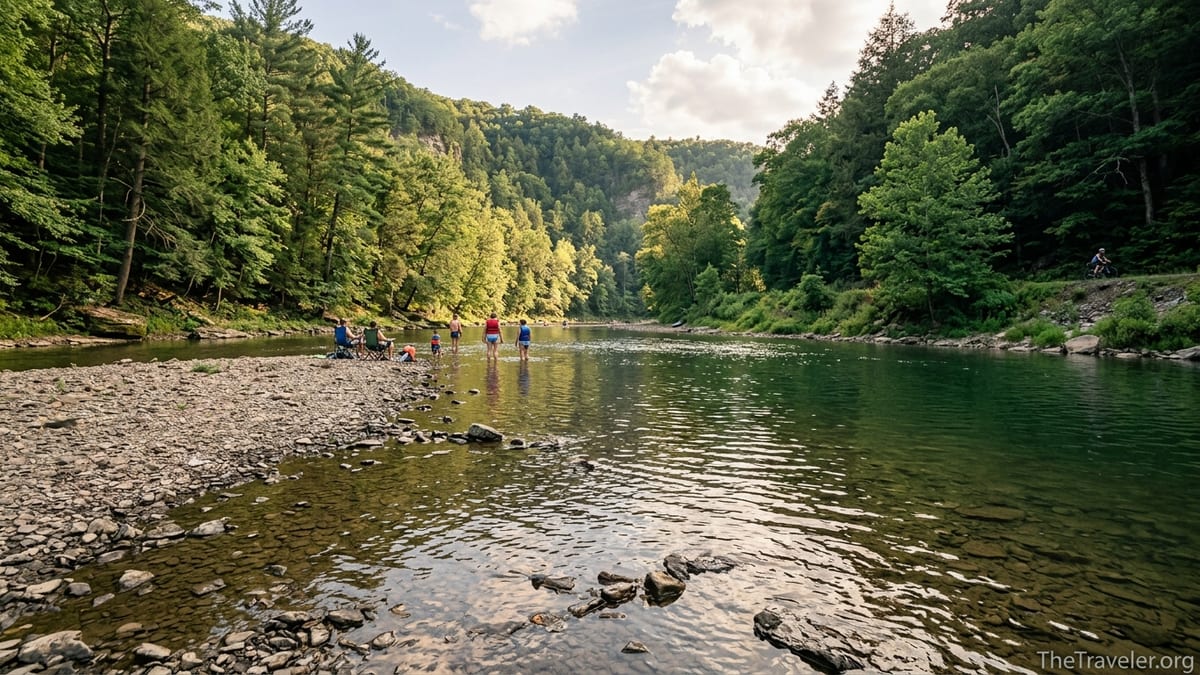
Campground reviews from visitors at Pettecote Junction and nearby sites often mention that the river by Cedar Run is fairly fast moving and better suited to confident swimmers, older kids, or adults. In lower water, families often settle on shallow gravel bars where younger children can splash while adults sit in camp chairs at the edge. When levels are higher, the same stretch can feel more like a mild whitewater river, and falling in without a life jacket could mean a long, cold swim to shore.
Temperature is another factor. Cedar Run and Pine Creek drain a heavily forested, high plateau. Snowmelt and cold springs keep the water cool even on ninety degree days. In May and early June, water temperatures are often cold enough that a prolonged swim without a wetsuit will leave most people shivering. By mid July and August, the shallows can feel refreshing but comfortable, especially on sunny afternoons, yet the deeper pools remain brisk. Travelers who are used to warm southern rivers or mid Atlantic bays should plan on much cooler water here.
The upshot is that “can I swim at Cedar Run” is less about legality and more about conditions and comfort. Strong swimmers visiting in late summer on a hot day may find Pine Creek near Cedar Run perfect for a long, lazy float with a tube and a life jacket. The same visitor in May, when the water is higher and colder, may decide that staying in a boat or simply wading along the edge is the smarter choice.
Best Places to Get in the Water Around Cedar Run
For most travelers, the easiest access to swimable water near Cedar Run is directly from a riverside campground. At Pettecote Junction along Beach Road, for example, unhooking your camper or pitching your tent usually puts you within a short walk of Pine Creek. Guests commonly wade in the shallows, sit in camp chairs in ankle deep water, or launch tubes for short floats starting upstream and ending back at the campground. This sort of arrangement is ideal if you want to supervise kids closely without having to relocate the car every time someone wants to cool off.
Another practical option is to combine time on the Pine Creek Rail Trail with quick dips in the creek. Families often rent bikes from outfitters closer to the northern end of the gorge and then ride a section that passes through Cedar Run or nearby Slate Run. On hot days, the pattern becomes ride for a few miles, then pull off at a gravel bar where the trail almost touches the water. Adults can wade in up to their knees to cool down, children can splash around under close supervision, and then everyone dries off and continues riding. This is less about marathon swimming and more about using the creek as a natural cooling station.
Those looking for classic swimming holes also have options, though you will generally drive a bit. Upstream in Tioga State Forest, the Cedar Run Swimming Hole near Leetonia is a roadside pool where a deep, calm section of creek is popular for summer dips. Access is almost at car door level, with just a few steps from parking to water, which appeals to travelers who are not up for a hike. The site has no lifeguards or facilities, so visitors are expected to follow leave no trace principles and to swim strictly at their own risk.
Beyond Cedar Run itself, other parts of the Pine Creek Gorge also offer places where paddlers and cyclists routinely stop to swim, especially where the creek bends around broad gravel bars. Guides and outfitters in the region can often point you to specific bends and pull offs that work well at typical summer water levels. For example, a canoe rental company might show you on a printed map where a popular mid day swim stop lies between put in and take out points on a Pine Creek trip.
Safety, Hazards, and When Not to Swim
Because there are no lifeguards along Pine Creek near Cedar Run, safety comes down to judgment and preparation. The most important factor is water level and speed. Outfitters and local paddlers often talk about the Cedar Run USGS gauge when deciding whether to paddle a particular section of Pine Creek. At lower levels, the river is forgiving and exposes many gravel bars. At higher levels after big rain events, even experienced paddlers describe it as pushy and cold, and say that “everyone goes swimming” whether they planned to or not.
As a visitor, a practical way to think about this is to pay attention to how the water looks when you arrive. If you see many exposed rocks and broad bars of gravel with visibly shallow riffles between them, you are likely dealing with low to moderate water that is suitable for cautious wading and for strong adult swimmers to play near shore. If the channel looks bank to bank full, muddy, and fast, with very few rocks visible, treat the river as unsafe for casual swimming and keep children and non swimmers out of the current even near the edge.
Cold shock is another real hazard. On a spring or early summer visit, you might arrive during the season when canoe camping is popular and see groups in drysuits or splash gear heading down the creek. Jumping in wearing only a swimsuit because the air feels warm can be a shock to the system and, for those with underlying health issues, a medical risk. Even in August, limit how long small children stay in the water, because they lose heat faster than adults.
Finally, this is a natural river environment. Expect slippery rocks coated in algae, uneven footing, and occasional deeper drop offs. In some sections, submerged logs or branches create snags where flotation devices can get pinned. The safest approach is to wear sturdy water shoes or sandals with toe protection, avoid diving or jumping where you cannot clearly see the bottom, and treat any current stronger than you can easily walk against as potentially dangerous.
Gear, Clothing, and Practical Tips for a Swim Day
You do not need technical whitewater gear to enjoy the water at Cedar Run in summer, but a few practical items can make the experience safer and more comfortable. A properly fitted Coast Guard approved life jacket is advisable for anyone venturing beyond shallow wading depth, and many families in the area treat life jackets as non negotiable for children, similar to a seat belt in a car. If you plan to float a stretch with tubes or inflatable kayaks, life jackets should be considered standard equipment for adults as well.
On your feet, cheap flip flops are a bad match for slick river rock. Closed toe water shoes, old trail runners you do not mind getting wet, or secure strap on sandals work far better. Travelers who forget them often find themselves buying basic water shoes at small outfitters or general stores in nearby villages, simply because walking barefoot on sharp stones gets old quickly. A light pair of synthetic shorts and a quick drying shirt are practical for those who plan to combine cycling or hiking with impromptu swims.
Because there are few formal facilities at popular river access points near Cedar Run, plan ahead for changing and basic comfort. Many visitors wear swimsuits under regular clothes so they can wade without needing a full change room. A large towel, a dry bag or plastic tote to keep spare clothes out of the sand and gravel, and a small cooler for water and snacks help turn a quick dip into a comfortable afternoon by the creek. Remember that glass containers are a poor choice on rocky, barefoot friendly riverbanks; pack beverages in cans or reusable bottles instead.
Finally, bring sun and insect protection. The gorge is forested, but the open stretches of gravel bar and water reflect a surprising amount of sunlight. A wide brimmed hat, sunglasses, and sunscreen are useful even on hazy days. In late spring and early summer, biting insects can be persistent at dusk along the river, so packing repellent makes evening swims more pleasant.
Respecting the Environment and Local Community
Cedar Run’s appeal lies in how unspoiled it feels. Protecting that character is part of every visitor’s responsibility. Local land managers and long time residents emphasize a simple principle: leave the creek looking as if you were never there. In practice, that means packing out all trash, including micro litter like bottle caps, snack wrappers, and bits of broken inflatable toys that often get left behind on gravel bars after a busy weekend.
Campground rules typically prohibit glass near the water, loud music late at night, and cutting live vegetation for campfires or shade. Respecting these guidelines matters not only for the natural environment but also for keeping swimming and river access available in the future. When specific stretches of riverbank are repeatedly abused, private landowners sometimes close informal access, and public agencies may tighten restrictions on parking or day use.
Wildlife also plays a role. Pine Creek and Cedar Run support healthy fish populations, and anglers share many of the same access points as swimmers. Giving space to people actively fishing, avoiding throwing rocks where lines are in the water, and keeping noise moderate helps different users enjoy the same stretch of creek. When you encounter turtles on logs, herons stalking the shallows, or, on rare occasions, a bald eagle overhead, enjoy the moment from a distance rather than trying to approach for a photo.
Lastly, remember that Cedar Run is a year round home to a small community, not just a seasonal playground. Drive slowly on narrow village roads, keep parking within designated areas, and avoid blocking private driveways or business access when you pull off to reach the water. Stopping in at local establishments for ice cream, a meal, or basic supplies is a tangible way to support the people who make it possible for visitors to keep enjoying this corner of the PA Wilds.
The Takeaway
So can you swim at Cedar Run? Yes, in the sense that people regularly wade, float, and swim in Pine Creek and at a handful of deeper pools on Cedar Run and nearby streams. But this is swimming in a wild river corridor rather than a managed beach. There are no lifeguards, no roped off shallow ends, and only a patchwork of formal access points.
For travelers willing to respect the currents, the cold, and the local community, the payoff can be memorable. Picture a July evening where the sun drops behind the gorge rim while you and your family sit ankle deep on a gravel bar, watching swallows skim the surface of Pine Creek. Or a bike ride along the Rail Trail broken up by a quick plunge into a clear, chest deep pool before rolling on to the next village.
The key is to treat the water at Cedar Run with the same respect you would give any backcountry environment. Check conditions before you commit to a long swim, wear sensible footwear and life jackets when appropriate, supervise children every moment they are near the current, and leave every access point cleaner than you found it. Do that, and Cedar Run can be one of the most rewarding places in Pennsylvania to cool off on a summer day.
FAQ
Q1. Is it safe for children to swim at Cedar Run?
Swimming at Cedar Run is best for older children who are confident in the water and always supervised at arm’s reach. Currents in Pine Creek can be surprisingly strong, and footing is uneven. For younger kids, focus on very shallow gravel bar areas near shore, use life jackets, and avoid the water entirely when levels are high or muddy.
Q2. Do I need a life jacket if I am just swimming, not boating?
There is no requirement to wear a life jacket when simply wading or swimming from shore, but it is strongly recommended for children and for anyone venturing into deeper water or using tubes and inflatables. Many local families treat life jackets as standard gear on Pine Creek, much like a seat belt in a car.
Q3. Are there lifeguards anywhere near Cedar Run?
No, there are no lifeguarded swimming beaches at Cedar Run on Pine Creek or on Cedar Run Creek itself. All swimming is at your own risk, whether you access the water from a campground, a Rail Trail pull off, or a roadside swimming hole in the surrounding state forest.
Q4. Can I swim in Cedar Run if the water level looks high?
If the river is bank to bank, fast, or muddy, it is wise to avoid swimming and keep even wading to a minimum. High water increases current speed, hides underwater obstacles, and lowers water temperature. In those conditions, stick to shore based activities or explore the area by bike or on foot instead.
Q5. Is there a best time of year to swim at Cedar Run?
The most comfortable swimming conditions are usually from mid July through late August, when water levels tend to drop and shallows warm slightly. In May and June, the water is often colder and higher, which is better suited to paddling than to long swims. Early fall can still offer pleasant wading on warm days, though evenings cool quickly.
Q6. Are there any official swimming holes I should look for?
There are no officially designated swimming beaches right in the village, but nearby you will find informal spots that locals favor, such as the Cedar Run Swimming Hole in Tioga State Forest and various gravel bars along Pine Creek accessed from campgrounds or Rail Trail pull offs. Always confirm that you have permission to use a particular spot and that conditions look safe on the day you visit.
Q7. What should I wear for swimming in Pine Creek or Cedar Run?
Wear a swimsuit or quick drying synthetic clothing, plus sturdy water shoes or old sneakers to protect your feet from sharp rocks and give you traction on slippery stones. A light shirt or rash guard helps with sun protection, and many visitors add a hat and sunglasses for long days on the gravel bars.
Q8. Can I bring my dog to swim with me at Cedar Run?
Rules for dogs vary. Some private campgrounds along Pine Creek are dog friendly with pets allowed to swim, while certain nearby nature areas and refuges prohibit dogs entirely. Always check the pet policies of your campground or the land manager ahead of time, keep dogs under control, and be mindful of other visitors who may not be comfortable around animals.
Q9. Are there restrooms or changing facilities near the water?
Facilities depend on where you access the creek. Campgrounds usually provide restrooms and sometimes simple shower or changing areas for registered guests. At pull offs along the Rail Trail or in the surrounding state forest, you may find only basic vault toilets or no facilities at all, so plan to arrive dressed for wading and bring a towel and dry clothes for after your swim.
Q10. Do I need any permits or passes to swim at Cedar Run?
You do not need a permit just to swim or wade in Pine Creek or Cedar Run where public access is allowed. If you are camping, you will pay normal campground or state forest camping fees. Anglers need a valid Pennsylvania fishing license if they plan to fish while they are in the water. Beyond that, follow posted rules, respect private property signs, and you should be able to enjoy the water without special paperwork.