


For millions of travelers arriving in New York Harbor between the 1890s and the 1950s, Ellis Island was the thin line between an old life and a new one. Today its surviving records are far more than dry lists of names. When you learn how to search and interpret them, they can reveal unexpected stories about your family’s journey, change long‑held assumptions and even reconnect you with relatives you never knew existed.
Get the latest updates straight to your inbox!
Why Ellis Island Still Matters for Family History
Ellis Island served as the main federal immigration station for New York from 1892 to 1954, processing roughly 12 million arrivals. For anyone with ancestors who passed through New York in that period, its ship manifests and related paperwork form a crucial bridge between the Old World and life in America. Even if your relatives arrived through other ports like Boston or Philadelphia, understanding Ellis Island records helps you read similar documents from elsewhere and place your family’s story in a wider migration picture.
Much of the Ellis Island material that survives today exists as microfilmed copies of passenger lists created by the federal immigration service and later transferred to the National Archives. Those reels have since been digitized and indexed in multiple databases, including a free 65‑million‑record Ellis Island passenger database operated by the Statue of Liberty–Ellis Island Foundation, and large collections at FamilySearch and commercial services such as Ancestry. Together, they allow you to sit in a living room in Denver or a cafe in Warsaw and pull up the same manifests that clerks inspected in New York more than a century ago.
For many families, finally seeing a great‑grandparent in those lists is profoundly emotional. A New Jersey teacher, for example, spent years hearing that her Italian great‑grandfather “came through Ellis” but had only a vague story to go on. By combining a possible year of arrival from a 1930 census entry with a narrowed search of Ellis Island records, she eventually found him recorded in 1913, listed as a 19‑year‑old laborer from Avellino with just 20 dollars in his pocket and a destination of Newark. That one page confirmed his village of origin and led her to cousins in Italy she had never met.
These records matter not only because they confirm dates and spellings, but because they capture ancestors at a moment of uncertainty and hope. Names, ages, occupations, destinations and even scribbled marginal notes can overturn family legends, shed light on lost relatives or reveal repeat crossings that no one talked about.
What You Can Actually See in an Ellis Island Record
At the heart of Ellis Island research is the ship manifest, sometimes called the passenger list. The format evolved over time, but by the early twentieth century most manifests recorded a rich set of details. In a single line beside your ancestor’s name you might see their age, marital status, last residence, exact village or town, occupation, literacy, amount of money carried and the name and address of a relative in the country of origin. Another column captured the relative or friend they were joining in the United States, often with a specific street address.
This level of detail can have startling results. A Minnesota man who believed his Polish great‑grandmother came from “somewhere near Warsaw” used the Ellis Island database to search variant spellings of her name. A manifest from 1907 did more than confirm her arrival. It listed her last residence as a village whose modern spelling differed slightly from the old handwritten form. With that clue, he was able to locate the village on a contemporary map, contact the local parish and obtain nineteenth‑century baptismal records that filled in three more generations of his family tree.
Manifests also include indirect clues that only make sense once you know how to read them. In one Italian family’s case, the manifest for a 1909 voyage listed a 10‑year‑old boy traveling with an older aunt, but his surname field was left blank. At first glance it seemed like a clerical slip, but by checking other pages and contemporary naming patterns, a researcher realized his last name had been assumed from the aunt’s entry above. That small insight helped confirm that the boy did in fact belong to their family line, even though his surname later changed in America.
In addition to the main manifest pages, some Ellis Island journeys generated a “Record of Detained Aliens” or “Record of Aliens Held for Special Inquiry.” These list passengers who were temporarily held for medical checks, financial concerns or questions about their paperwork. Discovering an ancestor on one of these pages can add dramatic texture to a family story, revealing that they spent several anxious days in detention before being allowed to land.
Where and How to Search Ellis Island Records Today
Modern researchers rarely touch the original microfilm. Instead, they rely on a network of databases built from those reels. The Statue of Liberty–Ellis Island Foundation maintains a free online passenger search that focuses on New York arrivals between 1892 and 1924 and later years through 1957. Its records can also be accessed in person at the American Family Immigration History Center on Ellis Island, where staff and volunteers help visitors locate and print manifests as keepsakes.
The National Archives in the United States holds the official federal copies of New York passenger lists on microfilm, and has partnered with several organizations to digitize those reels. That is why you can also find Ellis Island arrivals in collections called things like “New York Passenger and Crew Lists, 1897–1957” on genealogy platforms. FamilySearch, run by the Church of Jesus Christ of Latter‑day Saints, offers a widely used free index that covers many of the same manifests and often includes high‑quality images. Commercial sites such as Ancestry and MyHeritage provide additional search tools and improved indexing, useful for travelers who hit dead ends elsewhere.
To see how this plays out in practice, imagine a traveler from Chicago visiting New York who wants to prepare for an Ellis Island museum stop. The night before, she searches the Ellis Island database from her hotel room, using her great‑grandfather’s name and an approximate arrival year drawn from a World War I draft card. The Ellis Island index returns several possibilities. She cross‑checks each with census data and family stories, eventually matching him to a 1911 arrival because the manifest lists his destination as the very street in Chicago where her family still owns a building. The next day on Ellis Island she prints a large facsimile of the manifest and brings it home as a framed piece of family history.
Because different platforms use different indexing systems, it is worth repeating searches across several sites rather than assuming one negative result settles the matter. A name mistranscribed on one service may be correctly decoded on another, and some platforms allow creative filters, such as searching for passengers from a specific village or by the names of traveling companions.
Search Strategies That Uncover Hidden Ancestors
Ellis Island records reflect handwriting, accents and spelling conventions from more than a century ago, which means that straightforward name searches often fail. Successful researchers treat spelling as flexible. If you are looking for a Hungarian surname like Kovács, for instance, it might appear in manifests as Kovacs, Kowach, Kovaes or an even more surprising variant, depending on who wrote it down and how they heard it. Trying several phonetic spellings, swapping first and last names or dropping diacritical marks can all yield hits.
Another powerful tactic is to search for a group rather than a single individual. Many immigrants traveled with siblings, cousins or neighbors from the same village. A Reddit user researching an Irish family called Burns could not find the mother’s arrival but did locate a brother on a New York passenger list. By studying all of the surnames on the same page and then checking them in later census records, they realized that several neighboring families from County Mayo had settled on the same block in Boston. That cluster gave them the key to identify the missing woman under a slightly mangled spelling on another manifest.
Clues from American records often make the difference. Naturalization papers, delayed birth certificates, World War draft registrations and even old driver’s licenses sometimes list a precise date and ship of arrival. A researcher in Texas trying to verify his grandfather’s claim of entering through Ellis Island in 1921 eventually found a naturalization petition that named the steamship and date. Armed with that information, he was able to consult the New York passenger list microfilm via the National Archives catalog and obtain a certified copy of the manifest, something the Ellis Island online index alone had not easily revealed.
Patience and experimentation are essential. Experienced genealogists freely admit that they may run dozens of different searches before finding the right entry. They vary first names, reverse given names and surnames, try initials, widen or shrink the arrival date range and switch between English and original‑language spellings for home villages. When a database’s search interface is limited, some even browse by ship and date, page by page, especially when they already know which vessel carried an ancestor to New York.
Correcting Myths and Misconceptions About Ellis Island
Perhaps the most persistent Ellis Island myth is that inspectors routinely changed immigrants’ names on the spot. Historians and archivists point out that this story rarely fits the actual process. Immigration officers generally worked from ship manifests that had been compiled at the port of departure by steamship company clerks. Those lists served as the primary legal record. While names certainly evolved once people settled in America, the change almost always happened later, through personal choice, school enrollment, marriage records or court petitions, not an Ellis Island official arbitrarily erasing syllables.
What did happen is more subtle. Names on manifests were often recorded in a form that fit local spelling conventions in the port of departure, which could differ sharply from how the same name would be written in English. A Czech surname featuring accented characters might be simplified to unaccented letters in Hamburg, then anglicized again in Massachusetts. To a modern reader, this can look like three different names, but when you trace each step back through original documents, you see a chain of practical adjustments rather than a single dramatic change at Ellis Island.
Another misconception is that every immigrant arriving in New York passed through Ellis Island itself. Before the island opened in 1892, arrivals were processed at Castle Garden in lower Manhattan and, for a time, at a barge office near Battery Park. After Ellis Island closed as an inspection station in 1954, passengers were generally inspected on board ships or at piers. Some wartime and first class travelers were exempted from Ellis Island inspections altogether. A traveler who assumes “Ellis or nothing” may overlook ancestors who arrived in New York in the 1880s or mid‑1950s and appear in related passenger lists under different headings.
Finally, people are often surprised to discover just how many times a single relative crossed the Atlantic. A family in Ohio believed their Jewish great‑grandfather came once, in 1905, and never left. Ellis Island records revealed that he actually came in 1903, returned to Europe twice on business and brought over different siblings on each trip. The full manifest trail transformed a simple migration story into a complex web of family sponsorships, chain migration and entrepreneurial travel.
From the Archive to the Journey: Visiting Ellis Island in Person
For travelers planning a trip to New York City, combining online research with a physical visit to Ellis Island can be a powerful experience. Ferries depart from Battery Park in Manhattan and Liberty State Park in New Jersey, usually offering combined tickets that include both the Statue of Liberty and Ellis Island National Museum of Immigration. Many visitors recommend booking the earliest morning slots, both to avoid long security queues and to leave ample time for the museum’s exhibits and records center.
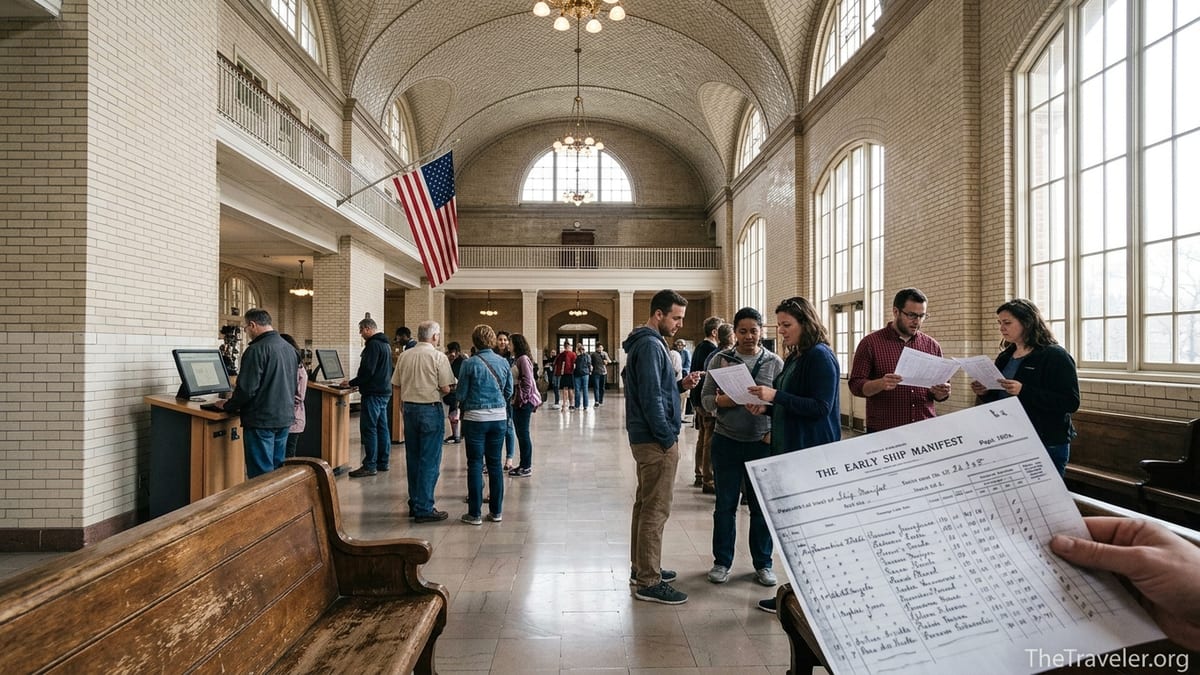
Inside the restored main building, you walk through the same cavernous Registry Room where inspectors once examined arriving passengers. Museum galleries trace the broader history of American immigration with artifacts, photographs and oral histories. For those who have already found their ancestors in digitized records, standing in that hall with a printed manifest can be deeply moving. One Canadian traveler described bringing his grandmother to Ellis Island for her 90th birthday. Holding a copy of her own 1929 passenger list, she stood on the balcony overlooking the Registry Room and quietly pointed to the spot where she remembered queuing with other children, clutching a small suitcase.
The American Family Immigration History Center on site lets visitors access the same digital database found online, but with the benefit of staff guidance, larger screens and high‑quality printers. Travelers who arrive with partial information can often refine their searches with the help of trained volunteers, who understand the quirks of the underlying microfilm and indexes. If a manifest is found, it can be printed on archival paper or saved for later download.
Spending time on Ellis Island also helps place family stories in a global context. Exhibits compare New York’s immigration station with other sites such as Angel Island in San Francisco Bay, where many Asian immigrants were detained in far harsher conditions. Seeing these contrasts on the same day you locate a relative’s name on a New York manifest can broaden your understanding of how different groups experienced America’s “golden door.”
Beyond Ellis Island: Following Your Ancestor’s Trail
Finding an ancestor in Ellis Island records is rarely the end of the story. Instead, it acts as a launchpad into other collections. The manifest often lists a final destination and the name of a relative or friend in the United States. Those details can point you to city directories, naturalization records, draft registrations, marriage certificates, cemetery plots and local newspapers in the town where your relative settled.
Consider a traveler whose Greek grandfather appears on a 1912 Ellis Island manifest with a destination of Lowell, Massachusetts, and a note that he is joining an uncle named Nikolaos at a specific street address. By checking that address in the 1915 Massachusetts state census, the traveler might find a crowded lodging house full of relatives and fellow villagers. Local church records could then reveal baptisms of siblings, while a World War I draft card confirms the grandfather’s exact date of birth. Each new record reinforces and expands the story first glimpsed in the Ellis Island manifest.
In some cases, Ellis Island research connects directly to modern legal processes. Applicants for European citizenship by descent, for example, often need certified proof of an ancestor’s lawful entry to the United States. When online Ellis Island searches are inconclusive, they can use information from partial manifests, naturalization files or family papers to submit a request to the National Archives for an official passenger arrival record. Several recent applicants for Italian and Croatian dual citizenship have described using this route when the Ellis Island database indexing did not surface their ancestor’s entry, but the underlying federal records still existed.
Following the trail forward can also have an emotional dimension. Once you know when and how an ancestor arrived, it becomes easier to imagine their first years in America: the neighborhoods they walked, the factories where they might have worked, the languages they heard on street corners. For travelers, visiting those neighborhoods today, from New York’s Lower East Side to Chicago’s Little Italy or Cleveland’s Slavic Village, can feel like an extension of the Ellis Island journey.
The Takeaway
Searching Ellis Island records is about far more than ticking a box on a family tree. It is a way to stand alongside your ancestors at the moment they stepped into an unfamiliar country and made choices that shaped your life today. The combination of digitized passenger lists, helpful archives and on‑site museum resources means that many travelers can now uncover those stories with a laptop and some persistence.
Along the way, you may confirm cherished family legends, debunk persistent myths or discover additional crossings and relatives that no one mentioned. Some people locate long‑lost villages or trace relatives forward to living cousins abroad. Others simply gain a better sense of the risks and hopes that powered an earlier generation’s travel.
Whether you are planning a pilgrimage to the Ellis Island National Museum of Immigration or quietly exploring databases from home, the records created there remain among the richest sources for understanding how ordinary people became part of the American story. With patience, creativity and a willingness to follow each new clue, those faded manifests can turn into a detailed, deeply personal map of your family’s past.
FAQ
Q1. Do I have to pay to search Ellis Island passenger records?
The core Ellis Island passenger database maintained by the Statue of Liberty–Ellis Island Foundation is free to search, both online and at the American Family Immigration History Center. Some additional tools and overlapping collections exist on paid genealogy sites, but you can often make substantial progress using only free resources like the Ellis Island database and FamilySearch.
Q2. What if I cannot find my ancestor in Ellis Island records?
First, consider spelling variations, possible earlier or later arrival years and the chance that your relative used a different given name or nickname. Then widen your search to other ports such as Boston, Philadelphia or Baltimore using broader passenger list collections available through the National Archives and genealogy sites. It is also possible that your ancestor arrived before Ellis Island opened in 1892 or after it closed as an inspection station in 1954, in which case related but differently labeled records will apply.
Q3. Are the names in Ellis Island records always spelled correctly?
Not necessarily. Ship clerks in European ports wrote down what they heard, often in their own language’s spelling system, and later indexers sometimes misread handwriting. As a result, you may see several versions of the same surname across different documents. Treat the manifest as a valuable snapshot, but always cross‑check with other records such as naturalization papers, church registers and local civil certificates.
Q4. Can Ellis Island records help me find relatives still living in Europe?
Yes, often indirectly. Manifests usually list a last residence, which may include a specific village or town, and the name of a relative back home. Once you can pinpoint that locality, you can search parish registers, civil records and modern directories or social media for people with the same surname. Many researchers have used Ellis Island clues to reconnect with cousins in Italy, Poland, Ireland, Greece and other countries.
Q5. How accurate are the ages and personal details on ship manifests?
Ages, occupations and even marital status on manifests are generally reliable but not perfect. Some passengers understated or overstated their age to meet immigration or military requirements, while others simplified occupations for clarity. When you compare Ellis Island data with census records, draft registrations and vital certificates, small discrepancies are common, but overall patterns usually align well enough to confirm identity.
Q6. What is the benefit of visiting Ellis Island if I have already searched online?
Visiting Ellis Island lets you experience the physical space where your relatives were processed and explore museum exhibits that place their journey in historical context. On site you can also access the database with staff assistance and obtain high‑quality printed copies of manifests. Many travelers find that standing in the Registry Room with a passenger list in hand gives their online research a powerful emotional dimension.
Q7. Can Ellis Island records be used for legal purposes, such as citizenship applications?
In some cases, yes. While the Ellis Island database itself is primarily a research tool, the underlying passenger lists preserved by the National Archives can be used to obtain certified copies of arrival records. Applicants for citizenship by descent or other legal processes often rely on those certified records to demonstrate an ancestor’s lawful entry to the United States.
Q8. Do Ellis Island records include people who were turned away?
Most manifests list all passengers who arrived at the port, including those later excluded or deported. Additional pages, such as Records of Detained Aliens or Special Inquiry lists, document people who were held for further review. However, follow‑up paperwork about appeals or deportations may be found in separate immigration files rather than in the core Ellis Island database.
Q9. What time period do Ellis Island records cover?
Ellis Island operated as a federal immigration station from 1892 to 1954, and passenger lists for ships arriving in New York during this period are generally included in the databases built from National Archives microfilm. Earlier New York arrivals, before 1892, are documented in Castle Garden and barge office records, while later arrivals after 1954 appear in different forms of immigration documentation.
Q10. Can I search Ellis Island records if I am not a United States citizen?
Yes. The databases that index Ellis Island passenger lists are open to anyone with internet access, regardless of nationality or location. Many researchers in Europe, Latin America, Asia and elsewhere use them to trace relatives who migrated to the United States, whether those relatives stayed permanently or eventually returned home.