


Between 1892 and 1954, more than 12 million people passed through Ellis Island, stepping into an uncertain future with little more than a suitcase and a name. Today, the former immigration station in New York Harbor is a museum and memorial, but the stories that unfolded beneath its vaulted ceilings still hit hard. For modern travelers, Ellis Island is not just another stop on a New York itinerary. It is a place where the drama of departure and arrival, fear and hope, is preserved in rooms, records, and voices that feel disarmingly close to the present.
Get the latest updates straight to your inbox!
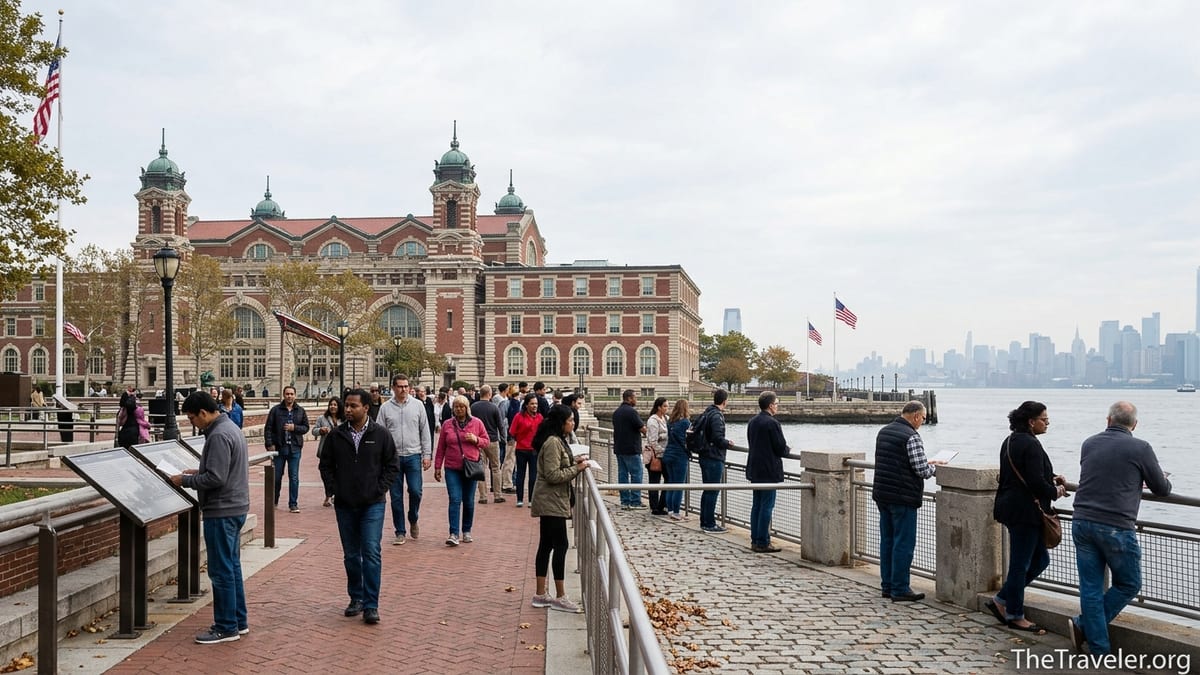
The Island of Hope and Tears
Ellis Island is often called the Island of Hope, Island of Tears, a phrase that captures the emotional whiplash many immigrants experienced as they waited to learn whether they would be allowed into the United States. Between its opening as a federal immigration station in 1892 and its closure in 1954, roughly 12 million arrivals were processed here, with peak years in the early 1900s when thousands could arrive in a single day. The scale is staggering, but what stays with visitors is not the number. It is the individual stories that turn statistics into something deeply human.
Walk into the restored Great Hall today and it is easy to imagine the room filled with lines of anxious families clutching identity tags. Many had already endured weeks in cramped steerage cabins on ships from Naples, Hamburg, or Odessa. On Ellis Island, they faced medical inspections, quick-fire questions about relatives and work plans, and the possibility of separation. For some, this vaulted room was the last barrier before a train ticket west. For others, it was the place where a dream quietly ended.
The National Park Service’s oral history project has recorded thousands of these memories, and on-site listening stations let you hear former arrivals describe their first steps onto American soil. One Italian teenager recalls being told to pin all her savings, wrapped in a handkerchief, to the inside of her dress so she would not lose it in the crowd. A Jewish refugee remembers the shock of bright electric lights and the overwhelming sound of dozens of languages in the Great Hall. It is these granular details that make a visit feel less like a history lesson and more like reading a family diary.
For travelers, this emotional undertone shapes everything about an Ellis Island visit. The ferries pull away from Manhattan or New Jersey with commuters and tourists checking their phones, but as the immigration station’s red-brick buildings come into view, the mood often shifts. Conversations quiet. Cameras come out. People look not just at the skyline they are approaching, but at the journey countless others once made without the assurance of return.
Walking Through the Great Hall
Most visitors start their Ellis Island experience in the Main Arrivals Building, now home to the Ellis Island National Museum of Immigration. After passing through the entry level with its ticketing, exhibits, and orientation panels, you climb the wide staircase that immigrants once took to reach the Inspection Hall. Rangers still stand at the top, echoing the position doctors once took to watch how people walked and breathed as they climbed, a simple way to spot potential health issues.
Inside, the Great Hall is a cavernous space with arched windows and a tiled ceiling. Today it is clean and orderly, with display cases and interpretive panels. Yet the room’s sheer size evokes the days when benches filled the floor and arrivals sat in nervous rows. You can stand at one end and look back toward the entrance, trying to imagine it with 5,000 people moving through in a single day during the 1907 peak. Travelers who have just come from the packed platforms of Penn Station or the subway tend to recognize the same sense of organized chaos, only here it is freighted with far higher stakes.
One of the most affecting parts of the Hall is a small alcove where audio recordings play descriptions of the medical checks that determined whether someone was fit to enter. A chalk mark on a coat could mean a suspected eye disease or a limp that might keep a person from steady work. For modern visitors who might associate immigration with forms and biometric scans, hearing about these brisk, public examinations is a reminder that the anxiety of crossing borders is not new. Parents in the crowd sometimes use this space to explain to their children why grandparents or great-grandparents rarely spoke about their arrival in America. It was, quite simply, one of the most frightening days of their lives.
Travelers who want to deepen the experience can time their visit to join a ranger-led Great Hall talk. These short programs often weave together real cases pulled from ship manifests and inspection records, reconstructing the journey of a specific family from departure port to final destination. Hearing how a Greek laborer headed for a railroad job in Chicago navigated the process, for example, puts a concrete human face on what can otherwise feel like an abstract migration wave.
Stories That Still Hit Hard
What makes Ellis Island especially powerful is how many of its stories are preserved in immigrants’ own words. Since the 1970s, the National Park Service and partner organizations have collected oral histories from people who arrived here in the first half of the twentieth century. On the museum’s upper floors, listening booths allow visitors to pause and hear these voices. Many recount the same sequence: the last look back at a village church, seasickness in the Atlantic, the first glimpse of the Statue of Liberty, the long lines, and at last either release or rejection.
One oft-cited account is from a young woman from Eastern Europe who arrived alone around 1910. She describes clutching a scrap of paper with a cousin’s New York address written in a language she could barely read. When an inspector asked whom she knew in America, she could only point to the paper and repeat the cousin’s name. After a tense pause, she was waved through and directed to the rail ticket counter downstairs. Decades later, she told an interviewer that if the inspector had simply shrugged and marked her for detention, she had no idea what would have happened to her. Standing in the same building, listening to her voice crack as she remembers that moment, hits modern travelers with an almost physical force.
Another story that resonates for visitors is that of migrants who were turned away for medical reasons. The island’s hospital complex, now accessible on special tours, once treated contagious diseases and serious conditions found during screening. In some cases, children recovered and were eventually reunited with families who had already gone ahead. In others, a diagnosis meant deportation. Thoughtful travelers often come away from the exhibits reflecting on how arbitrary the line between acceptance and exclusion could be, particularly at a time when immigration policy was increasingly restrictive.
For those with family connections to Ellis Island, the impact can be even more intense. The American Family Immigration History Center on the main floor offers access to ship manifests for passengers who arrived through the Port of New York between 1892 and 1954. It is common to see visitors emerge with a printed copy of a grandparent’s arrival record, complete with the name of the ship and a note about their intended occupation. For many, that thin piece of paper is the first concrete evidence they have ever seen of a story told around dinner tables for decades.
Planning Your Visit: Ferries, Costs and Timing
Despite its emotional weight, visiting Ellis Island is logistically straightforward. Access is by Statue City Cruises ferries only, departing from Battery Park in Manhattan and Liberty State Park in New Jersey. A standard ticket typically bundles round-trip ferry transportation, access to the grounds of Liberty Island to see the Statue of Liberty, and entry to the Ellis Island National Museum of Immigration. Prices can vary slightly by season and ticket type, but as a rough guide, adult tickets generally fall in the 25 to 30 dollar range, with reduced fares for children and seniors.
There is no separate admission fee for Ellis Island itself, which makes the museum exceptionally good value for travelers willing to devote the time. Ferries usually start running from around 9 a.m., and the last boat back from Ellis Island tends to leave in the late afternoon or early evening, with extended hours in peak summer. It is wise to check the most current schedule before committing to a specific time, especially around major holidays. Security screening operates much like an airport checkpoint, so building in extra time for lines at the departure point is crucial.
Most visitors who combine Liberty and Ellis Islands find that the entire excursion takes at least four to five hours, including ferry rides, security, and time on each island. Travelers who want a more reflective experience at Ellis Island often opt to take an early-morning ferry, spend only a short time on Liberty Island, and then devote the bulk of the day to the immigration museum. Audio guides are available in multiple languages, and they can be helpful for navigating the exhibits without feeling rushed.
Food and drink options on the island are limited to a cafeteria-style café in the main building, with typical New York pricing. For a family of four, a light lunch of sandwiches or salads with drinks can easily approach 60 to 70 dollars. Budget-minded travelers often bring snacks or a simple picnic to eat on outdoor benches overlooking the harbor. From here, with the Manhattan skyline on one side and the Verrazzano-Narrows Bridge on the other, it is easy to picture the crowded steamships that once approached this same channel.
Inside the Ellis Island National Museum of Immigration
The museum’s exhibits are structured to guide visitors from the broader history of global migration into the intimate realities of processing on Ellis Island. On the first floor, displays trace the political and economic forces that pushed people from Europe, the Middle East, and elsewhere at the turn of the twentieth century. Panels explore everything from famine in southern Italy to persecution in Eastern Europe and industrial recruitment campaigns that promised jobs in American factories and mines.
Upstairs, galleries focus on the physical experience of arrival. Original artifacts like trunks, religious objects, and clothing are displayed alongside large photographs of crowded ship decks and waiting rooms. A corner devoted to luggage is unexpectedly moving, showing how much a family tried to compress into a single battered suitcase. For modern travelers rolling carry-on bags from a midtown hotel to the ferry, the contrast is impossible to ignore. The museum does not romanticize the journey. It emphasizes that for many people, leaving home was an act of desperation, not simple adventure.
One standout space is the Registry Room, where a large American flag hangs above the hall. Interactive exhibits here invite visitors to explore changes in immigration law, including the quotas of the 1920s that dramatically reduced arrivals from certain regions. Rather than relying solely on text, the displays use individual case studies. For example, a panel might follow a Polish farm laborer arriving in 1913, then contrast his relatively straightforward passage with that of a would-be entrant in 1930 facing strict new limits. This approach keeps policy discussions grounded in real lives.
On the museum’s upper levels, the story extends beyond Ellis Island to wider questions of identity and belonging. Exhibits examine how successive immigrant communities have adapted to life in the United States, from working in Lower East Side sweatshops to opening small businesses in Midwestern towns. For travelers from abroad, these rooms offer context for the diversity they see on New York’s streets today. For American visitors, they often spark conversations about their own family paths: who came, who stayed, and who could not.
Tracing Your Own Family’s Journey
For many travelers, the most personal part of an Ellis Island visit is the chance to research their own family history. The American Family Immigration History Center, set in a high-ceilinged hall on the main floor, provides access to a vast database of passenger records from ships arriving in New York between 1892 and 1954. Staff and volunteers are on hand to help visitors search by name, approximate year of arrival, or port of origin. It is not uncommon to see someone carefully typing a grandparent’s name into a terminal and then falling quiet as a record appears on screen.
The emotional impact of finding a relative’s entry can be profound. A traveler might discover that a great-grandfather arrived at age 17, listed as a “laborer,” carrying ten dollars and bound for a boarding house in Brooklyn. Another might learn that the family name was spelled differently on the manifest, providing an explanation for why documents and oral tradition never quite matched. Copies of manifests can usually be printed on-site for a small fee or saved for later access, giving families a tangible keepsake to bring home.
Even for visitors without known Ellis Island connections, the research center is a revealing space. Sample records on display show the wide range of people who passed through: a Syrian peddler, a Sicilian stonemason, a Russian tailor, a Greek widow with three children. For travelers accustomed to thinking of New York in terms of neighborhoods like Chinatown, Little Italy, or Jackson Heights, these manifests offer a glimpse of how those communities began.
Outside the main building, the American Immigrant Wall of Honor stretches along the waterfront, engraved with thousands of names submitted by families across the country. Strolling past the panels, you see clusters of visitors searching for familiar surnames, often snapping photos when they find them. While the wall is a modern memorial rather than a historical record, it reinforces the idea that the stories that began at Ellis Island are still unfolding in households from Seattle to Miami.
Why Ellis Island Matters to Travelers Today
In a city filled with marquee attractions, Ellis Island offers something uniquely reflective. It is a place where travelers, whether they arrived in New York on a budget airline or a high-speed train from Boston, can consider what it meant to arrive with far fewer guarantees. Standing on the island’s perimeter paths, with ferries slicing across the harbor and container ships queued in the distance, the continuity of movement in and out of New York becomes strikingly clear.
For international visitors, the museum provides an accessible introduction to American debates over immigration that continue into the present. Exhibits explore how economic cycles, wars, and political shifts have shaped who could come and under what conditions. Rather than dictating a single viewpoint, they present stories from would-be immigrants, officials, and communities already in the United States. Travelers often leave with a more nuanced understanding of why immigration remains such a charged topic in American public life.
Domestic travelers, especially those from families with older American roots, sometimes find Ellis Island reshaping how they see their own history. A visitor from the Midwest might arrive thinking of themselves simply as “American,” only to discover a manifest listing an ancestor from Bavaria or Galicia who came through this very hall with little money and no English. In a time when travel is often packaged as entertainment, that kind of quiet identity jolt is unusual and memorable.
Practical considerations also underscore Ellis Island’s value as a travel experience. For the cost of a standard ferry ticket, visitors gain access not just to the Statue of Liberty but to one of the most detailed, thoughtfully curated explorations of migration anywhere. Compared with many big-city museums where admission alone can rival a restaurant bill, Ellis Island offers a more affordable way to confront big historical questions in a setting that is visually striking, emotionally resonant, and intimately tied to the skyline just across the water.
The Takeaway
More than 12 million people passed through Ellis Island, and the stories they carried still reverberate under the building’s vaulted ceilings and along its brick paths. For travelers, this is not simply a footnote to a Statue of Liberty photo stop. It is a destination in its own right, where the full weight of leaving one world for another is impossible to ignore. The combination of preserved spaces, detailed exhibits, and first-person voices makes Ellis Island one of the few places where a casual day trip can unexpectedly become a deeply personal encounter with history.
Whether you arrive with a printout of your great-grandmother’s manifest or no known connection at all, a visit here has a way of collapsing distance between past and present. The crowds on today’s ferries mirror, in a small way, the press of humanity that once streamed through the Great Hall. The questions facing modern migrants echo those asked by officials a century ago. Standing at the rail, with the wind off the harbor and the skyline ahead, you may find yourself imagining what it would feel like to step onto this island with everything at stake.
In the end, Ellis Island matters because it turns abstract phrases like "the immigrant experience" into rooms you can walk through and voices you can hear. It invites travelers to listen, to look closely, and to recognize that behind every arrival, then and now, is a story of risk, resilience, and hope. Long after you fold up your ferry ticket and return to the noise of the city, those stories have a way of staying with you.
FAQ
Q1. How long does a visit to Ellis Island usually take?
Most travelers should plan at least four to five hours for the combined Statue of Liberty and Ellis Island trip, including ferry rides, security screening, and time in the museum.
Q2. Do I need a separate ticket for Ellis Island?
No. Standard ferry tickets sold for the Statue of Liberty National Monument generally include round-trip transportation and access to the Ellis Island National Museum of Immigration.
Q3. Can I visit only Ellis Island without going to the Statue of Liberty?
In practice, ferries operate on a loop that serves both Liberty Island and Ellis Island, so most tickets and routes include stops at both sites as part of the same journey.
Q4. Is there an entrance fee for the Ellis Island museum?
There is no separate admission charge for the museum. The primary cost for visitors is the ferry ticket, which covers transportation and island access.
Q5. How can I look up my family’s immigration records at Ellis Island?
You can use research terminals at the American Family Immigration History Center inside the main building, where staff and volunteers help guests search passenger manifests.
Q6. Are the Ellis Island hospital buildings open to the public?
Parts of the historic hospital complex can be visited on special guided tours, which usually require an additional ticket and advance reservations due to limited capacity.
Q7. What is the best time of day to visit to avoid crowds?
Early-morning departures typically offer shorter security lines and slightly thinner crowds in the Great Hall, especially on weekdays and outside of peak summer months.
Q8. Is Ellis Island accessible for visitors with limited mobility?
The main museum building is equipped with elevators and ramps, and ferries are designed to accommodate visitors using wheelchairs or other mobility aids.
Q9. Can I bring food and drinks to Ellis Island?
You may bring small snacks or a simple picnic, although large coolers and glass containers are discouraged. There is also a café on-site offering meals and beverages.
Q10. Is Ellis Island worth visiting if I do not have immigrant ancestors?
Yes. The museum explores global migration, American history, and questions of identity in ways that resonate with visitors regardless of their personal family background.