


From the deck of the ferry, Ellis Island looks like another classic New York attraction, a quick stop you might squeeze in between a bagel in Midtown and a Broadway show. It took actually walking through its echoing halls, tracing the footsteps of millions who arrived with little more than a suitcase and a name, for me to realize that Ellis Island is not really a sightseeing stop. It is a place for reflection, a mirror held up to your own family story and to the idea of America itself.
Get the latest updates straight to your inbox!
Getting There: A Tourist Ticket to a Non‑Tourist Experience
The day started in a very typical New York way: in a security line. To reach Ellis Island, you must buy a ferry ticket from Statue City Cruises, the only operator allowed to dock at Liberty and Ellis Islands. As of 2026, a standard reserve ticket from Battery Park or Liberty State Park typically costs just under thirty dollars for adults, less for children and seniors, and includes access to both islands and the audio guide. It is the kind of purchase you make almost on autopilot when you are ticking off big‑name sights in a new city.
On the pier at Battery Park, a small crowd gathered around unofficial sellers offering “special” Statue of Liberty trips in cash. A recent New York City Council report and traveler anecdotes warn that these vendors often charge more for less, sometimes never setting foot on the islands at all. The official ferry line, by contrast, moves toward airport‑style screening: belts off, bags on the conveyor, everyone funneling through metal detectors. It is mildly inconvenient but reassuring, and it subtly frames what lies ahead not as an amusement, but as an important federal site.
The ferry ride itself takes about twenty minutes to Liberty Island, then another short hop to Ellis. Most guides suggest planning four to six hours for the full loop, which proved accurate on my visit. On the open upper deck, camera shutters clicked toward the Manhattan skyline. Yet as the brick buildings of Ellis Island drew closer, the mood around me shifted. The chatter dimmed, and a few people lowered their phones altogether. You could almost sense a collective awareness: this was not just a photo stop.
Stepping off the boat, I joined the slow procession toward the main building of the Ellis Island National Museum of Immigration. It looks like an elegant, red‑brick civic palace from another era, its arched windows and copper details restored in a major renovation that continued into 2024. Crossing the threshold felt like walking into a story that was both national and intimately personal.
First Impressions: The Baggage Room and the Weight of Arrival
The museum’s entrance level is the historic Baggage Room, once the chaotic receiving area where newly arrived immigrants stacked trunks and bundles before medical and legal inspections. Today it serves as both orientation space and exhibit hall, with century‑old luggage clustered in displays and a massive illuminated globe tracing migration routes to the United States. The air smelled faintly of coffee from the nearby café, but visually the room is dominated by those weathered suitcases, leather cracked and handles frayed.
I watched a family pause before a pile of steamer trunks. The parents read aloud from a panel explaining how many immigrants carried everything they owned in a single case. Their teenage son, in a brand‑new sports hoodie, stared for a long time without saying anything. It was a simple exhibit, but it did something that glossy interactive screens sometimes fail to do: it made history feel heavy and physical. I thought of my own grandparents, who arrived decades after Ellis Island closed, and imagined their few belongings stacked here among millions of others.
Along one wall, an introductory film narrated in clear, measured tones outlines the journey from departure ports in Europe to the processing halls of Ellis Island. Older visitors will recognize the film as a staple of the site for years, and it continues to frame the experience for first‑timers. Watching it with a diverse audience of tourists from Europe, Asia, Latin America and across the United States added another layer. When images of early twentieth‑century arrivals appeared on screen, I noticed several people unconsciously straighten their posture, as if meeting the gaze of those long‑ago faces.
Nearby, staff and volunteers from the National Park Service answered questions at an information desk, pointing visitors toward the audio tour pick‑up point, the café and the bookstore. It would be easy to treat this level like a lobby and hurry upstairs, but lingering in the Baggage Room sets the emotional tone of the visit. It is here that you begin to shift from “What can I see?” to “What did it feel like to arrive?”
Walking the Great Hall: Echoes, Exams and Uncertainty
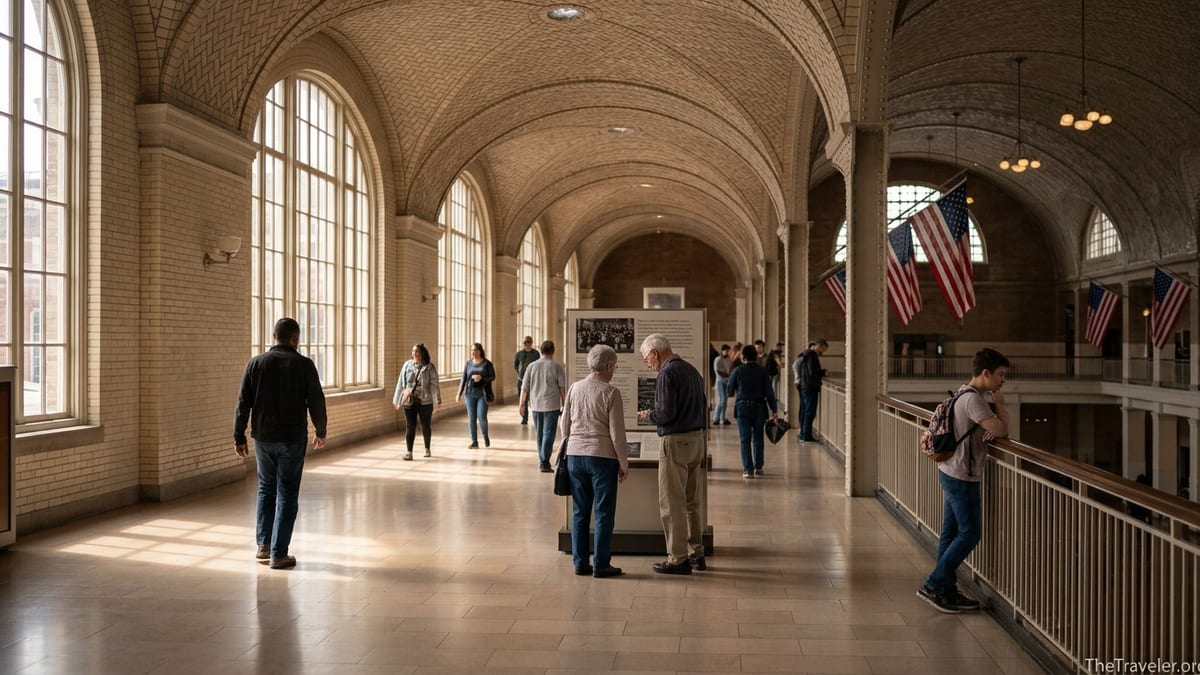
The heart of Ellis Island is the cavernous Great Hall on the second floor, where medical and legal inspections once determined whether new arrivals would be admitted to the United States. Today, sunlight pours in through tall arched windows onto a polished tile floor. American flags hang at either end, and the ceiling’s graceful vaulting softens the room’s institutional past. Yet the space still carries a distinct tension, especially when you arrive with the audio guide quietly narrating in your ear.
In one corner, I stood near a large black‑and‑white photograph showing the hall filled wall to wall with people, benches crowded, inspectors moving through the throng. The guide explained how doctors watched immigrants climb the stairs for signs of illness; any stumble or limp could mean further examination and possible exclusion. Looking from the photo to the relatively empty hall around me, it was startling to imagine the noise, the smells, the anxiety that once saturated the space. A modern visitor might climb those same stairs in comfortable sneakers, worrying only about getting a good angle for a picture.
Exhibit panels along the balcony rail use first‑person quotes drawn from diaries and oral histories. One describes a young girl clutching her mother’s skirt as officials pinned chalk marks on people deemed suspect, another recounts the terror of being separated from a sibling for medical checks. Reading those snippets, I caught myself glancing at families around me. A small child whined to go back to the gift shop; a parent scrolled through messages on a phone. It would be easy to dismiss that contrast as evidence of shallow tourism, but for me it underlined how much security most of us now take for granted.
Ellis Island welcomed an estimated twelve million immigrants during its operation, but the museum resists reducing them to statistics. Instead, the Great Hall’s exhibits foreground individual stories: a Polish farmworker, a Syrian shopkeeper, an Italian seamstress. Standing in the hall, I realized that if you go in simply to “see where people arrived,” you miss the deeper chance the room offers: to sit with the idea that entire futures hinged on a few minutes of questioning under this vaulted ceiling.
Journeys: The Peopling of America and a Wider View of Migration
Back on the first floor, tucked behind the more crowded main exhibits, is one of Ellis Island’s most quietly powerful spaces: the Journeys: The Peopling of America galleries. These exhibits trace immigration to the land that would become the United States well before Ellis Island opened in 1892 and extend the story through the late twentieth century. The design shifts subtly as you move through time, from rough wood and metal evoking colonial and early industrial eras to more modern materials and audiovisual displays for recent decades.
In the pre‑Ellis section, the focus widens beyond the familiar narrative of European arrivals. Panels and artifacts acknowledge the forced migration of enslaved Africans, the displacement of Indigenous peoples and the arrival of early Asian and Caribbean communities. A small case holds copies of letters and diaries from seventeenth‑ and eighteenth‑century migrants. Reading a line about leaving “all that is known” behind suddenly connected what might otherwise feel like distant history to the emotions etched on the faces in the Great Hall upstairs.
Further along, the post‑Ellis exhibits highlight immigration after the island’s closure in 1954: refugees from Vietnam in the 1970s, arrivals from Latin America and South Asia, shifting laws and policies that reshaped who could come and under what conditions. A video montage intercuts home movies from different decades: children learning English in crowded classrooms, families celebrating first paychecks, protests for immigrant rights in cities across the country. Watching it with visitors of varied ages and backgrounds, I sensed people searching for glimpses of their own communities.
This broader perspective was where my visit fully crossed from tourism into reflection. Before coming, I knew Ellis Island mainly through sepia‑toned images of early twentieth‑century European migrants. Standing in these galleries, I was pushed to think about immigration not as a chapter that ended when the island closed, but as an ongoing process that continues to shape the United States. The museum does not provide easy answers about policy or politics, but it leaves you with harder, more personal questions: How did my family come here? Who did not get the chance? What does arrival mean today?
Quiet Corners: Research Rooms, the Wall of Honor and Personal Pilgrimages
While many visitors understandably focus on the main exhibits, some of the most affecting moments of an Ellis Island visit happen in its quieter corners. One of these is the American Family Immigration History Center, a research space where, for a small fee, you can search ship manifests and records for relatives who passed through the island. Even if your family’s journey did not involve Ellis, watching others scroll through old passenger lists is powerful.
At one computer terminal, an older man from the Midwest sat with his adult daughter. With help from a staff member, they zoomed in on a digital manifest from the early 1900s. After a few tries with different spellings, a name they believed to be his grandfather’s appeared, handwritten in looping script, age nineteen, occupation “laborer,” country of origin noted simply as “Russia.” The daughter snapped a picture of the screen, then quickly wiped at her eyes. Around them, the research room remained hushed, but in that moment it felt like the building had done its deepest work: connecting abstract history to a single family story.
Outside, on a promenade facing the water, the American Immigrant Wall of Honor stretches along the perimeter, inscribed with hundreds of thousands of names submitted by families over the years. Compared with the exhibits inside, the wall is straightforward: just lines of engraved text. Yet visitors linger there, tracing letters with their fingers, taking group photos around a single name. I saw a group of college students touch the same family name before turning to pose with the Manhattan skyline in the background. It struck me as a perfect encapsulation of Ellis Island’s dual nature: part memorial, part backdrop to a modern city break.
None of this is mandatory. A traveler could, in theory, breeze through Ellis Island in an hour, glance at a few displays, buy a souvenir magnet and catch an early ferry back to lower Manhattan. But the infrastructure invites longer, more contemplative stays. Benches line the corridors, the café serves simple meals for those who choose to stay through lunch, and the audio guide offers deeper context in multiple languages. On busy weekends, you can see the difference clearly: some visitors rush toward the exit, while others settle into a quiet corner with a panel, letting the noise of the crowd blur into a kind of ambient soundtrack to their own thoughts.
Beyond the Museum: The Hospital Complex and Hard Hat Tours
For travelers seeking an even more immersive experience, Ellis Island offers guided access to its lesser‑known south side: the abandoned hospital complex. Once a state‑of‑the‑art medical facility for arriving immigrants, the complex now stands mostly empty, its corridors lined with peeling paint and rusted fixtures. The National Park Service, in partnership with a nonprofit conservancy, runs “Hard Hat Tours” that cost an additional fee, often around fifty dollars per person on top of the ferry ticket, with proceeds supporting ongoing preservation.
Joining one of these small‑group tours, you are issued a hard hat and led through a series of buildings that feel frozen in time. In the former contagious disease wards, sunlight cuts through cracked windows onto tiled floors. Old signage in faded lettering still marks isolation rooms. The guide shares stories of patients who arrived sick after weeks at sea, of nurses who lived on the island, of the difficult decisions doctors had to make about who could safely enter the country. Unlike the main museum, where exhibits are polished and curated, the hospital complex is intentionally raw, its decay left visible as part of the narrative.
This section of the visit is not for everyone. There are uneven surfaces, long periods of standing and a somber atmosphere that can be intense, especially for children. Yet for those who opt in, the experience rounds out the image of Ellis Island. It moves the story beyond triumphant arrival photographs to include the vulnerability and loss that were also part of the journey. As one fellow visitor on my tour remarked quietly while looking out a broken window toward the skyline, “You realize how close people came to getting here, but not quite.”
Walking back toward the main building after the tour, my tourist instincts tugged me toward the gift shop. Inside, shelves held the usual souvenirs: mugs, posters of vintage travel ads, miniature replicas of the Statue of Liberty. But after seeing the hospital complex, those items felt almost beside the point. I left with only a slim book of immigrant quotes and my hard hat memories, more interested in carrying the stories than the objects.
Practical Tips for a Thoughtful Visit
Ellis Island rewards a bit of planning, especially if you want your visit to feel reflective rather than rushed. Because the National Park Service does not charge an entrance fee for the museums themselves, the key cost is the Statue City Cruises ferry ticket. Booking a morning departure gives you the best chance to explore before midday crowds build, and it also ensures you have enough time to see both Liberty and Ellis Islands without constantly checking the clock. Afternoon departures, particularly after 2 p.m., can leave you short on time for Ellis before the last boats depart.
Weather matters more than you might think. On a clear spring or fall day, the ferry ride and outdoor spaces on both islands are pleasant, and natural light in the Great Hall can be stunning. In winter, winds on New York Harbor can be biting, and in peak summer the exposed decks and promenades can feel unforgivingly hot. Packing layers, water and a small snack is practical, but it also has a subtle benefit: if you are comfortable, you are more likely to slow down and engage with the exhibits instead of racing through.
Inside the museum, the free or low‑cost audio guide is worth accepting even if you generally dislike such devices. It adds voices and context that bring the photographs and objects to life, and you can always pause it when you want to wander in silence. If you are traveling with children or teens, consider looking up your own family’s immigration story beforehand and sharing whatever details you know. Having a name, a country or a decade in mind turns the visit into a scavenger hunt of sorts, anchoring abstract panels to something personally meaningful.
Finally, give yourself permission not to see everything. The museum spans three floors of exhibits, films and side galleries. Trying to cover it all in meticulous detail can leave you exhausted rather than moved. On my visit, I chose a few sections that resonated with my own background and spent more time there, then walked more lightly through others. Ellis Island is a place where what you bring emotionally shapes what you take away. Treating it less like a checklist and more like a conversation with the past leads to a richer experience.
The Takeaway
By the time I boarded the ferry back to Manhattan, the sun was lowering over the harbor, casting a soft glow on the red roofs of Ellis Island. Around me, fellow passengers compared photos and discussed dinner plans. Yet the sound that stayed with me was not the thrum of the boat’s engines, but the imagined noise of that Great Hall a century ago: dozens of languages overlapping, children crying, officials calling names that were sometimes shortened or altered in the process.
On paper, my trip to Ellis Island was classic tourism. I bought a ticket, took a ferry, walked through a museum, browsed a shop. In practice, it felt more like standing at a crossroads between past and present. The exhibits, the research rooms, the hospital corridors and the names etched on the Wall of Honor all conspired to turn my attention inward. I thought about my own relatives’ journeys, about people I know today navigating visas and borders, about what it means to belong to a country built so explicitly on movement.
New York offers plenty of attractions that dazzle on the surface: observation decks, designer stores, high‑energy shows. Ellis Island is different. Its power lies not in spectacle, but in the stories it preserves and the questions it asks of anyone willing to listen. If you allow yourself to slow down, to sit on a bench in the Baggage Room or linger under the arches of the Great Hall, you may find that your visit stops feeling like one more stop on an itinerary and becomes, instead, a quiet reckoning with how you fit into the ongoing story of migration.
FAQ
Q1. Do I need to buy a separate ticket to visit Ellis Island?
Ferry tickets sold by Statue City Cruises include both Liberty Island and Ellis Island, as well as access to the museums and basic audio guides.
Q2. How much time should I plan for Ellis Island alone?
If you move at a thoughtful but not rushed pace, expect to spend at least two to three hours on Ellis Island, not including Liberty Island or the ferry rides.
Q3. Is Ellis Island suitable for children?
Yes, but the subject matter can be serious. Families often find the Baggage Room exhibits, the Great Hall and the ship models especially engaging for school‑age children.
Q4. Can I research my ancestors during my visit?
Yes. The American Family Immigration History Center on Ellis Island allows visitors to search ship manifests and records, sometimes for a small additional fee.
Q5. Are the museums on Ellis Island free?
The National Park Service does not charge an entrance fee for the museums, but you must purchase a ferry ticket to reach Liberty and Ellis Islands.
Q6. What should I wear for a visit to Ellis Island?
Wear comfortable walking shoes and dress for the weather. You will spend time both indoors and outdoors and may stand for extended periods in exhibits and lines.
Q7. Is Ellis Island accessible for visitors with mobility needs?
The main museum building and ferries are generally wheelchair accessible, with elevators connecting floors and accessible restrooms available on site.
Q8. What is the Ellis Island Hard Hat Tour, and is it worth it?
It is a guided tour of the historic hospital complex on the island’s south side. It costs extra but offers a deeper, more atmospheric look at the site’s history.
Q9. When is the best time of day to visit Ellis Island?
Morning departures are usually best. They allow you to experience the exhibits before the largest crowds arrive and give you flexibility with return ferries.
Q10. Can I visit Ellis Island without going to the Statue of Liberty?
Ferries run in a loop that typically stops at Liberty Island first and then Ellis Island. You can choose to spend less time at one, but the same ticket covers both.