


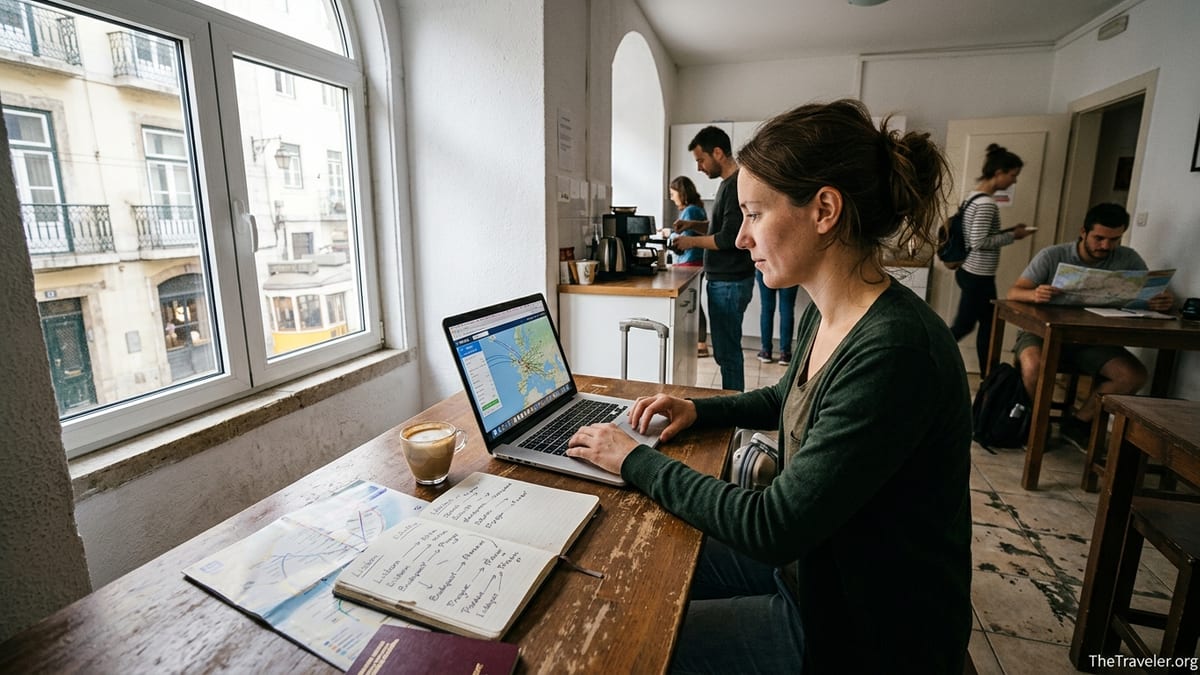
Solo travel looks spontaneous on Instagram, but my best trips have been quietly engineered at a laptop weeks or months in advance. The magic is not just where I go, but how I research destinations, stress-test safety and costs, and then plan just enough structure to feel confident while leaving room for the unexpected. This is the step-by-step approach I actually use when I plan my own solo adventures, from the first spark of an idea to the final backup plan saved on my phone.
Get the latest updates straight to your inbox!
Starting With the Right Question: What Do I Need From This Trip?
Before I open any flight search engine, I decide what problem this trip is meant to solve. Am I burned out and need somewhere quiet and walkable, like Ljubljana or Chiang Mai in the shoulder season, where I can work from a cafe and be in bed by 10? Or am I craving late nights and social hostels like you find in Lisbon’s Bairro Alto or Mexico City’s Roma neighborhood? Being honest about my energy level, budget, and social appetite is the single most important step in my research process.
For example, when I planned a March solo trip from New York, I first wrote down three nonnegotiables: daytime temperatures above 60 degrees Fahrenheit, a strong cafe culture where I could work a few hours a day, and a city with reliable public transport so I would not need a rental car. That shortlist knocked out otherwise appealing options like parts of Canada or Scandinavia for that time of year and pushed me toward southern Europe and North Africa: Valencia, Athens, and Marrakech became my comparison set.
I also think about my “risk budget.” If I am traveling after a stressful season at work, I do not combine an unfamiliar language, complex visas, and chaotic transit in one trip. In that case I might pick a place like Dublin, Amsterdam, or Montreal, where English is widely spoken and trains from the airport are straightforward. When I am ready for more challenge, I will add destinations like Hanoi or Bogotá, where logistics are still manageable for a first-time solo traveler but demand more preparation.
This initial clarity helps every later decision. It shapes where I search for flights, what kind of accommodation I filter for, and even which neighborhoods I consider safe or convenient enough to be my base.
How I Use Data and Real Travelers to Choose Destinations
Once I know what I want from the trip, I start gathering hard information instead of just relying on dreamy photos. I look at objective indicators like crime and safety rankings, health care quality, and public transport coverage, then cross-check them with reports from actual solo travelers.
For safety, I pay attention to broad patterns instead of absolute rankings. Global reports and insurance-company studies frequently put cities like Dubai, Singapore, and Tokyo near the top for safety and cleanliness, while many European cities such as Vienna and Copenhagen consistently score highly on liveability and infrastructure. I treat those lists as a starting point, then dive into solo travel forums and recent trip reports to see if the lived experience matches the numbers, especially for women, LGBTQ+ travelers, and travelers of color.
Real examples are what matter. Ahead of a recent trip to Tokyo, I saw that it frequently appears on lists of safe cities with low violent crime rates, but I also read nuanced accounts from solo women who felt comfortable on late trains yet still dealt with groping in crowds, aggressive touts in nightlife districts, and street harassment around Shibuya. That told me I should not avoid Tokyo, but I should plan to sit near women-only train cars when available, stay in a central but quieter neighborhood like Kichijoji or Nakameguro, and avoid wandering through club-heavy streets alone at 2 a.m.
At the same time, I watch for “hidden friction” that does not appear in statistics but shows up repeatedly in trip reports: confusing bus systems, limited sidewalks, cash-only restaurants, or long airport transfer times. When I was weighing Medellín against Mexico City for a two-week stay, I noticed many solo travelers praising Medellín’s metro for being clean and intuitive, while also warning about late-night safety in certain barrios. In Mexico City, people talked more about traffic and air quality than about violent crime in the central neighborhoods I was considering. Those details shaped my eventual choice and how I planned my days.
My Flight Search Routine: From Flexible Ideas to Booked Ticket
With a few candidate destinations in mind, I turn to flights. I usually start with flexible search tools like Google Flights and Skyscanner. I enter my home airport, set the destination to a region such as “Europe” or “South America,” and choose a whole month view instead of fixed dates. These tools show me which departure days are cheapest in a calendar format and often reveal airports I might not have considered, like flying into Milan instead of Rome, or arriving in Bogotá instead of Cartagena.
As an example, when I was comparing a spring trip to Rome vs. Athens, a flexible search from New York showed midweek round-trip fares to Rome hovering in the 600 to 700 US dollar range, while Athens was several hundred dollars more for my exact week. Once I saw that pattern, I built my itinerary around flying into Rome and taking a budget airline to Athens later if I had the time, instead of insisting on a direct flight to my original first choice.
I also use price tracking, but with realistic expectations. On Google Flights, I will set up alerts for two or three promising date ranges and cabins on specific routes, then wait a few days or weeks while I continue other research. Email alerts tell me when prices move up or down, often by tens of dollars at a time. I treat these alerts as a nudge, not gospel. If an alert says the current price is “typical” or “low for these dates,” and the fare fits my budget, I am comfortable booking rather than holding out for a hypothetical rock-bottom deal that may never appear.
When I am ready to buy, I almost always book through the airline directly unless there is an enormous price difference with a reputable online travel agency. Booking direct makes schedule changes, seat selection, and day-of-travel problems much easier to resolve, especially as a solo traveler with no one to split a surprise hotel night if I get stranded. I keep screenshots of my fare and confirmation in a notes app or cloud folder so that if something looks different at the airport, I have my own paper trail.
Accommodation: Reading Between the Lines of Reviews
Solo travel accommodation is less about luxury and more about eliminating friction. When I search major platforms for stays, I start by filtering for central neighborhoods near frequent public transport and walking distance to food. A cheap guesthouse 45 minutes outside the city may look good on paper, but if it means long bus rides back after dark or expensive taxis alone at night, the savings disappear quickly.
For example, in Rome I once booked a budget hotel near Termini station specifically because multiple reviewers mentioned that it was a five-minute walk from the airport train and that staff were at the front desk 24 hours a day. The room was basic, but arriving after a late flight, being able to walk under bright streetlights straight to the hotel without figuring out buses or taxis was worth far more than a slightly nicer room in a distant neighborhood.
When reading reviews, I look for patterns from solo travelers. If several people mention that a hostel’s bar is loud until 3 a.m., I will avoid it when I need early mornings, even if the average score is high. Conversely, if solo guests repeatedly highlight that a guesthouse owner walked them to the nearby metro, explained how to buy tickets, or helped them arrange early airport transport, I give that property extra credit. That sort of support can completely change the feel of a first 24 hours in a new place.
I also pay close attention to photos of the surrounding streets, not just the rooms. In Mexico City, one apartment I considered had gorgeous interior shots but several reviewers casually mentioned that the street outside was almost deserted at night, with shuttered storefronts and dim lighting. Another apartment in the same price range showed a busy corner with late-opening taquerias, pharmacies, and people out walking dogs. I chose the second option because a lively, mixed-use street at night usually feels more comfortable when I am walking home alone.
Planning Daily Logistics Without Over-Scheduling
Once flights and accommodation are locked in, I shift to day-to-day logistics. For solo travel, my goal is not to squeeze in every attraction but to remove uncertainty from the most stressful moments. That means planning the airport transfer, understanding public transport tickets, and mapping a “first day” route before I arrive.
In many cities, I look up whether there is a transit card or pass that simplifies moving around. For instance, in Rome, a 72-hour public transport pass can cover buses, metro, and some trains within the city for a flat fee, which removes the need to figure out individual fares on a jet-lagged brain. In Tokyo, I research whether an IC card like Suica or Pasmo is still the easiest way to tap in and out of trains, and whether it works on buses in the suburbs where I might stay. In London, I check what daily caps apply to contactless payments on the Underground so I do not accidentally overpay for Oyster top-ups.
I always write down, in plain language, how I am getting from the airport to my accommodation and back, including approximate travel time, expected cost, and what happens if my flight is delayed and the official train or bus stops running. For example, landing in Athens late at night, I knew the metro stops before midnight, so I checked the going rate of licensed taxis into the city center and the location of the official taxi queue. That meant I could confidently ignore freelance drivers inside the arrivals hall and walk straight to the line outside.
On the sightseeing side, I now avoid rigid hour-by-hour schedules. Instead, I group activities by neighborhood and designate “anchors” for each day: one thing I definitely want to do in the morning and one in the afternoon. In Lisbon, I might plan to visit the Jerónimos Monastery and nearby Belém Tower in one day, then leave wiggle room for a detour to the LX Factory or an unplanned pastel de nata stop. This structure naturally limits how much I try to cram into a single day and reduces cross-city zigzagging that is exhausting when I am alone.
Budgeting With Realistic Local Costs
My early research into costs goes beyond typical daily-budget blog posts. I want to know what locals pay for basics so I can spot inflated prices and avoid overpaying out of fear. I look up approximate costs of a simple restaurant meal, a supermarket basket, a metro ride, and a coffee in the places I am considering, then translate that into what a normal day for me might look like.
For instance, in Bangkok I learned that a plate of street food like pad thai or fried rice is often only a few US dollars equivalent, while a sit-down restaurant in a mall can be two or three times more. A grab-and-go iced coffee from a chain may be close to Western prices. So on a typical day there, I budget for two cheap street food meals and one mid-range dinner, plus a buffer for a nicer rooftop drink every few days. In Western Europe, I flip the assumption: I expect restaurant meals to be relatively expensive compared with high-quality supermarket options, so I plan more picnic lunches and casual takeaway dinners.
Transport and day trips can quietly dominate a budget, so I research passes and regional tickets early. In Japan, for example, national rail passes have risen in price in recent years and now tend to make financial sense only for itineraries that include several long-distance bullet train journeys within a week or two. For a slower trip that focuses on one region, region-specific passes or individual tickets may be better value. In Switzerland, I look into half-fare cards and saver day passes rather than assuming that a single nationwide rail pass will automatically be cheapest.
I also build a “problem fund” into my budget, usually around 10 to 20 percent of total trip costs, reserved for taxi rides when I am sick, last-minute accommodation if a hostel feels unsafe, or a same-day train upgrade when a local train is dangerously crowded. Knowing that money is there makes it much easier to make conservative, safety-first choices on the road instead of trying to tough out an uncomfortable situation just to stay on budget.
Balancing Safety With Authenticity
Solo travel always carries some level of risk, but systematic planning can dramatically tilt the odds in your favor without turning every trip into a sterile, bubble-wrapped experience. My safety planning starts during destination research and continues through daily decisions once I arrive.
First, I map out “comfort zones” inside each city rather than treating it as universally safe or unsafe. In Istanbul, for example, I feel comfortable walking alone through busy streets in Beyoğlu or around Sultanahmet during the evening, but I am more cautious about deserted alleys near nightlife zones late at night. In Mexico City, I will happily walk in well-lit parts of Condesa or Roma until late, but I plan trusted taxi or ride-hail rides if I am returning from bars after midnight, especially if my accommodation is slightly outside those central districts.
I also research local scams and typical annoyances in advance so they are less rattling if they happen. In touristy parts of Paris and Rome, I expect friendship bracelet sellers and petition scams; in parts of Southeast Asia I expect inflated prices for tuk-tuks leaving major bus stations. Knowing the going rate for a short ride in a city, or that official taxis should use a meter, allows me to say no with confidence and walk away. When a situation feels off, I give myself permission to pay a bit more for safety, even if it means ordering a ride-hail from inside a cafe instead of haggling in the street.
Finally, I tell one or two trusted people at home about my plans in concrete terms. I share my booked flights, accommodation addresses, and a high-level overview of where I expect to be each few days. I avoid broadcasting my exact location in real time on public social media, posting specific cafes or hiking trails only after I have moved on. This simple habit, combined with practical local precautions, helps me enjoy genuine, unscripted encounters without feeling exposed.
Building a Simple Digital Backup System
Good planning is not only about making decisions in advance, but also about having a cushion for when those decisions meet reality. My digital backup system is designed so that if I lose my phone, my debit card is skimmed, or a key app goes down, my trip becomes inconvenient, not catastrophic.
First, I store critical documents offline as well as in the cloud. I save PDFs or screenshots of my passport, visas, travel insurance confirmation, flight bookings, and accommodation addresses to an encrypted notes app and also to a folder that is available offline on my phone. I keep a printed list of emergency phone numbers and addresses in my day bag in case my phone battery dies.
Second, I diversify access to money. I travel with at least two debit cards and one credit card from different banks, and I keep them in separate locations: one in my wallet, one in a money belt or hidden pocket in my luggage, and sometimes a virtual card stored only in a secure app. Before leaving, I notify my banks of planned destinations and check whether they have fee-free partner ATMs in the countries I am visiting so I am not hunting for cash machines on my first day.
Finally, I maintain a simple “trip dashboard” in a notes app or document synced across devices. This includes flight numbers and times, hotel names and addresses with check-in instructions, local emergency numbers, and key transport details such as airport bus schedules or metro lines to my neighborhood. I organize it in the order I will need it, from departure day through return flight, so I can scroll rather than search when I am jet-lagged and standing in a crowded station with spotty Wi-Fi.
The Takeaway
Smart solo travel planning is less about being a natural-born explorer and more about building a repeatable system. I start by defining what I need from the trip, then use a mix of data and real traveler experiences to narrow down destinations. I search flights with flexible tools, choose accommodation that reduces late-night friction, and understand on-the-ground logistics before I land. Throughout, I keep budgets grounded in local reality and design safety and backup plans that let me say yes to new experiences without feeling reckless.
Over time, this approach has turned intimidating first-time destinations into places I now return to with ease. Cities like Tokyo, Lisbon, and Mexico City feel less like unknowns and more like old acquaintances, not because I know every street, but because I have a reliable way to get from vague idea to structured, flexible plan. With a bit of front-loaded research and a few nonnegotiable safeguards, solo travel stops being a leap into the dark and becomes something else entirely: a skill you can practice, refine, and carry with you to every corner of the map.
FAQ
Q1. How far in advance should I start researching a solo trip?
For international trips, I usually start destination and flight research three to six months ahead, which gives time to compare prices, book good accommodation, and handle visas if needed.
Q2. What is the safest type of accommodation for solo travelers?
There is no single safest option, but well-reviewed guesthouses, small hotels, and hostels with 24-hour reception in central, well-lit neighborhoods are generally a solid choice.
Q3. How do I judge if a neighborhood is safe before booking?
I cross-check maps with reviews that mention walking at night, look at street photos, and search recent traveler reports about noise, lighting, and late-night activity in that area.
Q4. Are flight price alerts really useful for solo travelers on a budget?
They help you understand general price trends and spot dips, but I treat them as guidance rather than waiting indefinitely for a perfect low; when a fare fits my budget, I book.
Q5. How much daily budget should I plan for food when traveling solo?
It depends heavily on the destination, but I estimate based on sample prices for simple restaurant meals, street food, and supermarket items rather than relying on generic daily averages.
Q6. What should I do if I feel unsafe at my accommodation after arrival?
If a place feels wrong, I trust that instinct, secure valuables, and move. I use my backup fund to book a different hotel for the night, then sort out refunds or complaints later.
Q7. How can I meet people safely when traveling alone?
I favor low-pressure options like walking tours, group classes, daytime meetups, and hostel common rooms, and I always arrange my own way back rather than relying on new acquaintances.
Q8. Do I really need travel insurance for solo trips?
I strongly recommend it. Even a basic policy that covers medical emergencies, evacuation, and trip interruption can save enormous stress and cost if something goes wrong.
Q9. How much of my itinerary should I plan in advance?
I usually book flights and first accommodations early, decide on a loose structure for each day, and leave at least one or two unplanned days in each week for spontaneous discoveries.
Q10. What apps are most useful for planning and navigating solo trips?
Offline maps, public transport apps, translation tools, airline and booking apps, and a secure notes or document app for storing key information make solo travel far smoother.