


Ask almost any traveler why they are driving the narrow, 11-mile loop road through Cades Cove, and you will hear the same answer: they are hoping to see a black bear. This broad pastoral valley in Great Smoky Mountains National Park is one of the most reliable places in the eastern United States to spot wild black bears, yet sightings are never guaranteed. The difference between a magical morning filled with bears in the fields and a quiet, empty loop often comes down to timing the season, time of day, and even the day of the week.
Get the latest updates straight to your inbox!
Cades Cove: The Smokies’ Bear Hotspot
Cades Cove sits on the Tennessee side of Great Smoky Mountains National Park, a wide, bowl-shaped valley surrounded by thickly forested ridges. The loop road that circles the cove gives visitors open sightlines across meadows where bears often leave the tree line to forage. Compared with heavily wooded areas like Newfound Gap Road or the Deep Creek valley, the cove’s open pastures make it much easier to actually see wildlife when it emerges.
National Park Service wildlife biologists estimate that the Smokies hold one of the densest black bear populations in the eastern United States, with bears roaming throughout the park’s more than 500,000 acres. That means a bear could appear almost anywhere, from the Abrams Falls trailhead to the back lawn of a Gatlinburg cabin. Yet repeat visitors and local guides know that Cades Cove stands out as a consistent viewing area because the mix of acorn-rich oak forests, berry patches, and grassy fields draws bears into the open more often than on many other park roads.
On a typical June day, a slow trip around the loop can produce multiple “bear jams,” the local nickname for traffic backups that form when a black bear steps into view. Drivers pull onto the loop at the entrance near Townsend around sunrise, and by mid-morning you may see rangers directing traffic as visitors crane for a look at a bear grazing near the John Oliver Cabin or moving along the tree line behind the Cable Mill historic area.
At the same time, it is entirely possible to spend three hours on the loop in August and see only deer and wild turkeys. Bears are common in Cades Cove, but their movements follow seasonal food availability and daily temperature swings. Travelers who understand these patterns have a much better chance of seeing bears while still giving them the space they need to remain wild.
Season by Season: When Bears Are Most Active in Cades Cove
Black bears in the Smokies are not fully predictable, but their behavior does follow a rough seasonal calendar that shapes how often they appear in Cades Cove’s fields. Spring, summer, and early fall each offer different opportunities and trade-offs for wildlife watchers.
In April and May, as temperatures rise and plants green up, bears emerge from winter dens and begin feeding heavily on tender vegetation, insects, and leftover acorns. Park managers note that bear activity across the Smokies climbs sharply in late spring, and Cades Cove is no exception. On cool May mornings, you may see a lone bear turning over logs along the forest edge near the Abrams Falls trailhead parking area, or a young bear crossing the loop road between Hyatt Lane and the Primitive Baptist Church in search of new forage.
Summer, especially from June through August, is peak bear season for many visitors. School holidays and warm weather mean the loop is busy nearly every day, and bears are also very active. Sows with cubs may feed in lower fields where blackberries ripen, while young males roam widely in search of food and mates. A family driving the loop on an early July weekday might spot a mother bear and two cubs in a distant meadow near the Loop Road’s back half, then later find a subadult bear climbing a cherry tree close to the Missionary Baptist Church side road.
By late September and October, bears enter hyperphagia, the phase when they eat almost constantly to build fat reserves for winter. Acorns and other hard mast become critical, drawing bears into the oak forests that ring the cove. This is still a productive time for sightings, but bears may spend more time just inside the woods rather than in the center of fields. A patient visitor who pulls into the overlook parking area near the Cable Mill early on a crisp October morning might watch a bear travel along the slope above the valley, pausing under oak trees to feed before disappearing into denser cover.
The Daily Rhythm: Time of Day Matters More Than You Think
Even in peak bear season, the time you choose to drive the loop can dramatically affect what you see. Black bears in the Smokies are most active during the cooler parts of the day, which means dawn and dusk are often the best windows for sightings in Cades Cove.
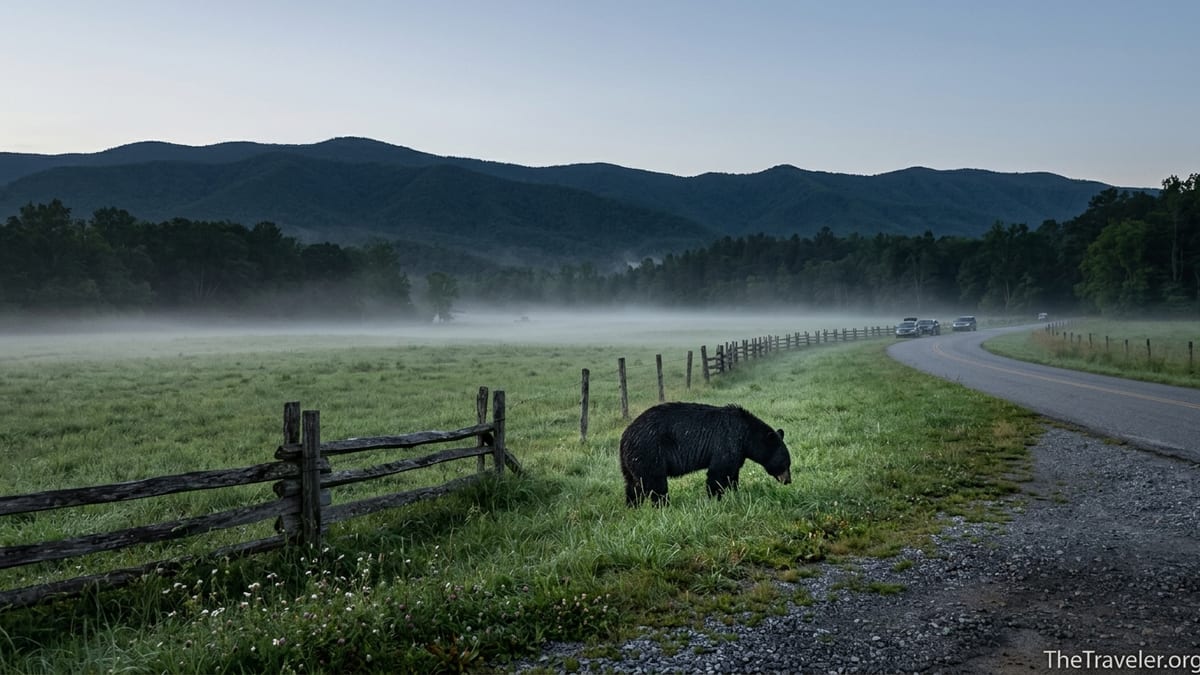
On a hot July afternoon, when the sun bakes the open fields and temperatures in the valley floor climb, bears are more likely to retreat to the shaded forested slopes above the loop road. A visitor who starts the drive at 2 p.m. may see only distant shapes in the trees, if anything at all. In contrast, arriving at the gate around sunrise, when mist still hangs in the fields, often reveals bears grazing in the open, sometimes within easy view from the paved shoulder as they feed on grasses and insects.
Travelers who stay in Townsend or Wears Valley often set alarms for 5 a.m. so they can be at the Cades Cove entrance when the loop opens at first light. Some report seeing two or three different bears within the first mile, before the road grows busy and mid-morning temperatures rise. Similarly, an evening loop starting about two hours before sunset can be productive, especially on warm days, as bears leave shaded ravines and return to lower fields to feed before nightfall.
Cloud cover and rain can shift this pattern. On overcast, cooler days in May or October, bears may be visible throughout the morning and even into mid-afternoon. For example, a drizzly day in late May might keep the valley in soft, cool light, and visitors could encounter a bear near the Abrams Creek crossing at 11 a.m. as it forages along the stream bank. On those rare days when a cold front keeps temperatures unseasonably low in midsummer, the “shoulder hours” of mid-morning and late afternoon can surprise even seasoned locals with frequent bear activity close to the loop.
Why Day of the Week and Road Rules Change Your Odds
Timing in Cades Cove is shaped not only by seasons and daylight but also by how the park manages the loop road. From roughly May through October, Great Smoky Mountains National Park typically closes the Cades Cove Loop to private motor vehicles on Wednesday and Saturday mornings until noon, reserving the road for cyclists and pedestrians. During those hours, bear sightings still happen, but only for visitors willing to travel the loop by bicycle or on foot.
For travelers determined to see a bear while staying inside the safety of a vehicle, this schedule matters. A family that arrives at 8 a.m. on a June Wednesday expecting to drive the loop may find the gate closed to cars and a line of cyclists instead. If bears emerge along the fields near Sparks Lane during those hours, only the cyclists and walkers will see them. However, if that same family returns at 2 p.m., they may catch bears moving again as temperatures fall, especially on a cooler day after a front has passed.
Traffic volume also changes the experience. Weekends in summer and during October leaf season can be extremely busy, with the 11-mile drive stretching to three or four hours because of congestion and bear jams. In those conditions, rangers sometimes close side roads like Rich Mountain Road or the Elijah Oliver access temporarily when bears linger near the pavement or when crowds begin approaching too closely. Visitors who choose a Tuesday morning in late September instead of a Saturday in July often find a quieter loop, easier parking at the Cable Mill, and more relaxed opportunities to watch a bear from a safe distance.
For photographers and wildlife enthusiasts, that difference in crowding can mean the chance to spend several minutes quietly observing a distant bear through binoculars near the Abrams Falls trailhead parking lot instead of watching it briefly between lines of stopped cars. The bears themselves may also behave more naturally when fewer vehicles, camera flashes, and shouting voices surround them.
Real-World Sightings: How Timing Plays Out for Travelers
Nearly every season brings new stories from travelers who either timed Cades Cove just right or learned, the hard way, how much timing matters. A couple visiting in late July, for example, might plan a lazy mid-morning loop and see nothing more than a groundhog by the roadside. After chatting with a ranger at the Cable Mill visitor contact station, they decide to return at sunrise the next day. That second morning, they are rewarded with a sow and two cubs crossing a distant meadow, followed by a young bear climbing a tree near the back half of the loop within their first hour.
Another traveler might book a cabin in Townsend for an October weekend specifically to see bears. They arrive at Cades Cove around 11 a.m. on a sunny Saturday, wait in a long entry line, and spend nearly four hours inching around the loop in traffic. They drive past a distant bear high on the hillside above the Primitive Baptist Church but cannot stop safely to watch. The next morning, after leaving the cabin early, they arrive at the loop just after sunrise. In the quiet light and thin fog, they watch a lone bear feeding in a field near Hyatt Lane for several minutes from their parked car before the first line of vehicles catches up.
Some visitors encounter closures that highlight how bears respond to human pressure. When a bear becomes too comfortable approaching vehicles or lingering on roadsides, the park may temporarily close areas like Rich Mountain Road to give the animal space and protect visitors. Travelers who experience such closures sometimes leave disappointed at missing a specific area, but those same closures are a sign of active bear use in the cove and a reminder that sightings result from sharing real habitat with wild animals, not from orchestrated viewing like a zoo.
These stories illustrate a pattern: travelers who treat Cades Cove as a place that rewards patience, flexibility, and repeat visits over several days usually see bears. Those who expect a guaranteed sighting during a single, crowded afternoon lap often leave having seen only traffic and historic cabins. Understanding bear behavior and adjusting plans accordingly can turn the odds in your favor.
Staying Safe and Respectful During Bear Encounters
Seeing a black bear in Cades Cove is thrilling, but it comes with responsibilities. The park’s rules are strict: it is illegal to willfully approach within 50 yards of a bear or to disturb it in any way. That distance is greater than many people realize. A bear feeding in the grass near the road might look deceptively calm, but if your presence changes its behavior, you are too close, even if you are still inside your vehicle.
On busy summer days, rangers and volunteers frequently move along the loop reminding visitors to stay near their cars, avoid crowding the road, and never attempt to offer food to wildlife. Unfortunately, it only takes a few people tossing snacks from a car window or leaving a cooler unattended at a roadside pullout near the Abrams Falls trailhead for a bear to begin associating vehicles with food. When that happens, the bear can quickly become a safety risk, and the outcome is often tragic for the animal.
Travelers should plan their Cades Cove visit with safety basics in mind. Keep all food stored out of sight inside your vehicle, and never leave trash or food scraps behind when you stop at the Cable Mill area or picnic near Abrams Creek. If you see a bear on the roadside, stay in your car, keep windows partly up, and move forward slowly when traffic allows instead of stopping directly beside the animal. On trails like Abrams Falls or Rich Mountain, hike in groups where possible, make noise in dense vegetation, and carry bear spray only if you know how to use it properly.
Respecting bears also means accepting that you might miss a closer photo in order to do the right thing. That could mean watching through binoculars from a pullout instead of walking into a field, or driving on when the roadside is already crowded. In the long run, visitors who keep their distance help ensure that Cades Cove remains a place where bears behave like wild bears, not like roadside attractions.
Planning Your Visit for the Best Chance of Seeing Bears
For many travelers, a bear sighting in Cades Cove is a once-in-a-lifetime memory worth planning carefully. Start by choosing your season. If your dates are flexible, late May through early July and again in late September to mid-October generally offer a productive balance of bear activity and comfortable weather. Budget travelers may find better lodging rates in Townsend or Pigeon Forge in midweek periods of May or early September, while still enjoying strong chances of wildlife sightings in the cove.
Next, think about the time of day and day of the week. If you are visiting in summer, build at least one full day in your itinerary for a sunrise loop and, if possible, a second loop near sunset. On cycling mornings when vehicles are restricted, consider renting bikes in Townsend a day ahead so you can ride the loop at first light, when bears may feed quietly in fields near Sparks Lane and Hyatt Lane. If you prefer to stay in your car, plan vehicle loops on non-cycling mornings or in the late afternoon and evening.
Allow enough time for traffic and unexpected delays. On a quiet weekday in May, driving the loop with a few photo stops might take 90 minutes. On a busy October Saturday, it can easily stretch to three or four hours. Build that range into your plans and bring water, snacks stored securely, and a full tank of gasoline before you leave Townsend or Gatlinburg. This buffer makes it easier to remain patient when a bear jam forms, and to move on when rangers ask vehicles to keep rolling past a roadside bear.
Finally, remember that Cades Cove is more than just bears. Historic churches, log cabins, and the working Cable Mill area trace the story of the 19th-century Appalachian community that once thrived here. Even if wildlife stays hidden on a particular day, walking to the John Oliver Cabin at sunrise, listening to birds in the fields, or hiking the Abrams Falls Trail can make your time in the cove feel rewarding. Treat bears as a gift rather than a guarantee, and each sighting becomes that much more meaningful.
The Takeaway
Bears are genuinely common in and around Cades Cove, but the idea of a guaranteed sighting on any given drive is a myth. Seasonal food sources, daily temperature swings, road management, and human behavior all shape when and where black bears appear. Travelers who understand those patterns and time their visits for cooler hours, quieter days, and shoulder seasons stack the odds in their favor.
Arrive early or late, give yourself more than one day in the area, and stay flexible enough to adjust plans when weather or road conditions change. Above all, keep your distance, secure your food, and respect the bears’ space. When you round a bend in the loop and finally see a dark shape moving through the misty grass, you will know you are witnessing a wild animal following its own rhythm, not a show put on for visitors. In Cades Cove, timing may change everything, but patience, respect, and realistic expectations make every encounter feel like the moment you were meant to be there.
FAQ
Q1. What is the best month to see bears in Cades Cove?
Late May through July and again from late September into October are often productive periods, when bears are actively feeding in and around the cove.
Q2. What time of day are bears most active in Cades Cove?
Bears are usually most active in the cooler hours around sunrise and the last two hours before sunset, especially on warm spring and summer days.
Q3. Can I guarantee seeing a bear if I drive the Cades Cove Loop?
No, sightings are never guaranteed. Even though bears are common, daily movements depend on weather, food availability, and human activity.
Q4. Are sunrise or sunset drives better for bear sightings?
Both can be good, but sunrise drives often combine cooler temperatures, lighter traffic, and bears still feeding in open fields after a quiet night.
Q5. Are bears more visible on cycling mornings when cars are restricted?
They can be, especially for cyclists and walkers willing to start early. With fewer vehicles and noise, bears may stay in fields longer, but there is still no guarantee.
Q6. Is it safe to get out of my car when I see a bear?
It is safer and required by park rules to stay near or inside your vehicle and keep at least 50 yards away, moving on when rangers or volunteers request it.
Q7. Do I need bear spray when visiting Cades Cove?
Bear spray is optional for most visitors who stay on the loop road. Hikers on trails like Abrams Falls may choose to carry it if they know how to use it properly.
Q8. What should I do if I encounter a bear on a trail near Cades Cove?
Stay calm, do not run, talk firmly, back away slowly if the bear is close, and give it plenty of space. Report unusual behavior to park staff as soon as possible.
Q9. How does bad weather affect bear sightings?
Cool, overcast, or lightly rainy days can keep bears active longer in the open, while very hot, sunny afternoons tend to push them into shaded forested areas.
Q10. Where should I stay if I want multiple chances to see bears in Cades Cove?
Many travelers base themselves in nearby Townsend or Wears Valley, which offer relatively quick pre-dawn access to the loop for repeated sunrise and sunset drives.