


Cades Cove, a broad, pastoral valley at the western edge of Great Smoky Mountains National Park, has become a symbol of both the park’s beauty and its crowding problem. On a peak October weekend, visitors can spend hours inching along the 11-mile loop road, windows down, hoping for a glimpse of deer or black bear. With Great Smoky Mountains National Park drawing well over 12 million visits a year, and Cades Cove long cited as its single most popular destination, many travelers now ask a fair question: is Cades Cove still worth visiting, or has it simply become too crowded to enjoy?
Get the latest updates straight to your inbox!
Why Cades Cove Draws So Many People
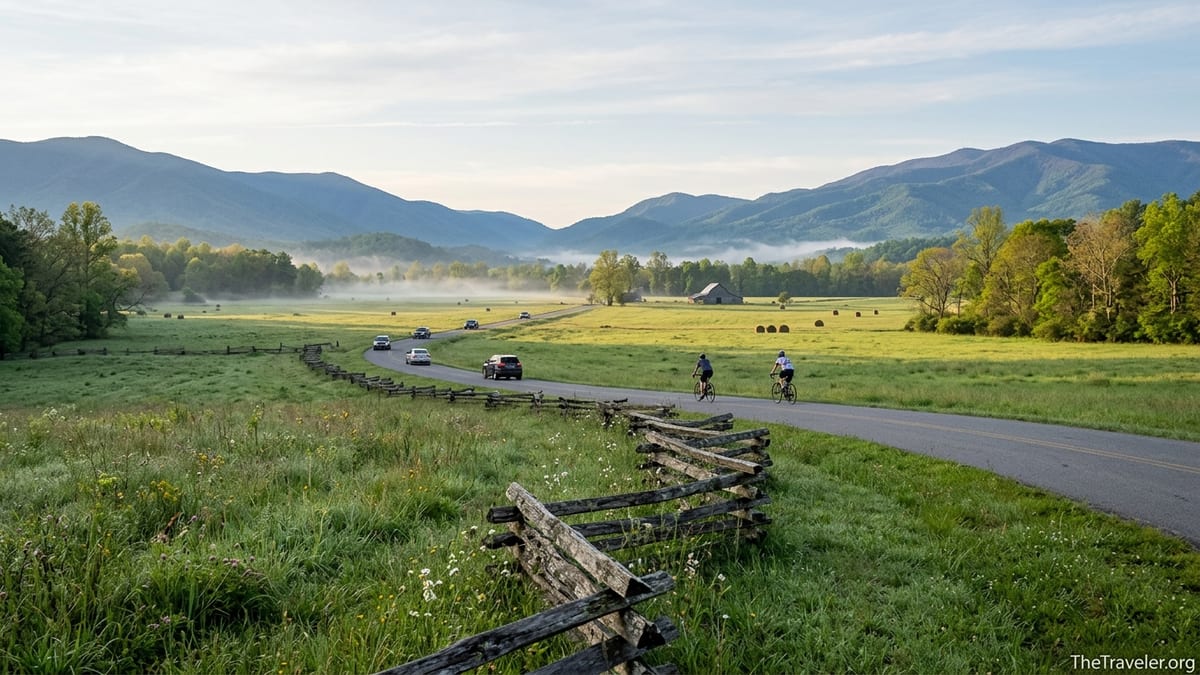
Cades Cove is an unusually accessible slice of classic Southern Appalachian scenery. The valley floor is ringed by blue-tinged ridges, with open fields, split-rail fences, and historic wooden churches that look much as they did when families farmed here in the 1800s. Wildlife is part of the draw: white-tailed deer are common at dawn and dusk, black bears are often spotted in late spring and early summer, and wild turkeys strut through the fields year-round.
That mix of scenery, wildlife, and history sits just 25 to 35 miles from heavy tourism hubs like Pigeon Forge and Gatlinburg on one side and the quieter gateway town of Townsend on the other. When you combine that proximity with the fact that entrance to Great Smoky Mountains National Park remains free, it is easy to understand how the park has become the most visited in the United States and why Cades Cove, specifically, now sees well over a million visits in a typical year.
For a first-time visitor, the experience can be unforgettable. A typical trip might involve stopping at John Oliver Cabin near the start of the loop, walking through the cool shade of sugar maples and tulip poplars to a hand-hewn log home, then driving on to the Missionary Baptist Church or the Primitive Baptist Church to wander the old cemeteries. Many families time their visit around sunset, when soft light hits the meadows and the ridges of the Smokies form a layered backdrop that feels almost painterly.
Those strengths are also what create the pressure. People who might not be ready to tackle steep backcountry trails can still enjoy dramatic mountain views here without leaving their vehicle for more than a short walk. As overall Smokies visitation has grown in recent years, Cades Cove’s loop road has effectively become a one-way funnel concentrating cars, motorcycles, and RVs into a narrow corridor.
How Crowded Has Cades Cove Actually Become?
Crowding in Cades Cove is not just a matter of perception. Even on an average summer day, it is common for visitors who start the loop late in the morning to report two to three hours for the 11-mile drive, particularly if they pull off at several historic sites. During the October leaf-peeping rush or on holiday weekends such as Memorial Day and Labor Day, it can take longer. Some travelers in recent years have described spending 45 minutes to move a single mile near popular pull-offs.
The park’s own communications have acknowledged that visitation at Great Smoky Mountains National Park has climbed dramatically compared with the levels its roads and facilities were designed to handle. When a national park built for a few million annual visits is now absorbing roughly three to four times that number, bottlenecks inevitably form at scenic loops like Cades Cove, Newfound Gap Road, and the Roaring Fork Motor Nature Trail.
On the ground, that translates to several familiar pain points. The approach road from Townsend can back up before dawn in peak fall color season. Parking lots at the Cades Cove riding stables and picnic area often fill by mid-morning in June and July. Once on the loop, a single bear feeding in a field can trigger a “bear jam,” where drivers stop in the travel lane instead of using pull-offs, sometimes turning the one-way road into a temporary parking lot.
Crowding is not constant, however. Midweek days in late November, early December, February, and early March can feel almost quiet, with only a trickle of cars and plenty of room to pull over at the larger fields. Even in busier months, arriving at the entrance station at sunrise often allows a relatively smooth loop, with traffic intensifying as the morning wears on and day-trippers arrive from cabins and hotels in Sevier County.
What the Experience Feels Like Today
For many travelers in 2024 and 2025, a visit to Cades Cove has become an exercise in trade-offs. A family staying in Pigeon Forge might leave their rental cabin at 7 a.m., grab breakfast in Townsend, and be at the loop entrance by 8 a.m. In this scenario, they may complete the loop in 2 to 2.5 hours with time for short walks to a church and cabin, light traffic, and a sense of calm as morning fog lifts off the meadows.
Shift that same visit just two hours later on a busy Saturday in June, and the feel changes sharply. Instead of quiet pulls into empty gravel lots, the family might find rangers directing vehicles, pull-offs packed with SUVs and pickup trucks, and lines forming at restroom facilities near the Cades Cove Visitor Center. The children still get their wildlife sightings, but adults spend significant mental energy on defensive driving, watching for pedestrians darting across the road and cars stopping suddenly in front of them.
There is also a cultural shift that seasoned park-goers notice. The loop has always had a mix of visitors, but in recent years there has been a noticeable increase in rental Jeeps, three-wheeled motorcycles, and caravans of sports cars on sunny weekends. That can create a more social, even festive, environment, but it can also detract from the contemplative feel some travelers associate with national parks. The experience now varies from turnout to turnout: one field might be silent except for birdsong, while two miles later the air carries the sound of revving engines and excited shouts as someone spots a bear.
Yet for all of that, the valley itself remains spectacular. Travelers who step away from the main road for even a short time often describe a striking contrast. A ten-minute walk on the Rich Mountain Road connector, the trail behind the visitor center to Cable Mill, or the path across the field to the Dan Lawson Place can quickly put you out of earshot of the loop traffic, surrounded instead by the sound of cicadas, creeks, and wind in the oaks and sycamores.
Park Responses: Parking Tags and Vehicle-Free Days
To manage crowding across the park, Great Smoky Mountains National Park introduced a parking tag system in 2023. Anyone parking longer than fifteen minutes within park boundaries is now required to display a valid tag on their vehicle. As of 2025, those tags are available in daily, weekly, and annual versions, with the daily tag typically priced under ten dollars. Drivers simply need one tag per vehicle, regardless of how many people are inside.
In practice, the parking tag system has affected Cades Cove by smoothing some pressure in the busiest lots and encouraging visitors to plan ahead. A couple driving in from Knoxville, for example, can purchase a daily tag in Townsend or at a kiosk before entering the loop, then use it to leave their car at the Cades Cove picnic area, the visitor center, and one of the church parking areas without worrying about separate fees. Rangers periodically patrol for tags, but the primary goal is visitor distribution rather than aggressive ticketing.
A more direct response to crowding inside the cove has been the expansion of vehicle-free days. On Wednesdays from early May through late September, the park closes the Cades Cove Loop Road to private motor vehicles, opening it instead to pedestrians and cyclists for most of the day. In recent seasons, that has meant walkers, runners, and bikes have the full 11 miles to themselves from morning into mid-afternoon, with cars allowed only in the early evening hours once the closure ends.
These vehicle-free Wednesdays have proven popular enough that rental bikes at the Cades Cove Campground Store can sell out early on clear summer days. A typical Wednesday morning in June now features families on rental cruisers, experienced local cyclists riding multiple laps, and photographers strolling the first two miles with tripods. For visitors who dislike traffic, these days offer a very different experience of the valley, although they introduce a new kind of crowding in the form of bike and foot traffic instead of cars.
Strategies to Avoid the Worst of the Crowds
For many travelers, the question is not simply whether Cades Cove is crowded but whether it is still possible to enjoy it without spending a vacation day trapped in a slow-moving line of cars. The good news is that with thoughtful planning, most visitors can still have a rewarding visit that feels more pastoral than hectic.
Timing is the biggest factor. Arriving at or just after sunrise, especially from Sunday to Thursday, dramatically improves your odds of a smoother loop in most seasons. For example, a couple staying in Townsend in October might leave their hotel around 6:45 a.m., pass the Townsend Wye before 7 a.m., and be at the loop gate near opening time. They are likely to see fog lifting off the meadows and deer feeding in the fields with relatively few other vehicles around. By contrast, starting the loop at 10 or 11 a.m. on the same day often means long waits near each historic church and near any wildlife sightings.
Season also matters. Mid-summer and October are the most intense, drawing families on school break and fall-color travelers. Late winter and early spring, outside holiday weekends, are considerably quieter. In February, for example, you might find frozen puddles along the gravel lanes to cabins and only a handful of cars spread across the full 11 miles. Layers and an understanding that some historic buildings may be damp or chilly are usually all you need to trade heat and crowds for solitude.
Mode of exploration can also transform your experience. On vehicle-free Wednesdays, visitors willing to bike the loop can bypass the frustrations of stop-and-go traffic entirely. Many rent single-speed or multi-speed cruisers at the campground store near the start of the loop, while others bring their own bikes and helmets. Walking even a portion of the loop, such as the stretch between Sparks Lane and Hyatt Lane, can provide open vistas with room to breathe. Travelers with young kids often push strollers along the first mile or so, then turn back before little legs tire.
Finally, consider your base. Staying in Townsend generally means a shorter, calmer drive to the Cades Cove entrance than staying in Pigeon Forge or Gatlinburg, where you will share the road with heavy resort-area traffic before even reaching the park boundary. Visitors who prioritize Cades Cove often choose simple motels, cabins, or campgrounds around Townsend or in the park’s own Cades Cove Campground specifically to minimize transit time and maximize early-morning access.
When Cades Cove May Not Be Worth It
Despite its enduring beauty, there are realistic scenarios where Cades Cove may not be the best use of limited time. One example is a peak-season weekend visit with a very tight schedule. If you are in the Smokies for a single summer Saturday, waking up late after a long drive the day before and hoping to squeeze in outlet shopping in Sevierville, a Dollywood evening, and a full loop of Cades Cove, something will have to give. In those circumstances, the loop can easily turn into a stressful, rushed box to check rather than a highlight.
Travelers who strongly dislike traffic or feel anxious driving curving mountain roads may also want to weigh alternatives. While Cades Cove’s loop is paved and generally gentle, the combination of steep roadside drop-offs in a few places, frequent braking, and the unpredictability of bear jams can be tiring. For visitors with limited mobility who rely heavily on vehicle access, long delays with no chance to exit the one-way loop for restrooms or shade can be especially uncomfortable on hot days.
Weather can tip the scales as well. A thunderstorm-filled July afternoon, for example, often means low visibility, slick pavement, and frustrated drivers. In those conditions, quieter nearby spots such as Tremont Road or the Middle Prong Trail may provide a more pleasant and flexible outing. Similarly, during or just after major events like regional flooding or windstorms, park advisories sometimes urge visitors to avoid certain roads, and Cades Cove may be less accessible or less safe than usual.
Finally, if your priorities lean strongly toward solitude or strenuous hiking, you may find better rewards elsewhere in the park. Ridge-top trails like the Appalachian Trail segments near Newfound Gap, or less publicized areas on the North Carolina side of the park, tend to see fewer crowds than Cades Cove, especially once you hike several miles from a trailhead.
Alternatives That Offer Similar Scenery With Fewer Lines
Travelers torn about Cades Cove sometimes find a middle path by visiting alternative areas that echo its scenery without the same level of congestion. One such area is the Foothills Parkway, particularly the western segment accessible from Townsend. This scenic drive offers sweeping views over the valley and toward the main Smokies crest, with multiple overlooks where you can pull off, stretch your legs, and photograph layers of blue ridges without being locked into a one-way loop.
Closer to the heart of the park, the Tremont and Middle Prong area provides a lush, river-centered experience that many people consider just as beautiful as Cades Cove. A family might drive the gravel section of Tremont Road, stopping at a riverside pull-off for a picnic and wading in shallow pools, then turn around whenever they are ready. Because the road is two-way, it rarely produces the same feeling of being trapped that can occur on the Cades Cove loop during a bear jam.
On the North Carolina side, the Oconaluftee Visitor Center and Mountain Farm Museum near Cherokee offer a compact set of historic log buildings, split-rail fences, and meadows reminiscent of parts of Cades Cove. Elk frequently graze in the fields at dawn and dusk, and visitors can stroll the Oconaluftee River Trail directly from the parking area. While Oconaluftee certainly draws crowds at times, its layout generally disperses visitors more evenly than the single-lane loop road at Cades Cove.
Even within the Cades Cove area itself, you can sometimes capture the essence of the valley without driving the full loop. For instance, hiking the Abrams Falls Trail from the mid-loop parking area on a relatively quiet weekday morning can give you a mix of creek-side walking, forest, and a popular waterfall, with much of the noise of the loop fading into the background once you are a mile or two in.
The Takeaway
So is Cades Cove still worth visiting, or has it become too crowded? The honest answer is that it can be both. For travelers who arrive at midday on a peak-season weekend, unprepared for delays, the loop can indeed feel more like a traffic jam than a wilderness experience. That reality has led some repeat visitors to skip the cove entirely in favor of less congested corners of Great Smoky Mountains National Park.
Yet for those willing to plan around timing, season, and mode of travel, Cades Cove still offers moments of genuine quiet and beauty. Sunrise light over frost-tipped fields in January, a distant coyote call echoing off the ridges on a misty April morning, or the soft clop of horses on the dirt road near the riding stables on a cool September afternoon remain as compelling as ever. These are not abstract rewards; they are available to anyone who builds their visit around them rather than around the busiest hours.
If Cades Cove has been on your list for years, it is not too late, but it does require more intention than it once did. Think carefully about your priorities, study current park advisories and hours before you go, and be realistic about your tolerance for crowds. If you value the valley’s historic structures, wildlife viewing, and pastoral views enough to plan an early start or choose a vehicle-free Wednesday, Cades Cove is still very much worth visiting. If your heart is set on solitude and spontaneity, the Smokies offer many other valleys and ridges where you can find them.
FAQ
Q1. Is Cades Cove still worth visiting for a first-time Smokies traveler?
For most first-time visitors, yes, Cades Cove remains worth the effort, provided you plan around crowds. Aim for an early-morning start, avoid peak holiday weekends if possible, and allow enough time to walk to at least one or two historic cabins and churches rather than only viewing them from the car.
Q2. What is the best time of day to drive the Cades Cove loop?
Early morning, just after sunrise, is generally the best time. Traffic is lighter, wildlife is more active, and temperatures are cooler in summer. Late afternoon can also be pleasant, but you risk encountering backups if bear sightings or earlier congestion have slowed the loop.
Q3. Which months are the most and least crowded in Cades Cove?
June, July, and October are typically the busiest months, especially on weekends and during school breaks. January, February, and early March are usually the quietest, aside from holiday weekends. Late April, early May, and mid-November often offer a balance of milder weather and manageable crowds.
Q4. Do I need a reservation or timed entry to visit Cades Cove?
You do not currently need a reservation or timed-entry ticket to drive the Cades Cove loop. You do, however, need a valid parking tag if you plan to park your vehicle for longer than fifteen minutes anywhere within the park, including at Cades Cove pull-offs and trailheads.
Q5. What are Cades Cove vehicle-free days and how do they work?
On Wednesdays from early May through late September, the park closes the Cades Cove Loop Road to most motor vehicles for much of the day. During those hours, pedestrians and cyclists can use the full 11-mile loop without sharing it with cars. Parking is available near the entrance, and many visitors either bring their own bikes or rent them nearby.
Q6. Can I still see wildlife in Cades Cove despite the crowds?
Yes, wildlife viewing remains one of Cades Cove’s strengths. Deer, wild turkeys, and smaller animals are commonly seen, and black bears are occasionally visible in fields or treelines, especially in late spring and early summer. To increase your chances, visit at dawn or dusk, move quietly at pull-offs, and never approach or feed wildlife.
Q7. Is it safe to bike the Cades Cove loop on regular days with cars?
Biking the loop on regular vehicle days is possible but less relaxing than on vehicle-free Wednesdays, as you must share the narrow road with cars, trucks, and RVs. Most cyclists who want a low-stress ride choose the Wednesday closures, while more experienced riders sometimes tackle the loop early in the morning on other days, using lights, helmets, and extra caution.
Q8. How long should I plan for a visit to Cades Cove?
For a basic drive with a few quick photo stops, plan on at least two to three hours, even on relatively quiet days. If you want to tour multiple historic buildings, picnic, or hike a trail such as Abrams Falls, your visit can easily stretch to half a day or more. On peak weekends, factor in the possibility that the loop alone could take several hours.
Q9. Are there good alternatives if I decide to skip Cades Cove?
Yes. The Foothills Parkway near Townsend provides wide-open mountain views from multiple overlooks, while the Tremont and Middle Prong area offers riverside scenery and hiking with less congestion. On the North Carolina side, the Oconaluftee Visitor Center and Mountain Farm Museum near Cherokee showcase historic buildings and meadows where elk are often seen.
Q10. Should families with small children or elderly travelers avoid Cades Cove because of the traffic?
Not necessarily, but extra planning helps. Families often do well with an early start, frequent short stops at churches or cabins for kids to stretch, and a clear plan for restrooms and snacks. For elderly travelers, consider the possibility of being in the car longer than expected and choose cooler parts of the day. If anyone in your group is very sensitive to heat or long drives, shorter scenic outings like the Foothills Parkway or a picnic along Tremont Road might be more comfortable.