


Step out of Oslo Central Station and you stand at the heart of Norway’s transport web. Known locally as Oslo S, this busy hub ties together the country’s main rail lines, the fast links to Oslo Airport Gardermoen, and the trams, buses and metro that criss-cross the capital. For travelers, understanding how these pieces fit together can turn a confusing arrival into an easy, almost seamless journey from plane seat to hotel bed or fjord-side café.
Get the latest updates straight to your inbox!
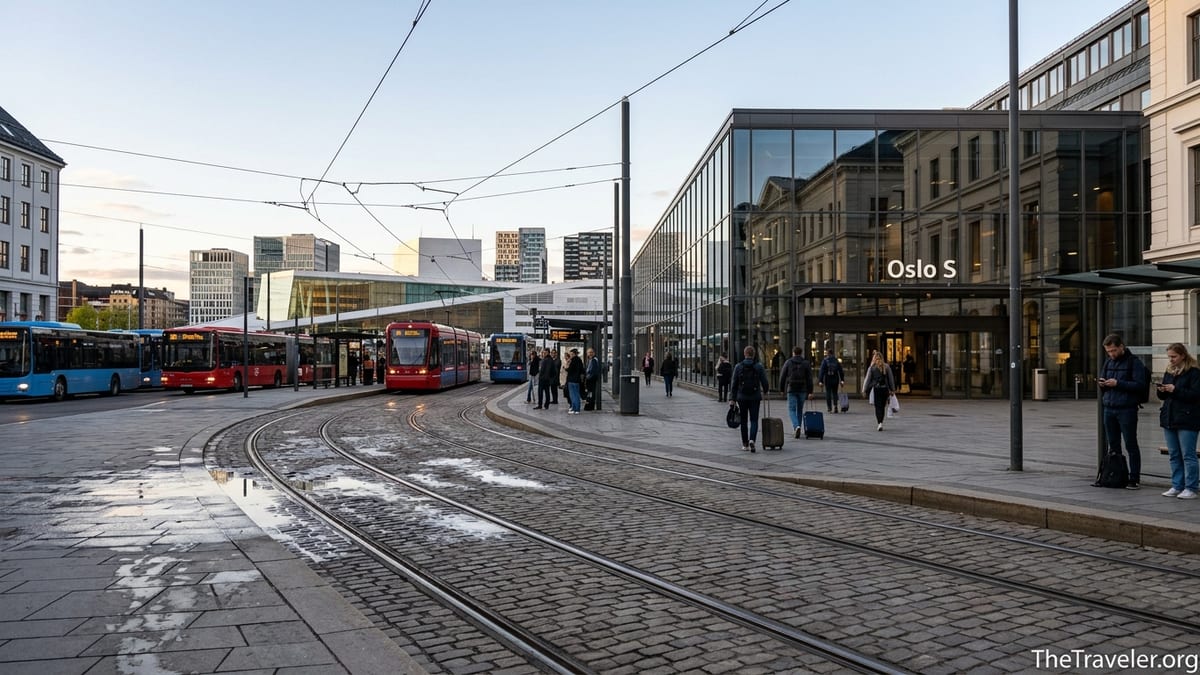
Oslo Central Station: Norway’s Nerve Center
Oslo Central Station is the country’s largest railway station and the point where long-distance, regional and commuter trains converge alongside the airport services. Trains arrive here from Bergen on the west coast, Trondheim and Bodø in the north, Gothenburg and Stockholm in Sweden, and a web of smaller cities in between. On a typical weekday morning you might see a sleek Vy train from Bergen glide in on one platform while a Swedish SJ train from Stockholm pulls in on another, with local commuter services shuttling in and out every few minutes.
For visitors, the first impression is usually how compact and walkable the station feels despite handling so many routes. Platforms are numbered in a simple sequence, and escalators and lifts feed directly down into a bright concourse lined with bakeries, supermarkets and currency exchange counters. Arriving on an early Vy Night train from Trondheim, for example, you can be off the platform, pick up a coffee and be on a tram within ten minutes if you know where to go.
Oslo S is also tightly integrated with the surrounding Jernbanetorget area, which functions as a single transport zone with the station. Step out one side of the concourse and you are on the square where trams loop, buses line up, and the entrance down to the Jernbanetorget metro station is just a few paces away. The physical distance between mainline rail, metro and tram is short enough that changing from a train from the fjords to a city tram can feel like crossing a single street.
Because of this, many Norwegians use Oslo S not just as a long-distance gateway but as a daily interchange. Commuters might ride a local train from a suburb like Ski into Oslo S, transfer to the T-bane metro for two stops to Majorstuen, and still be at their desk within 30 minutes of leaving home. For visitors arriving from the airport, tapping into this same network simply requires a bit of knowledge about ticket types and signage inside the station.
Getting from Oslo Airport Gardermoen to Oslo S
Oslo S is the default destination for rail passengers arriving from Oslo Airport Gardermoen, which sits around 50 kilometers north of the city. The two main train options from the airport are Flytoget, the airport express train, and the regular Vy regional and local trains. Both leave from the same level beneath the airport terminal and both bring you directly to the platforms at Oslo Central Station.
Flytoget is the fastest and most frequent option. Services typically run every 10 minutes during the day, and the journey from the airport to Oslo S is around 20 minutes. Ticket prices in 2026 are roughly double the cost of regular Vy trains, and many travelers pay in the region of 230 Norwegian kroner for a standard adult ticket from the airport to Oslo S. You buy simply by tapping a contactless bank card at the Flytoget gates or using the Flytoget app, then walking straight onto the train. Seats have more luggage space, power outlets and good onboard information screens, which business travelers and those with tight schedules often value.
The Vy regional and local trains cost significantly less and are only a few minutes slower. For example, a typical Vy ticket from Oslo Airport to Oslo S in 2026 often comes in around the mid-100 kroner range, with journey times around 23 to 25 minutes. These trains usually run at least twice an hour outside the very early morning and late night periods. You can buy tickets in the Vy app while walking from arrivals to the platform, or at the green Vy machines near the escalators. Many budget-conscious travelers report that by the time they have collected luggage and found the platforms, there is often a Vy train within minutes.
In practice, the choice comes down to your priorities. A couple landing mid-afternoon with a hotel a short walk from Oslo S might prefer Vy and pocket the savings, especially if they also need a Ruter ticket for city travel. A family landing late in the evening with tired children and big ski bags might go for Flytoget instead, appreciating the extra luggage space and slightly more frequent departures right up to close to midnight. Either way, all trains drop you into the same cluster of platforms at Oslo S, with clear signs pointing towards the city exits and onward connections.
Navigating the Station and Onward City Transport
Once your airport train or long-distance service pulls into Oslo S, your next step is usually to connect to Oslo’s urban transport network. This is coordinated by Ruter, the public transport authority that manages metro, trams, city buses, some local trains and ferries within the Oslo region. Jernbanetorget, directly outside the station, acts as one of Ruter’s main interchange points.
After leaving the platform, follow the signs marked “Jernbanetorget” or “T-bane” for the metro. A short escalator ride or a brief walk across the concourse brings you to the entrances where you can validate a Ruter ticket or simply show your activated ticket in the Ruter app if inspectors check. Most central journeys fall within Ruter’s Zone 1, which covers the whole metro network and almost all inner-city trams and buses. Visitors staying in neighborhoods like Grünerløkka, Frogner, Tøyen or Majorstuen will find their hotel easily reachable on a single Zone 1 ticket.
For example, if you arrive at Oslo S in the afternoon and need to reach a guesthouse near Frogner Park, you might take tram line 12 from Jernbanetorget towards Majorstuen, getting off at a stop like Vigelandsparken. With luggage, this route is often more comfortable than trying to navigate busy streets on foot. If you are staying near the hip Grünerløkka district, trams 11, 12 or 17 from outside the station will carry you quickly to stops like Olaf Ryes plass, lined with bars and cafés. A typical single Zone 1 ticket in 2026 is often in the 40 to 45 kroner range in the Ruter app, which remains much cheaper than a central taxi ride.
Ticket purchase is usually easiest through the Ruter app, which allows you to buy single tickets or 24-hour and multi-day passes that activate from the first time you travel. Paper tickets from kiosks and machines cost slightly more and are gradually being phased out, so relying on the app is both convenient and economical. A traveler spending three full days in Oslo might choose a 72-hour pass for Zone 1, allowing unlimited metro, tram, bus and inner-fjord ferry rides from the moment they arrive at Oslo S until they head back to the airport.
Using Oslo S as a Base for Exploring Norway by Train
Oslo Central Station is not only a gateway to the airport and city center but also the springboard for some of Norway’s most scenic rail journeys. Many travelers plan a few nights in Oslo, then depart from Oslo S on classic routes such as the Oslo to Bergen line, the Dovre line to Trondheim, or the line towards Stavanger on the southwest coast. All of these depart from platforms within the same main station, so it is common to step off a flight from abroad in the morning and be on a mountain-bound train in the afternoon.
The Oslo to Bergen railway, famous for its high plateau crossing, generally takes around six and a half to seven hours, with departures typically in the morning and early afternoon. A traveler might check out of a hotel near the Opera House, walk ten minutes to Oslo S, pick up a takeaway sandwich from a station bakery and board a Vy intercity service bound for Bergen. In winter, skis and snowboards are a regular sight on these platforms as Norwegians head to mountain resorts like Geilo or Finse, both accessible from trains leaving Oslo S.
Oslo S also offers direct trains towards Gothenburg and Stockholm operated by Swedish companies, making it a convenient jumping-off point for cross-border itineraries. For instance, someone could arrive from Oslo Airport in the morning, spend a day exploring the city using a Ruter day pass, then board an evening train to Gothenburg, reaching Sweden in about four hours. This kind of seamless international connection is one reason Oslo has become a popular start or end point for multi-country Scandinavian trips.
Because trains and airport services all meet at Oslo S, the station works particularly well for circular journeys. Travelers might fly into Oslo, take the train to Trondheim, then work their way south via the coastal Hurtigruten voyage or buses before rejoining the rail network back to Oslo S. Knowing that the final leg of the journey drops you in the same station that links directly back to the airport can simplify planning and reduce the need for extra hotel nights solely to manage connections.
Where Oslo S Meets City Life: Food, Shopping and the Waterfront
Unlike some purely functional railway hubs, Oslo Central Station is woven directly into the city’s everyday life. The main hall backs onto the modern Østbanehallen complex, a glass-roofed arcade filled with cafés, bakeries, casual restaurants and small shops. Locals regularly meet friends here for after-work pizza or coffee even when they are not catching a train, and travelers arriving from the airport can sit down within minutes for a hot meal rather than hunting through an unfamiliar neighborhood.
Step outside the station and you are a short walk from some of Oslo’s best-known sights. The angled white roof of the Oslo Opera House rises directly across the tracks, reachable in about five minutes on foot. Beyond it lies the new Bjørvika district, with the Barcode row of modern office towers and the waterside Deichman Library. Visitors often check into hotels within a five to ten minute walk of Oslo S in this area, using the station as their morning and evening reference point while they explore attractions like the Munch Museum or the harbor promenade.
On the opposite side of the station, the pedestrian street Karl Johans gate begins not far from Jernbanetorget and runs up towards the Royal Palace. This stretch is lined with shops, department stores and restaurants and forms the classic first-evening stroll for many visitors. A traveler who has taken a late afternoon train from Bergen might emerge from the station, drop a bag at a nearby hotel and be standing on Karl Johans gate among street musicians and outdoor terraces within half an hour.
Even those in transit can sample a bit of city life without venturing far. With a long layover between a train from Stockholm and an evening flight, for example, it is easy to lock luggage at Oslo S, walk down to the waterfront for a coffee by the fjord, then return by tram or on foot in time for the airport train. The compact layout means that “just passing through” Oslo often turns into a brief but memorable taste of the city.
Tickets, Zones and How to Combine Airport and City Travel
Understanding how airport and city tickets interact can save both time and money. The key point is that airport trains and city transport use different systems. Flytoget tickets are valid only on Flytoget services between the airport and central stops like Oslo S, while Vy tickets cover Vy trains and can in some cases be combined with journeys that extend beyond the airport into other regions. Ruter tickets, by contrast, cover the metro, trams, buses and some local trains within defined zones around Oslo, but not the airport express train.
For most visitors, the simplest approach is to buy a dedicated train ticket for the airport leg and then a separate Ruter ticket for the city. A typical pattern in 2026 is to purchase a Vy ticket from Oslo Airport to Oslo S in the Vy app, then once you step off the train and are ready to move around town, open the Ruter app and activate a Zone 1 ticket or 24-hour pass. This keeps the airport journey and urban travel clearly separated and avoids accidentally boarding a service where your ticket is not valid.
Travelers staying in Oslo for several days often find that a short period ticket gives the best value. For example, a visitor landing on a Thursday evening and leaving on Sunday night might buy an individual train ticket from the airport to Oslo S, then a 72-hour Ruter pass covering unlimited metro, tram, bus and ferry rides within Zone 1. They can use this to ride out to Holmenkollen for the city views, hop trams around Grünerløkka’s café streets, and even take ferries to the small islands in Oslofjord, all covered under one product.
Some travelers also consider airport buses or shared shuttles, especially if staying in districts not conveniently reached by rail. Airport buses typically stop near Oslo S and other major hubs such as Radisson Blu Plaza or the bus terminal, which is adjacent to the eastern side of the station. Prices can be comparable to or slightly higher than Vy trains, but buses may offer more direct stops outside certain hotels. For instance, someone staying in the northern part of the city might find that an airport bus that stops at Majorstuen or Storo reduces the need to transfer again on arrival.
Practical Tips for Smooth Connections at Oslo S
A few practical habits can make transfers at Oslo Central Station more relaxed, especially after a long flight. First, build in a little extra time between a landing at Oslo Airport and any onward long-distance train you plan to catch from Oslo S. While both Flytoget and Vy trains are generally reliable, winter weather or busy times can add a few minutes. Many experienced travelers leave at least 60 to 90 minutes between flight arrival and a fixed long-distance departure from Oslo S, giving space for baggage collection, ticket purchase and an unhurried walk through the station.
Second, take advantage of luggage facilities. Oslo S usually offers lockers where you can store bags for a few hours or a full day. If you have a midday arrival from the airport and an evening Oslo to Bergen train, storing suitcases at the station lets you explore nearby neighborhoods without dragging luggage up and down the hills. Similarly, those with a late-night airport departure might check out of their hotel in the morning, leave bags at the station, and enjoy a full final day in the city before catching a train back to Gardermoen.
Third, watch the information screens carefully, as platform assignments and intermediate stops can change. Flytoget sometimes terminates at Oslo S instead of continuing to stations like Nationaltheatret, particularly during maintenance periods, and regular Vy trains can also be rerouted. Verifying the final destination and calling points on the big departure boards in the main hall helps you avoid waiting in the wrong part of the station or missing a chance to stay on the train for a closer stop to your hotel.
Finally, remember that station staff and the staffed ticket counters are used to helping visitors who are unfamiliar with the system. If you are unclear whether your Ruter pass covers a certain local train, or whether your Vy ticket can be extended past Oslo S to a town like Drammen, asking at the information desk can save confusion. English is widely spoken, and staff are accustomed to explaining in plain language which ticket belongs on which train, and where to change for particular districts or attractions.
The Takeaway
Oslo Central Station is much more than a place where trains begin and end. It is the hinge between Norway’s intercity rail lines, the fast corridor to Oslo Airport Gardermoen, and the trams, buses and metro that knit the capital together. For travelers, mastering Oslo S means mastering the city itself. A smooth connection from airport platform to metro, a quick tram out to a neighborhood like Grünerløkka, or a well-timed departure towards the mountains can all start within a few steps of one another here.
By understanding the roles of Flytoget, Vy and Ruter, and by giving yourself a little time to navigate the concourse, you can turn what might have been a stressful transfer into an easy, almost enjoyable part of your trip. Whether you are using Oslo S as an overnight stop between flights and fjords, a base for a weekend in the city, or the launchpad for a long rail journey across Norway, the station is designed to connect you swiftly and efficiently to where you need to go.
FAQ
Q1. How long does the train from Oslo Airport to Oslo Central Station take?
The Flytoget airport express train usually takes about 20 minutes, while regular Vy trains are typically around 23 to 25 minutes between the airport and Oslo S.
Q2. Which is cheaper from Oslo Airport to the city, Flytoget or Vy?
Vy regional and local trains are generally cheaper, often around half the price of Flytoget in 2026, though exact fares vary. Flytoget is faster and more frequent but costs more.
Q3. Can I use a Ruter ticket on the airport express train?
No. Ruter tickets do not cover Flytoget. You need a separate Flytoget ticket, while Ruter tickets are for metro, trams, buses and some local trains within the Oslo zones.
Q4. Is Oslo Central Station within Ruter’s Zone 1?
Yes. Oslo S and the surrounding Jernbanetorget area are in Zone 1, which covers most central city travel on metro, trams and buses.
Q5. Do I need to buy train tickets from Oslo Airport in advance?
Not usually. Most travelers buy Vy or Flytoget tickets on arrival using apps, machines or contactless payment. Trains run frequently enough that advance booking is rarely essential.
Q6. How do I get from Oslo Central Station to popular neighborhoods like Grünerløkka?
From Oslo S and Jernbanetorget, you can take trams such as lines 11, 12 or 17 towards Grünerløkka, or use the metro and then walk. All are covered by a Zone 1 Ruter ticket.
Q7. Are there food and shops inside Oslo Central Station?
Yes. Oslo S has bakeries, cafés, small supermarkets and shops, plus the Østbanehallen arcade next door, making it easy to eat or pick up supplies between trains.
Q8. Is it easy to walk from Oslo Central Station to the Opera House and waterfront?
Very. The Oslo Opera House is about a five-minute walk from the station, and the Bjørvika waterfront with cafés and modern architecture lies just beyond it.
Q9. Can I store luggage at Oslo Central Station?
Yes. Oslo S usually offers self-service lockers where you can store bags for several hours or a full day, useful if you have time to explore between trains.
Q10. How much transfer time should I allow between my flight and a long-distance train from Oslo S?
Many travelers allow at least 60 to 90 minutes between scheduled flight arrival and a fixed long-distance departure from Oslo S, to cover baggage, ticketing and the airport train ride.