


Oslo Central Station, known locally as Oslo S, is Norway’s busiest transport hub and the gateway to much of the country. With regional and long-distance trains, the Flytoget airport express, local commuter services, a bus terminal, trams and the metro all converging here, it can feel overwhelming on a first visit. With a bit of orientation in advance, though, you can move through the station confidently, avoid wrong turns and make even tight transfers without a spike in your stress levels.
Get the latest updates straight to your inbox!
Understand the Basic Layout Before You Arrive
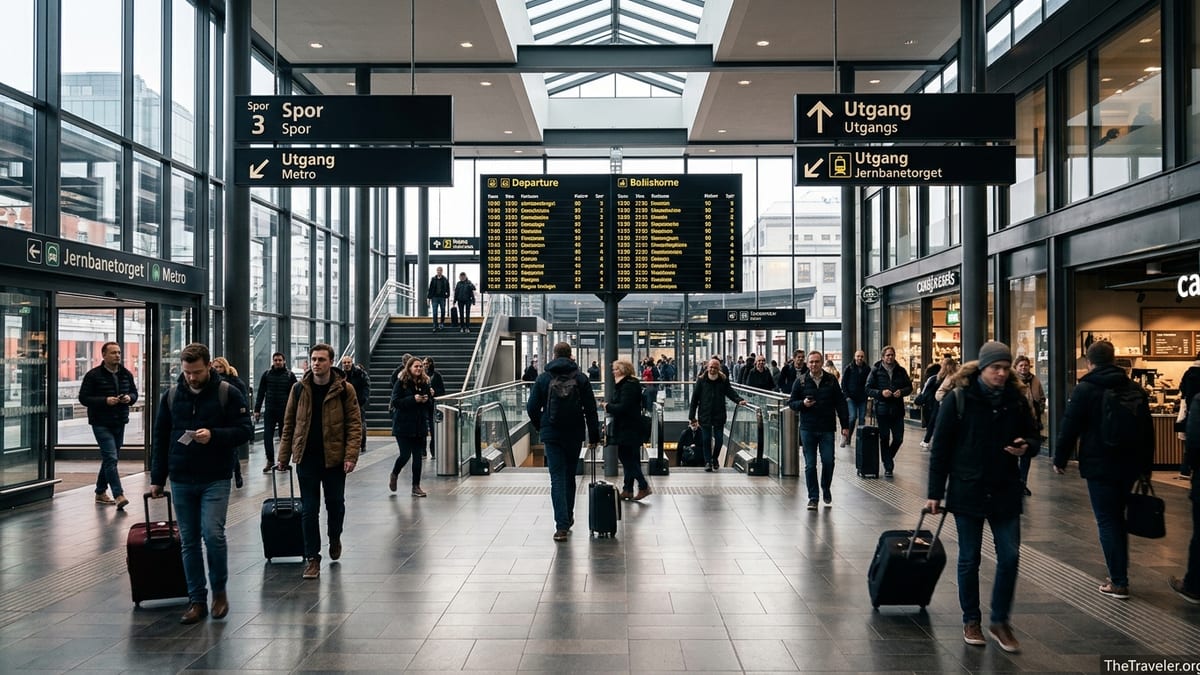
Most of the confusion at Oslo S comes from its size and the fact that it connects directly to shopping areas and the bus terminal. Picture the station as three key zones on two main levels. On the ground level is the main hall, where you find the huge departure and arrival boards, ticket machines and many of the entrances to the platforms. Directly connected to this hall is Østbanehallen, a historic station building that now houses cafés and restaurants, and beyond that the plaza at Jernbanetorget, where trams and the metro stop. One level below, in the basement, you will find some platforms, the Flytoget airport express terminal area and services like luggage lockers.
Platforms are numbered, typically with long-distance and regional Vy trains using higher-numbered tracks and the Flytoget airport express and some local services using lower numbers. Digital boards above the stairs and escalators list the next departures from each track, so even if you cannot immediately see your train on the main board, you can confirm you are heading toward the correct platform. If you arrive on a long-distance service from Bergen, Trondheim or Stavanger, you will normally roll directly into one of these platforms and step out into clearly marked corridors leading back toward the main hall.
Oslo S is integrated with the wider Jernbanetorget transport hub, which can make it feel like it never really ends. One exit leads toward the Oslo Bus Terminal, another toward Karl Johans gate and the city center, while others bring you up near the Barcode high-rise district or the Oslo Opera House. The key is to follow the black-and-white overhead signs. “Spor” means track, “Utgang” means exit and “T-bane” is the metro. Once you know those words, you can decode most signs on the fly and avoid following the wrong crowd.
Opening hours also matter if you are arriving very early or very late. The main station concourse typically opens in the very early morning around 03:45 and closes soon after 01:30 at night. Outside those times you may not be able to access indoor areas, but the outdoor plaza and some entrances to platforms used by night trains and airport services can still be open, so always check your specific departure time and build in extra minutes if you are traveling in the small hours.
Arriving by Airport Train or Long-Distance Service
Many visitors meet Oslo S for the first time when arriving from Oslo Airport Gardermoen. Two train options share the same basic route into the city: the Flytoget airport express and the regular Vy trains. The Flytoget service runs roughly every 10 minutes in daytime, with a journey time of about 19–20 minutes from the airport to Oslo S. It is the faster, more frequent and more expensive option, popular with business travelers and those in a hurry. Vy regional and commuter trains are slightly slower, often around 23 minutes, but usually cost roughly half the Flytoget price and are included in ordinary public transport ticketing zones.
When you step off the airport train at Oslo S, you typically arrive on platforms in the lower or central section of the station. Follow the stream of passengers toward the top of the platform where you will see overhead signs for “Utgang Jernbanetorget” if you want the metro or trams, or “Oslo Bussterminal” if you are continuing by long-distance coach. If you just need to transfer to another train, look for the nearest set of stairs or escalator. Digital screens at the top show a list of upcoming departures and their platform numbers, so you can immediately see, for example, that your onward Vy train to Bergen departs from track 4 in 25 minutes.
If you are arriving from a long-distance route such as the Bergen or Dovre lines, your train will normally arrive on one of the main long platforms leading directly into the heart of the station. You will pass information screens showing upcoming departures, and at the far end of the hall you will see the giant departure board. A typical connection might look like this: your Bergen train arrives at 11:03 on track 3, and your Flytoget to the airport departs at 11:10 from tracks in the airport terminal area. In practice, you step off the train, walk 1–3 minutes following the “Flytoget / Gardermoen” signs, reach the airport train area, buy a ticket at a machine or tap through the gate with a payment card, and still have several minutes in hand before boarding.
It often surprises travelers how compact these connections feel in reality. Even with a medium suitcase and a backpack, the walk from a long-distance platform to the airport express terminal is usually under five minutes at a calm pace. This is why locals frequently plan tight transfers of 10–15 minutes when switching between Vy and Flytoget services. If you prefer a more relaxed approach, 20–30 minutes is usually more than enough to walk, buy a coffee from a kiosk and find your next platform without breaking stride.
Reading Signs, Boards and Platform Information
Norwegian station signage is designed to be highly standardized. The main departure boards in Oslo S show time, destination, train number, operator (Vy, Flytoget or another operator) and platform, often indicated as “Spor 4” or similar. When your train is boarding, a “Går fra” or “Boarding” message appears, and when it is about to leave, it may change to “Avgått” meaning departed. Learning these few words makes it easier to read the boards quickly, especially if there are minor delays or platform changes.
On the way to the platforms, smaller screens list trains from that specific track over the next period. For example, walking toward Spor 10, you might see that in the next hour it handles an intercity train to Gothenburg, then a regional train to Halden. These screens show the intermediate stops, which is helpful if you are heading somewhere like Lillestrøm or Drammen and want to be sure you are boarding the right service. For the airport, Flytoget departures are clearly branded with the orange Flytoget logo and “Oslo Lufthavn,” while Vy departures to the airport will show either the line number or “Oslo Lufthavn / Gardermoen” in the destination column.
Inside the station, overhead directional signs use icons as well as words. A small airplane icon points the way toward airport trains, a suitcase icon indicates luggage storage, a bus symbol points toward the bus terminal and a metro logo marks routes to the T-bane. If you are transferring from train to metro, follow the signs to “T-bane Jernbanetorget.” Within a few minutes’ walk, mostly under cover, you will find ticket machines and escalators down to the metro platforms.
For travelers with limited mobility or heavy luggage, it is important to know that most platforms are reachable by both stairs and elevators. Near the end of each platform, there are lifts going up to the concourse. Elevators are clearly marked with the standard lift icon and are usually near the same place as stairs and escalators, which reduces the risk of getting separated from traveling companions. If you are changing between train and metro and prefer to avoid stairs entirely, staff at the information desk can point you to the most step-free route through the connected corridors and lifts.
Making Tight Connections Without Stress
Tight transfers are where good station navigation really pays off. Suppose your regional Vy train from Gothenburg is scheduled to arrive at Oslo S at 14:26, and you have booked a long-distance train to Trondheim at 14:37. On paper that is just 11 minutes, but in practice it is manageable if you prepare. Before you even arrive, check the expected platform for your onward train via your operator’s app or station information. When your Gothenburg train pulls in, move briskly toward the nearest exit and follow the signs to the correct “Spor” number. Typical walking time between adjacent platforms is 2–4 minutes, leaving you a cushion of several minutes to board calmly.
If your arriving train is running late and the connection time shrinks, resist the urge to sprint blindly. First, look at the small platform screens as you step off: these show whether your connecting train is also delayed, which often buys you more time than you thought. Second, listen for announcements in Norwegian and English, especially during disruption. In cases of severe delays or incidents affecting the station, such as technical faults on the tracks, operators may hold connecting long-distance services or direct you to alternative trains. It is better to follow updated instructions than to run to an empty platform for a service that has been moved or canceled.
For airport transfers, especially early flights, most locals regard 30 minutes at Oslo S between trains as generous. For example, if you land at Gardermoen at 07:00, catch a Vy train that arrives at Oslo S at 07:25, and have a Bergen train at 07:47, you have 22 minutes to change. In normal conditions this is ample, but if you feel anxious, you can instead take the more frequent Flytoget a few minutes earlier and arrive with extra time to spare. Because the airport trains arrive and depart from the same terminal area every few minutes, they are one of the easiest connections to manage in the whole station.
Travelers with lots of luggage or small children may want to build in a longer buffer. Adding an extra 15–20 minutes lets you use elevators rather than stairs, stop at a restroom, or grab snacks from a kiosk without glancing at your watch every minute. It also gives you flexibility if your arriving train is slightly delayed, which can happen during peak commuter hours or when there are temporary issues on the busy lines feeding into Oslo S.
Using Station Services: Tickets, Lockers and Facilities
Oslo S offers a full range of services that can make your journey smoother if you know where to find them. Ticket machines for Vy and local services are spread across the main hall, with screens offered in multiple languages and clear prompts. Many travelers buy or store tickets on their phones using operator apps, but the machines are a reassuring backup and an easy way to pay with cards. For Flytoget, you will find dedicated orange-branded ticket machines and gates in the airport express area; you can usually tap a contactless bank card at the gate instead of buying a paper ticket if you prefer.
If you arrive early or have a layover of several hours, the luggage lockers are especially useful. They are operated by a private company and located one level below the main hall, accessible from the Airport Express Train terminal area or via a staircase near one of the convenience stores. Lockers come in several sizes suitable for cabin bags or large suitcases and are typically rented for a period ranging from a few hours to several days. Payment is by card at the machine, and you receive a code or ticket that you need to reopen your locker, so keep it separate from your stored items. Many travelers use this service to drop bags for half a day while they walk to the nearby Opera House or explore the waterfront before returning for an evening train.
The station’s information desk and customer service point can help if you are unsure of your platform, have missed a connection, or need assistance with special mobility needs. Staff are used to international visitors and generally speak excellent English. They can rebook tickets if your delay is caused by the railway operator, point you to the correct platform at short notice, or suggest the quickest route to your hotel via local buses or trams. There is also a lost and found service connected with luggage storage, which centralizes items found on trains and in the station, so if you realize that your backpack is missing after a dash between platforms, report it as soon as possible.
Food, drink, and everyday supplies are abundant in and around Oslo S. You will find coffee chains, bakeries, fast-food outlets and small supermarkets either in the main concourse, in the connected Østbanehallen complex or in nearby streets. Prices vary, but grabbing a coffee and pastry before an early departure or stocking up on basic groceries after arriving from the airport is easy and can often be done in just a few extra minutes added to your transfer time.
Connecting to Metro, Tram and Bus from Oslo S
Oslo S does not exist in isolation; it is welded into the city’s wider transport network. Immediately outside the station is Jernbanetorget, a major interchange for trams and buses. If you step out of the main hall toward the large plaza, you will see tram tracks and platforms where several lines stop before heading out to neighborhoods such as Grünerløkka, Sagene or Majorstuen. Overhead digital signs at the tram stops show the route numbers and minutes until the next service, so even if you do not know the exact schedule, you can usually see something heading your way within a few minutes.
The metro, or T-bane, is accessed via Jernbanetorget station entrances just outside or within short walking distance of the main station exits. Following the “T-bane” signs leads you to escalators and lifts down to the underground platforms. From here, all metro lines fan out through the city, so if you are heading somewhere like Majorstuen, Nydalen or Sinsen, it is often a quick and simple connection. A typical route for a new arrival might be: airport train to Oslo S, then metro Line 4 from Jernbanetorget to Storo, all on the same integrated ticket if you used a regular Vy service from the airport rather than the dedicated airport express.
The long-distance bus terminal sits a short walk from the station, reached by following signs for “Oslo Bussterminal.” Covered walkways protect you from the weather for most of the route, and along the way you may pass additional ticket machines and small shops. From the bus terminal, you will find routes heading elsewhere in Norway or to neighboring countries, which makes Oslo S a natural pivot point for multi-part trips. If you have a tight bus connection, allow around 5–10 minutes’ walk from the center of the station concourse to your bus platform, plus extra time to find the correct bay.
Local buses within Oslo also call at stops around the Jernbanetorget area. If you are staying in a district without direct tram or metro service, such as some parts of the eastern or southern suburbs, a short bus ride from outside Oslo S can often connect you conveniently. Timetables are available digitally, and the same public transport tickets are valid across bus, tram and metro, which simplifies planning when you have just stepped off a train and are still in “navigation mode.”
What To Do When Things Go Wrong
Even in a well-organized hub like Oslo S, disruptions do occur. Technical faults, signal problems or severe weather can lead to trains being delayed, rerouted or canceled. When this happens, the key to not getting lost or stranded is to focus on reliable information channels. Departure boards are updated in real time, and any major incident usually triggers loudspeaker announcements in both Norwegian and English. Pay attention to these rather than relying on printed timetables you may have checked earlier in the day.
If a problem affects a whole line, such as a fault on the tracks south of the station, trains may turn around at outlying stations and replacement buses may be arranged. On busy weekday mornings, this can lead to crowded concourses and a lot of people moving in different directions. In that situation, move to the side of the main flows, check the board for your train, and if you are unsure, go directly to the information desk or a staff member in uniform. They can tell you whether to wait for a delayed train, head to another platform, or switch to a bus or tram for part of your journey.
For travelers heading to the airport during disruptions, operators often give priority to maintaining some form of connection between Oslo S and Gardermoen. This may involve extra buses or taxis replacing trains over part of the route. If you have a flight to catch and your planned airport train is not running, inform staff about your departure time and ask about the currently recommended route. In many cases, a slightly earlier or alternative train from another platform will still get you there in time, but in rare cases you may be directed to coach services or taxis arranged by the operator.
If you miss a long-distance train because of a delay on a connecting service operated by the same company, you may be entitled to rebooking at no extra cost. Keep your tickets and booking references, and visit the ticket office or customer service counter as soon as possible. Staff will usually place you on the next available departure and can also provide confirmation if you need to claim travel insurance later. Even when you are stressed, staying calm and dealing directly with official staff tends to lead to better outcomes than trying to rebook everything on your phone in a crowded hall.
The Takeaway
Oslo Central Station rewards a little advance preparation. Once you understand that the station is essentially a straightforward set of platforms connected to a main hall, with clear signage toward the metro, trams and buses, it becomes far less intimidating. Knowing a few basic Norwegian terms like “Spor” for track and “Utgang” for exit, along with the distinctive branding of services like Flytoget and Vy, allows you to read departure boards quickly and spot your train at a glance.
In everyday practice, most travelers find that even tight connections of 10–15 minutes are feasible, especially when changing between trains within the station. Building in a modest time buffer, using services such as luggage lockers and ticket machines, and asking station staff for help when needed all contribute to a smoother journey. With this mental map in place, Oslo S changes from a confusing maze into a convenient springboard for exploring Oslo, the rest of Norway and onward destinations across Scandinavia.
FAQ
Q1: How much time do I need to change trains at Oslo Central Station?
Most travelers are comfortable with 15–20 minutes between trains, which usually allows time to walk between platforms and check departure boards without rushing.
Q2: Is 10 minutes enough to transfer from a long-distance Vy train to the Flytoget airport express?
In normal conditions 10 minutes is usually enough, as the walk between platforms is short, but if you have heavy luggage or mobility issues, aim for 15–20 minutes.
Q3: Where can I find luggage lockers in Oslo S?
Luggage lockers are located one level below the main concourse, accessible from the Airport Express Train terminal area or via clearly marked stairs and escalators from the main hall.
Q4: Do staff at Oslo S speak English?
Yes, most station staff and ticket office employees speak very good English and are used to helping international travelers with directions and ticket issues.
Q5: What is the difference between Flytoget and the regular Vy train from Oslo Airport?
Flytoget is a dedicated, more expensive airport express running about every 10 minutes, while Vy trains are cheaper, slightly slower and part of the regular public transport system.
Q6: How do I get from Oslo S to the metro (T-bane)?
Follow the signs for “T-bane Jernbanetorget” from the main hall; within a few minutes’ walk you will reach escalators and lifts down to the metro platforms.
Q7: Is Oslo Central Station safe late at night?
The station is generally considered safe, with regular staff presence, but as in any busy hub you should keep an eye on your belongings and stay in well-lit, populated areas.
Q8: Can I buy all my tickets on my phone instead of using machines?
Yes, many travelers use apps from operators or the local transport authority, but physical ticket machines are available in the station if you prefer to pay by card on-site.
Q9: How do I get to the Oslo Bus Terminal from Oslo S?
Follow signs for “Oslo Bussterminal” from the main concourse; the walk is typically 5–10 minutes along covered walkways leading directly to the bus platforms.
Q10: What should I do if my train is delayed or canceled at Oslo S?
Check departure boards and listen to announcements for updates, then speak to station staff or the ticket office to find alternative routes or rebook your journey.