


Seoul Incheon International Airport is one of the few places in the world where a long layover can feel like a bonus rather than a punishment. With 8, 10 or even 15 hours between flights, you can sleep, soak in a Korean sauna, snack your way through local favorites, or simply find a quiet corner and press reset. This guide focuses on how to stay inside Incheon Airport and still have a layover that feels like a short city break, complete with real-world tips on prices, locations and how to move between terminals without wasting time.
Get the latest updates straight to your inbox!
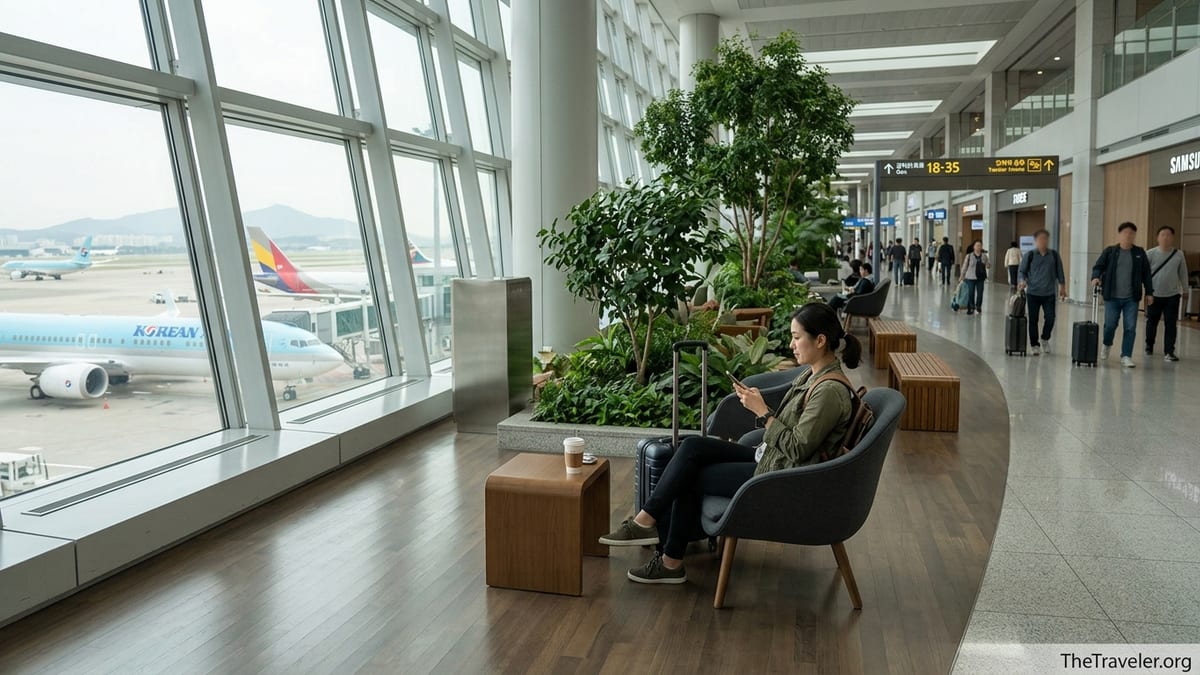
Getting Oriented: Terminals, Timing and Transit Basics
Incheon Airport is spread across two main terminals, Terminal 1 and Terminal 2, which are linked by a free underground shuttle train that takes around 5 minutes. Most Korean Air, Delta, Air France and KLM flights use Terminal 2, while many other international carriers use Terminal 1. If you have a long layover, it is worth checking in advance which terminal your arriving and departing flights use, because some of the best facilities, like the Spa On Air sauna in Terminal 1, may require a short terminal hop.
For layovers of 5 to 8 hours where you prefer not to leave the airport, focus on one or two activities in the same terminal to avoid extra walking and security checks. With 8 to 12 hours you can mix sleep, showers, a proper meal and some light exploring. If your connection stretches to 12 hours or more, you can comfortably schedule a longer rest in a capsule hotel or spa, plus a slow wander through shops, gardens and art displays without feeling rushed.
It is important to keep an eye on the local time and boarding procedures. For long-haul international flights, boarding can start 40 to 60 minutes before departure. Many travelers at Incheon underestimate walking time to far-flung gates, especially in the satellite concourse of Terminal 1. Aim to be back in your departure terminal at least 2 hours before departure if you are airside, and 3 hours if you have to clear security again after visiting landside facilities such as the public spa entrances or certain capsule hotels.
Currency is another practical detail. Almost all outlets in Incheon accept major credit cards, and prices are usually displayed in Korean won with approximate US dollar equivalents. A quick airport ATM withdrawal of a small amount of won can still be handy for buying bottled water from machines or small snacks if your card fails or terminals are briefly offline.
Sleep, Showers and Real Rest: Capsule Hotels and Spas
One of the biggest advantages of a long layover at Incheon is that you can actually sleep in a real bed or capsule without leaving the terminal complex. The Darakhyu Capsule Hotel by Walkerhill operates in both Terminal 1 and Terminal 2, with compact but comfortable private pods located inside the airport. Typical stays are sold in blocks of hours, so you might book a 6-hour package for an overnight layover or a 3-hour block to grab a nap after a red-eye flight. Travelers often report that the pods are quiet, with individual lighting and power outlets, and that check-in is streamlined for transit passengers.
If you are looking for the most “Korean” way to rest, consider visiting a jjimjilbang, a traditional Korean bathhouse and dry sauna. Incheon is famous for Spa On Air in Terminal 1, a full-service Korean-style sauna with hot tubs, dry and steam rooms, nap areas and showers. It is open 24 hours a day and is designed specifically for transit passengers who want to bathe and rest without booking a hotel room. Typical usage is paid per block of hours, and prices can be roughly comparable to a mid-range airport lounge day pass, but you gain access to bathhouse facilities instead of just snacks and chairs.
Since early 2025, Terminal 2 has its own Korean-style sauna operated as Spa at Home on the B1 level, west side of the terminal, also open 24 hours a day. It offers showers, a dry sauna and spa tubs, with free basic amenities such as shampoo, conditioner and body wash. This is especially useful if you are flying in and out of Terminal 2 and do not want to ride the shuttle train to Terminal 1 just to take a shower or sleep in a warm room for a few hours.
For travelers on a tight budget, Incheon’s regular seating areas can also be workable for a short rest, especially in quieter zones at the far ends of concourses. Some seating banks have legless recliners or bench-style seats without armrests, which allow you to lie down. Eye masks, earplugs and a small blanket or scarf make a big difference here. If you are planning to sleep in public areas, keep your valuables in a crossbody bag or money belt on your person, and use your cabin luggage as a makeshift footrest.
Soak, Sweat and Reset: Making the Most of Incheon’s Spa Culture
Even if you are not planning to sleep for long, Incheon’s spa options are among the most satisfying ways to freshen up during a layover of any length. A typical routine for many long-haul passengers is to clear security, head straight to Spa On Air or Spa at Home, take a hot shower, soak briefly in a warm tub and then move into the dry sauna rooms to stretch and decompress. After a long economy-class flight, 60 to 90 minutes of gentle heat and quiet can dramatically improve how you feel on the next leg.
These facilities function much like city jjimjilbangs in Seoul. After you pay, you receive a locker key and sometimes a basic set of lounge wear for dry areas. Shoes are stored in separate lockers at the entrance, and you shower thoroughly before entering any shared baths. Men’s and women’s wet areas are separated, while communal dry areas, nap rooms and snack corners may be mixed depending on the facility. Many travelers use the nap zones to lie down for an hour or two even if they do not book an overnight stay.
If you are concerned about time, build in at least 30 minutes to get from your gate or immigration area to the spa, check in, shower and return to your next flight’s gate. In busy periods, queues for showers can form, particularly in the early morning when arrivals from North America and Europe converge. A practical strategy is to visit the spa during mid-morning or early afternoon lulls, then use airport lounges or quiet seating areas closer to boarding time.
For those who prefer something simpler or free, Incheon also offers shower rooms in some airline lounges and in dedicated pay-per-use shower facilities. These usually include a towel, body wash and shampoo, and can be used in 30-minute slots. While the ambiance is less immersive than a full jjimjilbang, a quick hot shower is still one of the most effective ways to beat jet lag and arrive at your destination feeling human.
Eat Like You Are in Seoul: Real Korean Food Inside the Airport
Incheon’s dining scene has improved steadily over the years, and a long layover is an ideal moment to try Korean dishes without worrying about finding your way into the city. You will find familiar airport staples like global coffee chains and fast-food burgers, but the more rewarding options are Korean classics such as bibimbap, jjigae stews and Korean fried chicken served in casual sit-down restaurants scattered through both terminals.
Many first-time visitors gravitate toward bibimbap, a rice bowl topped with mixed vegetables, egg and often beef, served with a side of kimchi. In airport restaurants this is usually presented with clear instructions for mixing in chili paste to taste, making it a low-risk way to experiment with Korean flavors. Prices are typically higher than in downtown Seoul but still reasonable for an international hub, and the bowl format makes it easy to eat even if you are jet-lagged or not especially hungry.
For something warming during an overnight or winter layover, look for soups such as kimchi jjigae or doenjang jjigae, hearty stews served bubbling in stone pots. These come with rice and side dishes and are popular with Korean travelers heading home. If you have a morning layover, you may find congee-style rice porridge or simple toasted sandwiches in the landside cafés, while airside bakeries sell sweet red-bean pastries and croissants that pair well with a strong Americano.
Travelers who want a quick taste of Korean street food without leaving the airport can snack on tteokbokki, spicy rice cakes, or grab a takeaway box of kimbap, the seaweed-wrapped rice rolls sometimes called “Korean sushi.” These are easy to carry to a nearby seating area if restaurants are busy. When ordering, pay attention to spice levels, which can range from mild to very spicy; staff are used to foreign travelers and are usually happy to recommend options if you mention that you do not eat spicy food.
Stretch Your Legs: Gardens, Galleries and Quiet Corners
Even if you never leave the terminal building, Incheon offers multiple ways to walk around and see something beyond boarding gates and duty-free perfume. Within the terminal complex you will find indoor gardens, small cultural corners and changing art displays. These are particularly welcome on overnight layovers when many shops close and the airport feels calmer.
One of the most relaxing features is the series of small themed gardens that break up the concourses. These often include real plants, water features and wooden benches, providing a pocket of greenery where you can sit with a coffee or simply stretch your legs. If you are traveling with children, these spaces make for good mini-breaks between long walks through the terminal, and they are often quieter than the central shopping areas.
Incheon also hosts rotating exhibitions of Korean art and craft, including pottery, calligraphy and photography. These displays are usually located along main walkways or near central squares where passengers naturally pass through, and short explanatory panels in English explain what you are seeing. Spending 20 or 30 minutes wandering from one installation to another can reset your brain much more effectively than scrolling on your phone near the gate.
For travelers needing true quiet, look for designated rest zones, sometimes signposted on terminal maps as “Relax Zones” or “Nap Zones.” These areas typically feature dimmer lighting, slightly reclined seating and charging points. During peak daytime hours they can be popular, but late at night and early in the morning they are often sparsely occupied, which makes them an excellent place to read, meditate or simply sit in silence before re-entering the noise of a long-haul cabin.
Keep Moving: Light Exercise and Airport Walks
After a long overnight flight, a gentle bout of movement can be as refreshing as a nap. Incheon’s terminals are long and designed for walking, so one of the easiest ways to keep your body awake is to treat the concourses as an indoor walking track. Choose a time when the terminal is not crowded, keep your hand luggage light and simply walk from one end to the other, occasionally stepping into side corridors or window bays for quieter views of the runways.
Some travelers bring compact fitness tools such as resistance bands, which can be used discreetly near large windows or in underused corners of the terminal. A simple routine of squats, calf raises, light stretching and band exercises can help reduce stiffness and lower the risk of swollen ankles on your next sector. If you try this, choose a spot away from escalators and main flows of traffic, both for your safety and to avoid obstructing other travelers.
For families with children, airport walks can be turned into a game. Set small goals, such as walking to a specific sculpture, clock, or kid-friendly play zone in another wing of the terminal. Along the way, you can point out aircraft types or airline liveries visible through the large glass walls. Many parents report that a 30-minute exploratory walk followed by a snack in a café can dramatically reduce mid-flight restlessness for younger kids.
Comfortable footwear is crucial if you plan to do more than a quick stroll. If your layover is longer than 8 hours and you know you get stiff during flights, consider packing a lightweight change of clothes and sneakers in your carry-on specifically for airport walking. Changing into soft clothes and shoes can psychologically signal to your body that it has entered a recovery phase between flights.
Plan Like a Local: Using Time Blocks for Different Layover Lengths
The easiest way to avoid boredom at Incheon is to think in time blocks rather than one long, amorphous wait. For a 5-hour layover where you stay inside the transit area, you might allocate one hour for a full meal, 90 minutes for a spa visit or shower and change, another hour for a relaxed walk through the gardens and art displays, and then use the remaining time to sit near your gate and read or watch a film.
For an 8- to 10-hour connection, many experienced travelers recommend scheduling a proper sleep segment. A realistic plan could look like this: first hour for immigration or security and reaching your next terminal, 2 to 3 hours in a capsule hotel pod or spa nap room, one hour for a meal and coffee, 90 minutes to wander and shop, and then 90 minutes reserved for getting to the gate, passing any final security checks and boarding. This kind of structure prevents you from constantly checking the clock and wondering what to do next.
On very long layovers of 12 hours or more, it is tempting to plan ambitious activities, but energy levels after long-haul flights can be unpredictable. A more sustainable approach is to double down on rest and light experiences. You might book two separate 3-hour sleep blocks many hours apart, with meals and gentle walks in between, or combine a longer stay in Darakhyu with a separate visit to a jjimjilbang so you can both shower thoroughly and experience traditional Korean sauna culture.
Regardless of layover length, keep key documents and essentials easily accessible. Store your onward boarding pass, passport, a pen, and any required transit forms in a small pouch. Pack a minimal “airport kit” in your carry-on with toiletries in travel-sized containers, a spare T-shirt, fresh socks and underwear, and a phone charger. With this setup, you can pivot easily between a nap, a shower, a meal and a walk without having to dig through your main luggage at every step.
The Takeaway
A long layover at Seoul Incheon Airport does not have to mean hours of mindless scrolling in a plastic chair. With capsule hotels, 24-hour Korean-style saunas, real local food and surprisingly calm pockets of greenery and art, Incheon can feel more like a small city than a transit hub. The key is to decide what your body needs most, whether that is deep rest, movement, a proper meal or a chance to experience Korean culture in miniature, and then use the airport’s facilities to build a simple plan around those priorities.
By breaking your time into clear blocks and staying realistic about your energy levels, you can land, shower, sleep, eat, stroll and still arrive at your next gate with time to spare. Instead of dreading a 10- or 12-hour connection, you may find yourself secretly hoping for another long layover through Incheon on your next trip, if only for one more hot soak and a quiet bowl of bibimbap between flights.
FAQ
Q1. Can I use the Incheon Airport spas during a layover without leaving the airport?
Yes. Facilities like Spa On Air in Terminal 1 and Spa at Home in Terminal 2 are designed for transit passengers and can be used without entering central Seoul.
Q2. Do I need cash, or can I pay by card at Incheon Airport?
Most restaurants, shops and spa facilities accept major credit cards, but having a small amount of Korean won is helpful for vending machines and small purchases.
Q3. Is the Darakhyu Capsule Hotel inside security or outside?
Darakhyu operates capsule hotels within the airport complex, including airside locations, which allows many transit passengers to access their pods without fully exiting the secure area.
Q4. How early should I return to my gate after using the spa or capsule hotel?
Plan to be back in your departure terminal at least 2 hours before departure if you are airside, and 3 hours if you need to clear security or immigration again.
Q5. Are the Korean jjimjilbang facilities at Incheon mixed-gender?
Wet areas with baths and showers are separated by gender, while some dry saunas, rest areas and snack spaces may be mixed depending on the facility’s layout.
Q6. Is it safe to sleep in public seating areas at Incheon during a long layover?
Incheon is generally considered safe, but you should keep valuables with you, use your bag as a pillow or footrest, and choose well-lit, populated rest zones.
Q7. Can I find vegetarian or less spicy food options inside the airport?
Yes. Many restaurants offer vegetable bibimbap, mild noodle dishes and Western-style options. Staff can usually advise on less spicy choices if you ask.
Q8. Are there quiet places to work during a layover?
Yes. Incheon has multiple rest zones with charging points, and many cafés provide relatively quiet seating where you can work on a laptop between flights.
Q9. What should I pack in my carry-on to make a long Incheon layover easier?
A small toiletries kit, spare clothes, eye mask, earplugs, a phone charger and any medications make it much easier to shower, change and rest comfortably.
Q10. Is a long layover at Incheon enough to visit Seoul city itself?
You technically can if you have 8 to 10 hours or more, but travel times, immigration and security eat into that window. Many travelers find staying in the airport more relaxing.