


Ask a ranger or a seasoned local hiker to name the quintessential Great Smoky Mountains trail, and Mount Le Conte comes up again and again. Rising steeply above the lights of Gatlinburg to 6,593 feet, this massif combines raw elevation gain, cliff-edge views, and a rustic mountaintop lodge you can only reach on foot. For many hikers, standing on Le Conte’s wind-swept summit feels less like checking off a trail and more like joining a Smokies tradition.
Get the latest updates straight to your inbox!
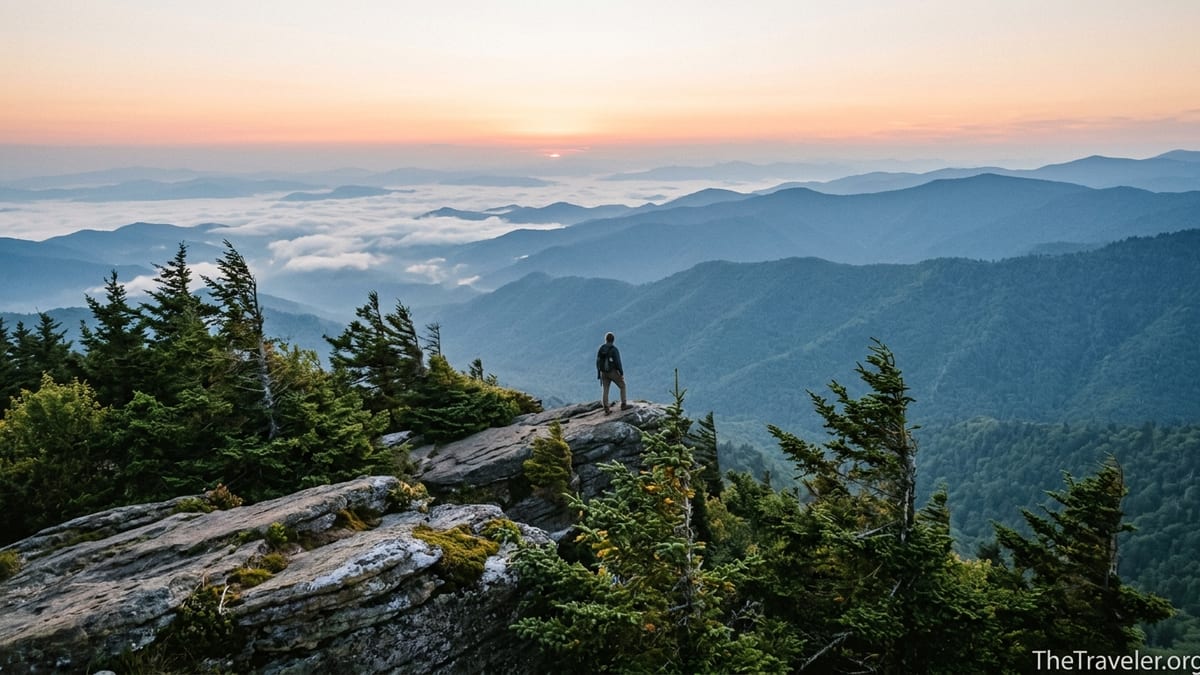
A Mountain That Defines the Great Smoky Mountains
Part of what makes Mount Le Conte legendary is the mountain itself. Although it is only the third-highest peak in Great Smoky Mountains National Park, its vertical relief is unmatched. From the outskirts of Gatlinburg, around 1,300 feet above sea level, Le Conte soars more than a vertical mile to its 6,593-foot summit, giving it the greatest rise from base to summit of any mountain east of the Rockies. When you stand on Cliff Top or Myrtle Point and look back toward town, the sheer amount of terrain you have climbed becomes vividly real.
Le Conte also showcases the park’s signature habitats in a single day. Hikers typically begin in a mixed hardwood forest filled with rhododendron and hemlock, then pass into cool spruce-fir forest above 6,000 feet that feels more like Canada than Tennessee. In late summer, you can start in warm, humid air at the trailhead and finish in temperatures 15 to 20 degrees cooler near the summit. In winter and early spring, it is common to see blooming wildflowers at lower elevations while rime ice coats the spruce trees up high.
For context, Great Smoky Mountains National Park contains more than 800 miles of trails, from kid-friendly waterfall walks to multi-day sections of the Appalachian Trail. Yet for decades, Le Conte has been treated as a rite of passage. Local hiking clubs keep careful track of how many times members reach the summit, and there is a small but passionate group of hikers who climb Le Conte weekly or even daily, sometimes racking up dozens of ascents in a single year.
The mountain’s profile has also grown with social media. Photos taken along the narrow ledges of Alum Cave Trail or on the sunrise perch at Myrtle Point are shared thousands of times each season. For first-time visitors scrolling through trip reports, Le Conte quickly emerges as the hike that seems to represent the best of the Smokies in a single long, unforgettable day.
Five Distinct Trails, Five Different Adventures
Unlike many famous peaks that have a single standard route, Mount Le Conte can be reached by five maintained trails, each offering a distinct experience. The most popular is the Alum Cave Trail, roughly 11 miles round-trip to the summit with around 2,700 feet of elevation gain. It climbs past narrow rock corridors at Arch Rock, sweeping views from Inspiration Point, and the massive overhang of Alum Cave Bluffs before continuing up exposed cliff-side sections with cable handrails. On busy October weekends, hikers who want a parking space at the Alum Cave trailhead on Newfound Gap Road often arrive before sunrise and find most of the roughly 70 or so marked spots filling quickly.
On the quieter side, the Trillium Gap Trail offers a more gradual but longer approach, around 13 to 14 miles round-trip depending on your exact destination near the summit. This route is famous for passing Grotto Falls, where you actually walk behind a curtain of water. On select days, day hikers may step aside to let a pack train of llamas pass; the animals carry fresh linens, food, and supplies up to LeConte Lodge several times a week. Seeing the llamas clip-clopping through the misty forest beneath old-growth hemlocks has become a Smokies memory in its own right.
Stronger hikers seeking a wilder feel often choose the Rainbow Falls or Bullhead Trails. Rainbow Falls, named for its 80-foot waterfall that often rewards hikers around the halfway mark, climbs more than 4,000 feet in elevation over a roughly 13-mile round-trip to the summit. The Bullhead Trail, badly damaged by the 2016 wildfires but now largely reopened, offers long, open views across burn scars where new wildflowers and saplings are reclaiming the slope. Some experienced locals like to climb Rainbow Falls and descend Bullhead, creating a demanding loop that adds up to roughly 14 miles and shows both the waterfall side of the mountain and its drier, fire-shaped ridges.
The Boulevard Trail provides perhaps the most alpine-feeling route. Instead of starting near Gatlinburg, hikers begin from Newfound Gap, at about 5,000 feet, and follow part of the Appalachian Trail before branching off on a narrow ridge. Although the net elevation gain to Le Conte is lower, the trail repeatedly drops and climbs along the crest, making it feel longer than the roughly 15-mile out-and-back statistics suggest. On cool summer days, hikers on the Boulevard walk through shaded spruce-fir forests with distant views toward North Carolina and occasional encounters with thru-hikers tackling the entire Appalachian Trail.
The Only Hike-in-Only Lodge in the Smokies
One of the greatest contributors to Le Conte’s mythic status is LeConte Lodge, a rustic collection of cabins and a dining hall just below the summit at about 6,360 feet. Long before the Great Smoky Mountains became a national park, an early advocate for preservation established a tent camp on Le Conte in the 1920s. Over time, it evolved into the simple lodge that stands today. There is no road to the property, no electricity in the guest cabins, and no way to arrive other than hiking one of the mountain’s trails.
Today, LeConte Lodge is often booked solid for the entire operating season, which typically runs from late March through late November. Reservations are handled a year in advance, and getting a coveted spot can feel like winning a small lottery. Many guests submit requests the moment the booking window opens, and returning visitors often plan special occasions such as anniversaries or milestone birthdays around a stay on the mountain. The lodge serves family-style hot dinners and hearty breakfasts in a communal dining hall, with simple dishes like beef stew, mashed potatoes, scrambled eggs, and pancakes that taste especially satisfying after a long climb.
This hut-to-summit experience is rare in the eastern United States. In the Rockies or Alps, hikers can choose from numerous backcountry lodges and refuges. In the Smokies, LeConte Lodge stands alone as the only place where you can sleep in a bed, enjoy hot meals cooked by a staff, and then watch sunrise and sunset from a mountaintop without ever getting into a car. That mix of effort and comfort, surrounded by low-key rustic charm, is a major reason so many hikers return again and again.
Even for those who do not have reservations, the lodge adds character to the hike. Day hikers passing through can refill water bottles at spigots, buy a cup of coffee or hot chocolate, or pick up a souvenir T-shirt or patch at the small gift shop. Prices are in line with a remote mountain operation; a hot beverage might cost only a few dollars, while logo clothing and keepsakes are priced roughly similar to what you would find in gateway-town outfitters. A popular tradition involves purchasing a dated LeConte Lodge shirt only after you have actually made it to the top.
Views, Weather, and the Smoky Magic of the Summit
At the top of Mount Le Conte, the mountain spreads into a broad summit area with several distinct viewpoints. The official high point, known as High Top, is a small, wooded bump marked by a rock cairn just above the lodge. While it offers limited views, it is the point peak-baggers seek out. For the panoramic payoffs, most hikers continue to two celebrated overlooks: Cliff Top and Myrtle Point. Cliff Top faces mostly west and northwest, making it a prime sunset spot where, on clear evenings, the ridges of the Smokies layer into blue silhouettes and the sky glows orange and pink above the Tennessee Valley.
Myrtle Point lies to the east and requires a short additional walk along a narrow, sometimes rocky path. Many overnight guests at LeConte Lodge set alarms before dawn and follow this trail by headlamp to watch the sunrise. On mornings when an inversion traps low clouds in the valleys below, Myrtle Point can feel like an island floating above a white sea, with only the highest Smokies peaks poking through. Day hikers who time their ascent carefully can enjoy the same spectacle, though it often means leaving the trailhead well before first light.
Le Conte’s elevation also makes it a magnet for dramatic weather. In summer, clouds often build by late morning, cloaking the upper slopes in shifting fog. A hiker who left a sunny parking lot on Newfound Gap Road might find themselves walking through “smoke” within a few hours, the diffuse light and drifting mist creating the soft, mysterious atmosphere that gave the mountains their name. In shoulder seasons, it is common for rain at lower elevations to fall as sleet or snow near the summit, and even in June or September the wind on the exposed ledges can feel surprisingly cold.
Because of this, rangers and experienced locals stress preparation. It is not uncommon to see unprepared visitors starting up Alum Cave Trail in cotton T-shirts and flimsy sneakers, only to turn around before Alum Cave Bluffs once the trail grows steeper and wetter. A more typical setup for a successful Le Conte day hike in spring or fall might include a small day pack, waterproof jacket, insulating layer, hat and gloves, at least two liters of water per person, and calorie-dense snacks such as nuts, jerky, or energy bars. Many guests who stay at the lodge also carry a compact headlamp, even in summer, in case fog or late departures stretch the hike into dusk.
The Culture and Community Around the Mountain
Most great peaks have their own community of devotees, and Le Conte is no exception. Over the decades, a kind of informal culture has grown up around repeated ascents. Local hiking clubs chronicle members who complete all five routes to the top, while others celebrate so-called “Le Conte seasons” where they try to log a summit in every calendar month. It is not unusual to meet someone on the trail who is on their tenth, twentieth, or even fiftieth visit. Some hikers keep handwritten notebooks of the dates, routes, and weather for each climb.
The lodge staff itself has become part of the legend. Seasonal employees live on the mountain for months at a time, hauling water, cooking meals, and sometimes carrying mail or supplies short distances when the pack llamas are not running. Many keep informal blogs or social media accounts describing daily life above 6,000 feet: hanging laundry in gusty winds, watching thunderstorms roll across the Tennessee Valley, or seeing the first snow of the year dust the cabins in October. For returning guests, seeing familiar faces among the crew lends a feeling of returning to a remote village they know well.
Stories from the mountain circulate widely. Day hikers tell of starting in pre-dawn darkness from the Alum Cave trailhead, sharing the narrow path by flashlight with a line of strangers all hoping to catch sunrise. Others recall how a surprise snowstorm in early April transformed the upper trail into a winter hike, with ice-coated handrails and crystalline branches adding both beauty and difficulty. A viral social media post from a hiker who started up at 4 am to catch the stars above Cliff Top and then watched the sun rise over a sea of fog sparked countless comments from people naming Le Conte as their favorite hike in the entire national park system.
Gatlinburg, the busy tourist town at the base of the mountain, also feeds into the tradition. Outfitters along the main parkway rent trekking poles, sell last-minute rain jackets, and stock souvenirs celebrating Le Conte. It is common to see visitors wearing “I Hiked It” shirts or caps in local pancake houses the morning after a summit, trading stories about slippery rocks, crowded parking, or unexpected wildlife sightings. In this way, the mountain becomes part of the town’s shared lore, connecting residents, seasonal workers, and visitors from across the country.
Practical Realities: Permits, Parking, and Planning Ahead
For all its romance, hiking Mount Le Conte also involves practical logistics that modern travelers need to navigate. Since 2023, Great Smoky Mountains National Park has required a parking tag for most vehicles stopping longer than 15 minutes. Visitors can purchase daily or longer-duration tags at automated machines in popular lots or at visitor centers, and rangers do cite vehicles without visible tags. A day hiker driving from nearby Pigeon Forge or Gatlinburg will typically stop at a kiosk or the Sugarlands Visitor Center before sunrise, buy a tag for only a modest fee, and display it before heading up Newfound Gap Road.
Parking at specific trailheads has become a critical part of Le Conte planning. The Alum Cave trailhead lot fills very early on peak days, particularly during fall foliage in October and on sunny Saturdays in June and July. Travelers who reach the area around 8 a.m. on a busy Saturday may find parking full and need to circle or wait for departing hikers to free spots. Some opt to start from Newfound Gap instead, where the main lot holds well over a hundred cars, and then hike the Boulevard Trail. Others arrive at Alum Cave in the gray light just before dawn to secure a spot, starting their ascent by headlamp.
Weather and road access can also affect plans. Newfound Gap Road, which connects Gatlinburg, Tennessee, to Cherokee, North Carolina, occasionally closes due to ice, snow, or rockslides, temporarily cutting off direct access to both the Alum Cave trailhead and the Boulevard Trail junction. Before committing to a pre-dawn drive, savvy hikers will often check the park’s official social media accounts or recorded phone line for up-to-date road status. A rockslide in recent years south of Alum Cave, for example, led to an extended closure on the Tennessee side that forced visitors to postpone hikes or seek alternative plans until repairs were completed.
For overnight trips, there are two main options. Hikers with LeConte Lodge reservations can overnight in one of the rustic cabins and enjoy meals included in the stay. Those who prefer camping can apply for a backcountry permit and stay at the Mount Le Conte shelter, a simple three-sided structure near the lodge that requires advance reservations through the park’s backcountry system. Both options tend to book quickly on weekends and peak seasons, so securing a spot often happens months before a boot touches the trail.
The Takeaway
Mount Le Conte is not the tallest summit in the Great Smoky Mountains, nor is it the most technically difficult. Yet it captures something essential about this park: steep, forested slopes that rise dramatically from busy valley towns; clouds and light that transform hour by hour; and a rare balance of wilderness effort and simple mountain comfort. With five distinct routes, a hike-in-only lodge, and views that encompass both the Tennessee and North Carolina sides of the range, Le Conte offers a full-spectrum Smokies experience in a single, demanding day or an unhurried overnight.
For travelers planning a first visit to the park, building an itinerary around a Le Conte summit can turn a standard vacation into a personal benchmark. Whether you ascend via the dramatic ledges of Alum Cave, the quiet forests of Trillium Gap, or the airy ridges of the Boulevard, the memory of standing above the clouds and looking down on Gatlinburg’s distant lights tends to linger long after the sore muscles fade. In a national park full of remarkable hikes, Le Conte earns its legendary reputation not through statistics alone, but through the way it weaves together landscape, history, and community into one unforgettable journey to the top.
FAQ
Q1. How long does it take to hike Mount Le Conte in a day?
Most day hikers allow 7 to 10 hours for a round-trip hike, depending on the route and fitness level. Faster, experienced hikers sometimes complete the Alum Cave route in 6 hours or less, while parties who take frequent breaks or stop at viewpoints often use the better part of a full day.
Q2. Which trail to Mount Le Conte is best for first-time hikers?
For many visitors, the Alum Cave Trail is the best introduction. It is shorter than several other routes and offers dramatic scenery, including Arch Rock, Inspiration Point, and Alum Cave Bluffs. However, it is still a strenuous mountain hike with significant elevation gain, so beginners should be reasonably fit and start early.
Q3. Do I need a permit to day hike Mount Le Conte?
You do not need a backcountry permit for a day hike, but you do need a valid Great Smoky Mountains National Park parking tag if your vehicle is parked longer than 15 minutes. Backcountry permits are required only if you plan to stay overnight at the Mount Le Conte shelter or other backcountry campsites.
Q4. How hard is the Mount Le Conte hike compared to other Smokies trails?
Mount Le Conte is considered strenuous by Smokies standards. Most routes involve more than 2,700 feet of elevation gain and 11 to 15 miles round-trip. While there is no technical climbing, steep sections, rocky footing, and altitude can challenge hikers who are used to flat or short trails.
Q5. Can families with children hike to Mount Le Conte?
Active families with older children or teens who have experience on longer trails can and do complete Le Conte, often via Alum Cave or Trillium Gap. It is usually not recommended as a first-ever hike for younger kids due to the distance, elevation gain, and exposure on some ledges. Parents should honestly assess their children’s stamina and comfort with heights.
Q6. How do I book a night at LeConte Lodge?
Reservations are handled directly through LeConte Lodge and usually open many months in advance for the following season, which typically runs from late March through late November. The lodge is small and highly popular, so interested travelers often submit reservation requests as soon as the booking window opens.
Q7. What is the best time of year to hike Mount Le Conte?
Late spring through fall offers the most reliable conditions for most hikers. May and June bring wildflowers and lush greenery, while late September and October feature vivid fall color but also the most crowds. Winter and early spring can be beautiful but may involve snow, ice, and seasonal road closures, so they are best for prepared and experienced hikers.
Q8. Is there water available on the trail or at the top?
Streams cross several routes, especially lower down, but water quality is not guaranteed and should be treated before drinking. Near the summit, LeConte Lodge maintains water sources that day hikers often use to refill bottles. Because conditions vary, it is wise to carry at least two liters per person and treat any water gathered en route.
Q9. Are dogs allowed on the Mount Le Conte trails?
Dogs are not allowed on most trails in Great Smoky Mountains National Park, including all Mount Le Conte routes. Only a few short, lower-elevation park trails permit pets, and they must be leashed. Travelers with dogs typically need to arrange boarding or pet care in nearby towns before setting out.
Q10. What should I pack for a Mount Le Conte hike?
Essential items include sturdy hiking shoes or boots, a small pack, at least two liters of water, high-energy snacks or lunch, a rain jacket, a warm layer, and a headlamp. Trekking poles are helpful on steep or rocky sections, especially for the descent. In cooler months, gloves, a hat, and microspikes or traction devices may be advisable for icy conditions near the top.