


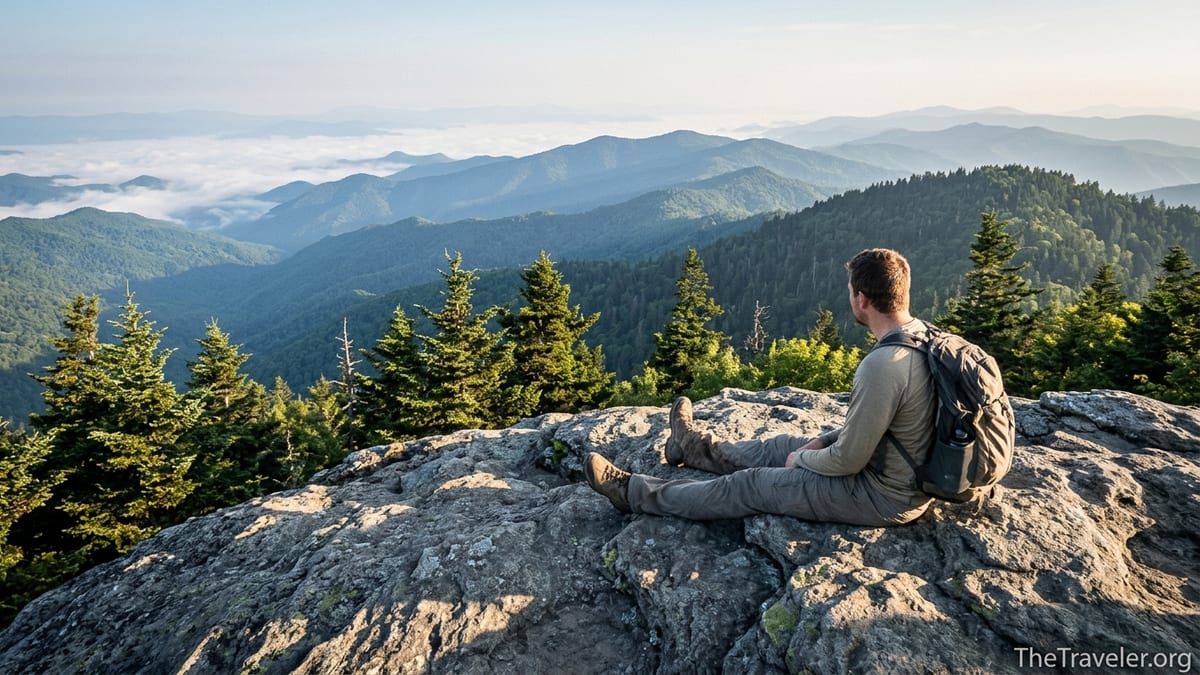
By the time I reached the weathered porch of LeConte Lodge, my legs were trembling so hard I had to brace against the railing. Sweat had dried to salt on my pack straps, my water bottles were down to the last sips, and every muscle from my calves to my lower back seemed to throb in unison. Yet as I looked out over the hazy folds of the Great Smoky Mountains, with layers of blue ridges fading into the distance, the hours of climbing to the 6,593 foot summit of Mount Le Conte felt not just justified but essential. The exhaustion was part of the story, and the views at the top were the perfect final chapter.
Get the latest updates straight to your inbox!
Meeting Mount Le Conte for the First Time
Mount Le Conte dominates the northern side of Great Smoky Mountains National Park, rising more than a mile from the valley floor near Gatlinburg to its 6,593 foot summit. Unlike many postcard peaks out West, you do not simply drive to a high pass and stroll the last mile. Reaching the top of Le Conte is a commitment. The shortest and most popular route, the Alum Cave Trail, covers roughly 10 to 11 miles round trip with around 2,700 to 3,000 feet of elevation gain, depending on how far across the summit ridge you wander.
Before I ever set foot on the trail, I had read about the mountain’s five routes: Alum Cave, The Boulevard, Trillium Gap, Rainbow Falls, and Bullhead. Each has its own character. Boulevard is airy and exposed along a ridgeline. Trillium Gap passes Grotto Falls, where you can walk behind a curtain of water. Rainbow Falls and Bullhead climb from the Cherokee Orchard side through long, sustained grades. Alum Cave, though, promised a little of everything: creekside walking, stone staircases, narrow ledges with cables, and big views from cliff tops. It was also the route that locals in Gatlinburg most often recommended when I asked in gear shops what single all day hike I should do.
That chorus of advice was echoed at the Sugarlands Visitor Center, where a ranger circled the Alum Cave trailhead on a map and warned me about crowds and the new parking tag system for the park. She reminded me that a tag is required if you plan to leave your car longer than 15 minutes, and that on busy days in summer and October the two large lots on Newfound Gap Road often fill by mid morning. If I wanted a guaranteed space, she said, I needed to think in terms of sunrise, not brunch.
Standing there in the visitor center, gazing at a relief map with Mount Le Conte rising steeply above Gatlinburg, the numbers finally sank in. I was not just popping out for a casual leg stretcher. I was planning a sustained mountain climb that would dominate the better part of a day. I left with a parking tag in my wallet and a new respect for the peak that would later leave me staggering with fatigue and joy in equal measure.
The Early Start: Headlamps, Empty Lots, and Cool Air
The alarm on my phone erupted at 4:30 a.m. in a cheap motel on the Parkway. Outside, Gatlinburg’s neon had gone mostly dark and the streets were quiet. By the time I boiled water for instant oats in the room’s tiny coffee maker and stuffed a pair of cheese and turkey wraps into my pack, it was just past five. I drove Newfound Gap Road by headlight, the curves familiar from daytime drives but entirely different in the dark, and pulled into the Alum Cave parking area a little before 6 a.m.
At that hour, the lower lot still had plenty of room. By contrast, hikers who roll in at 8:30 on a sunny Saturday in October often find cars lining the roadside and rangers writing tickets, since parking outside the designated lots is no longer allowed. An early start is not just about beating afternoon thunderstorms or leaving time for photos; it is increasingly the difference between beginning your hike with calm or frustration.
I clipped my parking tag to the dashboard, cinched my pack, and stepped onto the trail under a faint gray sky. The first mile or so follows Alum Cave Creek, an easy, mostly gentle path where wooden bridges cross the water and the forest feels close and damp. For that brief stretch, I could pretend I was on a pleasant morning walk instead of committing to several thousand vertical feet of climbing.
That illusion faded as the light strengthened. The trail soon tilted upward, trading soft creekside dirt for rockier footing, and my breathing quickened in the cool air. Somewhere above me, the cliffs of Alum Cave Bluffs and the distant ramps to Mount Le Conte’s summit waited, but in those first miles I could only hear the sound of the creek and the thump of my own heart.
Through Arch Rock and Up to Alum Cave Bluffs
Arch Rock is the first landmark that signals you are leaving the warm up portion of the hike behind. About 1.4 miles in, the trail passes through a natural stone arch carved by erosion. A staircase of wet, worn rock steps winds up inside, and a metal cable bolted to the wall provides a reassuring handhold. In spring, water sometimes seeps over the stones, turning the steps slick. I found myself planting my boots deliberately, grateful for grippy soles and trekking poles that could double as extra points of contact.
Many first time Smokies visitors assume this must be the famous Alum Cave, but the namesake feature still lies ahead. Past Arch Rock, the trail grows steeper. The forest begins to thin, and occasional openings in the trees hint at the larger views to come. The climb toward Inspiration Point, around 2 miles from the trailhead, introduced my calves to the effort they would sustain for several hours. Short switchbacks and rocky scrambles forced me to settle into a steady rhythm: forty steps, pause to breathe, forty more.
By the time the trail broke onto the shoulder of the ridge near Inspiration Point, the payoff arrived in earnest. Here the Smokies earn their name, with layer upon layer of ridges receding into blue haze. On some mornings you can see low clouds filling the valleys like a white sea. On my climb, thin bands of fog were still burning off, leaving a patchwork of sunlight and shadow across the hills. Even at this halfway point, hikers around me were already declaring the views worth the effort and turning back.
I pressed on another few tenths of a mile to Alum Cave Bluffs, arriving around 8 a.m. This is where the crowds concentrate. The “cave” is really a massive overhanging cliff, nearly 80 feet high, curving inward like the mouth of a wave frozen in stone. Hikers leaned against packs, taking long pulls from water bottles and sharing snacks on the flat, sandy floor. On a busy day, it can feel like a small outdoor amphitheater. A family from Kentucky told me they had driven down for a single long weekend and chosen this hike because guidebooks called it the most scenic in the park. For them, the bluffs were a climax. For me, they were a mid hike intermission before the real work began.
The Hardest Miles: Narrow Ledges and Steady Climbing
Above Alum Cave Bluffs, the character of the trail changes dramatically. The grade steepens and the path narrows, clinging to the mountainside as it winds toward the higher shoulders of Le Conte. In places, the park service has installed metal cables along exposed sections, and while the drop offs are not sheer cliffs, a slip on wet or icy days could have serious consequences. More than once, I watched hikers who appeared comfortable below the bluffs turn anxious here, moving slowly or turning back.
In cold months, this is where microspikes or other light traction devices can be the difference between a safe, exhilarating ascent and a hazardous one. Locals I spoke with in Gatlinburg described early spring days when lingering ice in the shaded switchbacks above Alum Cave sent unprepared visitors shuffling and sliding. In summer, the issue is less ice and more humidity and heat, especially later in the day. Either way, these upper miles demand respect.
As I climbed higher, the forest shifted from mixed hardwoods to fragrant spruce and fir. The air felt thinner, cooler, and more resin scented, a reminder that Mount Le Conte’s summit ridge sits at an elevation comparable to some of the highest points along the Blue Ridge Parkway. The trail ducked in and out of short, root filled corridors and then back to airy ledges with views down into deep green valleys and across to neighboring peaks like Mount Kephart and the central Smokies crest.
Fatigue became a constant companion. The watch on my wrist told me I had gained nearly 2,000 vertical feet since leaving the trailhead, but numbers mattered less than sensation. My quads burned as I stepped up stone risers. My shoulders ached from the pack straps. I began to break the climb into tiny psychological goals: make it to the next bend; reach the next stand of fir trees; chase that patch of sunlight across the trail. Somewhere above, other hikers were already sitting on the lodge porch, sipping coffee or lemonade sold in simple paper cups. That image, as much as the promise of summit views, kept me moving.
LeConte Lodge and the Summit Ridges
One of Mount Le Conte’s most distinctive features is LeConte Lodge, a rustic backcountry lodge perched just below the summit area. It operates with advance reservations and pack llamas that haul in supplies several times a week along the Trillium Gap Trail. Reaching the cluster of gray shingled cabins after hours of climbing feels almost surreal. I rounded a final bend and suddenly found myself walking past split rail fences and rock paths leading to porches lined with rocking chairs.
While I was only visiting for the day, the lodge still served as a psychological finish line. A signboard listed the day’s dinner menu and weather notes. Another board recorded the number of days the current caretaker had spent on the mountain. Inside the main office, day hikers queued patiently to buy snacks, lemonade, or a simple bagged lunch, often priced comparably to a casual cafe in Gatlinburg but tasting infinitely better simply because every item had been hauled up by foot.
I dropped my pack on the edge of the porch, along with a half dozen other hikers who were melting into the wooden benches. My legs buzzed with fatigue and a kind of lightheaded euphoria that only appears after long effort. When I finally stood again, the short walk to the nearby viewpoints at Cliff Tops and Myrtle Point felt almost leisurely. In reality, they still required a bit of up and down over rocks and roots, but after the sustained climb, the distance no longer intimidated.
Cliff Tops delivered the first true sense of why so many people call this one of the best views in the eastern United States. The overlook faces generally west, with a patchwork of rounded ridges and deep valleys spilling away toward Tennessee. On clear afternoons in summer and fall, you can sometimes see storm cells marching across distant hills while you sit in sunlight. Myrtle Point, reached by another spur trail across the ridge, offers a more open, 270 degree panorama and a famous sunrise vantage. Even during daylight hours, standing there made the long plod through the forest feel momentary, like a short prelude to the expansive present.
When Exhaustion Becomes Part of the Reward
Sitting on the edge of Cliff Tops with my back against a warm rock, I felt my body registering every step of the climb. My knees throbbed dully. My feet, normally fine in well broken in boots, ached at the heels and toes. A thin crust of sweat salt coated my sun shirt. Careful rationing had left me with just enough water for the descent. Under different circumstances, the same amount of discomfort might have felt like a problem. Up here, it felt like proof.
Travelers often talk about “earning” their views. On Mount Le Conte, that phrase is more than a cliché. The mountain guards its vistas behind several hours of consistent, sometimes strenuous climbing, and there is no cable car or scenic drive to shortcut the effort. When I looked around at the mix of solo hikers, couples, and multigenerational families scattered across the rocks, I could see the same combination of weariness and contentment. A grandmother from Ohio rubbed her knees and laughed as she admitted this was likely her first and last time up. A college student in a faded university hoodie lay flat on his back, arms spread, swearing that the Pepsi he bought at the lodge was the best drink of his life.
That shared exhaustion creates a kind of community. Strangers check in on one another, swapping details about where they started, how early they arrived, and which route they took. Some had climbed via the Boulevard Trail from Newfound Gap, adding extra distance and a more rollercoaster elevation profile. Others had come from the Trillium Gap side after stopping at Grotto Falls, accepting a longer but slightly less steep ascent. Despite different paths, everyone had spent the better part of a day moving uphill. The views, with their far horizons and shifting light, felt like a communal reward.
When people ask later whether Mount Le Conte was “worth it,” my answer always circles back to those minutes on the summit ridge. It was not just what I saw, although the Smokies were at their finest that day, but how I felt seeing it: emptied out in the best possible way, as if the climb had wrung out all my restless energy and left only a quiet sense of presence. The fatigue did not detract from the experience. It deepened it.
Planning Your Own Ascent: Practical Tips from the Trail
For travelers considering their own attempt on Mount Le Conte, a bit of planning can turn a grueling ordeal into a challenging but deeply satisfying day. The first element is timing. In peak months, especially June through October and during holiday weeks, aim to be pulling into the Alum Cave trailhead before 7 a.m. Weekdays are generally calmer than Saturdays, and shoulder seasons like late April or early November can offer cooler temperatures and fewer people, though trail conditions may be muddier or icier.
Gear matters, but it does not have to be complicated. Sturdy, broken in hiking shoes or boots with good traction are more important than any specific brand. Trekking poles can take stress off knees on both the ascent and descent, which becomes noticeable on a route that often takes 6 to 9 hours round trip for most reasonably fit hikers. Layered clothing is wise, because temperatures at the summit can be 10 to 20 degrees Fahrenheit cooler than down in Gatlinburg, and brisk wind across the ridges can chill sweat soaked shirts quickly.
Food and water planning can feel abstract until you are three hours into the climb and suddenly ravenous. As a rule of thumb, many hikers carry at least 2 to 3 liters of water per person for a summertime day hike to Le Conte via Alum Cave, along with calorie dense snacks like trail mix, jerky, nut butter sandwiches, and simple candy bars. While LeConte Lodge sells basic drinks and snacks in season, it is not a full service restaurant for day hikers, and relying on the lodge alone can leave you short if you underestimate your needs or arrive after closing hours.
Finally, be honest about fitness. Even travelers who exercise regularly at sea level may find continuous uphill walking at elevation more demanding than expected. Before my climb, I had spent several weeks taking long weekend walks with a weighted daypack, seeking out local hills and staircases. That modest preparation paid off when the steady grades above Alum Cave bluffs arrived. If your only regular movement is short urban strolls, consider starting with a shorter Smokies classic like Chimney Tops or the out and back hike just to Alum Cave Bluffs before committing to the full summit.
Respecting a Crowded but Fragile Mountain
Great Smoky Mountains National Park is the most visited national park in the United States, and the Alum Cave Trail to Mount Le Conte is one of its marquee hikes. That combination brings intense pressure to a relatively narrow corridor of forest and rock. On my descent, I passed long strings of hikers still heading up, some careful to stay on the main tread, others cutting switchbacks or stepping into fragile vegetation to pass.
The park service has responded in recent years with trail rehabilitation projects on several key routes, including Alum Cave and neighboring Bullhead and Rainbow Falls, to repair erosion and improve safety. As visitors, our part is simple but critical: stay on the constructed trail, avoid trampling mossy banks or sensitive plants, pack out every bit of trash, and resist the temptation to carve initials into rocks or trees. Small individual decisions add up quickly when thousands of people repeat them every week.
Wildlife encounters can also shape the experience. Black bears live throughout the Smokies, and while sightings on the Alum Cave Trail are not guaranteed, they are possible, especially in early morning or evening. Hiking in small groups, making noise on blind corners, storing food securely in your pack, and keeping a safe distance if you do spot a bear all help prevent habituation and protect both animals and people. More common than bears are smaller creatures: red squirrels chattering from branches, juncos flitting across the path, and occasional salamanders in damp seeps near the trail.
Even logistical details have environmental implications. Carpooling from Gatlinburg trailhead shuttles or cabin rentals out along the Parkway reduces parking lot strain and roadside congestion. Investing in a reusable water bottle instead of single use plastic means less risk of discarded bottles along the trail. Choosing lodging and restaurants in town that support conservation or local trail organizations extends your impact beyond a single day’s hike.
The Takeaway
When I finally reached my car again in the late afternoon, the Alum Cave parking lot looked entirely different from the quiet scene that greeted me at dawn. Cars circled slowly, hoping for spots. Day hikers returned dusty and sunburned. A few people leaned against their bumpers stretching tight calves, and more than one had that dazed, satisfied expression I recognized from my own reflection in the rearview mirror.
Mount Le Conte is not a casual stroll. It is a full day mountain ascent that will test your legs, lungs, and determination. Yet that is precisely what makes the experience so enduring. The memory of the climb lives not just in photographs from Cliff Tops or Myrtle Point, but in the ache of tired muscles, the taste of a simple sandwich eaten on a rock, and the quiet sense of accomplishment that settles in as you descend through changing forests and hear the creek again near the trailhead.
If you travel to the Great Smoky Mountains looking for a single hike that captures the park’s essence, the ascent of Mount Le Conte via Alum Cave should be near the top of your list. Arrive early, pack thoughtfully, respect the trail, and accept that by the time you reach the summit your body will feel every step. When you finally stand on that high ridge with ridgelines fading away into blue distance, you may find, as I did, that the exhaustion is not a drawback but a vital part of why the views feel so completely, unmistakably worth it.
FAQ
Q1. How long does it take to hike Mount Le Conte via Alum Cave Trail?
Most reasonably fit hikers spend about 6 to 9 hours round trip, including breaks, to hike from the Alum Cave trailhead to the summit area and back.
Q2. How difficult is the hike to Mount Le Conte?
The hike is considered strenuous due to its 10 to 11 mile round trip distance and roughly 2,700 to 3,000 feet of elevation gain, along with some steep, rocky, and narrow sections.
Q3. Do I need a parking tag for the Alum Cave trailhead?
Yes. Great Smoky Mountains National Park requires a paid parking tag for vehicles parked longer than 15 minutes, including at the Alum Cave lots.
Q4. What is the best time of year to hike Mount Le Conte?
Late spring through fall is most popular for clearer trails and longer daylight, but shoulder seasons can be cooler and less crowded, with a higher chance of ice or mud.
Q5. Are there restrooms or water sources along the trail?
There are restrooms at the trailhead and at LeConte Lodge in season, but no treated water taps on the trail itself, so you should carry all drinking water you need.
Q6. Can I do Mount Le Conte as a first big hike?
It is possible for determined beginners with good basic fitness, but training hikes on shorter, steep trails and honest pacing are strongly recommended beforehand.
Q7. Is the trail suitable for children?
Older, experienced kids sometimes complete the hike, but the distance, elevation gain, and narrow ledges mean it is best reserved for families used to long mountain days.
Q8. Do I need special gear like trekking poles or microspikes?
Trekking poles help most hikers, especially on the descent, and light traction such as microspikes is very useful in winter or early spring when icy patches linger.
Q9. Can I stay overnight at LeConte Lodge without hiking?
No. LeConte Lodge is only reachable by trail, and overnight stays require advance reservations plus the willingness to hike one of the mountain’s routes.
Q10. What happens if the parking lot is full when I arrive?
If the lots are full, you will need to wait for a space or choose another trail; roadside parking near Alum Cave is restricted, and tickets are common for illegal parking.