


More news on this day
Rail passengers face severe disruption after an emergency incident blocked key lines, forcing train operators to halt services, divert traffic and warn travelers of significant delays.
Get the latest news straight to your inbox!
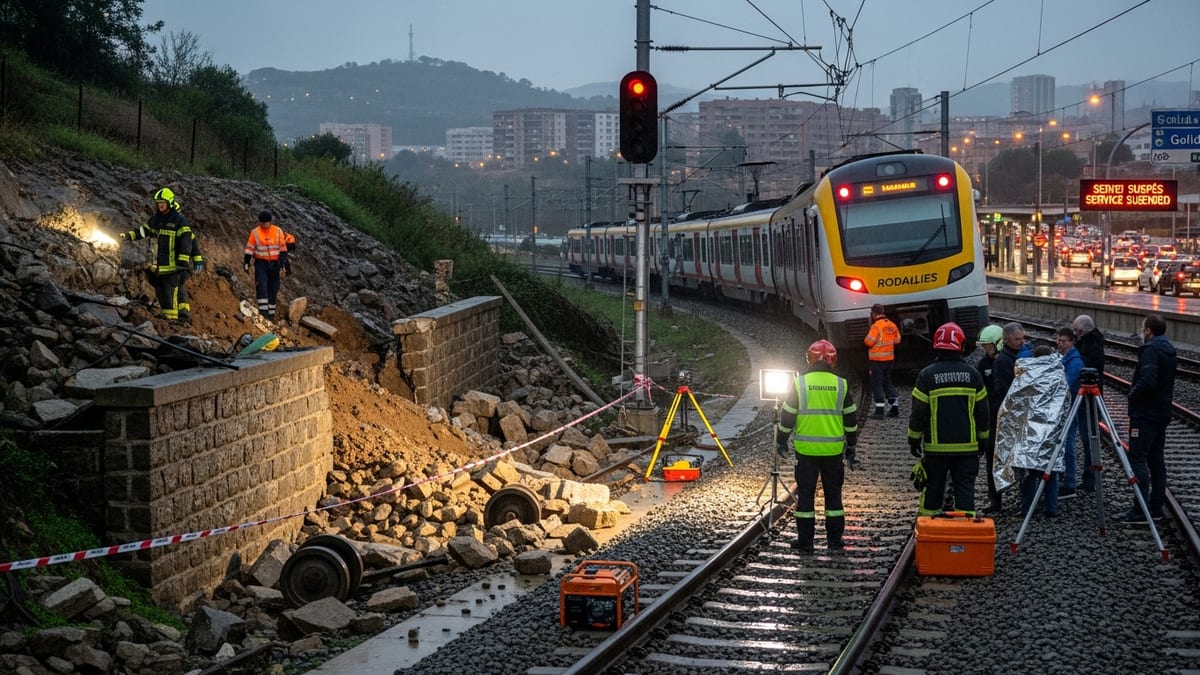
Emergency response blocks rail corridor
Initial reports indicate that an incident requiring emergency services has brought a busy section of track to a standstill, stopping trains in both directions and triggering a cascade of delays across the wider network. Services were held outside affected stations as crews attended the scene, with several trains reported to be at a standstill for extended periods while the line remained blocked.
According to published coverage and passenger updates, trains were ordered to make emergency stops as the incident unfolded, with rail traffic halted until responders could safely access the area and assess the situation. Operators described the disruption as significant, with no immediate forecast for a full return to normal running during the early stages of the response.
Information made available through journey planners and social media showed rolling updates through the day, as some services were cancelled outright while others were turned back short of their destinations or rerouted via alternative lines. Passengers approaching the affected corridor were repeatedly advised to reconsider nonessential travel or seek different modes of transport where possible.
While some lines began to reopen on a limited basis once the incident was brought under control, strict speed restrictions remained in place. This precaution meant that even after trains started moving again, knock-on delays continued to ripple across connecting routes and evening peak services.
Passengers face long waits, diversions and crowded stations
The line blockage quickly translated into long waits on platforms and on board halted trains, with some passengers reporting that they remained stationary for more than an hour as operators awaited clearance to move. Crowding developed at major interchange hubs as travelers tried to replan journeys on the move, forming long queues for replacement buses and taxi ranks.
Publicly available passenger accounts from affected trains described confusion as departure boards shifted rapidly between delayed, cancelled and revised services. In several cases, services were turned back mid-journey, depositing travelers at intermediate stations where onward options were limited, compounding the difficulty for those attempting to reach regional destinations.
At busy suburban nodes, local images and eyewitness descriptions highlighted congested concourses and station entrances as rail staff attempted to manage queues and direct passengers toward working platforms or bus stops. Reports indicated that some travelers chose to abandon rail altogether and seek road-based options, which in turn added pressure to surrounding road networks.
For visitors unfamiliar with the area, the shortage of clear alternatives created particular challenges. With rail replacement services taking time to be organized and road traffic heavy, many faced extended travel times and missed connections to onward long-distance trains and flights.
Rail operators activate contingency plans
Rail operators responded by activating disruption timetables and contingency plans designed for emergency incidents. Public information shows that priority was given to clearing trains already in the affected section and protecting safety at the incident site, while control centers worked to re-sequence services on parallel routes.
In some cases, operators requested additional staff to manage passenger flows at key stations, while control teams adjusted stopping patterns to relieve pressure at the worst-affected points on the network. Regional and intercity services were thinned out to create space for critical movements, with some trains running non-stop through minor stations to recover time.
Replacement road transport was introduced where practical, although reports suggest that sourcing sufficient buses at short notice remained challenging during the peak period. Where rail replacement could not be arranged immediately, passengers were advised to delay travel or postpone nonessential trips until later in the evening or the following day.
Travel advisories recommended that passengers check live journey planners before setting out, allow additional time for transfers and be prepared for revised routes or last-minute platform changes. Operators also reminded ticket holders that, under standard disruption policies, tickets would generally be accepted on later services if planned trains were cancelled or heavily delayed.
Wider impact on network resilience
The incident has once again highlighted how a single blocked section of line can disrupt rail travel well beyond the immediate area. Studies on rail operations note that when a main corridor is closed by an emergency, both passenger and freight services face complex rescheduling, with congestion spreading to alternative routes as operators attempt to reroute traffic.
Recent research into rail disruption and recovery points to the long tail of such events, with irregular train movements and altered stopping patterns continuing to affect journey times even after lines are declared open. In practice, this means that passengers may experience residual delays for several hours as operators work through backlogs and reposition trains and crews.
Urban and regional transport planners increasingly advocate for more flexible contingency strategies, including dynamic passenger information, pre-planned diversion routes and closer coordination with bus, metro and light-rail providers. The goal is to reduce the time it takes to offer viable alternatives when a corridor is suddenly blocked by an emergency incident.
The latest disruption also underscores calls from passenger groups for clearer communication during major incidents. Analysts argue that timely, accurate information on expected disruption duration and alternative options can significantly reduce stress for travelers caught up in unforeseen events.
What travelers should do if lines are blocked
For travelers planning journeys while the disruption continues, publicly available guidance suggests checking live information from operators before leaving home, particularly for evening or early morning services that may still be affected by earlier cancellations. Where possible, passengers are advised to build in extra time for connections and consider whether essential appointments can be rescheduled.
Experts in transport resilience recommend that regular rail users familiarize themselves with at least one alternative route and a non-rail contingency, such as a bus or coach corridor, in case a primary line is blocked without warning. Keeping a flexible ticket or mobile ticketing option can sometimes make it easier to switch routes quickly.
Passengers already en route are encouraged, according to travel advisories, to stay attentive to platform announcements and station displays, which often carry more detailed local information than high-level journey planners. In some cases, staying on a delayed through service may be faster than attempting a complex multi-stop diversion during a period of network-wide disruption.
As incident recovery progresses, operators typically move from an emergency footing to a stabilization phase, in which temporary timetables are published and services settle into a more predictable pattern. For now, travelers in the affected region are being urged to monitor updates closely and prepare for extended journey times while the blocked lines are gradually brought back into full operation.