


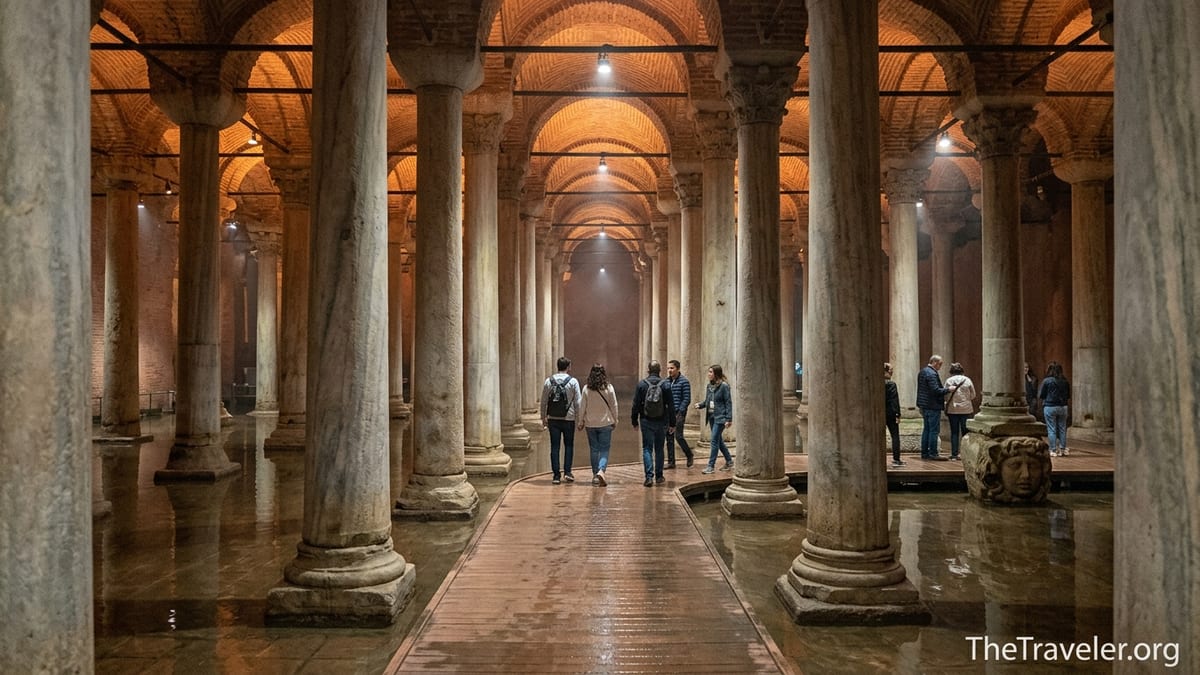
The Basilica Cistern in Istanbul is one of the city’s most atmospheric sights: a cool, echoing forest of marble columns beneath the streets of Sultanahmet. It is also one of the most mismanaged experiences in many travelers’ itineraries, thanks to confusing ticket options, long lines, and behavior that can quickly spoil the mood for everyone. Knowing what not to do before you descend the stairs can save you money, frustration, and embarrassment.
Get the latest updates straight to your inbox!
Don’t Assume It’s Included in Your Museum Pass
A common mistake is assuming the Basilica Cistern is covered by Turkey’s national Museum Pass. It is not. The cistern is operated by the Istanbul Metropolitan Municipality rather than the Ministry of Culture, so even the most expensive national passes will not get you through the turnstiles here. Travelers routinely discover this only after queuing at the entrance, when staff explain that separate tickets are required. If you are budgeting your day around “free” entries with a Museum Pass, leave room for this extra cost.
In 2026, a standard daytime ticket for the Basilica Cistern is around 1,000 Turkish lira, with special evening “night shift” sessions typically priced higher. That is a significant outlay, especially for families, so it is worth planning for in advance instead of being caught off guard at the ticket window. Visitors who arrive from Topkapi Palace or the Istanbul Archaeology Museums, where the Museum Pass does work, sometimes arrive irritated when they learn that the system is different just a few streets away.
Do not build an itinerary that depends on the cistern being a quick, free add-on. Treat it as a standalone paid highlight, alongside Hagia Sophia’s paid upper gallery and Topkapi’s Harem section, and you will be less likely to make rushed decisions or skip it in frustration once you reach the door.
If your budget is tight, remember you have alternatives. Smaller cisterns such as Binbirdirek in Sultanahmet are usually cheaper and quieter. They are not substitutes for the grandeur of the Basilica Cistern, but they give you a taste of Istanbul’s underground waterworks without the same ticket shock.
Don’t Trust Every “Official” Ticket Website or Street Seller
The digital landscape around the Basilica Cistern is confusing. When you search online, you will find dozens of slick, English-language sites that look official, but only one bare-bones platform is actually linked to the municipality. Others are private resellers bundling admission with audio guides, transfers, or generic “skip the line” promises. These can be useful, but none of them are the same as buying directly from the authorized ticket channels.
Travelers report paying well above the on-site rate through third-party sites that appear at the top of search results, only to discover that their expensive “VIP” voucher does not bypass security checks and sometimes still requires them to stand in a secondary queue for a staff member to convert the voucher into a physical ticket. In extreme cases, visitors have turned up with QR codes from obscure agencies that staff at the door will not accept, forcing them to pay again on the spot.
Outside the entrance, you may encounter freelance touts and unlicensed guides offering “special access” or claiming that the cistern is sold out unless you book with them. This is rarely true. While pre-booking skip-the-line tickets from reputable platforms can help on busy cruise-ship days, there is almost always some form of same-day entry available at the official ticket counters or through recognized providers that clearly list current prices and what is included.
Avoid paying anyone in cash on the street for a promise of later entry, and be wary of tourist information kiosks that do not clearly state their affiliation. If you want to use a reseller, stick to well-known international booking brands or long-established Istanbul operators, and always check that your ticket explicitly states whether it skips the ticket purchase line, the security line, or neither. Read recent reviews that mention the year 2025 or 2026 to confirm that the process still works as advertised.
Don’t Show Up at the Worst Time of Day Without a Plan
The Basilica Cistern is open daily, with last entry times adjusted seasonally and for occasional events or maintenance. The broad pattern is stable, though: late morning to mid-afternoon, especially between roughly 11:00 and 15:00 in peak season, is when lines are longest and the interior is most crowded. On days when large cruise ships are in port, the queue can snake out into the square, leaving independent travelers standing in the sun for 30 to 45 minutes or more before they even reach security.
One mistake is assuming that a slightly higher ticket price for the evening “night shift” sessions is an unnecessary splurge. In reality, many travelers find that the extra cost is worth it. Evening sessions, which typically run from around 19:30 to 22:00, tend to be quieter and more atmospheric, with moodier lighting that enhances the reflections on the shallow water. Photographers and anyone sensitive to crowds often leave far happier after a later visit than after a midday crush.
At the opposite extreme, some visitors wander down after a long day of sightseeing, only to arrive minutes before last entry, then rush through in twenty minutes so staff can lock up. You may technically tick the cistern off your list, but you will miss its slow, echoing charm. Aim for at least 45 to 60 minutes inside, whether you are on an audio guide or simply strolling among the columns.
To avoid disappointment, check same-day information locally. Recent disputes between national and municipal authorities have led to short-notice closures and temporary ticketing changes. Hotel concierges in Sultanahmet, official tourism offices, or the staff at nearby attractions such as the Hagia Sophia History Museum are often aware of same-week disruptions. Do not rely solely on a generic search result or a months-old blog post to assume the cistern is open exactly as you saw described online.
Don’t Rush the Details or Treat It Like Just Another Photo Stop
Many visitors descend the staircase, snap a few quick photos of the famous Medusa heads, and leave again within twenty minutes. That approach misses much of what makes the Basilica Cistern special. It is not simply a backdrop you breeze through between more glamorous landmarks. The columns, lighting, and subtle soundscape all tell a quiet story about how a city of millions once stored and moved its most important resource: water.
Instead of racing directly to the far western corner for the Medusa bases, slow down as you enter. Notice how some columns are fluted while others are plain, or how a few bear carved patterns such as the so-called “Crying Column” with its teardrop motifs. These were reused from older structures across the city and represent centuries of architectural recycling long before sustainability became a modern buzzword.
An audio guide or a short guided tour can help you make sense of what you are seeing. Prices vary, but many reputable operators sell combined “fast-track plus audio guide” packages at roughly the same rate as buying an entry ticket and renting an audio device separately. These often include downloadable app-based guides in multiple languages, allowing you to linger at stops that interest you rather than shuffling along with a large group.
Do not spend your entire visit with your phone held up in front of your face. The lighting here is low and warm, so many quick snapshots end up blurry, and you will leave with twenty nearly identical images of dim columns. Take a few composed shots, then slip your device into a pocket and simply walk. Listen to the subdued music and the quiet splash of the shallow water and carp. The experience is memorable precisely because it is slow and almost theatrical; give it enough time to work on you.
Don’t Ignore Photography Rules, Trip Hazards, or Preservation Signs
Although photography is generally allowed in the Basilica Cistern, there are clear limits that officials take increasingly seriously. Tripods, large stabilizers, and professional lighting rigs are typically prohibited during standard visitor hours, in part because they become dangerous obstacles on the slightly damp walkways. Using flash constantly is frowned upon and can earn you a sharp word from guards, especially near crowded bottlenecks such as the Medusa heads where startled visitors may step sideways into others.
Visitors have been asked to leave or delete images after crossing boundaries into off-limits areas or climbing onto barriers for a better angle. The walkways and platforms are there not just to keep your feet dry but to protect the 1,500-year-old fabric of the site. Leaning against fragile columns, resting camera gear on ancient bases, or letting children sit on balustrades may look harmless in a single snapshot, but multiplied by thousands of visitors each day it speeds up visible wear.
The stone steps at the entrance can be particularly slippery on rainy days, when people arrive with wet shoes from the street. Inside, the wooden and stone walkways sometimes have damp patches where condensation has collected. Do not rush, and do not walk while fiddling with a camera lens or phone settings. Take a moment at the bottom of the stairs to let your eyes adjust to the half-light, then proceed slowly, especially if you have limited mobility or are visiting with small children or older relatives.
Footwear matters more here than many travelers realize. Thin leather soles or fashion sneakers with little grip can turn the polished surfaces into a skating rink. Choose shoes with at least moderate traction for your Sultanahmet day, whether you are stepping into the cistern or climbing the slopes to Süleymaniye Mosque. You will not just be safer; you will feel more relaxed and able to focus on the columns instead of staring nervously at your feet.
Don’t Forget How Dark, Busy, and Echoing It Can Be
From the outside, the Basilica Cistern looks like a modest building at street level. Inside, it can be a sensory shock, especially for children, older visitors, or anyone prone to anxiety in low-light or crowded spaces. The lighting design leans toward theatrical spotlights, pools of shadow, and glowing reflections. Add in the echo of footsteps and voices, plus occasional live music or art installations, and you have an environment that can feel disorienting if you are not prepared.
If you or someone in your group struggles with claustrophobia, do not assume that because the cistern is large, it will feel open. At peak periods, the narrow walkways between columns may involve slow shuffling behind tour groups, with very little personal space. Consider visiting early in the day or late in the evening, when the density of people is lower and you can step aside to catch your breath without blocking others.
Parents sometimes underestimate how children will react. Younger kids may start enthusiastic, then quickly become frightened by the darkness, the strange acoustics, and the slightly spooky stories that inevitably surround places like the Medusa heads. Bringing a small, non-distracting comfort item, such as a soft toy or familiar scarf, can help. Avoid handing a child an uncovered tablet or bright phone to keep them occupied, since the sudden glare can disrupt the mood for everyone around.
Noise is another factor. The best visits happen when people speak in low voices and allow the echo of water and distant music to dominate. Unfortunately, it only takes one loud group to raise the volume of the entire space as others respond. Do your part by keeping conversations quiet and brief, and choosing a calmer time of day when large tour parties are less likely to arrive all at once.
Don’t Be Disrespectful: This Is Heritage, Not a Theme Park
It is easy to forget, amid the selfie sticks and tour flags, that the Basilica Cistern is part of Istanbul’s UNESCO-listed historic core and protected under Turkish cultural heritage law. It was not built for entertainment, and its survival through centuries of earthquakes, invasions, and neglect is precarious. Treating it as little more than a dramatic backdrop for social media undermines both the experience and the ongoing conservation work that keeps it open.
Some of the most common missteps are also the easiest to avoid. Do not throw coins or other objects into the water in the hope of good luck. The carp and the filtration systems have to cope with whatever ends up there, and staff periodically remove foreign objects at real cost. Do not leave paper notes, stickers, or small offerings wedged into cracks in the masonry, as they stain and damage surfaces over time.
Public displays of affection that would barely be noticed in a nightclub feel out of place in an underground monument built in the 6th century. Local visitors, including families and older Istanbulites, often come here to appreciate a piece of their city’s history. Behaving as you would in a museum or historic mosque courtyard is a good benchmark: relaxed but respectful, camera-friendly but not exhibitionist.
Finally, remember that staff are there to enforce more than just ticket rules. If a guard asks you not to lean on a column, not to sit on a balustrade, or to move along from a crowded photo point, they are protecting both you and the monument. Arguing loudly or mocking the rules in front of other visitors creates a tense atmosphere in a space that should feel almost sacred. A cooperative attitude will make your visit smoother and more enjoyable.
The Takeaway
The Basilica Cistern rewards visitors who approach it with a blend of planning and humility. Do not assume it is included in your passes, or that any glossy website or street seller is official. Do not show up at the busiest hour without a sense of current prices, possible closures, and your own tolerance for crowds and low light. Instead, set aside a dedicated slot in your day, buy tickets through trusted channels, and give yourself enough time to walk slowly, listen, and look closely.
When you descend the stairs in comfortable shoes, camera ready but not overused, you will find a cool, shimmering world that feels a long way from the tram bells and carpet sellers of Sultanahmet. Treat the cistern not as a quick box to tick but as a fragile, living monument in a city that has always depended on what lies beneath its streets. With a little foresight and a lot of respect, your visit can be one of the most quietly powerful experiences of your time in Istanbul.
FAQ
Q1. Do I need to buy Basilica Cistern tickets in advance?
While it is usually possible to buy tickets on the day at the official counters, advance purchase from reputable providers can save you a long wait during peak season, weekends, and cruise-ship days. If you are visiting between April and October or have a tight schedule in Sultanahmet, pre-booking a timed entry or fast-track ticket is sensible.
Q2. Is the Basilica Cistern included in the Museum Pass or other city passes?
No. The Basilica Cistern is run by the Istanbul Metropolitan Municipality rather than the national Ministry of Culture, so the Museum Pass and most standard national cards do not cover it. Some private city passes may bundle cistern entry, but always check the fine print before assuming access is included.
Q3. What are the typical opening hours and the best time to visit?
The cistern is generally open daily with last entry in the early evening for standard tickets, plus separate, later “night shift” sessions on many days. Exact hours can vary for events or maintenance, so confirm shortly before your visit. Early morning, just after opening, or evening sessions tend to be quieter and more atmospheric than the midday rush.
Q4. Are there any current closures or access restrictions?
Occasional temporary closures have occurred due to restoration work or administrative disputes between authorities. Because these can be announced at short notice, it is wise to check locally once you arrive in Istanbul, either with your accommodation, an official tourism office, or staff at nearby attractions, instead of relying solely on older online information.
Q5. Is photography allowed inside the Basilica Cistern?
Yes, personal photography is generally allowed, but tripods, large stabilizers, and professional lighting equipment are typically forbidden during regular hours. Flash is discouraged, and you must not cross barriers, climb on structures, or block walkways for extended photo sessions. Always follow staff instructions if they ask you to move along from busy viewpoints.
Q6. How long should I plan for a visit?
Most visitors spend around 45 minutes to an hour inside the cistern. This allows time to adjust to the light, walk the main routes at a relaxed pace, pause at features such as the Medusa heads and the Crying Column, and, if you have one, listen to an audio guide without rushing.
Q7. Is the Basilica Cistern suitable for children and older visitors?
Yes, but it is important to be prepared. The space is dark, echoing, and can be crowded, which some children find frightening and some older visitors find tiring. Stairs at the entrance and occasionally damp walkways require careful footing. Visiting at a quieter time of day and walking slowly can make the experience easier for everyone.
Q8. What should I wear and bring for a comfortable visit?
Wear comfortable shoes with decent grip, as stairs and walkways can be slick. Light layers are usually sufficient, since the cistern is cool but not cold. A small bag, a camera or phone with good low-light capability, and perhaps headphones for an audio guide are all you really need. Large backpacks, food, and drinks are best left at your accommodation.
Q9. Are guided tours or audio guides worth it?
For many travelers, yes. A short guided tour or a well-produced audio guide brings the history, engineering, and symbolism of the cistern to life in a way that simple wandering does not. Combined fast-track plus audio packages can be good value compared to buying entry and a separate guide product, especially if your time in Istanbul is limited.
Q10. What can I do if lines are very long or tickets are sold out?
If same-day lines are overwhelming, consider returning for an evening “night shift” session, when crowds are usually thinner, or shifting your visit to early morning. If tickets appear sold out online for a specific time, you may still find limited availability at the official counters or through reputable local operators, but avoid paying inflated prices to street touts promising last-minute access.