


For most travelers, the New Jersey Turnpike is not a destination. It is something you pass through on the way to somewhere else: New York or Philadelphia, New England or Florida, the suburbs or the Shore. Yet this 122-mile toll road has become one of the most famous highways in the United States, a concrete shortcut that shaped postwar America, redefined long-distance driving on the East Coast, and seeped into the nation’s pop culture imagination. To understand why, you have to see the Turnpike not just as a road, but as a story about speed, commerce, and the very modern idea of “getting there faster.”
Get the latest updates straight to your inbox!
A Superhighway Built at Record Speed
When the New Jersey Turnpike opened to traffic in November 1951, it was marketed as a “superroad” that could finally unravel the chronic traffic jams that strangled the Northeast Corridor. Construction of the mainline took roughly 22 months from 1950 to early 1952, an astonishing pace for a 118-mile, limited-access highway cutting through cities, marshes, and industrial corridors. For comparison, today a single urban interchange project can take that long from planning to ribbon-cutting. The New Jersey Turnpike Authority, created in 1948, was given wide latitude to design, build, and operate the toll road, and it used that power to fast‑track land acquisition, engineering, and construction.
The scale of the work was enormous. Contractors had to drive the highway through the industrial waterfronts of Elizabeth and Linden, across the Raritan River, and over twin bridges spanning the Passaic and Hackensack rivers in the north. A 1952 Life magazine photo essay showed convoys of bulldozers and concrete mixers pushing embankments through what had been marshland and factory backyards, underscoring how disruptive and ambitious the project was. In towns like Elizabeth, aerial photos from the early 1950s show blocks of homes and warehouses sliced in two by the new right-of-way, a visual reminder of the era’s faith in cars and highways as engines of progress.
By January 15, 1952, the Turnpike was carrying traffic from near the Delaware Memorial Bridge at the southern end of New Jersey up to Ridgefield Park in Bergen County, just short of the George Washington Bridge. Drivers could travel border to border across the state without a single traffic light. For truckers hauling goods between Baltimore, Philadelphia, and New York, that was revolutionary. A drive that might once have involved stop‑and‑go congestion along U.S. Route 130 or U.S. Route 1 could now be done in a fraction of the time, and toll receipts quickly proved that shippers were willing to pay for the privilege.
The opening itself reflected the public excitement. On November 30, 1951, New Jersey held a formal dedication ceremony even though the road was not yet complete from end to end. Dignitaries gathered near Woodbridge as state leaders heralded the Turnpike as a solution to both everyday traffic and the state’s broader economic ambitions. Within weeks, motorists were pulling onto the new concrete in everything from Studebakers to Buick Roadmasters, getting their first taste of what a true high-speed, controlled-access highway felt like long before the federal Interstate program existed.
The East Coast Freight Artery
From the beginning, the New Jersey Turnpike was engineered as a freight corridor as much as a passenger road. Unlike scenic parkways built earlier in the 20th century, it welcomed trucks and buses, and it aligned itself closely with existing industrial zones and ports. On a modern weekday, travelers driving between exits 10 and 15E pass a rolling gallery of intermodal rail yards, container depots, and warehouse roofs, with tractor‑trailers constantly streaming in and out of distribution centers in Carteret, Rahway, and Newark. This was by design: the Turnpike needed heavy truck traffic to support its toll-financed bonds, and it quickly became the preferred route for east coast logistics.
Traffic counts tell the story. While volumes fluctuate, sections of the Turnpike near Newark Liberty International Airport and the approach to the George Washington Bridge routinely rank among the most heavily traveled roadway segments in the United States, with daily counts in the hundreds of thousands of vehicles. You can feel that intensity on a Friday afternoon around exit 13A, as tractor‑trailers from national carriers and local drayage firms queue toward marine terminals and air‑cargo facilities, jockeying with New York-bound commuters and buses headed to the Port Authority Bus Terminal.
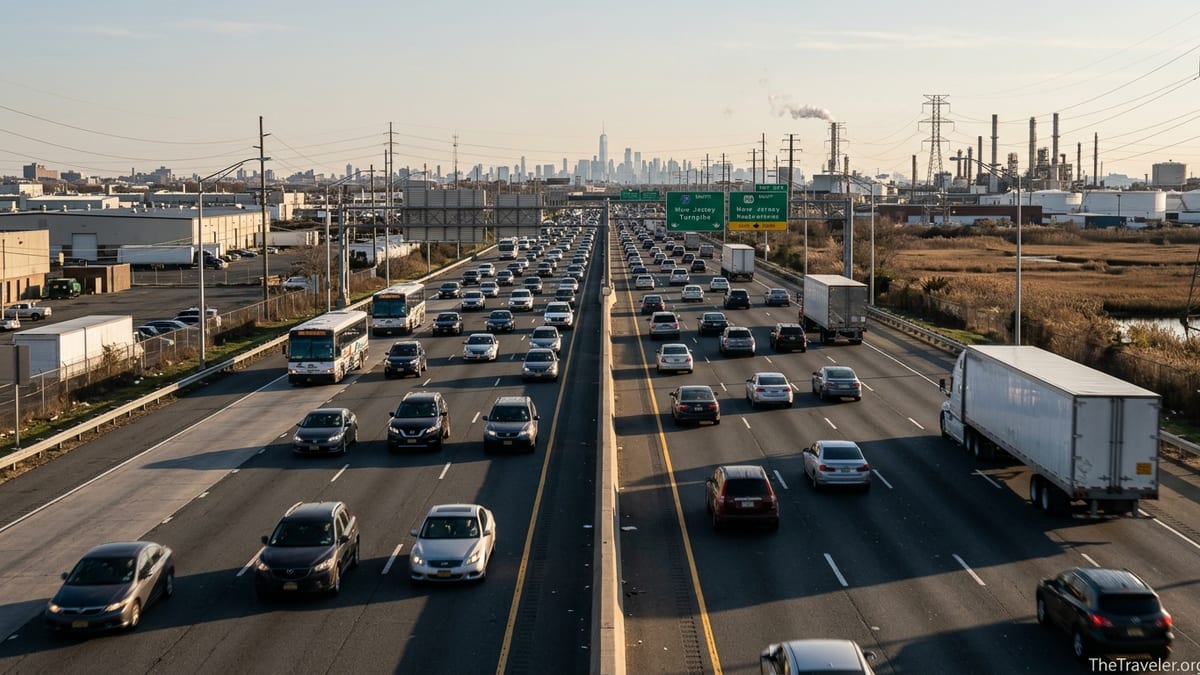
The Turnpike’s design evolved to handle this load. One of its most distinctive features is the "dual-dual" roadway system in its central section, introduced beginning in the mid-1960s. Here, separate inner and outer roadways divide cars and trucks, creating up to 14 lanes in some stretches between exits 6 and 14. A northbound driver might merge from the Pennsylvania Turnpike connector at exit 6, choose the car‑only inner roadway, and then later exit onto Interstate 78 for an eastbound run into Manhattan. A truck driver, by contrast, would typically take the truck‑permitted outer roadway, with wider lanes and more direct access to industrial interchanges.
That functionality has a direct everyday impact. A family leaving Maryland for a weekend in New England might log more than 40 of their trip’s most tension‑filled miles on the Turnpike between exits 1 and 14, plotting fuel stops and bathroom breaks around predictable congestion bottlenecks near the Delaware Memorial Bridge and the Newark Bay Extension. Long‑haul drivers schedule hours of service around overnight runs on the Turnpike, planning rest breaks at truck‑friendly service plazas and timing their passage through the New York metro region for late‑night windows when traffic thins, even if only slightly.
Gateway Between Major Cities and the Nation
The New Jersey Turnpike’s fame also stems from where it sits: between some of the most important cities in the United States. The road effectively stitched together the Northeast’s economic core years before Interstate 95 formally connected Miami to Maine. At its southern end, the Turnpike links directly to the Delaware Memorial Bridge, carrying motorists and freight into Delaware and onward toward Baltimore and Washington via I‑95. To the north, it funnels traffic toward the George Washington Bridge and the Lincoln Tunnel, placing New York City within a short drive for millions of people up and down the East Coast.
A typical long‑distance scenario illustrates its role. A motorist leaving Washington, DC, by mid-morning can reach the New Jersey Turnpike around lunchtime, after passing Baltimore and Wilmington on I‑95. From exit 1 near the Delaware Memorial Bridge, they can drive the length of New Jersey in about two hours in light traffic, emerging near the Hudson River crossings by late afternoon. That same route supports a constant flow of tour buses from Virginia and Pennsylvania bringing visitors into Midtown Manhattan for Broadway matinees, football fans headed to games at MetLife Stadium, and cruise passengers catching ships from Cape Liberty in Bayonne.
Closer to home, the Turnpike has become deeply woven into everyday commuting patterns. South Jersey residents near Bordentown or Florence might use the Turnpike to reach suburban office parks around exit 8A in Monroe Township, where warehouse and corporate campuses cluster near the highway. North Jersey commuters in places like Secaucus, Kearny, and Teaneck hop on for a few exits to reach job centers in Newark, Jersey City, or the Meadowlands. Add in airport traffic for Newark Liberty, accessible via exit 13A, and the Turnpike functions as the de facto front driveway of one of the nation’s busiest aviation hubs.
The highway’s connectors and spurs have extended its reach even further. The Newark Bay-Hudson County Extension guides drivers directly from the Turnpike to Jersey City and Bayonne, while the Pearl Harbor Memorial Turnpike Extension near exit 6 ties the mainline to the Pennsylvania Turnpike. When that link was fully integrated into Interstate 95 in 2018, it completed the last missing piece of I‑95’s continuous path along the East Coast, cementing the New Jersey Turnpike’s role as an indispensable segment in a continental corridor.
An Industrial Landscape That Became Iconic
Travelers remember the New Jersey Turnpike not for sweeping mountain vistas but for something more unusual: its unvarnished industrial scenery. Northbound drivers emerging from the toll plaza at exit 13 near Elizabeth encounter a panorama that has become instantly recognizable: oil refineries with flares flickering at dusk, tank farms, rail yards, and the steel skeleton of the Pulaski Skyway off to the east. The long viaducts over the Passaic and Hackensack rivers carry the roadway through a marshland punctuated by power lines, drawbridges, and distant Manhattan skyscrapers.
For many first-time visitors to the New York area, that scene is their introduction to the region, framed through a car window as they ride a bus from Newark Airport into Midtown or sit in the backseat of a rideshare. The smell of fuel, the orange glow of refinery fires at night, and the lattice of elevated ramps and overpasses can be jarring, especially for those expecting postcard views of the Manhattan skyline. Yet over time this landscape has become part of the Turnpike’s strange allure, symbolizing the gritty, working side of the metropolitan economy that tourists rarely see up close.
Photography has played a role in shaping that image. Vintage postcards and roadside guidebooks of the 1950s and 1960s rarely highlighted beaches or quaint towns along the Turnpike; instead, they often depicted aerial views of interchanges and bridges, celebrating the road’s engineering as a modern marvel. More recently, countless amateur photographers have posted sunrise shots of the Meadowlands taken from rest areas, with freight trains snaking below and the Manhattan skyline silhouetted beyond the marshes. These images reinforce the idea that the Turnpike is as much about infrastructure as it is about travel.
Even everyday experiences help fix the road in memory. Driving north on a rainy evening, wipers beating time, a traveler might crest the concrete viaduct before the Hackensack River and see a line of brake lights stretching toward the George Washington Bridge. To the right, the illuminated sign of a service area glows through the drizzle. To the left, an Amtrak train hurries along a parallel right-of-way toward Newark Penn Station. It is a uniquely Turnpike tableau: highway, rail, industry, and city all compressed into a narrow band of real estate.
Service Areas Named for New Jersey Legends
One of the quirks that helped make the New Jersey Turnpike famous is the way it names its service areas. Instead of generic titles, each plaza is dedicated to a notable New Jerseyan, turning routine fuel and bathroom stops into a rolling civics lesson. Northbound drivers encounter the Molly Pitcher Service Area in Cranbury, named for the Revolutionary War figure associated with the Battle of Monmouth, and the Joyce Kilmer Service Area, honoring the poet and soldier born in New Brunswick. Farther north, near the turnoff toward the George Washington Bridge, the Vince Lombardi Service Area pays tribute to the legendary football coach who grew up in Bergen County.
These service areas are more than signs on the highway. For many families, they function as familiar landmarks on long road trips. A family heading from Virginia to Boston might plan to stop at the Clara Barton Service Area around exit 5 to stretch their legs, then grab a late lunch at Molly Pitcher a little farther north. Inside, they will find a mix of national fast-food chains, coffee counters, and convenience stores selling everything from toll transponders and phone chargers to laminated road atlases and New Jersey Turnpike-branded T‑shirts.
For commercial drivers, the service areas are essential infrastructure. Many plazas offer dedicated truck parking where long-haul drivers can log federally mandated rest breaks, as well as separate diesel fueling lanes and simple showers. On a weekday night, it is common to see rows of tractor‑trailers idling outside Vince Lombardi, their drivers catching a few hours of sleep before attempting the morning push into the New York metro region. These scenes rarely make postcards, but they reveal how integral the Turnpike is to the daily rhythms of freight movement.
Over time, the service areas themselves have become characters in local lore. New Jersey residents will casually coordinate meetups “at Walt Whitman” or “at Joyce Kilmer” as if they were town centers. Travelers remember particular stops for small dramas: a flat tire discovered in the parking lot at Clara Barton, a sudden thunderstorm that forced families to dash from their cars into the restrooms at Alexander Hamilton, or the late-night coffee at Vince Lombardi that helped one more driver stay alert on the last leg home.
From Bruce Springsteen to The Sopranos: A Pop Culture Highway
The New Jersey Turnpike’s status as an American icon owes much to its appearances in music, television, and film. The road has been name‑checked or visually referenced in songs that defined entire eras of rock and folk. When Joni Mitchell sang about counting “the cars on the New Jersey Turnpike” in "Both Sides Now," she captured the monotony and wonder of watching headlights stream by on a long night drive. Bruce Springsteen, whose work is practically synonymous with New Jersey, evoked Turnpike landscapes in songs that depict young people racing along highways in search of something better beyond the refineries and factory towns.
On screen, the Turnpike achieved its most indelible moment in the opening credits of HBO’s "The Sopranos," which aired from 1999 to 2007. The sequence shows Tony Soprano driving from the Lincoln Tunnel through a succession of Turnpike interchanges and industrial views, the camera shifting between the New York skyline and the smokestacks and warehouses of North Jersey. For viewers across the country and abroad, that drive became the visual shorthand for New Jersey itself. Even today, travelers merging onto the Turnpike from the Lincoln Tunnel approach can recognize overpasses and sign gantries that echo the show’s intro.
The highway also appears, directly or indirectly, in films and video games that need a gritty East Coast backdrop. Scenes of car chases and late-night drives often use the Turnpike’s viaducts, toll plazas, or stacked interchanges as stand‑ins for the modern, industrial America of warehouses, container ports, and underpasses. In some open-world video games, fictionalized versions of the Turnpike carry players through dense urban-industrial corridors inspired by the real Newark–Jersey City–Hoboken landscape.
For travelers, this pop culture presence has tangible effects. A fan of "The Sopranos" visiting from Europe might insist on renting a car at Newark Airport and driving part of the Turnpike, just to see the skyline and industrial views they recognize from the opening sequence. Music fans queue Bruce Springsteen tracks or classic rock playlists as they drive north past the Meadowlands, transforming an otherwise utilitarian commute into an informal pilgrimage. In this way, the Turnpike is not just a road but a stage on which countless personal and fictional stories play out.
Toll Road Pioneer and Ongoing Workhorse
The New Jersey Turnpike was among the early modern toll roads in the United States, predating the creation of the Interstate Highway System in 1956. Its success demonstrated that user fees could finance large-scale infrastructure without direct federal funding, a model that influenced later toll roads across the country. From the start, drivers took paper tickets when entering and paid a distance-based toll when exiting, a system that allowed flexible pricing based on how far they traveled. Old tickets and toll cards from the 1950s and 1960s, some of which collectors still trade today, show how affordable the road once was; a full-length trip could cost just a couple of dollars, a fraction of modern rates.
As traffic grew, the Turnpike Authority poured toll revenues back into widening projects, bridge maintenance, and interchange upgrades. Major expansions in the late 20th and early 21st centuries added lanes between exits 6 and 9, reconfigured the massive junction near exit 8A to serve booming warehouse districts, and improved the approaches to Newark Liberty International Airport and the Port Newark–Elizabeth marine terminals. These projects were not just about easing congestion; they were about preserving the Turnpike’s role as a reliable artery for regional commerce in the face of aging infrastructure and rising demand.
Today, most passenger vehicles use electronic tolling via transponders, allowing them to pass through toll plazas at reduced speeds rather than stopping to pay cash. Many drivers barely register the moment they are charged; their monthly statements simply show a line of modest debits as they travel between exits for work or leisure. For occasional travelers without transponders, cash lanes still exist at major plazas, and exact toll costs depend on vehicle type and distance traveled. A family car driving from exit 7A near Robbinsville to exit 14 near Newark can expect to pay a toll in the low double digits, a price many consider a fair trade for time saved versus slower local routes.
Despite modernization, the Turnpike remains a physical grind. Roadwork is a constant feature, with lanes periodically closed for resurfacing, structural repairs, or bridge painting. Regular users quickly learn the rhythm of construction seasons, shifting their departure times to avoid overnight closures or weekend bottlenecks. This never‑ending maintenance underscores the reality that the Turnpike is not a museum piece; it is a heavily used, aging structure that requires continual investment to remain safe and functional.
The Takeaway
The New Jersey Turnpike became one of America’s most famous highways not because it is beautiful, but because it is essential. Conceived in the late 1940s and built at breakneck speed, it offered a new kind of driving experience: fast, controlled, and relentlessly focused on getting from A to B. It shortened the distance between major cities, powered freight movement along the East Coast, and reshaped commuting patterns for millions of residents. Along the way, its service areas, toll plazas, and industrial vistas lodged themselves into travelers’ memories.
Pop culture sealed its iconic status. From song lyrics about endless streams of headlights to television scenes framed by smokestacks and skyline silhouettes, the Turnpike gave artists a visual and emotional shorthand for modern, working-class New Jersey. At the same time, its pragmatic details, from rest stops named after historical figures to the daily ballet of trucks and sedans in its dual-dual lanes, kept it grounded in the unglamorous reality of how people and goods actually move.
For travelers passing through today, the Turnpike remains what it has always been: a demanding but indispensable route. A road trip from Washington to New England, a family run to an airport terminal, a trucker’s overnight haul, or a fan’s pilgrimage inspired by a favorite show all rely on this single corridor of concrete and steel. To drive the New Jersey Turnpike is to experience a concentrated slice of 20th- and 21st-century America: its engineering ambition, its commercial energy, its layered landscapes of ports and suburbs and city skylines just beyond the guardrails.
In the end, the Turnpike’s fame lies in that mix of necessity and mythology. It is a road people love to complain about, but rarely have the luxury to avoid. That combination of ubiquity, cultural presence, and sheer importance to the daily life of the region is what turned a 122‑mile toll road into one of the most recognizable highways in the United States.
FAQ
Q1. When did the New Jersey Turnpike officially open?
The Turnpike was dedicated and opened to traffic in stages in late 1951, with full border-to-border service completed by early 1952.
Q2. How long is the New Jersey Turnpike today?
The mainline of the New Jersey Turnpike covers roughly 122 miles from the Delaware Memorial Bridge area in the south to northern New Jersey near the George Washington Bridge approaches.
Q3. Why is the New Jersey Turnpike so important for freight?
The Turnpike directly connects ports, rail yards, airports, and warehouse districts between Delaware and the New York region, providing a fast, controlled-access route that truckers rely on for time-sensitive shipments.
Q4. What makes the Turnpike’s service areas distinctive?
Each service area is named after a notable figure with ties to New Jersey, such as Clara Barton, Molly Pitcher, and Vince Lombardi, turning routine stops into informal history lessons.
Q5. Is the New Jersey Turnpike part of Interstate 95?
Much of the Turnpike’s mainline carries the designation of Interstate 95, and connections near exit 6 and in North Jersey integrate it into I‑95’s continuous corridor along the East Coast.
Q6. Why does the Turnpike have separate inner and outer roadways?
The dual-dual roadway design in the central section separates cars and trucks, adding lanes and improving traffic flow and safety on some of the busiest segments of the highway.
Q7. Why is the scenery on the Turnpike so industrial?
The route was deliberately aligned near refineries, ports, and factories to serve freight and existing economic centers, which is why travelers see tanks, smokestacks, and rail yards rather than forests or farmland in many stretches.
Q8. How did the New Jersey Turnpike influence other highways?
Its early success as a toll-financed, limited-access “superhighway” helped demonstrate that user fees could fund major road projects, influencing later toll roads and aspects of the Interstate Highway System’s design.
Q9. Why is the New Jersey Turnpike so often mentioned in songs and TV shows?
Because it is a vivid, heavily used backdrop for everyday life in the Northeast, artists have used the Turnpike as a symbol of movement, escape, and the gritty reality of modern America.
Q10. What should first-time drivers on the Turnpike know?
Expect heavy traffic near major interchanges, be prepared for tolls, plan fuel and rest stops at service areas, and watch for frequent lane shifts due to ongoing maintenance and construction.