


Reaching Askja by road is one of Iceland’s classic highland adventures, but it is also demanding. Getting there means long distances on rough F-roads, at least some unbridged river crossings and many hours with no fuel, food or mechanical help. This is a trip only for confident drivers in a proper high-clearance 4x4 with suitable insurance, and only in summer when the roads are open and conditions are favorable.
Get the latest updates straight to your inbox!
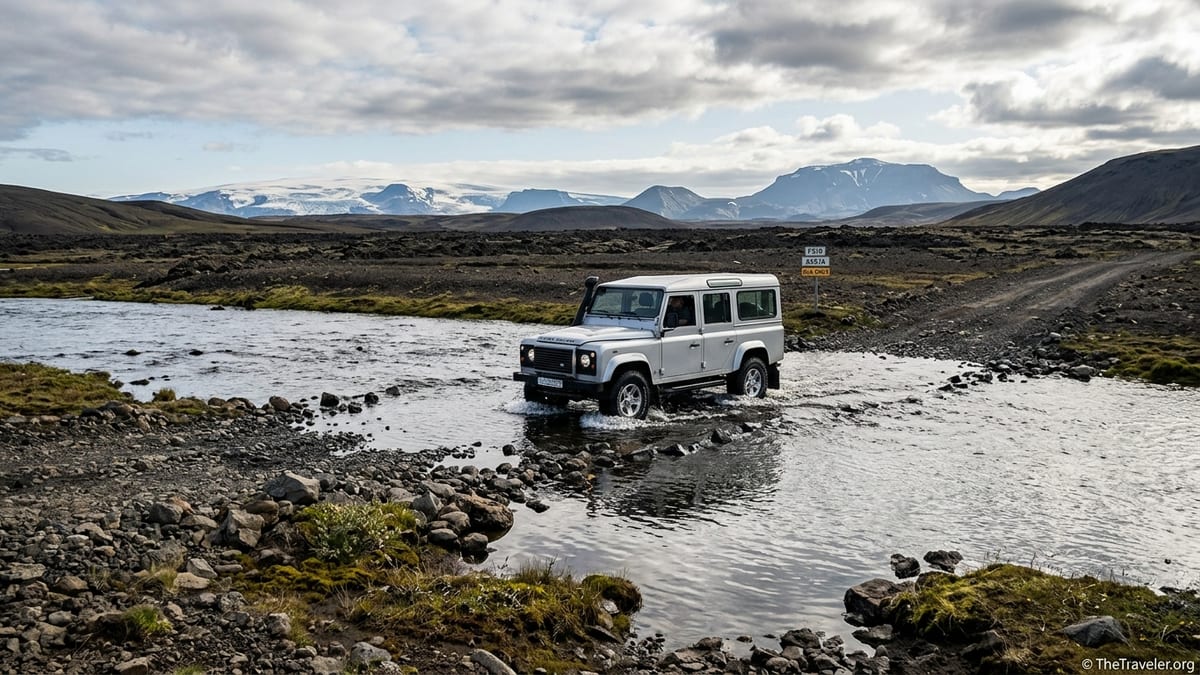
What F-Roads Are and Why Askja Is Not a Casual Drive
In Iceland, an F-road is a designated mountain road in the interior highlands. The “F” stands for fjall, meaning mountain. These roads are typically unpaved gravel or ash tracks, often rough, sometimes deeply rutted, and may include unbridged rivers and soft sand. By regulation, they are open only seasonally in summer and closed the rest of the year. National guidance from Icelandic road and tourism authorities explains that only four-wheel drive vehicles are permitted on F-roads, and that drivers must be prepared for rapidly changing conditions.
Driving a normal passenger car on an F-road is both illegal and unsafe. Official overviews of Iceland’s road system note that attempting an F-road in a standard two-wheel-drive car is a breach of traffic law and carries a high risk of becoming stranded far from assistance. Rental companies echo this: many state explicitly that their non-4x4 categories are not allowed on any F-road and that damage incurred there will not be covered.
Even within the broad category of four-wheel drive, not every vehicle is suitable. Several rental road manuals and safety guides distinguish between true highland 4x4s and smaller “city SUVs.” The former are high-clearance vehicles designed for rough tracks and river fords, such as larger body-on-frame 4x4s. The latter may have all-wheel drive but lack the ground clearance, underbody protection and sometimes low-range gearing that highland routes demand. For Askja, true highland-capable 4x4s are strongly recommended.
Regulations, opening dates and specific restrictions can change from year to year. Before committing to any drive to Askja, you should always check the latest F-road status and opening information from Icelandic road authorities, review current highland driving advice from official tourism sources, and confirm that your vehicle type is legally allowed on the roads you plan to use.
Understanding the Main Routes to Askja from the North
Most visitors who self-drive to Askja approach from the north, using Route 1 near Lake Mývatn or the area around Möðrudalur as their staging point. From there, two main combinations of F-roads are described consistently in recent trip reports and route guides: one using F905 and F910, and one using F88 and F910. Both end up on the highland track toward the Askja car parks, but they differ significantly in difficulty, especially in terms of river crossings.
The F905 plus F910 combination is widely regarded as the more accessible option for non-expert highland drivers, although it still requires a genuine 4x4 and full attention. Multiple recent accounts describe this route as rough and remote but manageable in a mid-size 4x4 when conditions are normal. There are river crossings, including a ford near where F905 meets F910, but these are usually shallower and technically easier than those on F88.
By contrast, the F88 approach to F910 is shorter on the map but significantly more demanding in the water crossings it includes. Current highland driving guides and recent traveler reports repeatedly highlight one particular river, often referred to by name, that can become deep and fast-flowing, especially in rain or during snowmelt. Experienced drivers in large, high-clearance 4x4s may manage it in good conditions, but it is generally considered unsuitable for inexperienced drivers and for many rental vehicles.
From the west there is another line of approach involving F910 from the highland interior. This is described in multiple sources as one of the more difficult routes in the Askja region, with rougher terrain, deeper fords and greater remoteness. It is typically recommended only for very experienced off-road drivers with highly capable vehicles, and it should be treated as a warning rather than an invitation for the average traveler planning a summer self-drive.
Route 1 to Askja via F905 and F910
For most travelers in a suitable 4x4, the standard recommendation is to reach Askja via F905 and F910 from the north or northeast. A common approach is to leave Route 1 either near the Mývatn area or near Möðrudalur. Depending on your exact starting point and conditions, typical non-stop driving times reported for the full approach to the Askja area range roughly from three to four and a half hours one way, but many drivers take longer because they drive cautiously, stop often and walk at viewpoints.
Conceptually, the sequence works as follows. From Route 1 east of Mývatn or near Möðrudalur, you first turn south onto a highland access road that leads to the start of F905. From here, F905 takes you into the highlands, starting as rough gravel and gradually becoming more rugged as you gain elevation and leave the last farms behind. The landscape opens into black lava fields and barren plateaus, reinforcing that you are far from services and should be fully self-sufficient.
F905 continues until it meets F910 at a junction in the highlands. This junction area is also where many drivers report encountering one of the more notable river crossings on the route. Conditions change from year to year and even day to day, but recent reports often describe this ford as moderate in depth in typical summer conditions, while still requiring proper assessment and a capable 4x4. After the junction, you follow F910 toward the Askja region, staying alert for further small fords, rocky stretches and soft sections.
Closer to Askja, a short spur road, commonly referred to as F894 in many guides, branches off toward the main car park for Víti and Öskjuvatn. This final section can be particularly rough, with stones and embedded rocks that demand slow, careful driving. Some drivers choose to park earlier and walk farther rather than risk underbody damage. Regardless of how close you drive, you should allow generous extra time for this final stretch and for the hike to and from the crater.
Route 1 to Askja via F88 and F910
The alternative from the north is to leave Route 1 onto F88, which heads into the highlands between the Mývatn and Möðrudalur areas. In distance terms, this route can appear more direct than the F905 and F910 combination. Many accounts describe the initial sections of F88 as relatively smooth gravel compared with some other F-roads, but this can be misleading because the main challenge here is not surface roughness but water.
F88 crosses several rivers on the way to its junction with F910, and at least one of these is widely cited as deeper and more technically difficult than those usually encountered on the F905 and F910 route. High-season trip reports, highland driving articles and videos emphasize that this ford can become problematic for smaller 4x4s when water levels are high. Depth, flow speed and the shape of the riverbed can change quickly in response to rain and temperatures, so a crossing that looked moderate in a video from a previous year can be hazardous on the day you arrive.
Because of these crossings, many local experts and rental safety resources recommend that only experienced drivers in large, high-clearance 4x4s consider using F88 to reach Askja. Even then, the guidance is to proceed only if recent conditions are favorable and to be prepared to turn back without hesitation if the river looks too deep or if there is any doubt. Drivers in smaller SUVs are generally advised to avoid F88 and instead use the F905 and F910 combination when open.
Should you choose F88, the conceptual sequence is that you turn off Route 1 onto F88, drive south through lava and desert landscapes, then reach the key river crossings. If you safely clear them and continue, F88 eventually meets F910. From there, you proceed toward Askja and eventually take the same spur toward the crater area. Because this route’s main risk centers on river depth rather than simply distance, you must factor recent weather, forecast and your own confidence into any decision to attempt it.
The Western F910 Approach and Why It Is Usually Not Recommended
Some maps and overviews show F910 stretching across the interior from the eastern side of Iceland toward Askja and beyond. Parts of this western or interior approach are renowned among off-road enthusiasts for their remoteness and difficulty. Recent commentaries and rental-focused blogs describe this section of F910 as challenging, with rough surfaces, higher elevation, potentially deep river crossings and long stretches far from assistance.
Several sources class this interior F910 route among the more serious highland tracks, noting that it has in the past featured deeper fords and conditions that can catch out even experienced drivers. The combination of distance, lack of nearby services, occasional soft sand and the potential for sudden weather changes makes it a route where recovery could be complex and time consuming.
For typical visitors renting a 4x4 for a summer holiday, the consensus is that this western F910 approach should be avoided for Askja. It is better suited to drivers with strong off-road experience, local knowledge, and heavily equipped vehicles often described as mountain vehicles, which may include enhancements such as very large tires and raised air intakes. Even for those, it remains essential to heed official road status updates and to cancel or reroute plans if the authorities warn of high rivers or poor conditions.
If you are simply weighing realistic options for reaching Askja as a visitor, treat the interior F910 route as an example of what not to attempt unless you truly know what you are doing and have the right vehicle and support. For most travelers, the decision will be between the F905 and F910 combination or a guided tour, rather than experimenting with the most difficult tracks available.
Comparing the Main Askja Routes: Distance, Rivers and Suitability
Although exact distances and driving times vary with starting point, vehicle, road surface and weather, it is possible to summarize the key differences between the main routes conceptually. From the Mývatn and Möðrudalur area, the F905 and F910 approach is generally somewhat longer in time than F88 when both are fully passable, but it is also widely regarded as less demanding in terms of river depth and technical difficulty.
Reports suggest that F905 and F910 together usually involve several river crossings, one of which near their junction is commonly considered the main challenge. In normal summer conditions, this ford is often described as moderate, meaning it may be approachable for a mid-size highland 4x4 driven cautiously by someone with at least some experience of rough-road driving. In contrast, F88’s main river ford is often marked out in guides as deep and occasionally fast, making it more appropriate only for larger, taller 4x4s and experienced drivers who know how to assess and execute such crossings.
In terms of remoteness, both options are serious highland routes with no fuel, shops or accommodation between the ring road and the Askja area. However, F905 and F910 are commonly promoted in recent visitor information as the preferred route for those who have not driven Icelandic highland roads before, provided they respect the risks. F88 serves more as a shorter but sharper alternative that demands a higher tolerance for risk and a better equipped vehicle.
A simple way to think about it is that first-time highland drivers in an appropriate highland-rated 4x4, especially those who feel nervous about deeper river crossings, should lean strongly toward F905 and F910 and be prepared to turn back if conditions are worse than expected. Drivers who are not comfortable with that level of commitment should consider forgoing self-drive altogether and joining a guided Askja tour that uses specialist super-jeeps and professional drivers.
Vehicle Choice, Rental Categories and Insurance Pitfalls
Rental companies in Iceland typically divide their fleets into categories that clearly distinguish between standard road cars, smaller crossovers or compact SUVs, and true highland 4x4s. Company manuals and terms available for current seasons show that many categories are explicitly barred from all F-roads, including some vehicles that superficially look like SUVs. Only those categories marked for highland or F-road use are legally and contractually allowed into the interior.
Within the permitted 4x4 categories, some Askja routes are still treated as requiring more capable models. Internal sales and road manuals from major rental brands highlight particular roads, including F88 and sections of F910, as routes that should only be driven in larger, higher-clearance 4x4s. These documents often use symbols or notes to distinguish which group of vehicles is allowed on which highland routes, and sometimes reserve only the top categories for the most demanding tracks.
Insurance is another critical consideration. Many rental contracts state that water damage from river crossings is excluded from all coverage, including premium insurance packages. That means that if you misjudge a ford and flood the engine or damage the vehicle’s electronics, you are personally liable for the costs. Some terms also emphasize that driving on F-roads in a vehicle not authorized for them can void coverage more broadly.
Before planning a self-drive to Askja, you should therefore confirm in writing that your specific vehicle category is allowed on F-roads in general, and on your chosen route in particular if the company makes such distinctions. Read the insurance terms carefully, paying special attention to water damage, underbody damage and off-road clauses. If the smallest 4x4 you were considering is excluded from stretches like F88, that is a strong signal that the route may be beyond its capabilities.
Safety on F-Roads and River Crossings
Safety is the decisive factor in whether driving to Askja yourself is a good idea. Official Icelandic safety advice for highland driving stresses careful planning, conservative decisions and respect for rapidly changing conditions. You are expected to submit or share a travel plan before heading into the interior, monitor weather forecasts and highland warnings, and check updated road conditions on the day of travel, not only when you first book your trip.
River crossings require particular skill. Common guidance from highland driving experts and rental safety materials is to stop well before each ford, get out of the vehicle, and assess the crossing on foot if it is safe to do so. You should look for the shallowest and calmest line, usually where other vehicles have recently crossed, and avoid driving into water you cannot see through. If the water looks muddy, opaque or is flowing quickly, that is a red flag.
A widely repeated rule of thumb is to avoid attempting a crossing if the water level is at or above your wheel hubs, especially in a rental vehicle without specialized modifications. If in any doubt, you should turn back, even if it means abandoning your plan to reach Askja that day. Enter the water slowly and drive steadily in a low gear, maintaining a constant speed to create a small bow wave rather than surging forward or changing gears mid-stream.
It is never safe or legal to follow unmarked tire tracks off the official road in search of an easier ford. Iceland’s environment agency is very clear that driving off-road is prohibited and can cause serious damage to fragile landscapes. Stick to marked tracks at all times, avoid stopping in soft or vegetated areas, and heed any signage, barriers or ranger advice. If you feel pressured by itinerary or cost to push beyond your comfort zone, that is usually a sign that a guided tour would be the safer choice.
Fuel, Provisions, Timing and Weather
There is no fuel at Askja. You must start the drive with a full tank from the last reliable fueling point on or near Route 1, for example in the Mývatn region or near Möðrudalur, and ensure that your vehicle’s range comfortably covers the full return distance plus a generous safety margin. Recent traveler discussions highlight that fuel consumption on F-roads is often noticeably higher than on paved roads because of low gears, rough surfaces and extended idling while assessing crossings.
You should also carry enough water, food and warm, waterproof clothing for everyone in the vehicle to handle significant delays. In poor weather or if you encounter issues, you could spend many hours waiting for assistance, and temperatures can drop quickly in the highlands even in mid-summer. A basic emergency kit with blankets, a first-aid kit and charged communication devices is strongly recommended.
The opening window for the Askja F-roads typically runs from late June into early or mid-September, but exact dates vary each year with snowpack and weather. Authorities update road status regularly during the season, sometimes opening sections later than usual or closing them temporarily after heavy rain or storms. River depth can change within hours, especially during warm spells or after persistent rain.
For these reasons, no responsible guide will promise that roads to Askja will be open or safe on specific dates. Instead, you should watch official road condition updates and highland bulletins in the days before your planned visit, check again on the morning of departure, and be ready to adjust your itinerary. If the F-roads you had planned to use are closed or marked with warnings about high water or mountain-vehicle-only conditions, you should not attempt to drive them in a regular rental 4x4.
Should You Self-Drive to Askja or Take a Tour?
By the time you have understood what the Askja F-roads involve, you should have a clearer sense of whether self-driving is appropriate for you. The combination of long gravel distances, significant remoteness, mandatory 4x4 use and at least some river crossings means this is not comparable to the ring road or to short gravel detours to waterfalls and viewpoints. It sits at the serious end of Icelandic driving experiences for visitors.
If you have no previous experience with highland driving or river crossings, feel anxious about the idea of assessing a ford by yourself, or are traveling early or late in the season when conditions are less predictable, it is wise to question whether this is the right time to attempt Askja by rental car. Guided super-jeep or bus tours exist precisely to make this volcanic area accessible to those who prefer an expert driver and specialized vehicle.
On the other hand, if you are a confident driver, accustomed to rough roads, have booked a genuine highland-rated 4x4 and are prepared to turn back if conditions look unfavorable, then the F905 and F910 combination in good summer conditions can be a realistic challenge. Your decision should always prioritize safety over sunk costs and plans made months in advance.
A simple mental checklist can help. If you cannot clearly answer yes to having a suitable high-clearance 4x4, understanding your rental and insurance restrictions, being comfortable with the possibility of turning back at a river crossing, and being ready to change your plan if roads are closed, then a guided tour is likely the better option. Askja will still be there on a future trip, and the safest journey is the one you are fully prepared to undertake.