


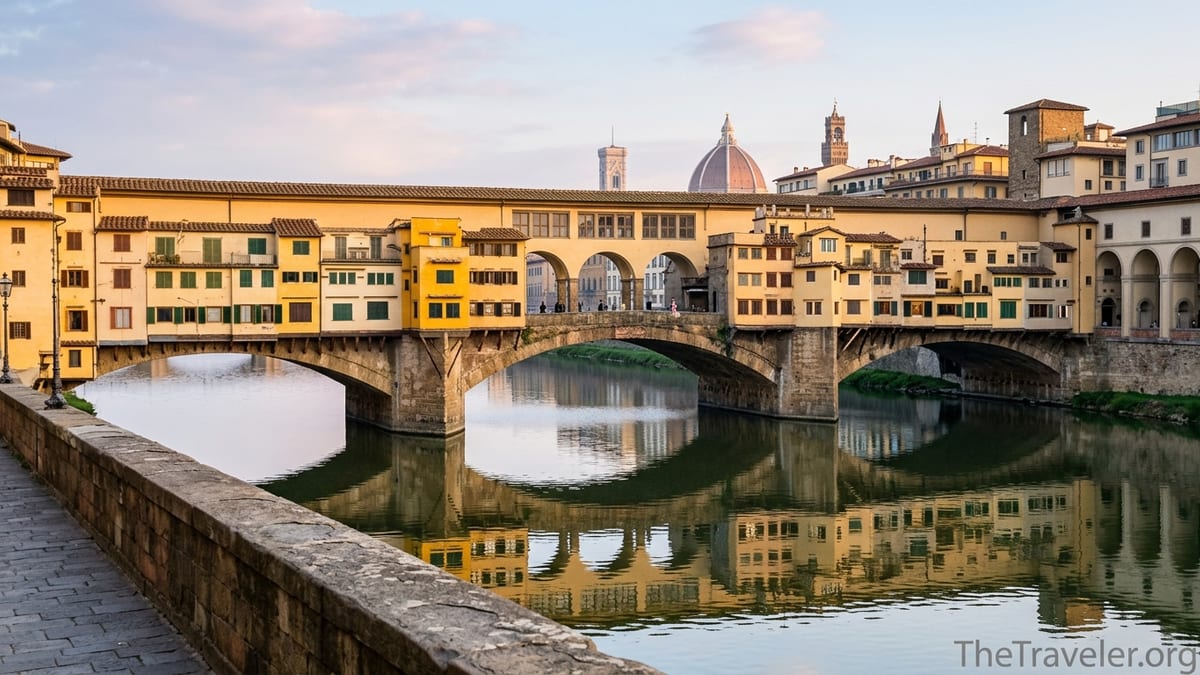
At midday in high season, Florence’s Ponte Vecchio can feel more like a moving conveyor belt than a romantic riverside landmark. Yet visit at the right moment and from the right angle, and this medieval bridge becomes what it once was: a calm crossing over the Arno, lined with tiny goldsmiths’ shops and washed in soft Tuscan light. With a bit of timing and local know-how, you can experience the Ponte Vecchio without the bus tours, selfie sticks and bottlenecks that so often dominate it.
Get the latest updates straight to your inbox!
Understanding Why Ponte Vecchio Gets So Crowded
Ponte Vecchio is both Florence’s most famous bridge and a key pedestrian route between the historic center and the Oltrarno district. That double role creates heavy foot traffic throughout the day. The bridge sits directly on the classic tourist axis that links the Duomo, Piazza della Signoria and the Uffizi on the north bank with Palazzo Pitti and the artisan streets around Santo Spirito on the south. Many first-time visitors simply follow this line on foot, and every route funnels over the same narrow span.
The bridge is open 24 hours a day and free to cross, so there is no natural pause in visitor flow. Instead, crowds peak in a predictable pattern. Recent visitor guides and local tourism sites note that tour groups and day-trippers usually begin to arrive in earnest around 9:30 to 10:00 in the morning and remain dense well into late afternoon, especially in spring and summer. On warm June or September afternoons, it is common to find the bridge shoulder-to-shoulder from one end to the other.
Shops on the bridge are another crowd magnet. Ponte Vecchio has been lined with goldsmiths and jewelers since the 16th century, and today the tiny boutiques sell everything from simple silver charms to high-end diamond pieces. Many open around 9:30 or 10:00 and close by early evening, typically about 7:00 pm. When shutters go up in the morning, so do the numbers of browsing visitors, small group jewelry tours and couples comparing engagement rings in the windows.
Finally, Ponte Vecchio is a prime sunset destination. As the sun drops behind the hills to the west, the stone arches and ocher-colored houses lining the bridge glow in warm light. Travelers often book early evening dinner reservations nearby and wander over to the railings just beforehand, creating another concentrated surge around 6:30 to 8:00 pm, particularly in late spring and early autumn.
The Best Times of Day to Have the Bridge to Yourself
If you want to experience Ponte Vecchio without feeling rushed or jostled, aim for early morning or late evening. Several current Florence visitor guides and local blogs agree that the quietest window is roughly 7:00 to 9:00 am. At this hour, the jewelry shops are still closed, the shutters are down and only a trickle of commuters and photographers cross the span. In winter, sunrise light often hits the river in a gentle, low angle, creating pastel reflections and almost empty walkways.
For example, a traveler visiting in April might leave a hotel near Santa Maria Novella at 7:15 am, walk through the still-sleepy Piazza della Repubblica, pass under the Uffizi’s arches and reach the Ponte Vecchio around 7:35. At this time, you may share the bridge with a few joggers following the river and a handful of locals heading towards offices near Palazzo Pitti. You can stop in the center gap, lean on the stone balustrade and photograph the Arno with unobstructed views toward Ponte Santa Trinita.
Late evening is the second-best option. Because Ponte Vecchio functions as a public street, you can stroll across long after businesses close. Around 10:30 or 11:00 pm, the tour groups are gone and only a scattering of couples, night photographers and locals remain. The shuttered jewelry stores create a series of wooden chests along the sides, giving the bridge a more medieval character. In high summer, when daytime temperatures in Florence can be intense, a post-dinner walk at this hour also brings cooler air off the river.
Season matters too. If your schedule is flexible, target shoulder months like March, early April, late October or November. Hotel rates near the historic center are often lower, and even midday on the bridge feels more manageable than July or August. Visitors in January and February may find Ponte Vecchio almost empty on gray weekdays, though you will trade crowds for the possibility of chilly weather and shorter daylight hours.
Smart Approaches and Walking Routes That Avoid Bottlenecks
How you approach Ponte Vecchio can make as much difference as when you go. The busiest pinch points are the north entrance near the Uffizi and Via Por Santa Maria, and the central viewing gap where everyone stops to look both upriver and downriver. If you come from Piazza della Signoria along Via dei Calzaiuoli and cut straight towards the river, you will likely join a wave of groups doing the same.
A quieter strategy is to approach through side streets. From the Duomo area, instead of heading directly south, walk west first toward the elegant arcades of Via Tornabuoni, then slip down one of the narrow lanes like Via del Parione toward the river. You can then cross on Ponte Santa Trinita, which is typically far less crowded, enjoy classic postcard views of Ponte Vecchio framed between its graceful arches, and only then wander back along the south riverbank to step onto the bridge itself.
On the Oltrarno side, try approaching via the back streets that run between Piazza Santo Spirito and Palazzo Pitti. Lanes like Via Toscanella and Borgo San Jacopo often feel almost residential in the morning. You emerge onto the bridge suddenly, without the sense of queuing up. If you are staying in this part of town, an early walk from a guesthouse near Piazza del Carmine to Ponte Vecchio can be one of the most relaxed experiences in Florence.
Once on the bridge, consider walking straight across without stopping in the densest middle section. Continue to the opposite bank, then drop down to the river level via the stone ramps and stairs that line sections of the Lungarno. From there, you can double back and enjoy less frequented perspectives of the bridge from below, then rejoin the street network away from the bottleneck around the central viewing gap.
The Best Viewpoints Around Ponte Vecchio Without the Crowds
Some of the finest experiences of Ponte Vecchio come from nearby, not from the bridge deck itself. If your goal is photography or simple contemplation rather than jewelry shopping, seek out alternative vantage points along the Arno. The most rewarding and accessible is Ponte Santa Trinita, the next bridge west. Many Florence regulars recommend arriving there about 30 to 45 minutes before sunset to watch the light catch the Ponte Vecchio’s arches upriver while avoiding the denser crowds actually standing on it.
For a quieter pause, walk a few minutes farther to Ponte alla Carraia, another westward bridge that offers a more open, less touristy feel. Here you share the scene with local cyclists and residents walking dogs, and you can look back along the river toward the cluster of bridges and the outline of the Duomo’s dome. Benches along the Lungarno on both banks between these bridges provide good spots to sit with a takeaway espresso and simply watch the evening unfold.
River-level paths are also worth seeking out. Sections of the embankment have lower walkways, especially on the Oltrarno side. In the early morning you may find fishermen setting up or a local runner pacing along the water, with the Ponte Vecchio above you framed by its underside arches and overhanging shops. These angles are excellent for photographers looking for reflections in the Arno or more unusual compositions that still feel authentic.
If you are willing to combine your Ponte Vecchio experience with a broader city view, consider walking up to Piazzale Michelangelo or the nearby church of San Miniato al Monte. While these viewpoints are popular, they spread people out over a large terrace or hillside. Arriving just after sunrise or in the last hour before sunset can give you a sweeping panorama of Florence, with Ponte Vecchio a small but distinct element in the ribbon of the Arno below.
Experiencing the Bridge Like a Local: Short Stops, Not Long Stays
Most Florentines do not linger long on Ponte Vecchio. For residents, it is still primarily a way to get from one side of the river to the other, not a place to spend an entire afternoon. Adopting this mindset can help you avoid frustration. Rather than planning a long “visit” to the bridge, treat it as a memorable moment in a larger walk through the city.
One simple tactic is to cross Ponte Vecchio as part of an early morning loop that includes a café stop. For instance, start at Piazza Santa Croce, wander through the empty streets toward the river, cross the bridge around 8:15 am, then continue into the Oltrarno for breakfast at a neighborhood bar. A cappuccino and pastry at a standing counter on Via Romana or Via dei Serragli will feel far more relaxed than trying to soak up atmosphere while hemmed in by midday crowds on the bridge itself.
Another approach is to pair the bridge with a museum or garden and use it primarily as a scenic connection. After a morning among the paintings of the Uffizi, rather than joining the midday flow directly outside, exit toward the Arno and cross Ponte Vecchio quickly to reach the Boboli Gardens. There, shaded paths and open lawns contrast sharply with the bustle you just passed through. On the return, you might choose a quieter bridge and backstreets instead of retracing your steps.
Keeping your expectations in check helps too. Even with careful timing, Ponte Vecchio is unlikely to be completely deserted, especially in peak season. If you frame your goal as finding a calm few minutes at the railings, or a short crossing punctuated by one or two quiet photos, you are more likely to leave satisfied than if you hope for uninterrupted solitude at noon in July.
Shopping, Food and Prices: How to Choose Wisely Near the Bridge
The jewelry along Ponte Vecchio is a major draw but also a common source of sticker shock. The bridge hosts a dense cluster of goldsmiths and watch dealers whose prices generally reflect both craftsmanship and location. Bracelets and necklaces can easily run into the high hundreds or thousands of euros, while even simple pendants or rings may start around a few hundred. If you are interested in buying, treat the shops as high-end boutiques rather than casual souvenir stands.
For travelers with more modest budgets, the better value often lies a few streets away. Artisan workshops in the Oltrarno, especially between Via Maggio and Piazza Santo Spirito, sell handmade jewelry, leather goods and ceramics in a quieter environment. Here, you might find silver earrings for a fraction of the price of gold pieces on the bridge, or a hand-tooled wallet from a small workshop instead of a global luxury brand.
Restaurants directly overlooking Ponte Vecchio typically charge a premium for the view. Menus often list pasta dishes at noticeably higher prices than trattorie only three or four blocks inland. If you care more about food quality than photographs of your table next to the river, consider walking a few minutes toward Via dei Neri on the north bank or into the side streets off Piazza Santo Spirito on the south. Small osterie and wine bars there serve plates of fresh pasta, crostini or a glass of Chianti at more reasonable prices in a less frantic setting.
For a crowd-free pause, gelato can be an ideal compromise. Instead of joining long lines at the most famous brand-name shops near the bridge, look for smaller gelaterie a bit further away, where locals stop in the early evening. You can then carry your cone back toward the river and find a quiet spot on a low wall or bench west of the Ponte Vecchio to enjoy both your dessert and the view without hovering in the densest foot traffic.
Safety, Scams and Staying Comfortable in Tight Spaces
Ponte Vecchio is generally safe, but its confined space and constant movement call for basic crowd savvy. Pickpocketing can occur in any tightly packed area of Florence, including the bridge and the approaches around the Uffizi and Palazzo Pitti. Keep bags zipped, avoid storing phones or wallets in back pockets, and be wary of anyone who tries to create a distraction or press close while others squeeze past.
Be cautious around street sellers who lay prints or paintings directly on the ground near the bridge. In some cases, travelers have reported being approached aggressively if they accidentally step on these items in crowded conditions, then pressured to pay for “damaging” the work. The easiest solution is to give such displays a wide berth or step around them deliberately, especially when the walkway is congested and your attention is on the views.
Comfort also matters when you are navigating crowds. In summer, temperatures in Florence can climb significantly, and the stone surfaces of the bridge and surrounding buildings hold heat. A light hat, sunscreen and a refillable water bottle go a long way if you happen to cross during midday. If the bridge feels too hot or packed, simply move a block or two inland where narrow streets offer more shade and slightly cooler air.
Finally, watch your step at night. While the bridge and nearby streets are lit, the stone paving is uneven in places. Comfortable shoes with good grip are helpful, especially if you plan to walk down to lower river paths for photographs. After rain, parts of the embankment can be slick, and railings near the water may be low by North American standards.
The Takeaway
Ponte Vecchio rewards travelers who think like residents rather than sightseers on a checklist. Instead of centering your day around the bridge, weave it naturally into your walks between neighborhoods, choosing moments when the flow of people slackens and the Arno feels closer than the crowds. Cross at dawn on your way to coffee in the Oltrarno, or pause at night when the shops are shuttered and the only sounds are river currents and footsteps on stone.
Use nearby bridges and riverbanks to admire Ponte Vecchio from a distance, spend your serious shopping time in quieter artisan streets, and reserve the bridge itself for short, meaningful crossings. With these habits, you will trade jostling tour groups for open views, rushed photos for deliberate memories, and the sense of being swept along for the quieter satisfaction of feeling, briefly, that the oldest bridge in Florence belongs to you.
FAQ
Q1. What is the least crowded time to visit Ponte Vecchio?
Early morning between about 7:00 and 9:00 am is usually the quietest, before jewelry shops open and most tour groups arrive. Late evening after about 10:00 pm is the next best option.
Q2. Is Ponte Vecchio open 24 hours a day?
Yes. Ponte Vecchio functions as a public pedestrian street, so you can cross at any time of day or night, even when the shops are closed.
Q3. When do the shops on Ponte Vecchio usually open and close?
Hours vary by store, but most jewelry shops open around 9:30 or 10:00 am and close in the early evening, often around 7:00 pm. Some may shut earlier in low season or on certain days.
Q4. Are there good viewpoints of Ponte Vecchio that are less crowded?
Yes. Ponte Santa Trinita and Ponte alla Carraia, both west of Ponte Vecchio, offer excellent views along the river with fewer people, especially outside sunset peak.
Q5. Is it safe to walk across Ponte Vecchio at night?
Generally yes. The area is busy and well lit, and many people stroll there in the evening. Standard city precautions apply, such as keeping valuables secure and avoiding isolated spots very late.
Q6. How can I avoid overpriced restaurants near the bridge?
Walk a few blocks away from the river into the Oltrarno backstreets or toward streets like Via dei Neri. Prices typically drop and food quality often improves once you leave the immediate bridge area.
Q7. Are there any scams to watch for around Ponte Vecchio?
Be cautious of street sellers who place prints on the pavement and may claim you damaged them if you step on one, and stay alert for pickpockets in dense crowds. Keep bags zipped and valuables out of easy reach.
Q8. Can I take good photos of Ponte Vecchio without standing in the crowds?
Yes. Photograph it from Ponte Santa Trinita, from river-level paths along the Arno, or from higher viewpoints like Piazzale Michelangelo, ideally at sunrise or before sunset.
Q9. Is Ponte Vecchio accessible for travelers with limited mobility?
The bridge itself is relatively flat and step-free, but paving stones are uneven and the approaches can be busy. Allow extra time, avoid peak hours and consider approaching via quieter side streets.
Q10. How long should I plan to spend at Ponte Vecchio?
Most travelers find that 15 to 30 minutes is enough for a relaxed crossing and a few photos. Longer stays are better enjoyed on nearby bridges or riverbanks where there is more space.