


Florence’s bridges are far more than ways to cross the Arno. They are stages where the city’s history, crowds, and river light all play out in different ways. Nowhere is that contrast sharper than between the famous Ponte Vecchio, packed with gold shops and camera phones, and its quieter upstream neighbor, Ponte alle Grazie. If you only have a day or two in the city, which bridge actually leaves the bigger impression on travelers?
Get the latest updates straight to your inbox!
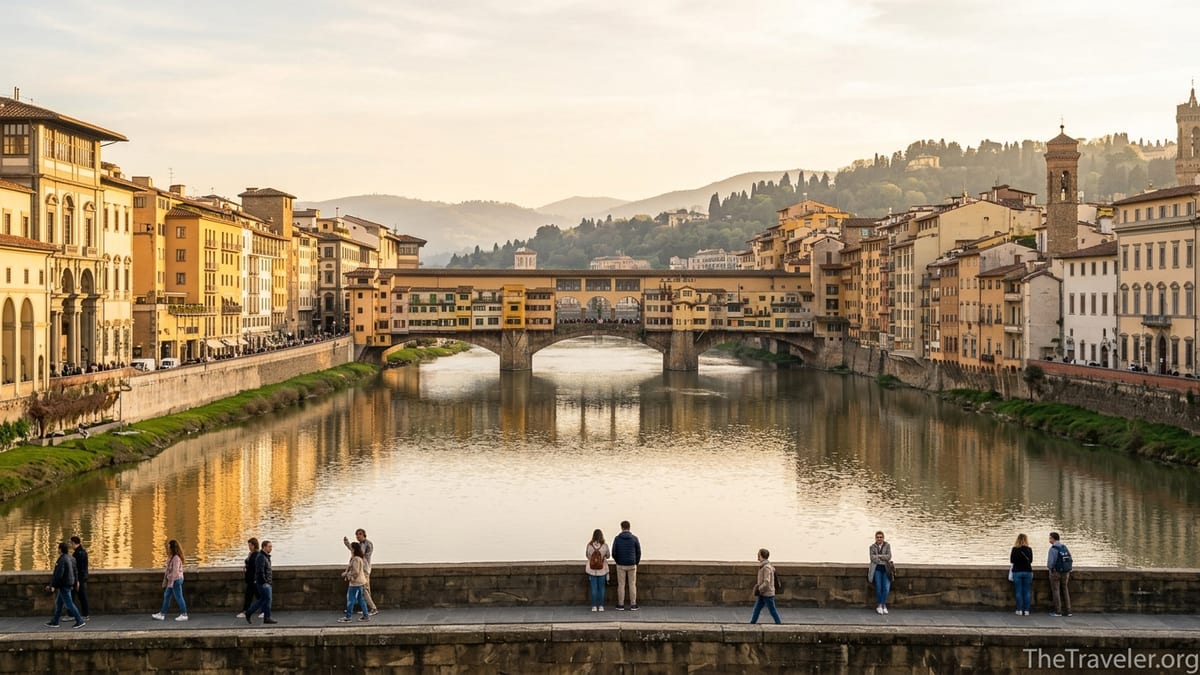
Two Bridges, Two Very Different Florences
The Ponte Vecchio is the bridge most visitors have seen in photographs long before they land in Tuscany. A medieval stone structure with three broad segmental arches, it is completely lined with tiny jewelry and goldsmiths’ shops that jut out over the water, with shutters that close at night like old wooden chests. Above those shops runs a section of the Vasari Corridor, the elevated passageway once used by the Medici to walk between Palazzo Vecchio and Palazzo Pitti without mingling with the crowds.
Walk ten minutes upstream, however, and you reach Ponte alle Grazie, rebuilt in the 1950s in clean, understated stone after its medieval predecessor was destroyed in World War II. It has five wide arches, generous sidewalks, and open parapets that frame some of the best panoramic views along the central Arno. From here, you can see the back of the Uffizi Galleries, the profile of Ponte Vecchio itself, and the villas and church facades climbing the hills of the Oltrarno.
For travelers, the choice between the two is not just about architecture. It is about what sort of Florence you want to remember. Ponte Vecchio is dense, commercial and theatrical; Ponte alle Grazie is open, reflective and oddly local. The bigger impression often comes down to whether you are looking for an iconic moment or a more intimate one.
Most first-time visitors will naturally gravitate to Ponte Vecchio because it connects major sights: the Duomo and Piazza della Signoria on one side, and Palazzo Pitti and the artisan streets of the Oltrarno on the other. Ponte alle Grazie, by contrast, tends to be discovered accidentally, by people staying near Santa Croce or cutting across the river toward the quieter San Niccolò district and the ramp up to Piazzale Michelangelo.
History and Character: Medieval Drama vs Postwar Resilience
Ponte Vecchio is rooted deep in Florence’s medieval story. Versions of a bridge stood here as early as Roman times, but the present stone bridge dates from the 14th century and survived both devastating floods and wartime damage that destroyed every other bridge in the city in 1944. Historically, its shops were occupied by butchers and tanners, whose refuse and smells poured into the river below, until Grand Duke Ferdinand I ordered them out in the late 16th century and invited goldsmiths instead. The result was a centuries-long specialization in fine jewelry that still defines the bridge today.
The character of Ponte Vecchio is theatrical and almost village-like. Behind the polished window displays, many workshops are still family operations, with descendants of 19th-century or early 20th-century founders working at their benches. Stepping into one of these narrow boutiques, you might see a goldsmith using a loupe and tiny hammer at the back of the shop, while the front room is filled with cases of 18-karat gold bracelets and filigree pendants. The bridge feels like a miniature high street floating above the Arno.
Ponte alle Grazie has an older origin but a younger face. The original medieval bridge, once known as Ponte di Rubaconte, was completed in the 13th century and at one time had nine arches and buildings on top, including chapels and convent structures. Like the rest of Florence’s bridges apart from Ponte Vecchio, it was blown up by retreating German forces in 1944 and then replaced in modern form in the 1950s. The current design is understated: pale stone, five arches, a slightly curved deck, and clean lines that put the focus on the surroundings rather than the bridge itself.
This mix of ancient roots and modern reconstruction gives Ponte alle Grazie a very different personality. Standing on it, you are surrounded by history, but you are standing on a piece of mid-20th-century engineering that symbolizes Florence’s effort to rebuild without trying to fake medieval ornament. Many travelers describe it as a place that feels authentically Florentine precisely because it is not trying to impress. The drama here comes from the view, the light, and the quiet hum of daily life.
Atmosphere and Crowds: Carnival Energy vs Quiet Contemplation
On a typical day in high season, crossing Ponte Vecchio feels a bit like threading your way through a small open-air shopping arcade that happens to be hovering over a river. Tour groups gather near the central openings in the rows of shops, guides holding up umbrellas as they point out the Vasari Corridor overhead. Street musicians play violins and accordions. Couples lean against the stone balustrades in the few open sections, jostling for a spot to take selfies as the sun drops toward the hills. At peak times, it can take several minutes just to move from one end to the other.
Prices in the jewelry shops reflect the location. A simple gold necklace in a Ponte Vecchio storefront can easily run into four figures in dollars, especially if it features intricate Florentine-style engraving or gemstone settings. Some shops offer tax-refund services and certificates of authenticity on the spot, but it is still very much a luxury environment, and impulse purchases can be regretted later. Travelers often step into these boutiques not necessarily to buy, but to admire the craft and atmosphere while letting the river breeze drift in through the back windows.
By contrast, Ponte alle Grazie rarely feels crowded, even in July or August. Locals walk across with grocery bags on their way home from the Coop supermarket near Santa Croce. Runners and cyclists use the bridge as part of their regular route along the lungarni, the streets that follow the riverbanks. Around sunset, you might see a handful of people lined along the parapet taking photos of Ponte Vecchio in the distance, but there is usually space to breathe, adjust your tripod, or simply watch the current without anyone bumping your shoulder.
The quieter atmosphere also changes the kind of encounters you are likely to have. On Ponte Vecchio, the conversations you overhear are often in English, German or Spanish, and you are more likely to be approached by someone selling trinkets or offering to take your picture. On Ponte alle Grazie, you are more likely to hear Italian and to watch ordinary routines: a nonna walking a dog, a student pausing to check messages, a fisherman leaning on the railing to judge whether the water is too high after recent rain. For many travelers, that everyday scene lodges more deeply in memory than the more orchestrated excitement of Ponte Vecchio.
Views and Photography: Where the Arno Looks Its Best
The classic visitor photo of Florence’s bridges is not taken from Ponte Vecchio itself, but from nearby spans that allow you to see its full profile. This is where Ponte alle Grazie has an advantage. Standing on its upstream side and looking west, you get the entire sweep of Ponte Vecchio framed by rows of ochre and terracotta buildings, with the soft hills beyond the city rising in the distance. In late afternoon, the westering sun lights up the bridge’s overhanging shops, turning the wooden shutters and plaster walls golden as their reflections streak the water.
If you are serious about photography, Ponte alle Grazie gives more flexibility. Its sidewalks are wide enough to set up a small tripod without blocking anyone, and the absence of tall side walls means you can easily shoot low over the parapet to catch reflections on the Arno. You can experiment with long exposures of the river flowing under Ponte Vecchio, or zoom in on the details of individual jewelry shops that cling to its sides. You can also pivot to face the opposite direction, capturing the green slopes behind San Niccolò and the stone tower of Porta San Niccolò at the eastern edge of the old walls.
That does not mean Ponte Vecchio is a poor place for photos, only that its strength lies in close-up details rather than panoramas. Early in the morning, around sunrise, you may find the bridge relatively empty. At this hour, you can stand near one of the central arches and capture the warm light touching the buildings along the river, or shoot along the curve of the shuttered shops before they open, when they resemble a continuous row of antique wooden chests. At night, the glow from the jewelry windows reflects in the river below, creating a glittering ribbon of light.
For many visitors, the most memorable image is actually the combination of the two bridges: standing on Ponte alle Grazie at blue hour, with the lights on Ponte Vecchio just coming on and the sky fading from pink to deep indigo. From here, you can appreciate why Ponte Vecchio became the postcard image while simultaneously feeling the calm that Ponte alle Grazie offers. It is an easy side trip: from the Uffizi area, you simply follow the river east for about ten minutes and cross at the next major bridge.
Shopping vs Strolling: What You Actually Do on Each Bridge
On Ponte Vecchio, the core activity is browsing. Even travelers who have no intention of buying fine jewelry often end up lingering in front of the display cases, pointing out elaborate necklaces or tiny pendants shaped like Florentine lilies. Some shops focus on traditional yellow gold pieces, others on modern white gold designs, and a few feature cameos or semi-precious stones. Many will invite you in for a closer look and offer to customize sizes or lengths if you have time to return the next day.
The bridge can be a legitimate place to purchase a once-in-a-lifetime piece, for example a pair of 18-karat gold earrings as a honeymoon souvenir, or a bracelet marking a milestone birthday. However, it is worth comparing prices elsewhere in Florence first, such as in smaller jewelry boutiques along streets like Via dei Calzaiuoli or in less central neighborhoods where rents and markups tend to be lower. If you decide to buy on Ponte Vecchio, ask clearly about materials, hallmarks and warranties, and consider having the piece evaluated at home later for peace of mind.
Ponte alle Grazie, by contrast, offers nothing to buy and everything to observe. Your main activity here is simply walking slowly from one side to the other, stopping in the middle to take in the views. Many travelers combine it with a visit to Santa Croce on the north bank, followed by a late-afternoon stroll over the bridge into the Oltrarno, then a climb up through the gardens and neighborhoods toward Piazzale Michelangelo for a wider sunset panorama over the whole city.
Because the bridge is so open, it is also a good place to pause with a takeaway coffee from a nearby bar or a gelato from one of the less touristy gelaterie around Piazza de’ Ciompi or Via dei Benci. Leaning on the railing with a cone in hand, watching the rowing clubs slip under the arches and listening to the muffled traffic behind you, you are likely to feel that this is the Florence that locals know best: slow, slightly worn, and deeply rooted along its river.
Access, Safety, and When to Visit
Both bridges sit in central Florence and are easy to reach on foot. Ponte Vecchio connects directly to the Vasari Corridor route between the Uffizi area and the Pitti Palace side, and many walking tours cross it as part of their standard loop. The surrounding streets are filled with souvenir shops, cafes, and high-end fashion boutiques, so you can easily combine a crossing with shopping on Via de’ Tornabuoni or a visit to the Uffizi Galleries.
Ponte alle Grazie lies between the Santa Croce neighborhood and the San Niccolò quarter. From Piazza Santa Croce, it is about a five-minute walk down Via de’ Benci to the river. The bridge then leads you directly toward the base of the hill that rises to the Piazzale Michelangelo viewpoint. This makes it a natural part of an afternoon or evening walk: Santa Croce to Ponte alle Grazie, across the river, then up through the gardens and residential streets for a sweeping view back over the city and its bridges.
In terms of safety, both bridges are generally secure, including after dark, though common-sense precautions apply. Pickpocketing can occur in dense crowds, which makes Ponte Vecchio more of a concern in that respect. Keep bags zipped, wallets in front pockets, and avoid placing phones loosely in back pockets while taking photos. On Ponte alle Grazie, the main hazard is more practical: watching children near the low parapets, and being aware of cyclists on the shared pedestrian paths.
Timing your visit can greatly influence which bridge feels more impressive. To experience Ponte Vecchio at something close to its romantic image, aim for early morning before the shops open or late evening after most tours have finished. For Ponte alle Grazie, late afternoon into sunset is ideal, when the light is soft on the façades and you can still comfortably linger without the strong midday heat that often bounces off the stone in summer.
Which Bridge Leaves a Bigger Impression?
Ask ten travelers which Florence bridge impressed them more, and you are likely to hear two very different kinds of answers. Those who choose Ponte Vecchio often speak about the emotional impact of finally standing on a structure they have seen in paintings, guidebooks and films. There is something undeniably powerful about recognizing the curve of arches, the jumble of pastel walls and wooden shop fronts, and realizing that you are now part of that centuries-long stream of people who have crossed it.
Others, however, come away more affected by Ponte alle Grazie because it gives them a rare pause in a city that can otherwise feel crowded and curated. Looking back at the historic core from this quieter vantage point, they remember the sound of water, the shifting color of the sky on the river, and the sense of seeing Florence from just far enough away to take it all in. The absence of commercial distractions lets the architecture and landscape speak more clearly.
Personality plays a strong role in which bridge resonates. If you appreciate craftsmanship, luxury goods, and animated crowds, Ponte Vecchio will probably remain the highlight. If you prize open views, breathing room, and glimpses of everyday life, Ponte alle Grazie may lodge deeper in your memories. Many travelers only realize the value of the second bridge on a return trip, when they have already taken the classic photographs and are ready for something quieter.
In practice, the most rewarding strategy is not to choose one over the other, but to use each for what it does best. Cross Ponte Vecchio once, slowly, as an experience in itself, then seek out Ponte alle Grazie for your reflective moment by the Arno. Together, they tell a fuller story of Florence: a city of spectacle and commerce, but also of silence, resilience, and riverside light.
The Takeaway
When travelers debate whether Ponte Vecchio or Ponte alle Grazie leaves a bigger impression, they are really comparing two different ways of meeting Florence. Ponte Vecchio is the city’s theatrical face: an intact medieval commercial bridge that feels almost like a set piece, complete with gold-heavy shop windows and a constant tide of humanity. It delivers the thrill of recognition and the buzz of a place that has drawn visitors for centuries.
Ponte alle Grazie, on the other hand, is Florence’s reflective side. Rebuilt after wartime destruction, it lacks the ornament that draws postcards, but compensates with wide skies, sweeping views and the quiet routines of local life. Standing here, with Ponte Vecchio framed in the distance, many travelers feel they have finally stepped out of the crowd and into the city itself.
Rather than asking which bridge is objectively better, it can be more helpful to think about what you want from your limited time on the Arno. If you are seeking that archetypal Florence moment, with jewelry stores glowing and the river running somewhere beneath your feet, you cannot skip Ponte Vecchio. If you are searching for a place to breathe, reflect, and take in the skyline without being jostled, make time for Ponte alle Grazie.
Ideally, you cross both. Start with Ponte Vecchio to understand why it is famous, then walk upstream to Ponte alle Grazie to see why Florence is more than its most photographed bridge. The memory that stays with you longest might not be the one you expected.
FAQ
Q1. Is Ponte Vecchio really worth visiting if it is so crowded?
Ponte Vecchio can be extremely busy, but it remains a unique example of a medieval bridge lined with active shops, and that combination of history and atmosphere is hard to find elsewhere. Visiting early in the morning or later in the evening reduces the crowds and lets you appreciate its architecture without feeling overwhelmed.
Q2. What makes Ponte alle Grazie special compared with other Florence bridges?
Ponte alle Grazie stands at one of the widest points of the Arno in central Florence and offers some of the city’s best open views, both toward Ponte Vecchio and toward the green hills behind the Oltrarno. Its relatively quiet sidewalks and simple postwar design create a calm, contemplative space in contrast with the more ornate and crowded bridges nearby.
Q3. Which bridge is better for taking photos of Ponte Vecchio?
Ponte alle Grazie is generally better for panoramic photos of Ponte Vecchio, because it sits upstream and gives you a clear, unobstructed view of the bridge’s full profile and its reflections in the river. From here you can capture the shops overhanging the arches and the surrounding cityscape without having to compete for space at a crowded lookout.
Q4. Can I buy quality jewelry on Ponte Vecchio, or is it mainly for tourists?
Ponte Vecchio hosts a mix of long-established family goldsmiths and shops that cater heavily to tourists. You can find high-quality pieces, but prices are often higher than in less central areas, and it is wise to compare, ask about materials and guarantees, and only purchase if you feel fully informed and comfortable with the cost.
Q5. Is there anything to do on Ponte alle Grazie besides enjoying the view?
The main attraction of Ponte alle Grazie is the view itself, but it also serves as a pleasant link between Santa Croce and the San Niccolò area. Many visitors use it as part of a scenic walking route: visiting Santa Croce, crossing the bridge, and then continuing up to Piazzale Michelangelo for a larger panorama over the city and its bridges.
Q6. How much time should I plan to spend on each bridge?
Most travelers spend around 20 to 30 minutes on Ponte Vecchio, longer if they browse jewelry shops in detail or pause for photos at several points. On Ponte alle Grazie, 10 to 20 quiet minutes are usually enough to take in the views, though photographers and those seeking a peaceful break often choose to linger.
Q7. Are these bridges accessible for visitors with limited mobility?
Both Ponte Vecchio and Ponte alle Grazie are generally accessible, with level surfaces and gentle slopes at each end, though the cobblestones and crowding on Ponte Vecchio can be challenging for wheelchairs or walkers. Ponte alle Grazie’s sidewalks are smoother and wider, which many visitors with limited mobility find more comfortable.
Q8. What is the best time of day to visit each bridge?
For Ponte Vecchio, early morning or late evening helps you avoid the heaviest crowds and offers softer light on the river and buildings. For Ponte alle Grazie, late afternoon toward sunset is ideal, when the sun illuminates Ponte Vecchio in the distance and reflections on the Arno are at their most photogenic.
Q9. Are there good places to eat or drink near each bridge?
Near Ponte Vecchio you will find a dense concentration of cafes, gelaterie and restaurants on both sides of the river, especially toward the Uffizi and in the Oltrarno streets leading to Palazzo Pitti. Around Ponte alle Grazie, options are a bit more local in feel, with wine bars and trattorias tucked into the streets around Santa Croce and the quieter lanes of San Niccolò.
Q10. If I have only one evening in Florence, which bridge should I prioritize?
If this is your first visit and you want the classic Florence experience, prioritize walking across Ponte Vecchio at dusk to see its shops and riverside views. If you prefer a quieter, more reflective evening moment, consider spending your limited time on Ponte alle Grazie, watching the lights come on across the old city and seeing Ponte Vecchio framed in the distance.