


Walk La Rambla the wrong way and you will come away convinced it is an overhyped strip of tacky terraces, plastic paella, and pickpockets. Walk it the right way and it becomes a vivid introduction to Barcelona: plane trees arching overhead, the smell of coffee from side streets, fragments of Catalan overheard at market stalls. The difference lies in how, when, and where you choose to stop. This guide shows you how to experience La Rambla at its best while sidestepping the most common tourist traps.
Get the latest updates straight to your inbox!
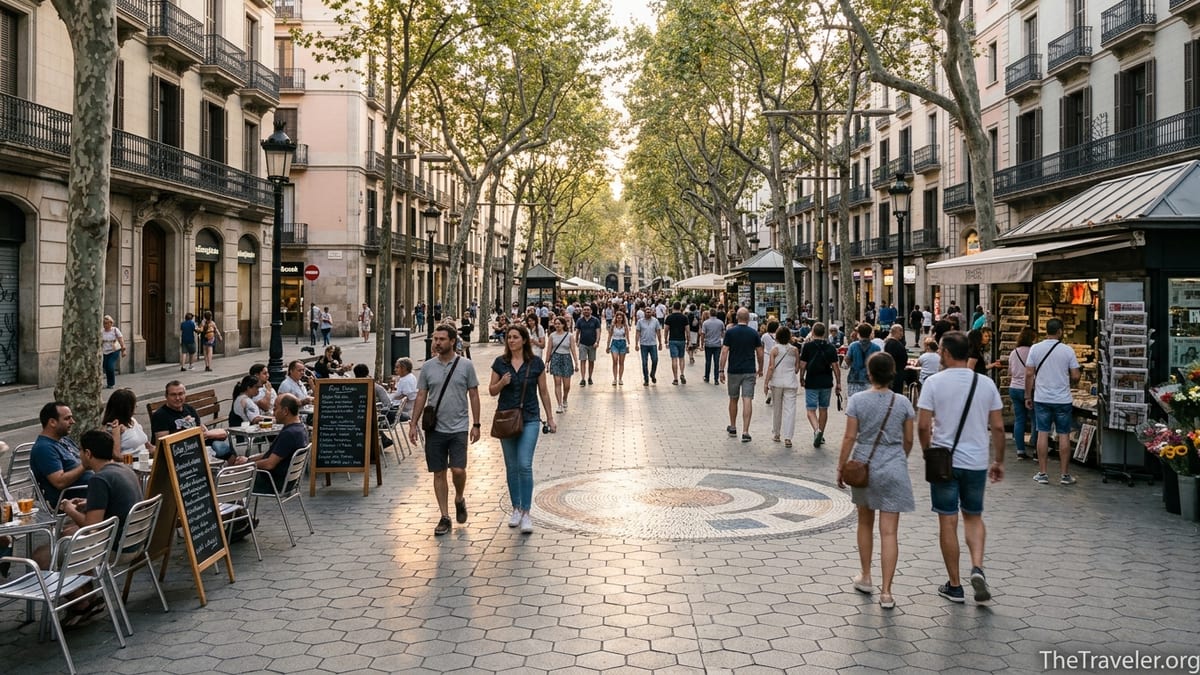
Know What La Rambla Really Is (And What It Is Not)
La Rambla is a 1.2-kilometer pedestrian boulevard running from Plaça de Catalunya down to the Christopher Columbus monument at Port Vell. It is one of the densest concentrations of visitors anywhere in Barcelona, and that shapes everything from prices to the kinds of businesses that survive here. Long-time residents often avoid it, not because it lacks history, but because the everyday city they use now exists a few streets away. Understanding this helps set your expectations: La Rambla is a spectacle more than a neighborhood hangout.
The street is divided informally into stretches: near Plaça de Catalunya you will find newspaper kiosks and chain stores; further down are flower stands, souvenir shops, and the entrance to the Mercat de Sant Josep de la Boqueria, one of Barcelona’s most famous markets. Closer to the sea, the crowds thin slightly near the Liceu opera house and Plaça Reial, a grand arcaded square just off the boulevard. Seen with the right mindset, La Rambla is a spine that connects you to far more interesting places on either side, such as the Gothic Quarter and El Raval.
What La Rambla is not is a place for value-for-money dining or quiet reflection. Its central terraces live off convenience and foot traffic, not repeat local customers. If you accept that it is primarily a stroll and a gateway rather than your main destination for meals and shopping, you are already halfway to avoiding its worst traps.
Think of La Rambla as a stage set. Enjoy the performers, architecture and energy, then step off down a side street when you actually want to eat, drink, or shop. The most rewarding moments usually happen once you are no more than two or three minutes away from the main flow.
Timing Your Walk to Beat the Worst Crowds
One of the simplest ways to experience La Rambla without frustration is to choose your time of day carefully. Early morning, roughly between 8:00 and 9:30, is when cleaners are still hosing down the paving stones and delivery vans are unloading crates for nearby cafés. The street is quieter, stallholders are setting up, and you can actually see the famous mosaic by Joan Miró under your feet near the Liceu metro entrance instead of just the backs of people’s shoes.
Late afternoon and early evening, from about 17:00 to 19:30, can also be pleasant outside of peak summer, when the worst of the midday sun has faded and locals finish work. The atmosphere is energetic but not yet the shoulder-to-shoulder shuffle that builds up later at night. Aim to walk the full length once during one of these calmer windows, then return only to specific spots you liked.
Midday in high season, particularly between roughly 11:00 and 15:00, is when cruise ship passengers and tour groups tend to converge. This is when terrace prices feel most inflated, queues at La Boqueria spill onto the pavement, and many of the classic scams are in full swing. If your schedule forces you to pass through at this time, treat it as a transit corridor: keep moving, keep your bag closed, and save your lingering for a shaded plaza in the nearby Gothic Quarter.
Very late at night, especially after midnight, parts of the lower Rambla can feel more chaotic than charming, with a mix of drunk visitors, unofficial street vendors, and the occasional petty crime. It is not usually dangerous in an aggressive sense for most visitors, but the balance tips away from anything you might reasonably call an authentic local atmosphere. For a late-night stroll, the waterfront promenade or well-lit streets around Plaça de Catalunya tend to feel more relaxed.
Spotting and Avoiding the Classic Tourist Traps
The clearest sign you are walking into a tourist trap on La Rambla is when a restaurant or bar sends staff onto the pavement to wave laminated menus at anyone who slows their pace. Large photo menus with bright pictures of paella, sangria in fishbowl-sized glasses, and “special menus” in six languages are less about showcasing quality and more about catching the hungry and undecided. It is not unusual to see basic paella here priced at around 20 to 25 euros per person, plus a separate charge of 3 to 5 euros for bread you did not ask for, and a “cover” fee on top.
Another common trap is the oversize cocktail or sangria jug. A board might advertise “Mojito 5€” or “Sangría 7€” in big letters, but the small print reveals that the price is “per person” or only valid if everyone at the table orders one. The same drink might cost closer to 3 or 4 euros in a local bar three streets away. If a terrace has giant plastic cocktail glasses on display, it is often a signal that the experience is designed around novelty rather than quality.
Souvenir stands along La Rambla also lean heavily on impulse buys. T-shirts, fridge magnets and Gaudí-themed trinkets are inevitable, but prices here are often noticeably higher than in the small shops scattered through the Gothic Quarter or El Raval. As an example, the same Barcelona football scarf that sells for around 8 to 10 euros in a shop off Carrer de Ferran might be tagged at 15 euros on a La Rambla stall. If you are buying more than a token item, it usually pays to browse side streets instead.
Street performances can be wonderful, but they can also blur into a form of trap when they involve aggressive requests for money. Human statues who insist you pay before taking any photo, or performers whose helpers block your path with props until you drop coins into a hat, are best avoided. The best rule of thumb is that any experience that begins with pressure, confusion, or lack of clear pricing rarely ends well for the visitor.
Staying Safe Without Becoming Paranoid
La Rambla’s reputation for pickpocketing is not invented. Petty theft is one of the most reported problems in central Barcelona, and crowded, distracted environments provide ideal conditions. That said, you can dramatically reduce your risk with a few practical habits. Use a cross-body bag that zips completely, and keep it in front of you in crowded stretches. If you carry a backpack, wear it on your chest when moving through the densest crowds, especially near metro entrances like Liceu and Drassanes where thieves often operate.
Most thefts here rely on distraction. Someone might bump into you while a companion lifts your phone, or spill something on your shirt and insist on helping you clean it while another hand goes for your pocket. Others hold clipboards and ask you to sign a petition, or offer bracelets or roses “for free,” then create a scene to demand payment while a partner searches your bag. If anyone approaches you unexpectedly in a busy spot, the safest response is a brief “no, thank you” while you continue walking without stopping or engaging.
At cafés and terraces, avoid leaving your phone or wallet on the table or draped over the back of a chair. A classic trick is for someone to place a piece of paper or a menu on the table, covering your phone, then lift both away in one movement. Instead, keep valuables in a closed pocket or inside your bag with the strap looped around your leg. Many locals do this as a matter of habit, not fear, and it quickly becomes second nature.
It is also worth preparing digitally. Before you go out, set up the “find my device” functions on your phone, and keep a photocopy or photo of your passport stored securely online in case you need to report a theft. Consider a simple money belt or a flat pouch under your clothing for your passport and a backup credit card, while keeping only the cash you need for the day in an accessible wallet. This way, even if something is taken, your trip is disrupted but not ruined.
Where to Eat and Drink Near La Rambla Without Overpaying
If you want to experience La Rambla and also eat well, separate the two activities. Use the boulevard for strolling, then step a few minutes into the surrounding neighborhoods when it is time for a meal. Just behind the Liceu opera house, the narrow streets of the Gothic Quarter hide small bars serving traditional Catalan dishes and tapas at prices that attract locals as well as visitors. A typical lunch menu of the day in one of these side-street spots might cost around 14 to 18 euros and include a starter, main course, dessert, bread, and a drink.
La Boqueria market, which opens directly off La Rambla, is world-famous and visually impressive. It is worth walking through to see the fish stalls and colorful displays of fruit, but many of the front-row juice stands and ready-to-eat counters now charge premium prices. A simple plastic cup of mixed fruit might be 3 or 4 euros near the entrance, while vendors deeper inside the market often sell more generous portions for a similar or slightly lower price. If you want a snack here, walk at least halfway into the market before buying, and favor stalls where you see local shoppers choosing ingredients rather than only pre-cut fruit cups and candy.
For coffee and breakfast, a practical strategy is to step into El Raval or further into the Gothic Quarter. In these areas, an espresso and a croissant at a neighborhood café can still cost roughly 3 to 4 euros in total, compared with 4 euros or more for the coffee alone at a La Rambla terrace that includes a “view surcharge.” Look for places where prices are written on a simple board in Spanish or Catalan and where customers at the counter look like office workers or students rather than only tourists with guidebooks.
In the evening, consider treating La Rambla as your route to a better dining scene. Walk down the boulevard to people-watch, then cut east towards El Born or west towards Sant Antoni, both of which have clusters of modern tapas bars, natural wine spots, and small bistros. Here, sharing several plates between two people and a glass of wine each might come to 25 to 35 euros per person for considerably higher quality than the frozen paella and fluorescent cocktails so common on the main drag.
Finding Authentic Culture Along and Around the Boulevard
Despite its reputation, La Rambla still offers pockets of genuine culture if you know where to look. The Gran Teatre del Liceu, Barcelona’s historic opera house, stands roughly halfway down the boulevard and continues to host opera, classical concerts, and special events. Even if you are not attending a performance, you can sometimes join a short daytime tour of the interior for a modest fee, which allows you to see the ornate auditorium and learn about its history of fires and reconstructions.
Just off the lower section of La Rambla is Plaça Reial, a neoclassical square framed by palm trees, arcades, and lampposts designed in part by a young Antoni Gaudí. During the day, the arcades house cafés and restaurants, some touristy and some more local, but the architecture and proportion of the space are the real draw. Come earlier in the morning to appreciate its form, then slip away for coffee on a quieter nearby street like Carrer d’Escudellers or Carrer Nou de la Rambla.
For a deeper sense of the city, treat La Rambla as a jumping-off point to explore the Gothic Quarter on one side and El Raval on the other. A two-minute walk from the bustle can take you to medieval streets around the Barcelona Cathedral or to contemporary culture centers and street art in El Raval. Here, you will find independent bookshops, small galleries, and family-run bakeries that serve the people who actually live in the area.
Even the street performers on La Rambla can offer more than quick photo opportunities if you are selective. Musicians playing traditional Catalan songs or classical guitar, especially those who perform without aggressive helpers, are often talented professionals who treat the street as a stage. Drop a coin or two if you linger to listen, but avoid shows that seem designed primarily to funnel large crowds into tipping after a carefully orchestrated “finale.”
Smart Ways to Shop Without Getting Gouged
Shopping directly on La Rambla is mainly about convenience, not uniqueness or price. If you forgot a hat or need sunscreen, kiosks here can be useful, but for anything beyond essentials, the value is usually better a short distance away. For example, small grocery stores and bakeries off Carrer de l’Hospital or Carrer del Carme often sell bottled water and snacks at prices closer to what local residents pay. On La Rambla, a half-liter bottle of water can easily be 2 to 3 euros, while side-street shops might charge around 1 euro for the same thing.
For more interesting souvenirs, head into the Gothic Quarter, where you can find artisanal shops selling ceramics, prints by local designers, and Catalan specialty foods. Here, you might pay 6 to 8 euros for a hand-painted tile that feels like a piece of Barcelona, rather than 5 euros for a generic magnet you will see in every tourist city in Europe. If you are drawn to something on La Rambla, take a photo of it and see if you can find a similar item nearby at a better price and quality.
Bargaining is not a major part of shopping culture in Barcelona’s formal shops, but in some souvenir-heavy areas, particularly at stalls and markets, polite negotiation is sometimes possible for multiple purchases. If you are buying three or four items, you can ask if the seller can do a small discount for the lot. Keep it friendly; a simple “Is there a better price if I take all of these together?” in English or simple Spanish often gets you a few euros off without any drama.
The main rule is to avoid impulse buys made when you are tired and thirsty on the main boulevard. Build one or two focused shopping moments into your day away from La Rambla, and you will likely come away with fewer items, but ones that actually mean something when you unpack them at home.
The Takeaway
La Rambla is neither a no-go zone nor the pure heart of Barcelona. It is a crowded, theatrical thoroughfare layered with history, daily life, and heavy commercialization. To enjoy it on your own terms, treat it as a scenic route rather than a destination: walk its length at a calm time of day, keep your valuables secure, and resist the pressure to sit at the first terrace that waves a menu in your direction.
The real pleasure of La Rambla lies in contrast. Let its energy wash over you, then step down a shaded side street into the quieter rhythms of the Gothic Quarter, El Raval, or nearby neighborhoods where people live, work, and meet friends. When you use the boulevard as a frame for the city rather than your entire picture, you discover why locals may roll their eyes at the tourist traps yet still acknowledge that, in small doses and on your own terms, La Rambla is worth a walk.
FAQ
Q1. Is La Rambla safe to visit during the day? La Rambla is generally safe during daylight hours, but it is a hotspot for pickpockets. Stay alert, keep bags zipped and in front of you, and avoid leaving phones or wallets on café tables.
Q2. Are the restaurants on La Rambla worth trying? Some are acceptable for a drink and people-watching, but many serve mediocre food at inflated prices. For better value and quality, walk a few minutes into the Gothic Quarter, El Raval, or El Born.
Q3. What is the best time of day to walk La Rambla? Early morning or late afternoon is ideal. The street is less crowded, temperatures are milder, and you can actually see the details of the architecture and street life.
Q4. How can I avoid pickpockets on La Rambla? Use a cross-body bag, keep valuables in zipped pockets, avoid engaging with street hustlers offering bracelets or petitions, and stay especially aware in dense crowds and around metro stations.
Q5. Is La Boqueria market a tourist trap? Parts of La Boqueria, especially near the main entrance, now cater heavily to tourists and charge higher prices. It is still worth visiting, but for better value, walk deeper inside the market or use it mainly for a look rather than a full meal.
Q6. Where should I go near La Rambla for authentic food? Step into nearby streets in the Gothic Quarter or El Raval for small tapas bars and neighborhood restaurants. These areas offer more local clientele and more realistic prices than the main boulevard.
Q7. Is it safe to walk La Rambla at night? Early evening is usually fine, but very late at night the lower section can feel rowdy and less comfortable. If you are out late, stick to well-lit main routes and avoid walking alone if you feel uneasy.
Q8. Are the street performers on La Rambla legitimate? Many musicians and performers are genuine and add to the atmosphere, but some acts are paired with aggressive tip-seeking or scams. Enjoy performances from a slight distance and only tip where you feel no pressure.
Q9. Can I find good souvenirs on La Rambla? Basic souvenirs are plentiful but often overpriced and generic. For more distinctive items, explore small shops in the Gothic Quarter and surrounding streets just off the boulevard.
Q10. How long should I spend on La Rambla? Most visitors find that one unhurried walk of 30 to 60 minutes, combined with time exploring the side streets and nearby neighborhoods, is enough to appreciate La Rambla without getting overwhelmed.