


Pisa is far more than a quick stop for a tilted photo. This compact Tuscan city mixes world-famous monuments with student energy, budget-friendly food, and easy transport links, making it an excellent base or short city break. Here is how to experience Pisa’s icons, eat like a local, and navigate the city smoothly using the most up to date on-the-ground details.
Get the latest updates straight to your inbox!
Understanding Pisa: Layout, Vibe and When to Go
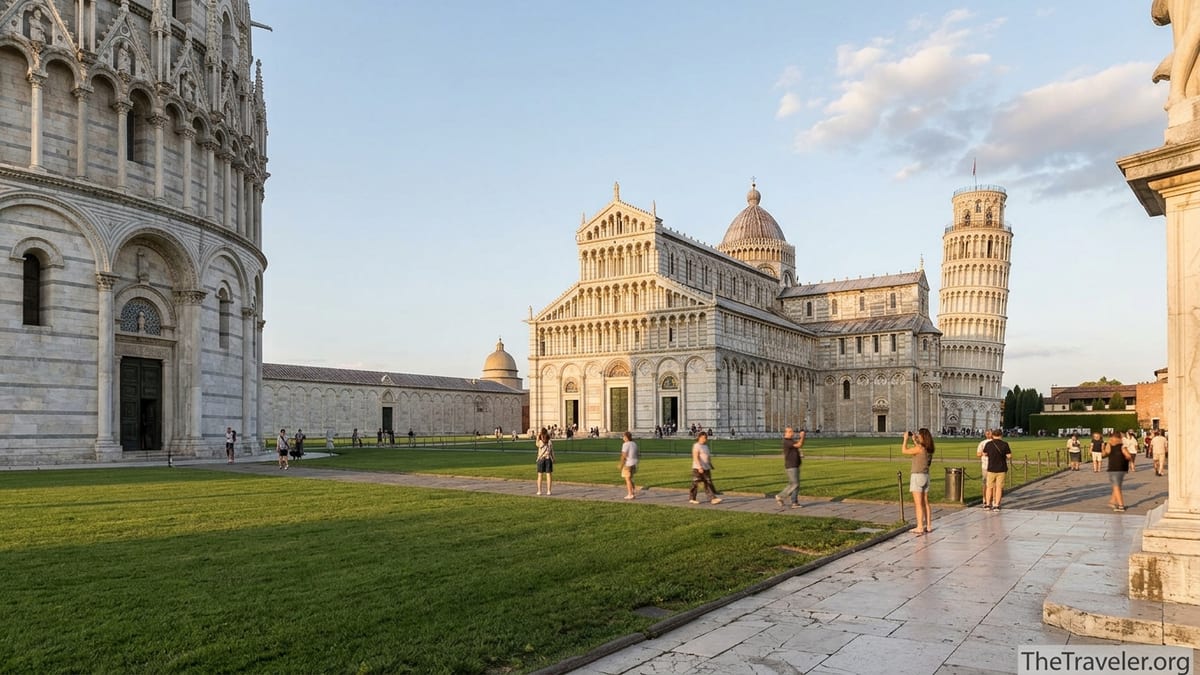
The Pisa most visitors see runs between the central train station, Pisa Centrale, and the Piazza del Duomo where the Leaning Tower rises above the lawns of the so-called Square of Miracles. The historic center spreads along both sides of the Arno River, connected by bridges like Ponte di Mezzo. Distances are short: you can walk from Pisa Centrale to the Leaning Tower in about 20 to 25 minutes at an easy pace, or take a local bus for a quick hop.
Pisa’s atmosphere is shaped by its universities as much as its monuments. Around Piazza delle Vettovaglie and the lanes off Borgo Stretto, you will find students crowding cafes, inexpensive panino bars and craft beer spots. In the evenings, Lungarno, the riverside promenade, fills with young locals meeting for an aperitivo rather than tour groups, which makes this area ideal if you want a more “everyday” Pisa once you have seen the main sights.
In terms of timing, spring and early autumn are usually the sweet spots. Late March to early June and late September to October often bring mild days and cooler evenings, with fewer heat waves and crowds than July and August. Winter has short days and a greater chance of rain, but hotel prices usually drop and queues at the Leaning Tower are much shorter. Whenever you go, try to see Piazza del Duomo early in the morning or in the last hour before sunset to avoid the busiest midday coach tours.
For a short stay, many travelers spend just half a day in Pisa on their way to Florence or the Cinque Terre. If you can, plan at least one night. Staying over lets you experience the tower without the thickest crowds, explore quieter neighborhoods like San Martino, and wander the riverfront after day-trippers have left.
Arriving and Getting Around: Practical Transport Tips
Pisa’s Galileo Galilei Airport sits only about 1.5 to 2 kilometers from the city center, which makes arrivals unusually straightforward. A people mover shuttle, branded Pisa Mover, runs between the terminal and Pisa Centrale station roughly every 5 to 8 minutes from early morning until around midnight, with slightly extended hours in peak summer. The ride takes about 5 minutes and a single ticket typically costs a bit under 3 euros per person, making it the most convenient option for most travelers landing with carry-on luggage.
If you prefer a door to door ride, airport taxis cluster just outside arrivals. A standard taxi into the historic center usually costs in the region of 15 to 20 euros in normal traffic for a 10 minute journey, with small surcharges possible for late night, Sundays, or extra luggage. For families or groups of four, this can work out competitively versus multiple Pisa Mover tickets, especially if you are staying beyond walking distance from Pisa Centrale.
Within the city, walking is the default. The old town is compact, relatively flat, and full of narrow streets where cars have limited access. Many visitors arrive at Pisa Centrale, drop bags at their hotel, then walk to the tower via Corso Italia, cross the Arno at Ponte di Mezzo, and continue along Borgo Stretto and Via Santa Maria. Allowing 30 to 40 minutes lets time for window shopping and coffee stops. City buses operated under the regional Tuscan network connect the station, Piazza del Duomo and outlying districts, and tickets are usually available from newsstands, tabacchi shops, and station kiosks for roughly 1.70 to 2 euros for 60 to 90 minutes of travel.
For day trips, Pisa Centrale is a strong rail hub. Fast regional trains reach Florence in roughly one hour and Lucca in about 30 minutes, often for under 10 euros each way in second class if you buy standard regional tickets. This allows you to base yourself in Pisa, where accommodation and meals are often slightly cheaper than in Florence, while still exploring the wider region by rail.
Top Sights: Beyond the Leaning Tower
The Leaning Tower is the headline act, but it sits inside a larger monumental complex that justifies at least half a day. The tower itself is the freestanding bell tower of Pisa’s Cathedral, and climbing its 294 steps is one of the city’s signature experiences. As of mid 2026, the official adult ticket to climb the tower costs around 20 euros for a timed 30 minute slot. Everyone pays the same base price, with free entry reserved for certified disabled visitors and a helper. Tickets are non-refundable and non changeable, and you will be asked to show an ID that matches the name on your ticket, so choose your time carefully.
Right beside the tower, the Romanesque Cathedral of Santa Maria Assunta dazzles with a marble facade, carved pulpits and a coffered ceiling. Entry to the cathedral alone is often free or bundled if you purchase a combination ticket that includes the Baptistery, Camposanto cemetery and museum buildings, typically priced in the mid teens in euros depending on the exact combination. Many travelers opt for a combo ticket plus a separate tower ticket, giving access to interiors as well as the iconic climb. Expect bag security scanners at the entrance to the Square of Miracles and allow extra time at busy hours.
After the monuments, walk five to ten minutes to the riverside for a change of scenery. Along Lungarno, you will spot the tiny church of Santa Maria della Spina, a gothic jewel right on the Arno’s southern bank, and a series of ochre palazzi that glow in late afternoon light. Cross to explore Borgo Stretto, a medieval arcade street packed with cafes and independent shops, and the nearby Piazza delle Vettovaglie, home to a lively morning produce market. Browsing this area gives a sense of daily life that you will not find in souvenir rows around the tower.
If you have another half day, consider small side trips. Marina di Pisa, on the coast, is reachable by bus from the city center and offers a marina, stone beaches and sunset views over the Tyrrhenian Sea. The village of San Giuliano Terme lies a short train or bus ride away at the foot of green hills, with historic spa buildings and walking paths. These outings are inexpensive and reveal a quieter side of the Pisan region compared with the crowded monument lawns.
Eating in Pisa: Trattorias, Street Food and Coffee Bars
Food in Pisa leans toward simple Tuscan cooking: grilled meats, hearty bean soups, and generous use of olive oil. Around Piazza dei Cavalieri and the lanes north of the river you will find traditional trattorias serving ribollita, pappa al pomodoro and tagliatelle with wild boar ragù for around 10 to 16 euros a plate. Portions are usually robust, and a typical dinner of a shared antipasto, one main dish each, a carafe of house red and cover charge might land in the 25 to 35 euro per person range at a mid-range local place.
Pisa also has a strong street food culture centered on cecina, a thin savory pancake made from chickpea flour, water, olive oil and salt baked in a large round pan. Locals eat slices of cecina on their own, dusted with pepper, or tucked into focaccia for a cheap, filling snack. Classic spots in the center, like long running bakeries and pizzerias near Vicolo del Monte or around Piazza delle Vettovaglie, sell a slice for only a few euros, making this one of the best value bites in town. At busy hours you might see a short line of students and office workers grabbing cecina and a drink to go.
For a casual sit down meal, pizzerias are plentiful and often stay open slightly later than traditional restaurants. Expect individual pizzas cooked in wood or gas ovens to cost between 7 and 12 euros depending on toppings. In many Pisan pizzerias, pizza is baked in round pans rather than directly on the stone, resulting in a slightly thicker, crisp edged base that locals are fond of. If you are trying to keep costs low, pair a simple margherita with a draft beer or house wine and you can comfortably dine for under 20 euros per person.
Mornings in Pisa revolve around coffee bars rather than large breakfasts. Order at the counter like locals to save money: an espresso typically costs around 1 to 1.50 euros, with a cappuccino a little more, and a fresh pastry such as a buttery croissant or jam filled brioche in the 1.50 to 2 euro range. Student friendly specialty coffee spots near the university quarters serve flat whites and pour-overs and may charge closer to 3 to 4 euros per drink, but they also provide quieter seating and reliable Wi-Fi if you need to work for an hour.
What and Where to Eat: Local Specialties and Authentic Areas
When you read menus in Pisa, look for a few local keywords. Cecina is the must try street food. Trippa alla pisana refers to tripe stewed with tomato, herbs and often white beans, a classic of home style cooking. Baccalà, or salted cod, turns up fried in light batter as a snack or cooked in a tomato sauce over polenta. You will also spot cinghiale, wild boar, in ragù form over pasta or polenta, especially in cooler months. As for sweets, try Torta co’ bischeri, a shortcrust pie filled with chocolate, rice and candied fruit that originates from the nearby town of Pontasserchio but is widely sold in Pisan pastry shops.
For a realistic example of a food day in Pisa, imagine starting with a cappuccino and pastry at a small bar off Borgo Stretto for about 3 to 4 euros total. For lunch, pop into a traditional pizzeria around Piazza delle Vettovaglie and order a slice of cecina and a small piece of pizza for around 6 to 8 euros. Later, enjoy an aperitivo on Lungarno, where many bars offer a spritz or glass of Tuscan wine paired with small snacks for 6 to 9 euros. Dinner at a mid-range trattoria in the San Martino district south of the river might include a shared plate of crostini, two pasta dishes, a half liter of house red and water, ending up near 60 to 70 euros for two.
If you want to avoid tourist heavy restaurants, be cautious of places immediately facing the Leaning Tower and along the main approach streets, where laminated multilingual menus, aggressive staff calling you in, and higher cover charges are common. Instead, walk five to ten minutes toward the center and look for dining rooms filled mostly with Italian conversation, blackboard menus in Italian and more modest decor. Neighborhoods like San Martino, around Via San Martino and Piazza Sant’Omobono, or the back streets behind Borgo Stretto, often have better price to quality ratios and see more locals than tour groups.
Vegetarians and vegans usually fare better in Pisa than in more meat heavy parts of Italy. Cecina is naturally plant based, and many trattorias can make tomato or vegetable based pastas without cheese on request. Around the university area you will also find Middle Eastern and North African spots serving falafel, hummus and vegetable plates at student friendly prices, offering an alternative when you need a break from Tuscan flavors.
Money, Safety and On the Ground Etiquette
Pisa uses the euro, and card payments are widely accepted at hotels, supermarkets and most sit down restaurants. That said, it is useful to carry some cash for small bakeries, bars outside the center, market stalls and bus tickets from older machines. ATMs are plentiful around Pisa Centrale, Borgo Stretto and the main squares. As in the rest of Italy, expect a per person cover charge, the coperto, of 1 to 3 euros at many restaurants. This covers bread and table service but is listed separately on the bill, so do not be surprised when you see it.
In terms of safety, Pisa is generally considered a medium sized European city where common sense precautions go a long way. Petty theft and pickpocketing are the main risks, particularly around Pisa Centrale, on crowded buses, and in Piazza del Duomo around the Leaning Tower. Keep phones and wallets in zipped bags or front pockets, and be cautious when strangers approach overly friendly to offer unofficial tours or “free” friendship bracelets. Many locals advise simply saying “no grazie” and walking away from persistent street vendors if you are not interested.
Local dining schedules may differ from what you are used to. Lunch service in traditional restaurants typically runs from around 12:30 to 14:30, while dinner starts around 19:30 and peaks after 20:30. Kitchens at non touristy places often close by 22:30 or 23:00, so if you arrive much later than 21:30 you may find limited options beyond pizzerias, pubs or take away spots. Booking a table by phone or via restaurant apps is wise for Friday and Saturday evenings, especially at well known trattorias in the center.
Finally, small gestures of etiquette help smooth your stay. Greet shopkeepers with a “buongiorno” or “buonasera” when entering. At cafes, if you sit at a table rather than drink at the counter, expect to pay a little more for the same coffee, particularly in the most scenic piazzas. When buying bus tickets or smaller food items, have a few coins and smaller notes handy so you are not relying on large bills for every purchase.
The Takeaway
Pisa rewards travelers who look beyond the postcard of the Leaning Tower. Stay one or two nights, walk the medieval lanes, and you will discover a compact city where student life keeps prices relatively low, local food remains straightforward and satisfying, and the Arno provides a peaceful backdrop at sunset. With the airport just minutes from the center and frequent trains to Florence, Lucca and the coast, Pisa slots easily into a broader Tuscan itinerary.
Use the practical details in this guide as a framework rather than a rigid checklist. Prices and opening times shift slightly from season to season, and part of Pisa’s charm is leaving space to follow a side street toward an inviting bar or a bakery’s cecina tray just emerging from the oven. Plan your big-ticket moments like the tower climb in advance, then give yourself time to wander, snack, and watch daily life unfold in this small but surprisingly rich Tuscan city.
FAQ
Q1. How much time do I really need in Pisa?
Many travelers visit Pisa as a half day stop, but staying one night gives you time to climb the Leaning Tower, explore the cathedral complex, wander the riverfront and enjoy an unhurried dinner in the historic center.
Q2. How much does it cost to climb the Leaning Tower of Pisa?
As of mid 2026, the official adult ticket to climb the Leaning Tower costs around 20 euros for a timed 30 minute slot, with tickets sold in advance and limited flexibility for changes or refunds.
Q3. Is Pisa safe for solo travelers and families?
Pisa is generally safe, including for solo travelers and families, provided you take basic precautions against pickpockets around the station and the Leaning Tower area and avoid leaving valuables unattended.
Q4. What is the best way to get from Pisa Airport to the city center?
The Pisa Mover shuttle connects the airport to Pisa Centrale station in around 5 minutes for a low single digit euro fare, while taxis cost roughly 15 to 20 euros for most central destinations.
Q5. Can I see Pisa and Florence in one day from Pisa?
Yes, frequent regional trains link Pisa Centrale and Florence in about one hour, so it is feasible to base in Pisa and spend a long day sightseeing in Florence before returning in the evening.
Q6. Where should I go for authentic, non touristy food in Pisa?
For more local dining, look a few streets away from the Leaning Tower in areas like San Martino, Piazza Sant’Omobono or behind Borgo Stretto, where menus are mainly in Italian and prices are geared toward residents and students.
Q7. What local dishes should I try in Pisa?
Do not miss cecina, the chickpea pancake often eaten in focaccia, as well as Tuscan staples like ribollita, baccalà dishes, wild boar ragù and the chocolate and rice pie known as Torta co’ bischeri.
Q8. Do I need to book Leaning Tower tickets in advance?
Booking in advance is strongly recommended, especially from spring to autumn, as time slots to climb the tower are limited, non refundable and can sell out at peak times.
Q9. Is Pisa good for budget travelers and students?
Yes, Pisa’s large student population helps keep prices moderate, with affordable street food options, reasonably priced trattorias, and budget friendly public transport making it attractive for cost conscious visitors.
Q10. Can I visit the coast from Pisa without a car?
Yes, you can reach Marina di Pisa by local bus from the city center in under an hour for a modest fare, making it easy to combine a city stay with a short trip to the sea.