


Plage du Ponteil is where Antibes slows down. Curving between the old town ramparts and Cap d’Antibes, this long ribbon of pale sand offers those postcard views of the Riviera while staying more low‑key than many neighboring beaches. With thoughtful timing and a few local tricks, it can feel remarkably peaceful, even in the height of summer.
Get the latest updates straight to your inbox!
Getting Your Bearings: Why Ponteil Is Special
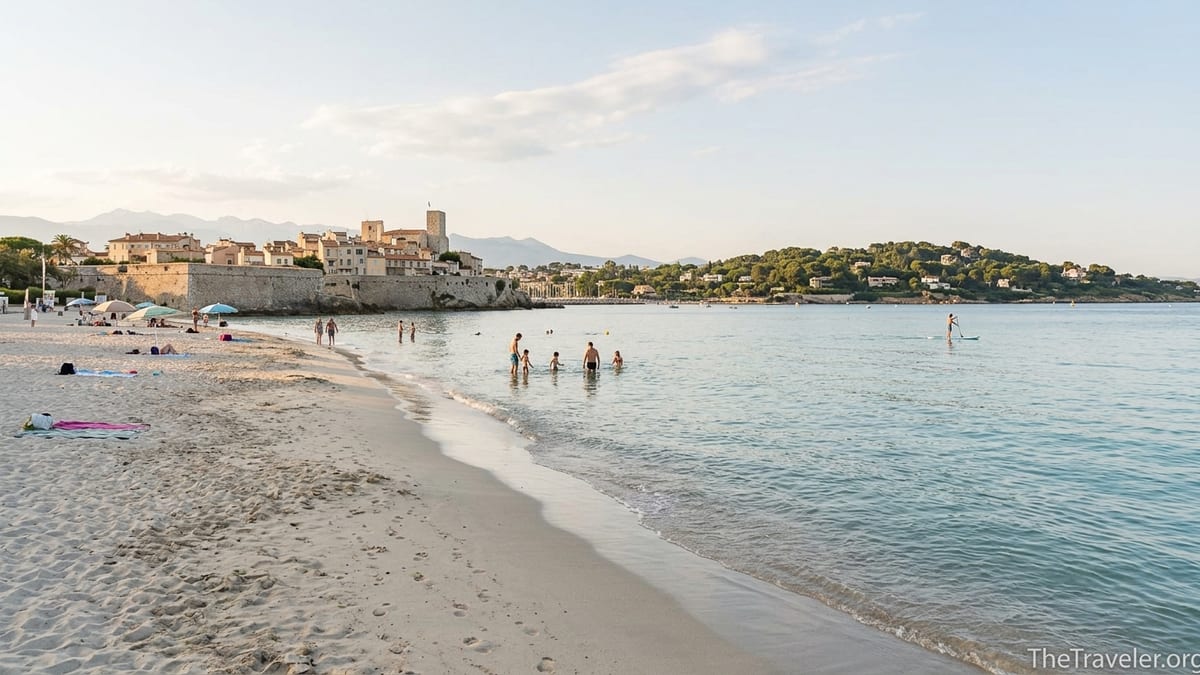
Plage du Ponteil sits just south of Antibes’ old town, running along Boulevard James Wyllie with the stone ramparts and Fort Carré on one side and Cap d’Antibes on the other. The beach is long and shallow, with calm water that feels more like a lagoon than open sea. Locals tend to choose Ponteil when they want an easy, no‑fuss swim close to town without trekking out to the more remote coves of Cap d’Antibes.
What makes Ponteil particularly appealing is the combination of views and practicality. From the sand you can look back to the old town skyline, pick out the Picasso Museum in the former château, and on clear days see the Alps rising behind Nice. At the same time you have lifeguards in season, showers, public toilets, and a flat promenade that makes access simple if you are carrying beach bags or pushing a stroller.
The vibe is family‑oriented and relaxed. You are likely to see French grandparents supervising children at the water’s edge, office workers slipping in for a lunchtime swim, and a mix of visitors who have chosen Antibes over busier Nice or Cannes. The result is a beach that feels lived‑in rather than stage‑managed, with enough space to breathe outside of the busiest August weekends.
The beach is officially public and free to access. While the neighboring Plage de la Salis has a slightly wider sweep of sand, many residents quietly prefer Ponteil for its softer atmosphere and those straight‑on views of the ramparts and the curve of Cap d’Antibes.
Timing Your Visit for the Quietest Moments
If your goal is quiet, the hour of the day matters more than the day of the week. On a typical July or August morning, arriving between 8:00 and 9:30 am often means sharing the beach mainly with locals, joggers on the promenade, and a few paddleboarders far out in the bay. The light is still soft, the sand cool underfoot, and conversations stay low enough that you can hear the gentle slap of water against the buoys.
By late morning the character changes. Around 11:00 am, families start arriving with parasols and coolers, and by mid‑afternoon in high season the central stretch of Ponteil fills in. If you prefer a quieter atmosphere but still want warmth and swimmable water, plan on early mornings or the last two hours of daylight. On summer evenings, locals often return after 6:30 or 7:00 pm with a simple picnic from a bakery in the old town, when day‑trippers have drifted back to trains and the sun drops behind the hills above Nice.
Seasonal timing matters as well. Late May and June, and then September into early October, can be sweet spots. The water is usually warm enough for comfortable swimming, yet schools are in session and coach tours are fewer. On a clear Tuesday in mid‑September, you might find generous spaces between towels even in the middle of the day, and you will have a better chance of finding parking close to the sand.
Weather can reshape the experience. Ponteil is naturally sheltered by the curve of the bay, so even when the Mistral kicks up whitecaps farther west, the water here often remains relatively smooth. After heavy rain, local authorities sometimes advise against swimming for a day or two due to runoff; check posted notices on the beach access signs or ask the lifeguards in season rather than assuming the water is always at its best.
Where to Sit for the Best Views and More Space
Although Ponteil is one continuous arc of sand, different stretches offer different moods. The section closest to the old town, near the small sailing club and the end of the ramparts, frames Antibes beautifully. If you settle here and sit facing east, you will see stone walls, terracotta roofs, and the square tower above the Picasso Museum rising above the waterline. This is a favorite area for photographers around golden hour, so expect more people with cameras and tripods lingering near the water’s edge as the light softens.
For a slightly quieter pocket in busy months, walk farther along towards the western end, near where Ponteil meets the start of Plage de la Salis. The sand here tends to have fewer dense clusters of umbrellas than the stretches closest to the promenade entrances. On a typically busy summer Saturday, that extra five‑minute walk from the old town can translate into noticeably more personal space between towels and a murmur of conversation instead of a constant background roar.
If your priority is a calm, unhurried swim, look to the sections marked off by buoys and watch where older local swimmers choose to enter the water. Many of them favor the middle of the beach, where the gradient into the sea is gentle and the sandy bottom stretches for a long way without rocks. The shallow shelf extends dozens of meters, so you can wade out waist‑deep while still seeing your feet clearly against the pale sand.
For people‑watching combined with a panoramic backdrop, sitting closer to the promenade can be rewarding. From there, you can watch locals walking their dogs, parents pushing strollers, and cyclists rolling towards Cap d’Antibes, all with the line of masts from the yacht club and the outline of the Alps hovering in the distance. If you prefer to feel more cocooned and less observed, pushing your towel closer to the waterline creates a subtle buffer between you and the flow of the walkway.
Practical Access, Parking, and Facilities
Ponteil’s accessibility is one of its strongest advantages. From Antibes’ old town, you can walk to the beach in roughly 10 to 15 minutes. A typical route runs from Cours Masséna, where the daily market takes place, along Boulevard d’Aguillon, and then down to the seafront before you pick up the promenade that curves around to Ponteil. The walk is mostly flat, making it realistic even if you are carrying a beach bag, a foldable chair, and a parasol.
Behind the beach sits a long, tree‑shaded parking strip that locals aim for when they are coming with heavier gear or young children. In high summer, drivers often start filling these spaces by mid‑morning. If you arrive later and find the waterfront full, your next realistic options are underground car parks closer to the center, such as garages near Place du Général de Gaulle or the station, followed by a 10 to 20 minute walk down to the sea. Outside of July and August, however, it is often possible to park within a few minutes’ walk of the sand, especially on weekdays.
The beach is equipped with showers and public toilets set back from the sand, and there are simple snack kiosks and small cafés nearby where you can buy coffee, cold drinks, or a basic sandwich. Prices for a takeaway jambon‑beurre or pan bagnat typically sit below what you would pay in a sit‑down seafront restaurant in nearby Juan‑les‑Pins, although you are still paying Riviera rates rather than inland village prices. Many visitors choose to pick up pastries and fruit at the market in the old town in the morning, then use the beach facilities merely as a base for rinsing off and changing.
Ponteil is also one of Antibes’ more accessible beaches for travelers with limited mobility. A paved promenade runs the length of the beach, and seasonal ramps and designated access points make it easier to move from walkway to sand. In the main summer period, staff and adapted equipment may be available to assist people who need help transitioning from shore to water, so it is worth checking the signs by the main access or asking the lifeguards what support is on offer that season.
Quiet‑Minded Activities and Photo‑Worthwhile Moments
While Ponteil certainly accommodates beach games and family noise, it also lends itself to slower pursuits that keep the atmosphere gentle. Early in the day, you will see locals swimming steady laps parallel to the buoys, using the flat water as an outdoor pool. If you enjoy moving meditation, joining them for a quiet swim just after sunrise can be one of the most peaceful ways to start a day on the Riviera, with the old town still in shadow and the first light hitting the higher hills behind Nice.
Kayak and paddleboard rentals are typically available a short stroll away near the sailing club and neighboring beaches. Instead of treating these as high‑energy activities, you can use them to find your own pocket of calm. Paddling slowly out until the beach becomes a soft line of color gives you a new angle on Antibes, with the stone walls and tiled roofs layered against the hinterland peaks. Go early in the morning or later in the afternoon, when rental queues are shorter and the water is less busy with swimmers.
Photography is another way to savor Ponteil without adding to the noise. The classic image is taken from the sand looking back to the old town, but you can also walk to the end of the beach and up a short way towards Square Albert 1er. From there, you get a slightly elevated view that pulls the beach, Antibes, and the Alps into the same frame. Around January and February on very clear days, the contrast between snow on the peaks and sun on the water can be striking, even if it is too cool for swimming.
In the evenings, Ponteil becomes a favored spot for informal picnics. Stopping by a deli counter in the old town for a tub of olives, some local cheese, and a baguette, then carrying everything down to the beach, can turn a simple dinner into a memorable quiet moment. You might have a group playing soft guitar at one end and children finishing sandcastles at the other, but compared with many Riviera seafronts lined with loud bars, Ponteil tends to wind down gently as the sky darkens.
Linking Ponteil with Antibes Old Town and Nearby Beaches
One of the best ways to experience Ponteil is to think of it as a chapter in a longer, slow day. You can start in Antibes’ old town with coffee near the Cours Masséna market, browse stalls for fruit and local socca, then walk out along the ramparts towards Plage de la Gravette. From there, a coastal stroll takes you past Port Vauban and eventually along the seafront road to Ponteil, with constant views across the bay.
After a swim and a few hours of reading on the sand at Ponteil, you might feel ready for a change of scenery. Continuing along the promenade brings you to Plage de la Salis, another sandy public beach with its own strong views back to the old town and out towards the forested slopes of Cap d’Antibes. Salis is a touch livelier, with more activity in the shallows and a sense of being at the threshold of the cape. Walking this entire curve from the old town to Salis and back, with a swim at Ponteil as the centerpiece, makes for a full yet unhurried day without ever needing a car or bus.
More energetic travelers sometimes combine Ponteil with a portion of the coastal path around Cap d’Antibes. From the far end of Salis, you can continue along the shoreline towards Plage de la Garoupe, where the water deepens to a brilliant turquoise and the views open wider across the bay. Even if you only walk a short section of the famous Sentier du Littoral before turning back, the contrast between Ponteil’s sheltered bay and the rockier coastline of the cape sharpens your appreciation of each.
In the other direction, a short stroll from Ponteil back towards town leads you to small viewpoints where the line of the beach curves perfectly between the old town and the cape. These are good spots to pause if you want the scene without the sand, perhaps on a cooler day in spring when you are more interested in photographs and sea air than sunbathing. The walkways here are mostly flat and well surfaced, so they suit travelers who like to explore at a gentle pace.
Staying Nearby for Early Mornings and Late‑Day Calm
If experiencing Ponteil at its quietest is a priority, staying within walking distance makes a noticeable difference. Accommodation in the streets between Boulevard Albert 1er and the seafront puts you close enough that you can step onto the sand within five to ten minutes of leaving your front door. That makes it easy to pop down for a sunrise swim before breakfast or slip out for a final paddle after dinner without worrying about parking or bus times.
Many rentals in this area are modest apartment blocks rather than large hotels, often with small balconies and, if you are fortunate, a partial sea view. Travelers who have stayed here often mention the convenience of being able to leave beach gear in the car or apartment and walk down with just a towel and a book. If you are traveling with children, being able to retreat quickly for naps or to escape the brightest midday sun can be a major advantage.
Alternatively, basing yourself in Antibes’ old town combines atmosphere with reasonable access to Ponteil. From a quiet side street in the historic center, you can still be at the beach in roughly a quarter of an hour. This setup suits travelers who want evenings in the stone lanes with restaurants and wine bars, but who also value the option of low‑key mornings or afternoons at a sandy beach without relying on public transport.
Compared with staying in Juan‑les‑Pins or Nice, both of which have their own merits, being near Ponteil positions you slightly away from the busiest nightlife while keeping you close to day‑trip options. Regular regional trains connect Antibes with Cannes, Nice, and Menton, so you can explore livelier seafronts and then return to Ponteil’s softer mood when you are ready for some quiet again.
The Takeaway
Experiencing Plage du Ponteil at its best is less about finding a hidden secret and more about paying attention to timing and small choices. Arriving early or late in the day, drifting a little farther down the sand from the main entrances, and combining beach time with slow walks to and from the old town all help you find the space and calm you are looking for.
Ponteil rewards those who keep things simple. A towel, a paperback, a bag of fruit from the Cours Masséna market, and perhaps a rented paddleboard are often all you need. In return, you get that rare mix of practical facilities, family‑friendly shallows, and expansive views that stretch from medieval ramparts to distant Alpine peaks.
Whether you use it as your daily ritual while staying nearby or as a half‑day escape from busier hubs along the Riviera, Ponteil can still feel surprisingly gentle for such a central beach. With a bit of planning, it becomes not just another stop on a French Riviera itinerary, but a place where you remember the feel of quiet water and the sight of Antibes glowing in late afternoon light.
FAQ
Q1. How do I get to Plage du Ponteil from Antibes’ old town without a car?
You can walk from the old town in about 10 to 15 minutes by following the seafront promenade past Port Vauban and continuing along Boulevard James Wyllie until you reach the main beach access points.
Q2. When is Plage du Ponteil usually the quietest?
In summer, the quietest times are generally early morning before 9:30 am and the last couple of hours before sunset. Outside of July and August, weekdays in late spring and early autumn are often very calm.
Q3. Is the water at Plage du Ponteil suitable for children and less confident swimmers?
Yes, the bay is shallow for a long distance and usually very calm, which suits children and people who prefer to stand or wade. As always, conditions can vary, so check the flags and follow lifeguard advice in season.
Q4. Are there showers and toilets at the beach?
Yes, Ponteil has public showers and toilets set back from the sand. They are basic but practical, and they make it easy to rinse off and change before walking back into town.
Q5. Can I rent sun loungers or umbrellas on Plage du Ponteil?
Facilities change slightly from season to season, but there are usually areas nearby where you can hire loungers and umbrellas, especially closer to adjacent beaches and beach restaurants. Many visitors still bring their own lightweight chairs and parasols.
Q6. Is Plage du Ponteil accessible for travelers with limited mobility?
The promenade behind the beach is flat and paved, and there are ramps at various points to help you move from walkway to sand. In peak season, adapted equipment and staff may be available to assist access to the water, so check the notices near the main entrance.
Q7. How difficult is parking near Plage du Ponteil in summer?
There is a long parking strip behind the beach, but it can fill up by mid‑morning in July and August. If you arrive later, you may need to use underground car parks closer to the center and walk 10 to 20 minutes to the beach.
Q8. Are there restaurants or cafes directly on the beach?
You will find simple snack kiosks and small cafes within a short walk of the sand, serving drinks, ice cream, and light meals. For a wider choice of restaurants, many people head back towards the old town or continue to the seafront in Juan‑les‑Pins.
Q9. Can I combine a visit to Plage du Ponteil with the coastal path around Cap d’Antibes?
Yes. A common plan is to spend the morning or early afternoon at Ponteil, then walk on to Plage de la Salis and continue towards the start of the Cap d’Antibes coastal path near Plage de la Garoupe for a short scenic section.
Q10. Is Plage du Ponteil a good base for exploring other towns on the French Riviera?
Staying within walking distance of Ponteil in Antibes gives you easy daily beach access while keeping you close to the train station. From there, regular regional trains connect you to Nice, Cannes, Monaco, and other Riviera towns for day trips.