


Plage du Ponteil in Antibes is one of the most accessible, family friendly beaches on this stretch of the French Riviera. Most visitors stop at the obvious: a long strip of soft sand, shallow turquoise water and postcard views of the Old Town ramparts. Yet just a few minutes off the main shoreline are quieter corners, local routines and easy paths into some of the Côte d’Azur’s most atmospheric scenery. With a little curiosity, Ponteil becomes far more than a place to spread a towel.
Get the latest updates straight to your inbox!
Understanding Plage du Ponteil Beyond the First Impression
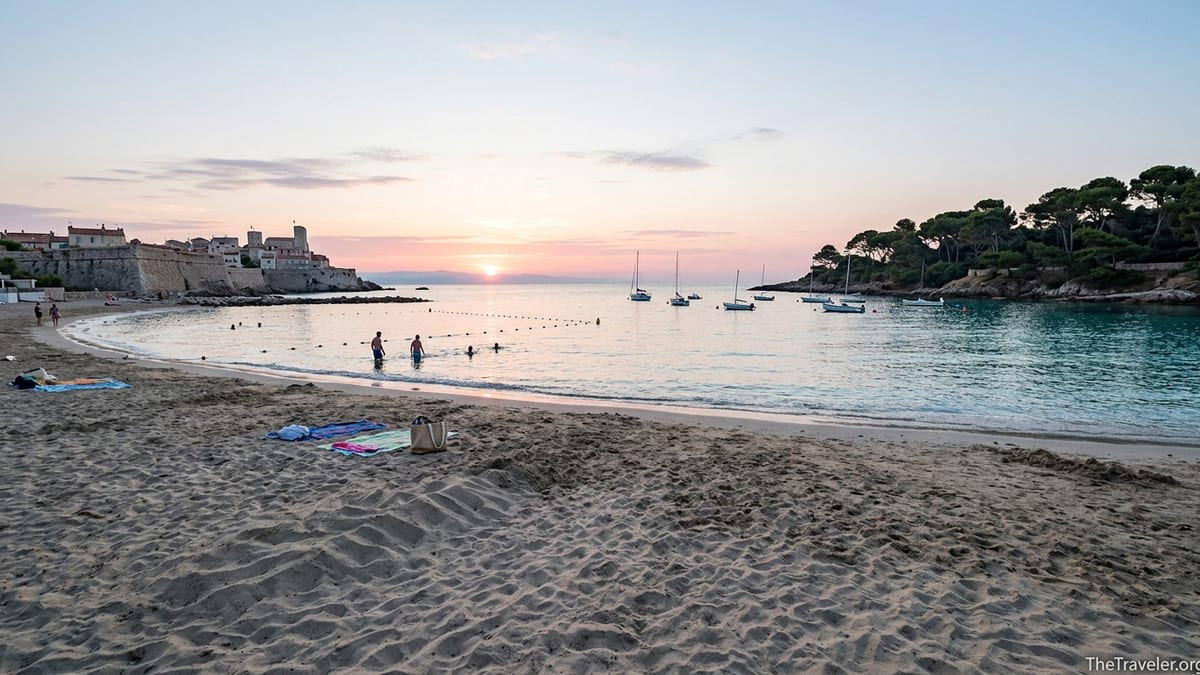
At first glance, Plage du Ponteil feels straightforward. It is a deep curve of sand on the town side of Cap d’Antibes, framed by the old stone ramparts of Antibes to the west and the pine covered headland of the peninsula to the east. Lifeguard posts and marked swimming zones make it popular with families, while a paved promenade behind the sand carries joggers, dog walkers and locals heading home with baguettes.
Because it is so central and easy, many visitors treat Ponteil as a simple beach stop before moving on to better known sights like the Picasso Museum or the glam private beaches on Cap d’Antibes. They rarely walk to either end of the bay, explore the rocks, or follow the promenade as it curves toward Plage de la Salis and the foot of the cape. That is where the character of the area really reveals itself.
Spend an entire morning or late afternoon here instead of rushing through, and you start to notice the details: the shallow gradient that lets children wade out far from shore, the small boats moored just beyond the swimming buoys, and the steady rhythm of locals taking a quick dip before work or at sunset. Ponteil is not just a beach; it is the front garden of Antibes, with several quiet corners that most short term visitors never reach.
The Overlooked Ends of the Beach: Rocks, Views and Quiet Corners
Most people stop in the central section of Ponteil, where rental sunbeds, snack kiosks and pedalos cluster in high season. Walk five minutes toward either end of the bay and the atmosphere changes. To the east, near the small Port de la Salis, the sand narrows and gives way to low rocks. This area is less convenient for umbrellas but much better for those who like to sit with their feet in the water or slip on a mask and snorkel around the stone outcrops. In summer you will often see locals with simple Decathlon masks and fins exploring the rocks before breakfast.
The western end, closest to the Old Town ramparts, is even more commonly overlooked. Here, the beach is backed by the fortified walls of Antibes and by a wide pedestrian path. It is an excellent place to lay a towel if you want shade later in the afternoon, because the sun dips behind the ramparts earlier than in the central stretch. From this end you also get one of the best perspectives on the medieval skyline of Antibes, especially around golden hour when the stone glows softly and the Alps often appear as a pale blue sawtooth behind Nice.
These ends of the beach are where you will find quieter picnic spots. Instead of the standard panini at the first snack stand you see, pick up a paper wrapped socca or a slice of pissaladière from a bakery in the Old Town, then walk five to ten minutes back to Ponteil and settle at the margins of the sand. You will likely be surrounded by local families, older couples with folding chairs, and teenagers playing paddleball, rather than a dense cluster of day trippers.
Snorkeling and Rock Pools: A Different Way to Experience the Bay
Plage du Ponteil is known for its gently shelving seabed, which is ideal for nervous swimmers and children. What many people miss is that the edges of the bay, particularly toward Plage de la Salis, offer surprisingly good conditions for casual snorkeling on a calm day. The water here is usually clearer than along the main town beaches further west, and the clusters of rocks close to shore create small habitats for fish and sea urchins.
A practical approach is to bring a simple mask and snorkel rather than full scuba style gear. Enter the water from the sand, swim parallel to the shore toward the rocky edges, and you will start to see schools of small fish like saupe and wrasse flitting among the stones. In late summer, when the sea is warmest, you may notice sea cucumbers on the seabed and the occasional starfish clinging to submerged rocks. It is modest by tropical standards but far richer than you would expect only a few minutes from a busy promenade.
At low sea states, shallow rock pools around the eastern edge become natural aquariums for children. Parents often set up their base on the sand and then wander over with nets and plastic buckets to let youngsters peer at tiny crabs and shells in ankle deep water. The key is timing: arrive early when the water is relatively calm, ideally before the afternoon breeze raises chop on the surface. This is also when underwater visibility tends to be best, turning an ordinary beach day into an easy, equipment light mini snorkeling excursion.
The Promenade Route to Plage de la Salis and the Gate to Cap d’Antibes
One of the simplest but most rewarding things that many visitors skip is the short coastal walk from Plage du Ponteil to nearby Plage de la Salis. Following the promenade east for about ten to fifteen minutes turns a static beach stop into a mini coastal stroll with ever changing views of the Old Town. As you walk, the fortified walls fall behind you, the masts of small sailboats appear, and the profile of Cap d’Antibes rises ahead.
Plage de la Salis itself is another broad, sandy beach, yet its setting feels slightly wilder than Ponteil. Pine trees lean over the sand, and from here the path continues around the headland, eventually linking with the famous coastal trail of Cap d’Antibes. Many travelers drive straight to the more remote beaches of the cape or start the longer Sentier du Littoral hike from La Garoupe, but for anyone based in central Antibes, the Ponteil to Salis stretch is an easy way to taste the landscape without needing a car.
For a simple half day, spread your towel at Ponteil in the morning, then walk the promenade to Salis around midday when the sun is high and the color of the water intensifies. Stop for a coffee or a cold drink at one of the casual seafront cafés near Salis, then either walk back along the shore or continue a little further to see the first villas of Cap d’Antibes peeking above the pines. The return route at the end of the afternoon, with the sun starting to sink over the Esterel hills, often gives some of the most photogenic light of the day.
Morning Rituals and Sunset Scenes Locals Keep to Themselves
Because Ponteil is so close to the center of Antibes, it has become woven into daily routines in a way that many visitors do not notice. Before 9 a.m., especially outside the peak of July and August, the beach is dominated by locals. Retirees walk slowly along the waterline, stopping for a chat before wading in for a brief swim. Office workers arrive by bicycle, lock up along the promenade railings, and dive in for ten refreshing minutes before heading to work in town.
Joining this early rhythm gives a completely different impression of the beach. The sea is usually calmer, the light soft and slanting, and the main soundtrack is the clink of rigging on sailboat masts rather than loud music or children’s games. If you buy a takeaway espresso from a café on Boulevard d’Aguillon or near the Marché Provençal and carry it down to the sand, you will see Antibes at its most relaxed and unvarnished.
Evening brings another shift. Many day trippers leave by late afternoon, especially those coming from Nice or Cannes for a few hours at the beach. From around 6:30 p.m. in summer, Ponteil belongs mainly to locals again and to overnight visitors staying in nearby apartments and hotels. Small groups arrive with bags of baguette, cheese and rosé or chilled soft drinks from the supermarket, then settle in for a sunset picnic. The view across the bay often includes the pink glow on the mountain range behind Nice and the twinkling lights of the port as boats return.
Using Ponteil as a Base for Walks and Urban Exploration
Plage du Ponteil is more than a place to swim; it is a natural hub that lets you combine sea time with gentle urban exploration. From the promenade behind the sand, you can reach the Old Town in roughly ten to fifteen minutes on foot. That makes it easy to split your day into beach and culture without needing transport. A typical pattern for many repeat visitors is to swim in the morning, walk into town for lunch in the Marché Provençal area, then return to the beach for a late afternoon dip.
On the inland side of the beach, small residential streets behind the promenade give a quick glimpse of everyday life in Antibes. Modest apartment buildings with balconies overlook pocket sized gardens, laundry hangs from windows, and electric scooters lean against stairways. You can wander these backstreets for a few minutes on the way to or from Ponteil and quickly feel a world away from the polished boutiques nearer the yacht harbor.
For walkers comfortable with a slightly longer outing, Ponteil is also a natural first step toward a bigger circuit around the base of Cap d’Antibes. From the beach, follow the coast toward Salis, then continue along the foot of the cape to reach the start of the more rugged coastal trails around La Garoupe and beyond. Even if you do not complete the full loop, walking for an extra half hour opens up rewarding viewpoints towards the Lérins Islands off Cannes and along the jagged coastline to the west.
Practical Tips, Costs and Seasonal Nuances Most Guides Skip
Because Ponteil is a public, unsupervised stretch for much of its length outside the central lifeguarded zones, costs here remain relatively modest compared with the private beach clubs further along the Riviera. Laying a towel on the sand is free, and while there are paid loungers in high summer, many locals prefer to bring their own lightweight foldable chairs or mats. Small supermarkets within walking distance of the Old Town mean you can assemble a picnic for two at a fraction of the price of a meal in a seafront restaurant, especially if you opt for simple items like tomatoes, fresh bread, olives and a wedge of local cheese.
Parking can be the main challenge in peak season. Several small car parks and on street spaces line the roads around Ponteil and Salis, but they often fill by late morning in July and August. If you are staying in Antibes itself, walking is generally faster than trying to park close. Visitors based in nearby towns often find it easier to arrive by regional train into Antibes station and walk roughly twenty minutes down through the Old Town to the water rather than driving in.
Seasonality changes the character of the beach more than its appearance. In July and August, expect dense crowds in the central sections from late morning onward, inflatables in the water, and a lively, often noisy atmosphere. In late September or early October, on the other hand, the same sand may host only scattered groups of locals sunbathing on towels, with plenty of space between them. Sea temperatures remain pleasant well into autumn most years, which makes this shoulder season one of the most rewarding times to discover the subtler sides of Ponteil without the press of summer tourism.
The Takeaway
Plage du Ponteil is often filed away in guidebooks as simply a convenient town beach in Antibes, a place to cool off before moving on. Spend a little more time and curiosity here, and it becomes a lens through which to understand daily life on this stretch of coast. From the quiet rocky corners where fish circle below your fins, to the early morning swims of office workers and the easy promenade that leads you toward the pine fringed beaches of Cap d’Antibes, Ponteil rewards those who wander beyond the most obvious patch of sand.
Using the beach as a base for small explorations, rather than as a standalone destination, changes the rhythm of a day in Antibes. Instead of checking off sights, you weave together swims, walks, simple food and casual observation into something more relaxed and memorable. That, more than any single viewpoint or cove, is what most visitors miss when they never look beyond the main shoreline of Plage du Ponteil.
FAQ
Q1. Is Plage du Ponteil suitable for families with young children?
Yes. The water is shallow for a long way out, there are marked swimming zones in season, and the sand is soft enough for young children to play comfortably.
Q2. How long does it take to walk from Plage du Ponteil to Plage de la Salis?
Allow about ten to fifteen minutes at a relaxed pace along the flat seaside promenade, with views of the Old Town behind you and Cap d’Antibes ahead.
Q3. Are there showers and toilets at Plage du Ponteil?
In the main central area of the beach there are usually basic public facilities such as outdoor showers and nearby toilets, especially during the summer season.
Q4. Can I snorkel directly from Plage du Ponteil?
Yes. While the central sandy area is best for simple swimming, the rocky edges near Plage de la Salis offer clearer water and more marine life for casual snorkeling.
Q5. What is the best time of day to visit if I want to avoid crowds?
Early morning and late afternoon are generally quieter, particularly outside late July and August, when many day visitors have not yet arrived or have already left.
Q6. Is parking available near Plage du Ponteil?
There are small car parks and on street spaces near the beach, but they can fill quickly in summer. Walking from central Antibes is often easier than trying to park nearby.
Q7. Are there places to buy food and drinks close to the beach?
Yes. Simple snack stands and cafés operate near the beach in season, and the Old Town of Antibes, with bakeries and small supermarkets, is within easy walking distance.
Q8. Can I combine a visit to Plage du Ponteil with a walk on Cap d’Antibes without a car?
Yes. From Ponteil you can walk along the promenade to Plage de la Salis and continue toward the cape, reaching the start of longer coastal trails entirely on foot.
Q9. Is Plage du Ponteil open year round?
The beach itself is accessible throughout the year. Lifeguard services and some facilities operate mainly in the warmer months, typically from late spring to early autumn.
Q10. Are there quieter spots if the central beach feels crowded?
Yes. Walk a few minutes toward either end of the bay, especially near the rocks by Plage de la Salis or under the Old Town ramparts, where the atmosphere is usually calmer.