


Just west of Naples, beyond the familiar cone of Vesuvius, lies another, far stranger volcano. At first glance the Phlegraean Fields look harmless: a patchwork of suburbs, Roman ruins, fishing harbors and low green hills. Yet beneath this everyday Italian landscape is one of the most closely watched volcanic systems on Earth, a restless caldera whose history of gigantic eruptions, slow pulses of uplift and subsidence, and recent earthquakes shapes everything from local myths to modern evacuation plans. For travelers, understanding the story behind the Phlegraean Fields is the key to appreciating not only its beauty and archaeological riches, but also the quiet tension that defines life along this bay.
Get the latest updates straight to your inbox!
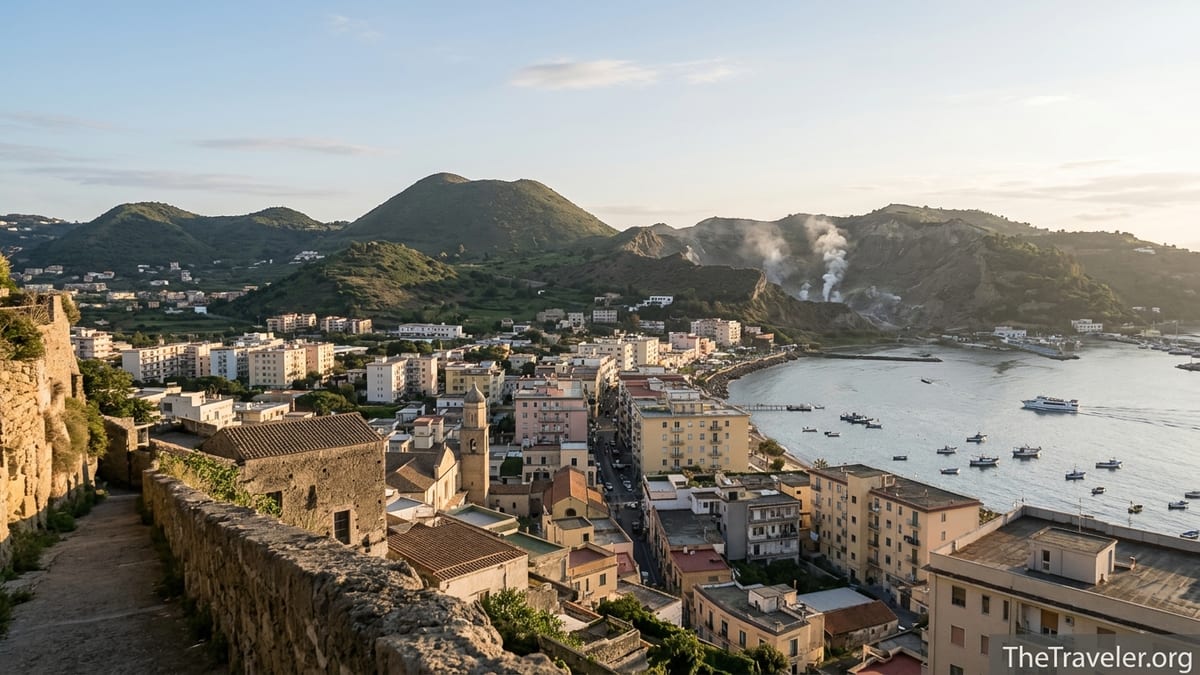
A Volcanic Giant Hiding in Plain Sight
The Phlegraean Fields, or Campi Flegrei, form a vast, 12–15 kilometer wide volcanic caldera stretching from the western edge of Naples out through Pozzuoli, Bacoli and the Bay of Pozzuoli. Unlike the iconic profile of nearby Vesuvius, this volcano is mostly invisible from a distance. Its rim is made of low hills such as the Astroni crater and the slopes above Pozzuoli, while inside the caldera you find apartment blocks, vineyards, football pitches and train lines. As your Circumflegrea commuter train rattles between Naples and Torregaveta, you are literally crossing the floor of a supervolcano.
Geologically, the caldera is the scar left by two enormous eruptions in the late Pleistocene. The older Campanian Ignimbrite event, around 40,000 years ago, spread ash across much of the Mediterranean and even into Eastern Europe. A later eruption about 15,000 years ago, often called the Neapolitan Yellow Tuff eruption, reshaped the coastline again. Today, tuff from these eruptions forms the yellow stone used in historic buildings in Naples, a tangible reminder that the city’s architecture is quarried from ancient ash.
For visitors, this scale is easiest to grasp at viewpoints along the seafront in Pozzuoli. Looking back toward Naples you can see the gentle sweep of the caldera rim, with no high peak to anchor the eye. It feels like a normal bay, lined with cafes and fishing boats, yet volcanologists rank Campi Flegrei among the most hazardous volcanic systems in the world precisely because so many people live on top of it.
This juxtaposition of the ordinary and the extraordinary runs through every part of the Phlegraean story. A morning here might begin with espresso in a bar beneath a hillside that is itself a vent from a past eruption, continue with a walk through Roman markets deformed by centuries of ground movement, and end with a sunset over fumaroles where the volcano still breathes.
From Super‑Eruptions to Small Cones: A Compressed History
The long history of the Phlegraean Fields is written in overlapping craters, lava domes and layers of ash. After the great caldera‑forming eruptions, activity did not stop. Instead, the system shifted into a new phase, with smaller but still powerful eruptions building individual vents within the larger caldera. One of the most striking examples for travelers is Monte Nuovo, the “new mountain” that rose almost overnight in the 16th century.
In September 1538, after days of earthquakes and steaming ground, an eruption began near the fishing village of Tripergole on the shore of the Bay of Pozzuoli. Over the course of about a week, explosions blasted ash and scoria into the air, and a 120‑meter high cinder cone gradually took shape. By early October, Monte Nuovo stood where the village and part of the coastline had been. Today visitors can hike a short trail from the modern town of Lucrino to the crater rim in less than half an hour, looking down into a quiet bowl of scrub and pines that belies its violent birth.
Other vents tell older stories. The Solfatara crater, traditionally famous for its fumaroles and boiling mud, is the eroded remains of an eruption more than four thousand years ago. Farther north, near Cuma and the Arco Felice, layers of volcanic tuff preserve evidence of eruptions that were already ancient by the time the Greeks founded their colonies here. Each of these features marks a moment when magma and gas forced their way to the surface, reconfiguring the land that modern travelers now cross by road and rail.
Importantly, not every eruption in the Phlegraean Fields has been catastrophic. Most documented events over the last few tens of thousands of years were smaller, localized eruptions, disruptive on a regional scale but nowhere near the caldera‑forming super‑eruptions of the distant past. Modern hazard planning is built around this record, considering scenarios from modest ash‑producing events to larger explosive eruptions, and it shapes how authorities manage everything from building codes to signage in train stations.
Bradyseism: When the Ground Gently Breathes
One of the most distinctive and unsettling features of the Phlegraean Fields is bradyseism, a slow vertical movement of the ground that can last years or decades. The term, from Greek roots meaning “slow movement,” describes cycles in which the caldera floor gradually rises and then subsides, sometimes by meters. These movements are not theoretical. Travelers can see their imprint in Roman ruins that currently sit below sea level, and in tide‑gauge data collected at Pozzuoli harbor since the early 20th century.
Historical records describe significant uplift episodes in the 1970s and 1980s, when the town of Pozzuoli rose by roughly 3 meters in little more than a decade. As pavements cracked and the harbor shallowed, authorities evacuated tens of thousands of residents from the Rione Terra district. Many families were rehoused in new suburbs upland from the old town, and the historic quarter remained largely abandoned for years. Today, when you walk through the restored lanes of Rione Terra, interpretive panels explain how doors and windows that once opened at street level ended up meters higher than the warped paving stones below.
Since about 2005 the caldera has entered another phase of uplift. Monitoring by Italy’s National Institute of Geophysics and Volcanology (INGV) shows that the center of Pozzuoli has risen by well over a meter in less than two decades. Residents feel this mostly through swarms of small earthquakes, typically of low magnitude, that occasionally rattle windows and nerves. For visitors staying in seafront hotels or guesthouses, these tremors can be an unexpected reminder that the ground beneath them is not static.
Scientists attribute bradyseism to pressure changes in a complex system of magma and hydrothermal fluids at several kilometers depth. As hot fluids and gas accumulate, they expand and lift the overlying rock. When pressure drops or pathways open, the ground can subside again. The details are still being researched, with recent studies using everything from satellite radar to thermal cameras to track subtle changes in temperature and ground motion across the caldera.
A Landscape of Steam, Ruins and Everyday Life
The Phlegraean Fields are one of the few places where an active caldera, a major metropolitan area and world‑class archaeological sites share the same compact space. This creates a landscape in which daily life, ancient history and volcanic processes overlap so tightly that it can be difficult to say where one ends and another begins. A walking circuit around Pozzuoli offers a clear example of how these layers coexist.
Begin at the Macellum of Pozzuoli, often called the Temple of Serapis, a Roman marketplace whose columns are banded with holes bored by marine mollusks. These marks show that the floor of the building once lay below sea level for centuries before rising again, a physical gauge of bradyseism. Just a few minutes away, cafes bustle on the modern waterfront while ferries depart for Ischia and Procida. From a table beside the harbor you can watch fishermen unloading their catch onto a quay that has itself shifted up and down relative to the sea over historical times.
Not far to the northwest, the archaeological park of Baiae preserves the remains of luxurious Roman villas and bath complexes that once lined the shore of a sheltered bay. Today many of these ruins lie underwater in a protected marine area, accessible only to snorkelers and divers on guided tours. The partly submerged columns and mosaic floors owe their position to the same long‑term caldera dynamics that affected Pozzuoli. For travelers, a glass‑bottomed boat trip over the site doubles as both an archaeological excursion and a lesson in slow geological change.
Overlaying all this are the subtle signs of current volcanic activity. The famous Solfatara crater, long a tourist stop for its sulfur vents and hissing fumaroles, remains closed to casual visits for safety reasons after incidents and tightening regulations. However, the steam plumes at nearby Pisciarelli, on the slopes above the Agnano area, are visible from public roads, especially on cool mornings when white vapor contrasts with the dark slope. Locals drive past on their way to work or to the big suburban shopping centers, an everyday routine unfolding against a background of ongoing volcanic unrest.
Modern Monitoring and Recent Unrest
Because so many people live on and around the Phlegraean Fields, the area is subject to exceptionally dense scientific monitoring. Networks of seismometers, GPS stations, tiltmeters and thermal cameras collect continuous data on earthquakes, ground deformation and heat flow. Research groups analyze changes in seismic wave speeds, gas chemistry and gravity to build a more detailed picture of the caldera’s “plumbing system,” the connected pockets of magma, water and gas deep below the surface.
In recent years, this monitoring has taken on renewed urgency. Between 2023 and 2025, several magnitude 4‑class earthquakes occurred beneath the caldera, including one in May 2024 that was widely felt across Naples. More recently, in 2025 the area experienced an earthquake around magnitude 4.6 associated with a seismic swarm. These events were not large in global terms, but they were the strongest recorded here in decades and prompted additional civil protection measures, building inspections and temporary closures of some archaeological sites for safety checks.
Scientific studies published between 2024 and 2026 suggest that uplift and seismicity have accelerated compared to previous years. Some research groups argue that the system could be approaching a critical transition within the next decade, although they emphasize that this does not necessarily mean a large eruption is imminent. The transition might instead involve a change in the behavior of the hydrothermal system, with uplift eventually stabilizing or subsiding. Importantly for travelers, Italian authorities operate on a precautionary basis: the area is kept under a high alert level for monitoring, but life in Naples and its suburbs continues normally, with regular public updates from the Civil Protection Department and INGV.
Practical signs of this monitoring are visible to observant visitors. Small fenced‑off concrete pillars mark GPS benchmarks along the waterfront at Pozzuoli. Information boards at train stations explain evacuation routes and color‑coded alert levels. During periods of intense seismic swarms, local news bulletins may interrupt programming to reassure residents and share official advice. For someone staying a few nights in a hotel in Pozzuoli or Bacoli, these touches provide context for the occasional tremor or news report about bradyseism that might otherwise seem alarming.
Risk, Civil Protection and Everyday Preparedness
The presence of an active caldera beneath a dense urban and suburban area has prompted Italy to develop detailed risk‑management and evacuation plans for the Phlegraean Fields. The Civil Protection Department divides the region into zones of varying hazard for ash fall, pyroclastic flows and other volcanic phenomena, and it regularly runs drills with local authorities. In 2024, for instance, a large‑scale exercise involved simulated evacuations, coordination between municipalities, and procedures for protecting cultural heritage sites like the Amphitheater of Pozzuoli and the ruins of Cuma.
For residents, this planning translates into clear information about where to go and what to do in case alert levels change. Many households receive brochures explaining evacuation routes by car, bus and train. Schools participate in emergency drills, and local governments work on assessing the vulnerability of buildings, a process given extra legal support by national decrees linked specifically to the bradyseism crisis. Over time, this fosters a culture of quiet preparedness rather than panic.
Travelers will rarely be directly affected by these measures, but they may notice the infrastructure that supports them. Road signs along the ring roads indicate designated evacuation routes toward the A1 and A3 motorways. Some hotels and guesthouses in the Pozzuoli and Bagnoli areas keep copies of civil protection leaflets at reception. During periods of stronger seismic activity, certain archaeological parks or underground sites might close temporarily for inspections, as happened in May 2024 when all sites in the Phlegraean Archaeological Park paused visits for safety checks after a notable earthquake.
From a practical perspective, visitors are advised to follow the same basic guidelines that residents do: rely on official channels for information, pay attention to instructions from local authorities, and treat temporary closures as a normal part of travel in a geologically active region. Travel insurance policies that cover trip interruption can provide an extra layer of reassurance, although it is worth reading the fine print to see how they handle natural hazard alerts and civil protection orders.
Visiting the Phlegraean Fields Today
Despite its reputation in scientific circles, the Phlegraean Fields remains very much an inhabited and visitable region. For many travelers, it offers a richer and less crowded alternative to the standard Naples and Pompeii circuit, layering volcanic history with Greek and Roman heritage, seaside life and contemporary Naples culture. A typical day might combine a morning exploration of Pozzuoli’s Roman amphitheater with lunch on the waterfront and an afternoon walk on Monte Nuovo, ending with seafood in the harbor town of Bacoli.
Access is straightforward. Local trains connect central Naples with stations across the caldera, including Pozzuoli, Lucrino and Torregaveta, in under an hour, with tickets priced similarly to other suburban lines. Buses link smaller neighborhoods to main hubs, while taxis and ride‑hailing services fill the gaps, especially in the evenings. Many visitors choose to base themselves in Naples and make day trips, but staying overnight in Pozzuoli or along the coast gives more time to absorb the atmosphere of a community that lives daily with its volcano.
Some specific sites require up‑to‑date information before visiting. The Solfatara crater has been closed to standard tourist visits for several years, and any reopening would be tightly controlled. The underwater park at Baiae operates through licensed dive centers and glass‑bottom boat operators that may adjust schedules based on sea conditions, conservation rules and any temporary restrictions linked to seismic activity. Before planning a dive or boat excursion, it is sensible to confirm current operating status via local tourism offices, hotel concierges or directly with tour providers on the ground.
Even simple experiences take on added depth once you understand the setting. Watching the sun set behind Procida from the waterfront in Pozzuoli, you are looking across part of the caldera rim. A soak in the thermal baths around Agnano draws on hot waters heated by the same system of magma and fluids that drives bradyseism. A quiet evening walk through the alleys of Rione Terra doubles as a tour through a district shaped by both Roman engineers and 20th‑century volcanic unrest.
The Takeaway
The story of the Phlegraean Fields is one of contrasts: between super‑eruptions in the deep past and the smaller but still potent events of recorded history, between the slow breathing of bradyseism and the sudden jolt of an earthquake, between scholarly anxiety about future scenarios and the calm resilience of communities who have lived with this volcano for generations. For travelers, engaging with this story turns an already fascinating destination into something deeper and more memorable.
Understanding the caldera’s volcanic history does not mean expecting catastrophe at every turn. Rather, it invites a more nuanced appreciation of a region where geology, history and daily life are inseparable. The Roman columns of the Macellum, the submerged villas of Baiae, the steep bowl of Monte Nuovo and the subtle tilt of modern streets in Pozzuoli all speak to a landscape in motion over timescales that blend human and geological memory.
As research continues and monitoring networks refine their picture of what is happening beneath the surface, the Phlegraean Fields will remain under close watch. Yet trains will keep running, ferries will cross the bay, and cafes will fill each evening with conversation. For those willing to look beyond the usual postcard views, this restless volcanic field offers one of the most compelling lessons in how people adapt to, and coexist with, the powerful forces that shape our planet.
FAQ
Q1. Is it safe to visit the Phlegraean Fields right now?
Travel to the area is generally considered acceptable by Italian authorities, who maintain continuous monitoring and clear alert systems. As with any active volcanic region, conditions can evolve, so visitors should stay informed through official channels and follow local guidance, especially during periods of increased seismic activity.
Q2. How likely is a major eruption in the near future?
Scientists agree that the Phlegraean Fields are in a phase of unrest, with uplift and frequent small earthquakes, but they cannot predict with certainty if or when a significant eruption will occur. Current research suggests a system under increasing pressure, yet possible outcomes range from continued bradyseism without eruption to smaller‑scale events rather than a super‑eruption.
Q3. What should I do if I feel an earthquake while staying in Pozzuoli or Bacoli?
If you feel shaking, follow standard earthquake safety advice: move away from objects that could fall, protect your head and neck, and avoid stairs or elevators until the tremor stops. Afterwards, listen for instructions from local authorities via television, radio or official alerts, and follow your hotel’s emergency procedures if they are activated.
Q4. Can I still visit Solfatara and other fumarole areas?
The classic tourist route inside the Solfatara crater has been closed to unrestricted visits for safety reasons, and any access that exists is tightly managed. Fumarole activity at nearby areas such as Pisciarelli is visible from public roads and viewpoints, but visitors should respect barriers and warning signs and avoid approaching active vents on their own.
Q5. Are the archaeological sites affected by the volcanic activity?
Yes, in the sense that slow ground movements and occasional earthquakes influence how sites are managed and conserved. After stronger seismic events, authorities may temporarily close areas like the Phlegraean Archaeological Park or specific ruins for inspections. In the long term, bradyseism and subsidence are part of the reason why some Roman structures sit below current sea level.
Q6. How can I learn more about the volcano while I am there?
On site, information panels at locations such as the Macellum of Pozzuoli, Rione Terra and Baiae explain the link between geology and history. Local museums and visitor centers occasionally host exhibits on volcanic risk and monitoring, and guided tours with licensed guides often weave recent scientific findings into their narratives.
Q7. Does the Phlegraean unrest affect Naples city center as well?
The strongest effects of uplift and small earthquakes are concentrated in and around Pozzuoli, Agnano and the inner caldera, though moderate tremors can be felt in Naples, especially western districts like Bagnoli and Fuorigrotta. Central Naples continues to function normally, with authorities integrating volcanic risk into broader emergency planning for the metropolitan area.
Q8. Is travel insurance necessary for a visit to the Phlegraean Fields?
While not legally required, travel insurance that includes trip interruption or cancellation can be useful, especially if your itinerary depends on specific tours or access to heritage sites. Travelers should read policies carefully to see how they address natural hazards and official closures linked to volcanic or seismic activity.
Q9. What time of year is best for visiting, given the volcanic situation?
Volcanic unrest at the Phlegraean Fields is not strongly seasonal, so the best time to visit is usually based on weather and crowd levels. Spring and autumn offer mild temperatures and fewer visitors, with the same need to stay informed about current seismic activity and any temporary restrictions.
Q10. How can I travel responsibly in such a sensitive area?
Responsible travel in the Phlegraean Fields means respecting safety barriers, following guidance from park staff and guides, and supporting local businesses that invest in preservation and risk awareness. Choosing guided visits for delicate archaeological or geothermal sites and staying informed about current conditions help both protect the area and reduce your own risk.