


Calgary International Airport, better known by its code YYC, often surprises first-time visitors. From the curb, glassy check-in halls and long concourses make the airport seem vast and potentially confusing. Yet once you step inside, Calgary reveals itself as one of Canada’s more straightforward hubs to navigate, with a layout and wayfinding system that quietly guide you from door to gate far more smoothly than you might expect.
Get the latest updates straight to your inbox!
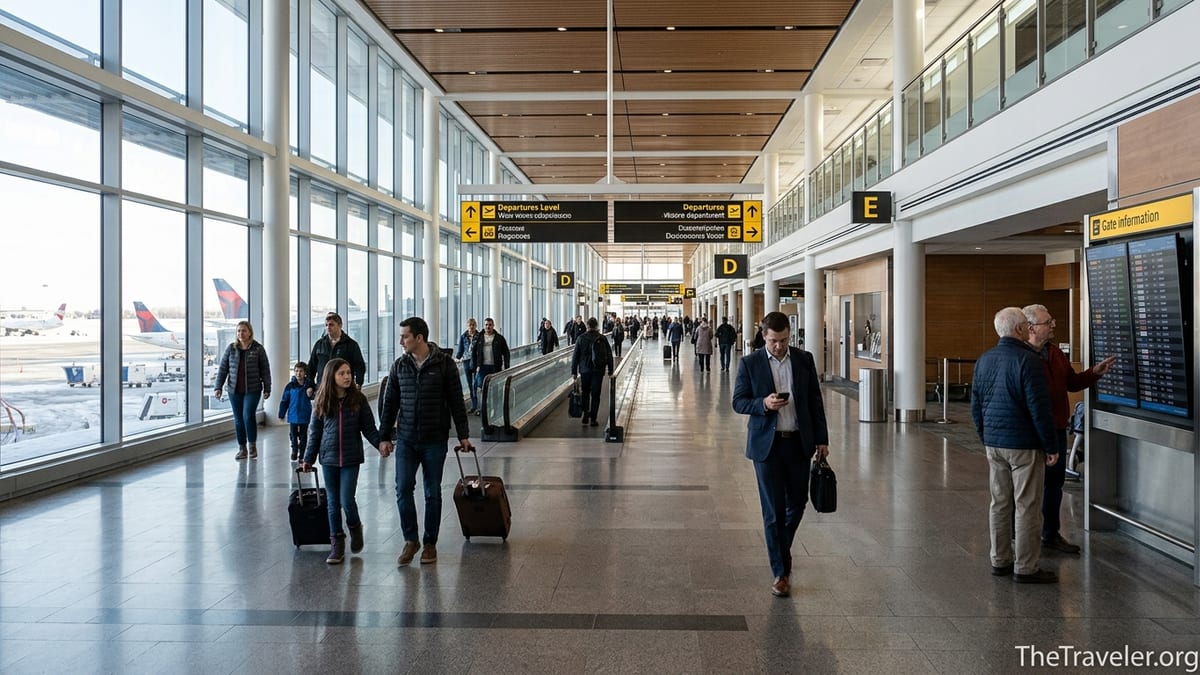
First Impressions: A Big Airport That Feels Manageable
YYC is Canada’s fourth-busiest airport by passenger volume and handles close to 19 million travelers a year. For many visitors, especially those accustomed to compact regional terminals in the Prairies or U.S. Rockies, the scale can be a surprise. The glass-fronted departures level stretches in both directions, with separate check-in islands for WestJet, Air Canada and other carriers, and long views that make the terminal feel even larger.
That sense of size grows once you clear the doors. Ahead is a high-ceilinged check-in hall, flanked by self-serve kiosks, baggage drops and long lines of counters. Overhead, signs point to domestic, international and U.S. departures. At first glance it can look like a sprawling maze. Travelers landing for the first time after a long-haul flight from London or Tokyo sometimes comment that YYC feels closer to a mini-Denver than to a regional Canadian airport.
The key difference is that Calgary’s terminals are joined into a single connected complex. Instead of multiple disconnected buildings, YYC functions as one large, continuous structure with five concourses: A, B and C for domestic flights, D for most international routes, and E for U.S. departures. Once you understand that you are moving along one main spine rather than hopping between scattered terminals, the airport starts to feel more like an elongated shopping mall than a labyrinth.
Walking distances can still be substantial. A connection from a turboprop arrival at the far end of Concourse A to a widebody flight departing from the far gates of Concourse D might involve 15 to 20 minutes of walking at a relaxed pace. But moving walkways, rest areas and clear direction signs break up the journey, so the experience feels more like a straightforward stroll than a stressful dash.
How YYC Is Laid Out: One Big Building, Five Concourses
Understanding YYC’s basic layout is the fastest way to make it feel smaller. Think of it as one joined terminal with two main halves: the original Domestic Terminal where Concourses A, B and C sit, and the newer International Terminal that houses Concourses D and E. All five concourses are linked airside once you pass security, which means that in most cases you do not have to exit and re-clear security when connecting between domestic and international flights.
In broad strokes, WestJet dominates Concourse A and much of B, Air Canada’s main base is Concourse C, international airlines such as KLM or Lufthansa typically use Concourse D, and U.S.-bound flights on carriers like WestJet and Air Canada depart from Concourse E. Actual assignments can shift, but if you know, for example, that your WestJet flight to Vancouver is likely in A or B, you can visually orient yourself as soon as you enter the check-in hall.
After you drop your checked bag, most domestic and international travelers now funnel through a single centralized security area located roughly in the middle of the building. Once you clear screening, you emerge into a post-security corridor that branches to A and B on one side, C directly ahead, and the long connector to D and E on the other. This centralized layout is a major reason why YYC, although large, remains navigable: you reach one central decision point and then follow signage to your concourse rather than threading through multiple checkpoints.
Calgary also operates the YYC Link shuttle, a small airside passenger shuttle that loops between concourses A, C and the international D/E area for much of the day. If your feet are tired after a transatlantic flight to Concourse D and your next leg leaves from Concourse A, riding the YYC Link for part of the journey can cut your walk and give you a chance to sit and regroup while still moving toward your gate.
Wayfinding and Signage: Why It Is Easier Than It Looks
The airport’s expansive footprint could easily be overwhelming, but Calgary has invested heavily in wayfinding design and digital signage. Overhead signs use consistent colors and icons to differentiate domestic, international and U.S. routes. For example, yellow-topped signs with clear gate letters and arrows help you spot your path even from across a large hall. Pictograms for baggage claim, customs and restrooms are deliberately bold and simple so they work for travelers who speak little or no English or French.
Throughout the main departures level, large flight-information displays are positioned not just at the central departures board but also at key junctions: outside security, near the forks to each concourse and beside several seating areas. This means that when your boarding gate is assigned or changes, you rarely have to walk far before you find an updated screen. For instance, if your Air Canada flight from Toronto initially shows “C gates” with no specific number, you can head to Concourse C and check the nearby screens rather than worrying about missing a last-minute gate change.
Digital displays, including those installed as part of a broader passenger communication system, reinforce static signs. When construction temporarily shifts a corridor or closes a side passage, screens can quickly redirect passengers with bright on-screen arrows and text. You might see a message such as “Temporary detour to Gates B15–B25, follow orange signs” accompanied by animated arrows. This kind of dynamic guidance helps keep the airport functioning smoothly even during renovations.
Another subtle aid to navigation is the use of architectural cues. Ceiling height, natural light and floor finishes often change as you move from the domestic to the international side of the building. Travelers walking from Concourse C toward D will notice more expansive views, larger gate lounges and artwork that subtly signals a change in zone. These environmental differences, combined with color coding on pillars and walls, help your brain keep track of where you are without your having to constantly consult a map.
Walking Times, Shortcuts and the YYC Link Shuttle
Because YYC is long and linear, walking distances can add up, but the routes are intuitive. From the central security exit, it is typically a five to eight minute walk at an average pace to most gates in Concourse C, and about ten minutes to many gates in Concourse B. More remote gates at the ends of A or D can push walking time to 15 or 20 minutes. Travelers with mobility issues can request wheelchair assistance from their airline, but even for those who are reasonably fit, it is wise to factor in a little buffer time.
The moving walkways that run along the main connectors make a real difference on tight connections. Imagine a winter evening where you land from Edmonton into a gate in Concourse B at 6:10 p.m. and your onward flight to London from Concourse D boards at 6:50 p.m. The screens and overhead signs will point you toward D, and if you stay on the moving walkways for most of the route, you can usually cover the distance in about 10 to 12 minutes without having to jog. That leaves enough time for a quick washroom stop before arriving at your gate as boarding begins.
For even longer stretches, particularly between A and the international terminal, the YYC Link shuttle is a helpful option. It operates airside between morning and late evening, following a loop that links concourses A, C and the D/E complex. The shuttle looks like a small tram and is clearly labeled, with stops adjacent to the main concourse corridors. On a typical day, if you just miss a shuttle, another will arrive within several minutes. A family arriving from a Caribbean vacation into Concourse D with young children and strollers, for example, can ride the shuttle toward Concourse A instead of pushing little ones the entire way down the long connector.
There are not many genuine “shortcuts” in the sense of hidden corridors that bypass the main routes, but Calgary’s connectors are designed to be as direct as possible. The airside passage between the Domestic and International terminals runs in a mostly straight line, aided by moving walkways and clear signage. Travellers who stay airside and follow “Connections” signs generally avoid backtracking, while those who accidentally exit to the public arrivals level may find themselves needing to re-clear security, adding extra time and stress.
Connections: Domestic, International and U.S. Flights
For connections, YYC can look intimidating on a map, yet it performs efficiently in practice, especially for domestic-to-domestic and domestic-to-international transfers. Official guidance suggests arriving two hours before a domestic departure and roughly three hours before an international or U.S. flight, in line with other major Canadian hubs. Minimum connection times for airline-protected itineraries are often under an hour for domestic and around 75 to 120 minutes when international or U.S. customs procedures are involved, so most same-ticket connections are designed to be achievable if flights are on time.
Domestic-to-domestic transfers benefit most from the unified security concept. If you land from Winnipeg at a gate in Concourse A and your continuing flight to Victoria departs from Concourse C, you simply follow “Connections” signs, stay airside and walk to your next gate. Baggage is routed by the airline, so you do not need to claim and recheck your bags. Under typical conditions, such a connection with a one-hour layover gives you enough time to walk, use the restroom and possibly grab a quick snack in the main food court near Concourse C.
International and U.S.-bound connections are more involved but still logical. Arriving from an overseas flight into Concourse D, you will route through Canada Border Services Agency inspection. After clearing immigration and customs, you will either follow signage to domestic connections, where you can drop your checked bag on a transfer belt and head back toward the domestic concourses, or, for some itineraries, proceed directly toward the transborder E concourse and U.S. preclearance. Large overhead signs mark each option, and staff in the arrivals hall can point you to the right lane if you are unsure.
For U.S. flights, YYC has a dedicated preclearance area in Concourse E. Travelers heading to destinations such as Denver, Phoenix or Los Angeles formally enter the United States before boarding. The process involves security screening plus an interview with U.S. Customs and Border Protection officers. To manage this extra step, YYC restricts access to the U.S. preclearance area to a set number of hours before departure, so arriving too early will simply mean waiting in the main terminal. Practical experience shows that a three-hour buffer before departure is comfortable during busy periods, while a bit less time can suffice for early-morning or midweek flights when queues are shorter.
Services, Seating and Stress-Reducing Touches
Beyond the basic logistics of moving people from curb to gate, YYC incorporates services and amenities that help the airport feel more human in scale. One of the most visible is the network of White Hat Volunteers, local ambassadors identifiable by their white cowboy hats and vests. Stationed at information desks and roving through the concourses, they answer questions about gates, connections, airport facilities and Calgary itself. A solo traveler arriving from Europe with a tight connection to a small Alberta city can quickly ask a White Hat Volunteer which route is fastest rather than deciphering maps on their own.
Seating areas are relatively generous, particularly in the newer D and E concourses, where high ceilings, large windows and power-equipped seating banks soften the sense of being in a vast transit space. Many gate zones feature armchairs with plug points and USB outlets, making it easier to recharge devices during longer waits. Parents with children will find play areas in the domestic concourses and kid-friendly seating near some food outlets, which makes the airport feel less like a sterile corridor and more like a series of manageable zones.
Food and retail outlets are clustered at natural crossroads, such as the central domestic food court near Concourse C and the dining street near D gates. This means you do not have to leave your desired path by far to find a coffee or a quick meal. For instance, if you are walking from B to D, passing through C brings you by multiple cafes and quick-service restaurants where you can pick up a sandwich and return to your route without losing more than a few minutes.
Digital tools add another layer of reassurance. The official Calgary Airport app and many third-party flight-tracking apps give you real-time gate information, security wait estimates and terminal maps. A traveler waiting at downtown Calgary’s central bus station can check current security wait times before catching the Route 300 airport bus, helping them decide whether to leave 15 or 30 minutes earlier. Combined with in-terminal displays, these tools reduce the uncertainty that often makes large airports feel more stressful than they need to be.
Practical Tips to Make a Big Airport Feel Small
A few simple strategies can make YYC feel even easier to handle. First, note your concourse letters as early as possible. Your airline’s confirmation email or mobile app will usually list your concourse and gate on the day of travel. Even if the gate number later changes, knowing that your flight almost certainly departs from C instead of A or D lets you aim for the right general direction as soon as you pass security.
Second, budget realistic walking time. If you are arriving on a regional flight into Concourse A and continuing internationally from Concourse D, treat the connection as a 15-minute walk at minimum. That way, when your inbound flight is slightly delayed, you will already have mentally prepared yourself for a purposeful walk rather than a stressful sprint. Families with strollers or travelers with heavy carry-ons may want to add a few extra minutes or consider using the YYC Link shuttle where convenient.
Third, stay airside whenever possible during connections. If you follow “Connections” or “International connections” signs and resist the temptation to exit to arrivals unless instructed, you avoid having to pass through security again. This is especially important for self-connecting passengers who booked separate tickets; a misstep that sends you landside can require a fresh check-in and security screening, adding 30 minutes or more to your transit time.
Finally, do not hesitate to ask for guidance. Uniformed airport staff, airline agents and White Hat Volunteers are accustomed to helping guests navigate the building. If your 50-minute WestJet layover from Saskatoon to a long-haul flight in D concourse feels tight, tell the flight attendant before landing or speak with an agent at the arrival gate. They can provide specific advice, sometimes flagging your tight connection for ground staff or reassuring you that your next gate is only a five- to ten-minute walk away.
FAQ
Q1. Is Calgary International Airport actually large compared with other Canadian airports?
Calgary is one of Canada’s busiest airports and its terminal footprint is sizeable, but it is still smaller and generally easier to navigate than Toronto Pearson or Vancouver.
Q2. How long does it typically take to walk between domestic and international gates at YYC?
Most travelers can walk between domestic concourses and the D international concourse in about 10 to 15 minutes using the main connector and moving walkways.
Q3. Do I have to go through security again when connecting at Calgary?
In many cases, no. If you follow the “Connections” signs and stay airside, you can usually move between concourses without re-clearing security, especially on same-ticket itineraries.
Q4. How much time should I allow for a domestic-to-international connection?
Airlines often sell domestic-to-international connections of around an hour, but planning for at least 75 minutes gives a more comfortable buffer for walking and possible delays.
Q5. What makes finding my way easier inside such a big terminal?
Clear overhead signage, consistent gate lettering, frequent flight-information screens, color-coded zones and helpful White Hat Volunteers all work together to guide you step by step.
Q6. Is Calgary a good airport for families and less experienced travelers?
Yes. Wide corridors, family washrooms, play areas, plenty of seating and visible volunteers make it approachable even for first-time flyers or families with young children.
Q7. How early should I arrive at YYC before my flight?
Plan around two hours before a domestic departure and three hours before international or U.S. flights, allowing extra time during peak holiday periods or severe weather.
Q8. What is the YYC Link shuttle and when should I use it?
The YYC Link is an airside shuttle that runs between parts of the domestic and international concourses; it is helpful on longer connections or when traveling with limited mobility.
Q9. Are there enough places to eat and rest without leaving my path to the gate?
Yes. Food courts, cafes and shops are positioned along the main routes, so you can grab a meal or coffee while still heading generally toward your concourse.
Q10. What should I do if I feel lost or worry I will miss my connection?
Ask the nearest airport staff member, airline agent or White Hat Volunteer for directions, and let them know your departure gate and boarding time so they can suggest the quickest route.