


Zurich Airport is one of Europe’s easiest gateways, and getting into the city centre is usually fast, reliable and straightforward. The choice, though, can feel overwhelming when you are jet-lagged and standing in the arrivals hall: train, S-Bahn, tram, taxi, Uber-style services or prebooked private transfer. This practical 2026 guide walks you through each option with realistic prices, travel times and luggage tips, then recommends the best choice for different types of traveller.
Get the latest updates straight to your inbox!
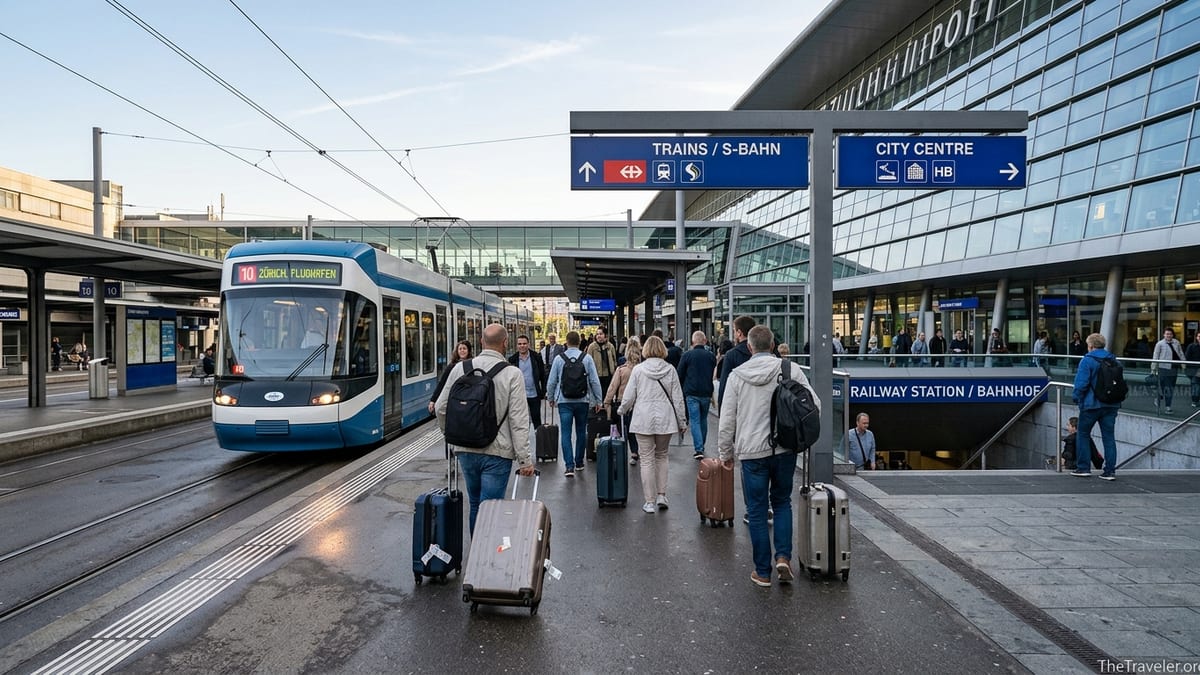
Orientation: Zurich Airport to Zurich HB in a Nutshell
Zurich Airport sits roughly 10 kilometres north of the city centre. For most visitors, “city centre” means Zurich Hauptbahnhof, usually abbreviated to Zurich HB, the main station at the top of Bahnhofstrasse and within easy walking distance of the old town and the Limmat riverfront. The airport and Zurich HB are linked by frequent trains, S-Bahn services and tram line 10, plus a dense network of buses and premium-priced taxis and transfers.
The airport railway station, Zürich Flughafen, is directly underneath the main terminal complex. You simply follow the “Bahn / Train” signs down the escalators to the SBB ticket hall and platforms. From here, there are around a dozen trains per hour to Zurich HB, a mix of S-Bahn commuter trains and long-distance InterRegio or InterCity services, with journey times typically between 9 and 15 minutes depending on the stopping pattern.
Prices are based on the Zurich transport authority’s zone system. Both Zurich Airport and Zurich HB sit within the same tariff combination, so a standard second-class adult ticket for the airport-to-city journey is usually in the low teens of Swiss francs for a single, with a 24-hour ticket roughly double that. These same tickets are valid on both trains and trams within the zones you purchase, which is useful if you want to connect on a tram or bus after arriving at Zurich HB.
The key choice is speed and comfort versus cost. Trains and S-Bahn are the fastest and, for solo travellers, the best value. The tram is slower but very scenic and convenient for several hotels along its route. Taxis and private cars are significantly more expensive but can make sense late at night, with heavy luggage or for families who want door-to-door convenience.
Train and S-Bahn: Fastest Route Into Central Zurich
For most travellers, the direct train or S-Bahn from Zürich Flughafen to Zurich HB is the default option. Services on S-Bahn lines such as S2, S16 and S24, along with various InterRegio and InterCity trains, run roughly every 5 to 10 minutes from early morning until around midnight. In practice this means you rarely need to check a timetable; you simply go down to the platforms and board the next train labelled “Zürich HB”. Typical journey time is about 10 to 12 minutes platform to platform.
In 2026, a standard second-class adult ticket for the relevant zones from the airport to Zurich city centre is usually in the low teens of francs when bought as a point-to-point single at the SBB or ZVV ticket machines. A 24-hour ticket for the same zones costs about twice the single fare and is good value if you plan to use trams and buses the rest of the day. Children with a Junior or Children’s Co-Travelcard can generally travel free with a parent, while holders of national or regional travel passes often have the route included or discounted.
Buying tickets is straightforward. In the arrivals area, you will see green ZVV or red SBB ticket machines as well as an SBB Travel Center slightly downstairs near the platforms. Machines accept major credit cards and usually allow you to switch the interface into English easily. Many visitors now simply use the SBB Mobile or ZVV app to buy a digital ticket before they walk to the platform; inspectors on board will scan the QR code on your phone.
For luggage, standard Swiss trains have good overhead racks for small and medium bags as well as luggage spaces near the doors. If you are arriving with large suitcases after a long-haul flight, avoid trying to board at the very last second, as commuter services can be busy at rush hour. Allow yourself to choose a carriage that looks less crowded. If you need to store bags for a few hours, both Zurich Airport and Zurich HB have lockers in various sizes, typically costing a few francs for several hours, which is useful if you want to explore before checking into your hotel.
Taking Tram 10: Scenic, Cheaper and Slower
Tram 10 is the main tram line linking Zurich Airport with several central districts and the main station area. Trams depart from right outside the terminal complex, reached by following the “Tram” signs from arrivals. The trip to the central stops around Zurich HB normally takes around 35 minutes, so it is noticeably slower than the 10 to 12 minutes by train, but many visitors appreciate the views of suburban neighbourhoods and the feeling of “arriving in the city” at street level.
The same ZVV zone ticket that covers the train also covers tram 10, so you do not pay more to ride the tram. Many travellers buy a 24-hour ticket at the airport and then use tram 10 to get into town, hopping off at stops like “Central” or “Bahnhofplatz/HB” to reach hotels around the Limmat or the old town. If you are staying near the university or along the Nordstrasse and Universitätsstrasse corridors, tram 10 can actually be more convenient than the train because it delivers you closer to your door without a change.
Trams are generally very accessible for travellers with luggage thanks to low-floor vehicles with level boarding. There are usually designated spaces for prams and suitcases in the middle sections. During weekday rush hours, trams can feel quite full, especially near major stops like Oerlikon and Milchbuck, but the airport section usually has space when you board. The ride quality is smooth and quiet, and you have constant views of everyday Zurich life through large windows.
One detail to remember: Zurich trams do not sell tickets on board. You must buy your ticket at a machine on the platform or via the ZVV or SBB app before you board. Many first-time visitors make the mistake of jumping on, intending to buy a ticket later, but ticket inspections in Zurich are frequent and fines are substantial. As long as you have a valid zone ticket in your pocket or on your phone, you can calmly choose between the train and tram at no extra cost.
Taxi, Ride-Hailing and Private Transfers: Door-to-Door Comfort
Outside the arrivals level, Zurich Airport has a clearly marked official taxi rank. Licensed airport taxis line up here and operate on regulated tariffs. In 2026, a typical door-to-door ride from Zurich Airport to a central hotel near Zurich HB or Bahnhofstrasse usually costs in the region of 60 to 70 Swiss francs in normal traffic. The drive time is about 20 to 30 minutes depending on congestion, roadworks and the exact location of your hotel.
For many solo travellers, that price is significantly higher than public transport. However, for a family of four with heavy bags or for business travellers arriving late at night after long flights, the cost-per-person difference narrows and the convenience of being dropped right at the hotel entrance can be worth it. For example, a family of four might pay roughly 65 francs for a taxi, which works out to around 16 francs per person, only modestly more than individual train tickets but with no transfers or walking in the rain.
Ride-hailing services operate in the Zurich area in forms similar to Uber or Bolt, although availability can fluctuate and pick-up rules at the airport are subject to change. Prices are often a little lower than standard taxis during off-peak times, though they may surge during busy periods or bad weather. In practice, many visitors find that by the time they factor in app wait times and locating the ride-hailing pick-up point, the savings over an official airport taxi are limited, especially for short city-centre trips.
Prebooked private transfers offer a middle ground between taxis and public transport. Several companies allow you to reserve a driver who will meet you in the arrivals hall with a name sign and escort you to a waiting sedan or minivan. Prices typically start somewhere above the taxi range for a private car but can be attractive for groups that fill a larger vehicle. This is a particularly good option if you are arriving with ski gear in winter or bulky trade-show materials, or if you value the reassurance of having everything arranged in advance.
Tickets, Zones and Luggage: Practical Details to Know
Zurich’s integrated transport system is built around zones rather than individual tickets for each mode. Both Zurich Airport and Zurich HB are within the regional network, so a ticket that covers the necessary zones lets you ride trains, S-Bahn, trams, buses and even some boats within the time validity. This is why many visitors choose a 24-hour or multi-day pass, which simplifies travel and encourages spontaneous exploring by tram or boat once they reach the city.
At the airport, ticket machines clearly display an option for “Zurich City” or show the necessary zone combination. You can select English, tap in your destination or choose a city pass such as a 24-hour network ticket for the central zones. Payment by credit card, contactless and local debit cards is standard. If you prefer human assistance, the staffed SBB counter can advise you on whether a Swiss Travel Pass, Zurich Card or simple zone ticket is the best value based on your itinerary.
Luggage handling is generally seamless. Modern low-floor trains and trams are designed with suitcases in mind, and lifts or escalators connect most platforms to the concourses. Travellers with very heavy baggage or limited mobility may find the vertical movement between arrivals, ticket hall and platforms a bit of a workout, but everything is signposted and barrier-free. If you need to lighten your load, self-service lockers at Zurich Airport and Zurich HB can store anything from cabin bags to large suitcases; you pay a modest fee in francs for several hours or a day.
For those planning onward rail travel later in their trip, consider picking up printed timetables or an information booklet from the SBB office beneath the Airport Center, or simply rely on the SBB Mobile app. It shows real-time departure boards from both Zurich Airport and Zurich HB, including platform numbers, which is particularly reassuring if you are changing from a long-distance train to a local S-Bahn or vice versa.
Comparing Options by Traveller Type
Different travellers prioritise different things, and Zurich conveniently offers a suitable airport-to-city option for almost everyone. If you are a budget-conscious solo traveller or couple, the train or S-Bahn is usually the clear winner: it is fast, inexpensive by Swiss standards and drops you right into Zurich HB, from where you can walk or take a short tram to most central hotels and hostels.
Families with children and luggage often find the choice less straightforward. If your accommodation is within an easy walk of Zurich HB, taking the train and then strolling together through the largely pedestrian centre works fine, and children often enjoy the novelty of Swiss trains. However, if you are staying up a hill in districts like Zurichberg or in a residential area with fewer direct public transport links, booking a taxi or private transfer might save both energy and arguments, especially after a long-haul flight.
Business travellers typically value reliability and time. During the working day, the train is usually the fastest and most predictable, and Zurich’s business districts around Zurich HB, Paradeplatz and Enge are very well connected by tram from the station. Late at night, very early in the morning or when entertaining clients, a taxi or prearranged car service can make more sense, particularly if you want to travel directly between the airport and an office or meeting venue without changing vehicles.
For visitors who enjoy seeing a city unfold at street level and are not in a rush, tram 10 is a good choice. Imagine arriving mid-morning on a clear day, buying a 24-hour ticket and riding the tram into town while watching commuters, leafy residential streets and glimpses of the city skyline pass by. You will arrive more slowly than by train, but with a better feel for Zurich’s everyday life before you even check into your hotel.
Suggested Scenarios and Real-World Examples
Consider a long weekend visitor arriving from London on a Friday evening with hand luggage only and a hotel booked near the main station. After clearing passport control, they follow signs to the train station under the terminal, buy a 24-hour city ticket at a machine, then hop on the next S-Bahn to Zurich HB. Ten minutes later they are in the heart of the city, walking five minutes to their hotel. They have saved the cost of a taxi and can still use the same ticket for a tram ride to the lake after dinner.
Now imagine a family of five landing from New York on an early Sunday morning flight with two large suitcases, two smaller cases and a stroller. Their apartment rental is in a residential part of District 3, requiring at least one tram change from Zurich HB. In this case, prebooking a minivan transfer or heading directly to the taxi rank may be worth the extra cost. The driver loads the bags into the boot, the children can nap in the back seat, and the family is dropped at their front door without having to navigate unfamiliar platforms and connections.
A solo business traveller arriving for a day-trip meeting near Bahnhofstrasse might combine options. They could take the train to Zurich HB in the morning for speed and reliability, walk or take a short tram to the office, then, after a long day that ends with a client dinner, order a ride-hailing car or taxi back to the airport for a late evening flight. The total cost will be higher than using trains both ways, but the time saved at the end of a long day might be more valuable than a few extra francs.
Finally, consider a backpacker starting a Swiss rail journey. They might land at Zurich Airport, buy a national rail pass or Swiss Travel Pass at the SBB counter, then take the short train hop into Zurich HB to drop bags at station lockers or a nearby hostel. After a few hours exploring Zurich’s old town on foot and perhaps a quick dip in the lake, they return to the station to board a long-distance InterCity train to Lucerne, Interlaken or Chur, effectively using Zurich as a convenient, well-connected starting point.
The Takeaway
Getting from Zurich Airport to the city centre is a textbook example of Switzerland’s efficient, integrated transport system. The train and S-Bahn are the fastest, most frequent and best-value choices for most travellers, whisking you from the terminal to Zurich HB in roughly ten minutes for a relatively modest fare. Tram 10 offers a slower but scenic alternative that can be more convenient if your hotel lies along its route.
Taxis, ride-hailing and prebooked private transfers are significantly more expensive but provide door-to-door comfort that many families, business travellers and late-night arrivals appreciate. When you divide the fare among several passengers or balance it against the time and effort of making connections with heavy luggage, these options can make practical sense.
The right decision depends on your priorities: budget, time, comfort and how much luggage you are carrying. With tickets that work across trains, trams and buses, it is easy to mix and match solutions during your stay. Whichever option you choose on arrival, you will quickly discover that getting around Zurich is straightforward, predictable and often surprisingly pleasant, setting a positive tone for the rest of your Swiss trip.
FAQ
Q1. How long does it take to get from Zurich Airport to Zurich city centre by train?
The direct train or S-Bahn from Zurich Airport to Zurich Hauptbahnhof usually takes around 10 to 12 minutes, with frequent services throughout the day.
Q2. How much does the train from Zurich Airport to the city centre cost?
An adult second-class ticket from the airport to central Zurich typically costs in the low teens of Swiss francs for a single journey, with 24-hour tickets roughly double that.
Q3. Is the tram from Zurich Airport to Zurich city centre a good option?
Yes. Tram 10 is slower than the train at about 35 minutes but is scenic, runs frequently and can be more convenient if your hotel is along its route.
Q4. Are taxis from Zurich Airport to the city centre expensive?
Compared with public transport, taxis are expensive. A standard ride into central Zurich commonly costs around 60 to 70 Swiss francs, though prices vary with traffic and exact destination.
Q5. Can I use the same ticket for both train and tram between the airport and city?
Yes. Zurich uses a zone system, so a valid zone ticket for the airport-to-city journey generally allows you to use trains, S-Bahn, trams and buses within those zones.
Q6. What is the best option if I have a lot of luggage?
If you have very heavy or multiple bags, a taxi or prebooked private transfer offers the easiest door-to-door service. Trains and trams can still work, but expect more lifting and walking.
Q7. Is there public transport at night between Zurich Airport and the city?
Regular trains and trams run from early morning until around midnight. At very late or very early hours, options may be limited and a taxi or prearranged transfer can be more practical.
Q8. Do I need to buy tickets before boarding trams and trains at Zurich Airport?
Yes. You must buy a valid ticket before boarding both trains and trams, either at ticket machines, at the SBB counter or via the official transport apps on your phone.
Q9. Which option is best for families with children?
For families with light to moderate luggage, the train is fast and good value. For those with strollers, multiple suitcases or young, tired children, a taxi or private transfer can be easier overall.
Q10. Can I pay for transport from Zurich Airport with a credit card?
Yes. Ticket machines and the SBB and ZVV apps accept major credit cards, and licensed taxis at the airport also typically accept card payments alongside cash.