


Indira Gandhi International Airport in Delhi is the main gateway to India for millions of visitors every year. For first-time travelers, the mix of new technology, heavy crowds and intense taxi competition can feel overwhelming, especially after a long-haul flight. This guide walks you step by step through terminals, transport options, SIM cards, money exchange and essential arrival tips, using real examples so you know exactly what to expect when you land.
Get the latest updates straight to your inbox!
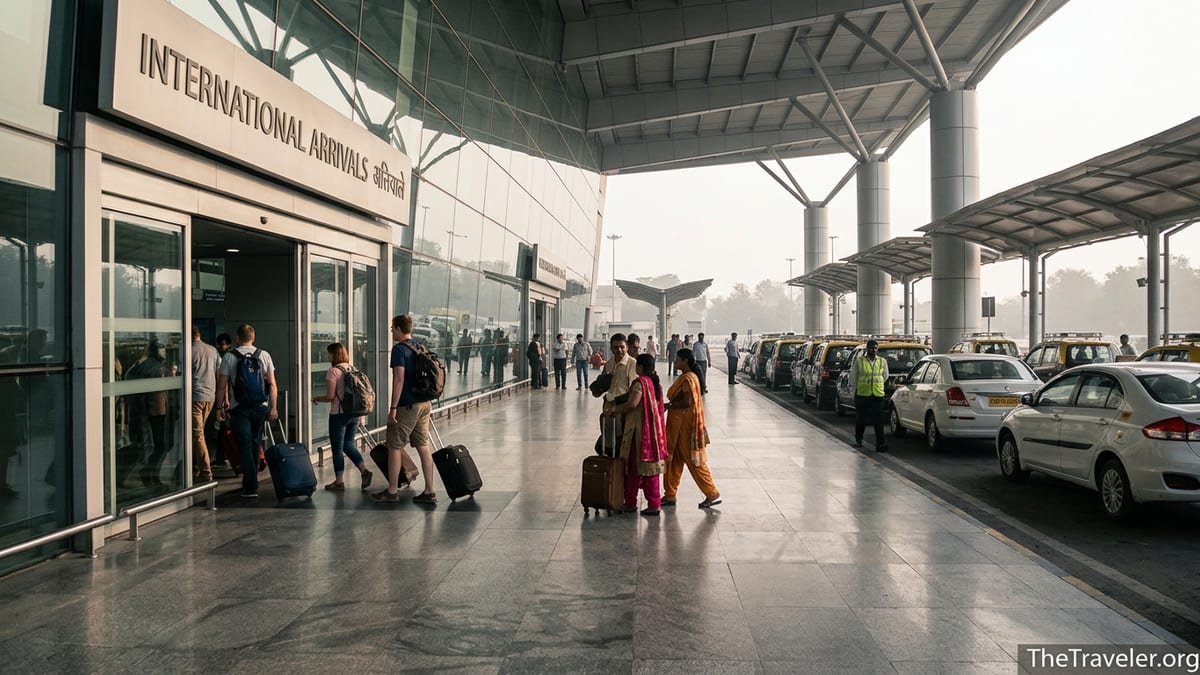
Understanding Delhi’s Terminals and Layout
Delhi’s Indira Gandhi International Airport (IATA: DEL) has three main passenger terminals that are several kilometers apart, and only some are linked directly to the fastest metro line. Terminal 3 (T3) is the large modern building handling almost all full-service international flights along with many domestic flights on Air India and Vistara. If you are arriving from Europe, North America, the Middle East or Southeast Asia on airlines such as Air India, Vistara, Lufthansa, British Airways, Emirates or Singapore Airlines, you will almost certainly land at T3.
Terminal 1 (T1) and Terminal 2 (T2) are used mainly for domestic low-cost and overflow operations. IndiGo and Akasa typically use T1 for many of their domestic routes, while T2 handles a mix of domestic services and shifting traffic depending on construction and seasonal demand. First-time visitors are often surprised that you cannot simply walk from T3 to T1; you should think of them as separate airports, and always check your booking or boarding pass to confirm which terminal your flight uses before you set off.
If you have a self-planned connection between an international T3 arrival and a domestic departure from T1 or T2, you must allow realistic transfer time. In free-flow traffic, a taxi between T3 and T1 takes around 15 to 20 minutes, but at busy evening hours it can take longer. Travelers connecting from an overnight London flight arriving around 9:00 to a domestic departure at 11:30 from T1 often cut it very fine once immigration lines and baggage delays are added. Whenever possible, aim for at least a 3 to 4 hour buffer between separate tickets.
Within T3 itself, international and domestic sections are under the same roof but separated airside. Arriving international passengers go through immigration and baggage claim on a lower level and exit into the public arrivals hall. From there you will find official taxi counters, money exchange booths, bank ATMs, a metro access route and branded counters for services like Airtel for SIM cards. It is worth taking a moment in this hall to organize money, data and transport before stepping outside.
Airport Express Metro and Other Public Transport
The fastest way from Delhi Airport into the city center is the Airport Express Metro, also known as the Orange Line. It runs from the IGI Airport metro station near T3 to New Delhi station in roughly 20 to 22 minutes, with trains that feel similar to a European airport rail link. As of mid 2026, a typical single journey fare from the airport to New Delhi station is around 60 to 80 rupees, making it both faster and usually cheaper than a taxi for solo travelers. Services normally start around 6:00 in the morning and run until late evening, but you should always check the latest first and last train timings if you arrive on a very early or very late flight.
To reach the Airport Express from T3 arrivals, follow the signs for “Metro” after exiting customs. You pass through a short covered walkway, then down into the metro concourse where you purchase a token from machines or staffed counters. A real-world example: a traveler landing from Frankfurt at 10:30, clearing immigration and baggage by 12:00, can often be at New Delhi station by 12:30 using the Airport Express. From New Delhi station, you can transfer to the Yellow Line of the regular Delhi Metro to reach areas like Connaught Place, Chandni Chowk or South Delhi without using a road vehicle at all.
For passengers arriving at or departing from T2, the same Airport Express station serves both T3 and T2, but there is a short outdoor walk or shuttle between the terminal and the station. Some travelers choose to get off at Aerocity station, one stop before the airport, where there are several mid-range hotels used for overnight layovers and meetings. For example, many passengers with a long daytime transit book a room at an Aerocity hotel and use the Airport Express for a quick round trip into the city to see India Gate or Connaught Place.
Regular Delhi Transport Corporation airport buses and private coach services also operate between the airport, central Delhi and key suburbs. These are cheaper than taxis but slower and less intuitive for first-time visitors with luggage. A typical government airport bus from T3 to Kashmere Gate or Anand Vihar bus terminal can cost a fraction of a taxi fare, but might take 60 to 90 minutes depending on traffic and stops. For most first-time tourists staying near central Delhi, the combination of Airport Express Metro plus a short local taxi or auto rickshaw ride from New Delhi or Shivaji Stadium station strikes a good balance between cost, comfort and predictability.
Uber, Ola, Prepaid Taxis and How to Avoid Scams
Delhi has app-based cab services such as Uber and Ola alongside traditional radio taxis and government-regulated prepaid taxi booths at the airport. After leaving customs in T3, you will see counters in the arrivals hall for official prepaid taxis run under the supervision of Delhi Police and airport authorities. Here you pay a fixed amount for your journey based on a published fare chart. In return you receive a printed slip with the taxi number and fare. For instance, a typical sedan fare from T3 to Connaught Place in central Delhi might be in the range of 500 to 800 rupees depending on the official schedule and any night surcharge. You then walk outside to the designated taxi lane and hand the slip to the driver, with no further bargaining required.
Uber and Ola work well at Delhi Airport, but the pick-up process can feel chaotic the first time. You must have mobile data or airport Wi-Fi to book the ride, and the app will direct you to a specific pick-up zone outside arrivals or at a designated parking area. At busy evening times between about 17:00 and 21:00, surge pricing and longer waits are common. A solo traveler going from T3 to a hotel in Aerocity might pay as little as 200 to 300 rupees in an off-peak Uber Go, but someone heading to South Delhi during the rush could see prices jump higher than an official prepaid taxi, especially for Uber Premier or Ola Prime.
One recurring issue first-time visitors report is unlicensed drivers in the arrivals hall offering “cheap taxi” or “special tourist cab.” These drivers may quote a seemingly reasonable figure at first, only to add luggage fees, tolls and invented charges later, or detour via shops and unofficial “tourist offices.” A common real-world scenario is a traveler heading to Paharganj near New Delhi station who agrees to a vague 400 rupee fare with a tout, and later finds themselves paying double after an argument at the hotel. To avoid this, either book with Uber or Ola on your phone or walk straight to the official prepaid taxi counter and ignore unsolicited offers.
If you need to transfer between terminals, particularly from T3 to T2 for a domestic connection, avoid taking random cabs. The airport operates a free shuttle service for legitimate passengers holding a connecting ticket, and T2 is within short driving distance of T3. Several travelers have reported unnecessary charges of several hundred rupees for short inter-terminal rides when they accepted offers from opportunistic drivers outside arrivals. When in doubt, ask an airport staff member in uniform where the official shuttle stops, or follow the clearly signposted routes between the terminals.
SIM Cards, eSIMs and Staying Connected
Staying online from the moment you land in Delhi helps with everything from booking cabs to sharing your hotel address with drivers. Inside T3 arrivals, major Indian telecom providers such as Airtel generally operate kiosks that sell tourist-friendly SIM cards and increasingly eSIM activations. Travelers report paying the equivalent of 10 to 25 US dollars for packages that include several gigabytes of data, local calls and a validity period of 15 to 28 days. For example, a common plan might be around 700 to 1,000 rupees for 1.5 GB of data per day over three to four weeks, which is plenty for navigation and messaging during a short trip.
Activation at the airport kiosk usually involves presenting your passport and visa, having your photo taken and filling out a short digital form. Depending on the provider and time of day, the SIM might be live within 10 to 60 minutes. Some travelers describe buying an Airtel SIM on arrival, taking the Airport Express to their hotel, and finding the connection working by the time they check in. Others report longer activation times when arriving late at night, so you should not rely on an instant connection in the first minutes after landing.
For many first-time visitors, an India eSIM purchased before travel can be a smoother option. Several international and regional providers now sell India-specific eSIM data packs that you install by scanning a QR code before you fly. The eSIM becomes active when you land and your phone registers on an Indian network. A typical example is a 10 to 20 GB data-only package valid for 15 days, which you buy online for a fixed price in dollars or euros. Once in Delhi, you can then decide whether you still want a local voice number from a kiosk, but at least you already have data to book your ride and message your hotel.
One reason some frequent visitors recommend buying SIM cards in the city rather than at the airport is cost and flexibility. A neighborhood Airtel or Jio store in South Delhi or near New Delhi station may offer a wider range of prepaid plans, sometimes at slightly lower prices. However, reaching those shops still requires you to navigate the first journey from the airport without local connectivity. For a short first visit, many travelers find that paying a little more at the airport kiosk is worthwhile for the convenience of being online from the start.
Money Exchange, ATMs and Practical Examples
Delhi Airport offers multiple ways to get Indian rupees on arrival. In the T3 arrivals hall, you will find currency exchange counters from well-known foreign exchange companies alongside ATMs from major Indian banks. Airport exchange rates are typically less favorable than rates in the city, and counters may add service fees, so many experienced travelers only change a small amount here. For instance, a first-time visitor might exchange the equivalent of 50 to 100 US dollars into rupees to cover the taxi, a SIM card and snacks, then use ATMs or city exchanges for larger amounts later.
ATMs can offer better effective rates but are not risk-free. It is wise to use machines from large Indian banks such as State Bank of India, HDFC Bank, ICICI Bank or Axis Bank, which you will usually find in or near the arrivals hall. These banks are more likely to have reliable machines and clear English-language prompts. Some ATMs may propose “dynamic currency conversion,” offering to charge your card directly in your home currency at a poor rate. In most cases, choosing to be charged in rupees and allowing your home bank to handle the conversion works out cheaper.
Contactless card payments are increasingly common in Delhi, especially at mid-range hotels, coffee chains, larger restaurants and organized taxi services. For example, a guest staying at an Aerocity hotel can often pay their room bill and meals entirely by Visa or Mastercard without ever using cash. However, smaller guesthouses, local eateries and auto rickshaw drivers still rely heavily on cash. A traveler heading from the airport to a budget hotel in Paharganj or Karol Bagh will want at least a few thousand rupees in small notes handy for rickshaws, tipping and food.
It is also important to think about safety when handling money right after arrival. Crowding at airport exits creates opportunities for pickpocketing, though serious incidents remain relatively rare inside the secure perimeter. Instead of opening your wallet in the middle of the crowd, step aside near a seating area, put most of your cash in a money belt or inner pocket, and keep only what you need for the first ride accessible in a small separate wallet or cardholder.
Connections, Layovers and Surviving Your First Arrival
Delhi is a major hub, so many travelers arrive on an international flight and then connect onward to domestic destinations such as Jaipur, Varanasi or Goa. If both flights are on the same ticket and airline group, your baggage is usually tagged through, and you can use the official transfer desks at T3 without passing through Indian immigration if your connection is purely international to international. For mixed international and domestic connections, you will typically clear immigration, collect your bag, pass customs and then follow the “Domestic Transfers” or “Connecting Flights” signs to check-in again.
Realistically, a two-hour connection involving immigration, baggage and a terminal change is risky at busy times. Travelers flying from New York to Delhi landing around 23:00, then connecting to an early morning domestic flight before 2:00, often find that queues and potential delays leave little room for error. A safer pattern is to build in at least three hours for connections that involve entering India, more if you need to move from T3 to T1 by road. Airlines sometimes sell tighter connections, but those rely on everything running perfectly.
For long layovers, Aerocity near the airport has become a popular base. Hotels there range from business-oriented international brands to more affordable Indian chains, all within a 10 to 15 minute drive or a couple of Airport Express stops. An example itinerary might be arriving from Sydney at 6:00, checking into an Aerocity hotel for breakfast and a nap, then taking the metro into central Delhi late morning to visit Old Delhi or Lodhi Gardens before returning for an evening connection. This breaks the monotony of the airport while keeping you close in case of traffic or weather disruptions.
Your first hour after landing sets the tone for your trip, so treat it as a sequence of small steps rather than one overwhelming challenge. Once you exit the aircraft, follow the “Arrivals” signs at a normal pace, ignore anyone trying to rush you, and focus on immigration, baggage, money, SIM and transport one by one. Carry a printed copy of your hotel address with landmarks recognizable to local drivers, such as “near Connaught Place” or “behind Select Citywalk Mall,” to reduce confusion and backtracking in traffic.
First-Time Delhi Arrival Tips and Common Pitfalls
Delhi can feel intense on arrival, especially if you land in the early morning after a long overnight flight. Air quality may be hazy, temperatures can be high for much of the year, and crowding at exits is normal. One practical tip is to have a bottle of water in your carry-on to drink while waiting at immigration and baggage claim. Once in the arrivals hall, pause on a bench or by a café to gather yourself before stepping outside, especially if you are tired or jet-lagged. Many travelers find that taking ten minutes to sit, check maps and confirm their ride plan on Wi-Fi makes the onward journey much smoother.
Weather and seasonal conditions matter in Delhi. In winter months, especially December and January, heavy fog can disrupt flights across North India, leading to diversions and delays. A traveler scheduled to land in Delhi at 08:00 in early January may not actually arrive until midday if dense fog affects visibility. In the hot season from roughly April to June, daytime temperatures can climb well above 35 degrees Celsius, making long waits outdoors uncomfortable. Packing a light scarf or cap and wearing breathable clothing on arrival days can make a big difference if you need to queue outside for buses or taxis.
Another common pitfall is underestimating the emotional impact of culture shock. Delhi’s soundscape includes car horns, construction noise, loud conversations and street vendors, which may feel overwhelming immediately after the controlled quiet of a long-haul cabin. It helps to build in an easy first day in your itinerary. Many seasoned visitors plan to spend their arrival day simply checking into a hotel, having a simple meal and taking a short walk in a relatively calm area such as Lodhi Gardens, India Gate lawns or a modern shopping district, leaving the busy markets of Old Delhi for when they are better rested.
Finally, keep in mind that most people you meet at the airport, from immigration officers to café staff and legitimate taxi drivers, are simply doing their jobs and used to helping foreigners. A polite “Namaste” or “Hello” followed by clear, simple English usually works well. Avoid raising your voice or showing frustration, even if things move more slowly than you hoped. Patience and a bit of planning turn what could be a stressful arrival into an efficient and even enjoyable introduction to India.
FAQ
Q1. Which terminal will I arrive at in Delhi for an international flight?
If you are flying into Delhi from overseas on major airlines such as Air India, Vistara, Emirates, Lufthansa, British Airways or Singapore Airlines, you will almost always arrive at Terminal 3, which handles most full-service international traffic.
Q2. How much time should I allow to connect from an international flight to a domestic one?
If you need to clear immigration, collect baggage and check in again for a domestic flight, aim for at least three hours, and four hours if you must transfer between T3 and T1 by road. Tighter connections are possible but leave little margin for delays or queues.
Q3. Is the Airport Express Metro safe and suitable for first-time visitors?
The Airport Express Metro is considered one of the safest and most comfortable ways to reach central Delhi. Trains are air conditioned, luggage friendly and monitored by security, which makes them a good choice for first-time travelers, especially during daytime and evening hours.
Q4. Should I take Uber or a prepaid taxi from Delhi Airport?
Both options work, but prepaid taxis are simpler if you do not yet have mobile data. You pay a fixed fare at the counter and avoid negotiation. Uber or Ola can be cheaper during off-peak hours if you have an active SIM or eSIM to book the ride.
Q5. Can I buy a local SIM card directly at Delhi Airport?
Yes, major providers such as Airtel usually have kiosks in the T3 arrivals hall selling tourist SIMs and eSIM activations. You will need your passport and visa, and activation can take from a few minutes to an hour depending on the time and system load.
Q6. Is it better to exchange money at the airport or use an ATM?
Airport exchange counters are convenient but often give weaker rates and may charge fees. Many travelers withdraw a modest amount of cash from a bank ATM in arrivals, then use additional ATMs or city exchanges later if they need more rupees.
Q7. How much does it cost to get from the airport to central Delhi?
As a rough guide, a solo traveler using the Airport Express Metro might pay around 60 to 80 rupees to New Delhi station, while a taxi or app cab to areas like Connaught Place typically falls somewhere around 500 to 800 rupees depending on traffic, time of day and vehicle type.
Q8. Is it safe to arrive alone at night in Delhi Airport?
Inside the terminal, security is tight and the environment is generally safe, even late at night. The main precautions are to use official taxis or app cabs, avoid unsolicited offers and share your ride details or hotel address with a trusted contact where possible.
Q9. Can I sleep at Delhi Airport during a long layover?
Yes, many passengers rest in seating areas in the airside and landside zones, though seating can fill up at peak times. For more comfort and privacy, you can book a hotel in Aerocity or use an in-terminal transit hotel or lounge if your ticket and budget allow.
Q10. What is the single most important tip for first-time arrivals in Delhi?
Have a simple written plan for your first hour: know your terminal, your hotel name and area, your chosen transport option and whether you will get cash and a SIM at the airport. Following that plan calmly makes everything else easier.