


Zurich Airport is one of Europe’s most efficient hubs, but stepping off a long flight into an unfamiliar terminal can still feel overwhelming. This practical arrivals guide walks you through what happens after landing at Zurich Airport today, from passport control and baggage claim to buying a SIM card, finding an ATM, and catching the right train, taxi, or rental car for your onward journey.
Get the latest updates straight to your inbox!
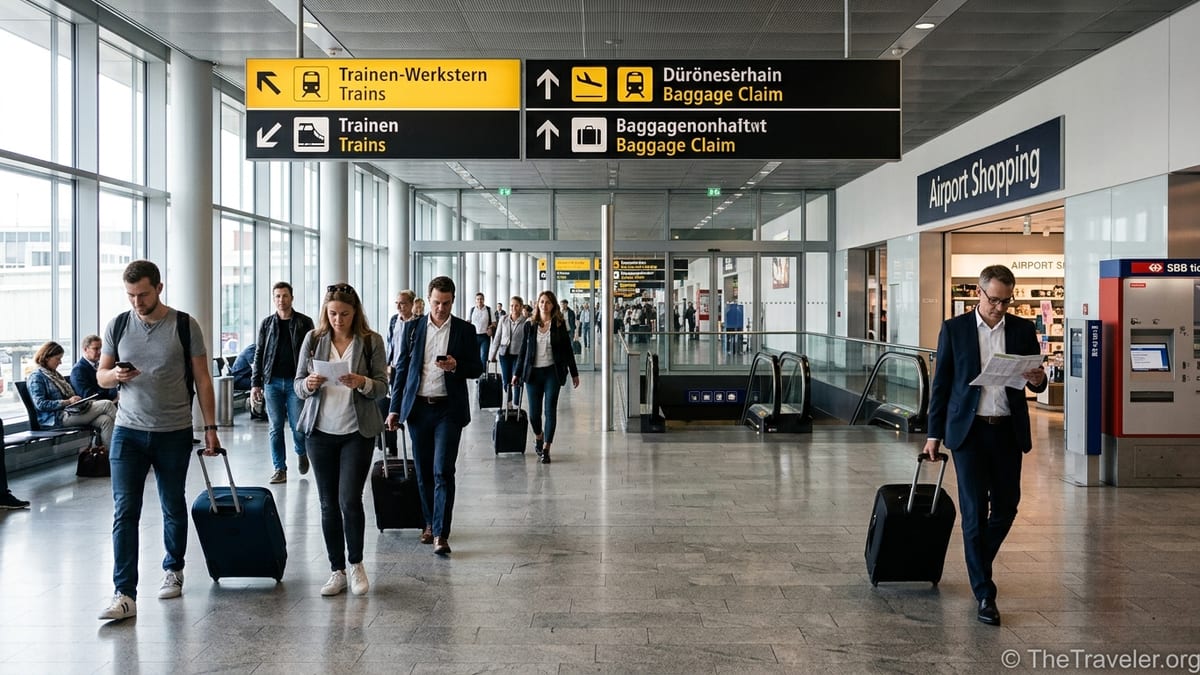
Understanding the Layout of Zurich Airport on Arrival
Zurich Airport has one main terminal complex with multiple piers (A, B/D and E). Most European and Schengen flights arrive at piers A and B/D, which are connected directly to the central terminal building. Many long-haul flights from North America, Asia and the Middle East use the E gates, which sit across the airfield and are linked to the main terminal by an underground shuttle train. Wherever you land, you will be funneled toward passport control and baggage claim by clear overhead signs in German and English.
After you disembark, simply follow the yellow "Baggage claim" and "Arrival" signs. If you arrive at the E gates, you first board the short underground Skymetro shuttle to the main terminal; this ride takes only a couple of minutes and runs continuously. From gates A and B/D, the walk to passport control is usually 5 to 10 minutes at a normal pace. Transit passengers will see separate signs for transfer routes, while all others should follow the arrival symbols toward immigration.
There are two main public arrivals halls at Zurich Airport: Arrivals 1 and Arrivals 2 on Level 1 of the terminal complex. After you collect your baggage and pass customs, you will emerge into one of these halls, where you will find information desks, meeting points, some shops and cafés, and access to the Airport Shopping mall and ground transport. Both arrivals halls are connected indoors, and it generally takes only a few minutes to walk between them.
Directly beneath the terminal, on the level signed as "Bahnhof" or "Airport Center," is Zurich Airport railway station. Stairs, escalators and elevators connect the arrivals level with the station concourse. The design means you can go from clearing customs to standing on a train platform in around 10 minutes if you travel light and queues are short.
Passport Control: Schengen vs Non-Schengen Arrivals
How you experience passport control at Zurich Airport depends largely on where you are flying in from. If you arrive from a Schengen Area country such as Germany, France, Italy or Spain, there is usually no formal passport control when you enter Switzerland. You will follow the arrivals signage directly toward baggage claim and customs, though you should still carry your passport or ID card in case police conduct random checks.
Arriving from a non-Schengen country, such as the United States, United Kingdom, Canada, the United Arab Emirates or Singapore, you will pass through a staffed immigration checkpoint. Swiss border police handle passport control here. EU and EFTA citizens typically have dedicated lanes and, at busy times, eGates may be available for eligible biometric passports. Non-EU passports line up in the "All Passports" or "Non-EU" lanes, where officers check your travel documents, visa if required, and sometimes ask a few brief questions about your trip.
Queue times vary by time of day and season. Early morning long-haul arrivals can create peaks, yet many travelers report clearing non-Schengen passport control in 10 to 25 minutes under normal conditions. When several large aircraft arrive together, it can take longer, especially if staffing is tight. If you have a tight onward rail connection, it is wise to allow at least 45 minutes from landing to exiting into the arrivals hall, more if you need to check a visa or are traveling with a family.
Practical tip: If you have a connecting flight from Zurich but your ticket is on a single itinerary, follow the "Transfer" signs rather than "Arrival" and check the information screens. In some non-Schengen to non-Schengen connections, you may stay airside and clear security rather than full Swiss immigration, which can save time. If Zurich is your final stop, always follow the arrival signs and be prepared to show proof of accommodation, a return ticket and sufficient funds, particularly if you require a Schengen visa.
Baggage Claim and Lost Luggage Support
Once you have cleared passport control, you are guided directly to the baggage claim hall. Overhead displays list arriving flights and carousel numbers. For instance, if you have just arrived on a morning flight from New York with Swiss or United, you will see your flight number and the assigned belt on large digital boards as you enter the hall. Baggage trolleys are available free of charge in the reclaim area, useful if you are managing multiple suitcases or ski gear.
Typical waiting times for checked baggage at Zurich Airport vary, but many travelers find their bags begin arriving within 10 to 25 minutes of reaching the carousel. During peak times, or with heavily loaded long-haul flights, it can take longer. If you are traveling with sports equipment like bicycles or skis, oversized luggage is often delivered to a dedicated counter or special belt, which is clearly signed near the main carousels.
If your luggage does not appear, head to the lost and found or airline baggage service desk located in the baggage reclaim area. Each major airline, such as Swiss, Lufthansa and British Airways, has a ground handling partner at Zurich that manages delayed or damaged bags. You will need your passport and baggage tag receipt to file a Property Irregularity Report, after which the staff can arrange to deliver your bag to your hotel or home address in Switzerland when it arrives.
Zurich Airport also offers paid baggage services in the public arrivals area, including left-luggage storage near Arrivals 2. This can be handy if you have an extended layover and want to explore Zurich without carrying your suitcases. Opening hours are generally from early morning into the evening, and fees depend on the size of your bag and storage duration, typically charged per calendar day rather than per hour.
Customs: What to Expect When Entering Switzerland
After collecting your bags, you will walk through Swiss customs before entering the public arrivals hall. As in many European airports, Zurich uses a dual-channel system. If you have nothing to declare and your purchases fall under personal allowance limits, you follow the green "Nothing to declare" channel. If you exceed duty-free limits, are carrying large amounts of cash, or need to declare specific goods, you enter the red channel to speak with a customs officer.
Switzerland allows duty-free imports of personal items and gifts for your own use within certain value and quantity limits. There are specific allowances for alcohol, tobacco and meat products, and some goods such as counterfeit items, certain animal products and restricted medications are tightly controlled. For example, bringing more than a modest amount of cigarettes or spirits could incur import tax, and bringing high-value electronics for resale is not permitted without declaration. Travelers connecting onward by train within Switzerland are still considered to have entered Swiss customs territory at the airport, so this is the point at which you must declare goods.
Arrivals are not routinely stopped in the green channel, but customs officers do conduct random spot checks. You may be asked to put your luggage through an x-ray scanner or answer questions about what you are bringing into the country. If you are unsure whether something needs to be declared, it is safer to use the red channel and ask. Fines for undeclared dutiable goods can be significant compared with the relatively modest tax you would pay by declaring them voluntarily.
Digital tools are increasingly common for Swiss customs. The federal authorities promote the use of official smartphone applications that allow you to calculate duties and sometimes pay tax on certain declared goods before crossing the border. While not mandatory, these tools can make the process smoother if you are carrying expensive items or large quantities of goods from outside Switzerland and want to be sure you are compliant before choosing the green or red channel.
Money, ATMs and Buying a Local SIM Card
As soon as you step into the public arrivals area, you will see bank ATMs along the walls and near the exits to the Airport Shopping mall. Major Swiss banks such as UBS and Credit Suisse, along with cantonal and regional banks, operate machines at Zurich Airport. These ATMs typically dispense Swiss francs and often offer euro withdrawals as well. Using an ATM to withdraw Swiss francs is usually more economical than exchanging cash at a bureau de change counter, especially if your home bank card offers reasonable foreign transaction terms.
Card payments are widely accepted across Switzerland, including at train ticket machines, supermarket checkouts and small cafés. Visa, Mastercard and often American Express work reliably. Mobile payments like Apple Pay and Google Pay are common. This means you do not need to withdraw a large amount of cash on arrival. For many short stays, taking out around 100 to 200 Swiss francs is enough for incidental expenses like public restroom fees, small bakeries or rural kiosks that may still prefer cash.
For mobile connectivity, Zurich Airport is one of the easiest places in Switzerland to buy a local SIM card. In the Airport Shopping area adjacent to the arrivals halls you typically find outlets of major providers like Swisscom and Salt, as well as multi-brand electronics and travel shops selling prepaid SIM kits from networks such as Sunrise. Staff are accustomed to international travelers and can help insert and activate the SIM on your smartphone, though you should ensure your device is unlocked before you travel.
Prices and data volumes change regularly, but as of mid-2026, many visitors report paying in the region of 20 to 40 Swiss francs for a prepaid package with several dozen gigabytes of data valid for a few weeks. To purchase a Swiss SIM card, you are required to show a passport or national ID, and your details are registered in the system, a legal requirement in Switzerland. If you arrive late at night when some shops are closed, another option is to buy a travel eSIM online before you fly, or pick up a prepaid SIM in a city center supermarket such as Coop or Migros once you reach Zurich.
Accessing the Train Station and Public Transport
One of Zurich Airport’s biggest advantages is its integrated rail station located directly beneath the terminal. To reach it from the arrivals halls, follow the signs marked with a white train symbol and the word "Bahn" or "Railway". Escalators and elevators take you down to the Airport Center level, where the station concourse is located next to a shopping arcade with supermarkets, bakeries and convenience stores. From here, further escalators lead to the train platforms, typically labeled tracks 3 and 4 for most city-bound services.
Fast, frequent trains connect Zurich Airport to Zurich Hauptbahnhof (Zurich HB), the city’s main station. The journey usually takes around 10 to 12 minutes, and services run approximately every 5 to 15 minutes depending on the time of day. A standard second-class ticket for the short ride into the city typically costs just under 7 Swiss francs for an adult, with discounts available for holders of Swiss half-fare cards or travel passes. Many travelers simply buy a "Zone 110 + Airport" ticket or a short-term Zurich transport ticket that covers both the airport link and local trams and buses for a set period.
You can purchase tickets from red and gray SBB ticket machines using cards or cash, or at the staffed SBB Travel Center in the station concourse, where English is widely spoken. The SBB Mobile app is also highly recommended by regular visitors; it allows you to buy digital tickets and search timetables for longer journeys such as Zurich Airport to Lucerne, Interlaken or Basel. For example, a traveler landing at 07:00 and heading straight to Lucerne might catch an intercity train from Zurich Airport with an easy change at Zurich HB, all arranged via the app as soon as they have mobile data or Wi-Fi.
Beyond trains, Zurich Airport is also a hub for local trams and regional buses. Outside the terminal complex, just a short walk from the arrivals halls, is the tram and bus station served by lines such as Tram 10, which runs via Oerlikon to Zurich city, and a range of regional buses connecting nearby towns. Trams take slightly longer than trains to reach Zurich HB but can be useful if your hotel is in a northern district along the tram route. All these modes are integrated under the Zurich public transport tariff system, so the same ticket often covers your local tram and train within the relevant zones.
Taxis, Ride Services and Car Rental Options
If you prefer door-to-door transport, taxis are easy to find directly outside the arrivals areas. Official "Airport Taxi" vehicles line up in marked ranks in front of Arrivals 1 and Arrivals 2. Zurich Airport advises passengers to use these licensed taxis, which are regulated and metered. A typical ride from Zurich Airport to central Zurich, such as the area around Bahnhofstrasse or Zurich HB, usually costs in the region of 60 to 70 Swiss francs in normal traffic. Travel time is roughly 15 to 25 minutes depending on congestion.
Licensed taxis accept major credit cards, and many drivers speak good English. For hotel transfers further afield, such as lakeside resorts or corporate offices around Zug or Winterthur, pre-booking a private transfer or limousine service can be more cost-effective than metered fares. Several Swiss and international chauffeur companies operate at Zurich Airport and wait in the designated meeting zones in the arrivals halls holding name boards for prearranged passengers.
App-based ride services are more limited in Switzerland than in some other countries, and traditional taxis and limousines still dominate airport pickups. Some local ride-hailing or car-sharing services may operate in the Zurich region, but they often have restrictions on airport pickups or designated meeting points. If you plan to use a specific app, check in advance whether it is officially allowed to pick up at Zurich Airport and where the exact meeting point is located.
Car rental desks for major international brands such as Europcar, Hertz, Sixt, Avis and Budget are located in the Airport Center area, usually on a level connected by escalator from the arrivals halls. The actual rental car garages are in adjacent parking structures connected by covered walkways. If, for instance, you are planning a self-drive holiday to the Bernese Oberland or a road trip around Lake Constance, you can complete the paperwork at the desk, then follow the signs to the correct parking level to collect your vehicle. Remember that Switzerland drives on the right, winter tires are common in the colder months, and parking in city centers can be expensive, so many visitors choose trains and trams unless they specifically need a car for rural exploring.
Onward Travel across Switzerland from Zurich Airport
Zurich Airport is a convenient starting point for journeys across much of Switzerland. After reaching Zurich HB by train, you can connect to intercity and regional services that fan out in all directions. For example, direct trains from Zurich HB reach Lucerne in about 45 minutes, Bern in around 1 hour, and Basel in roughly 1 hour 15 minutes. Many visitors heading to the mountains, such as Interlaken, Zermatt or St. Moritz, make a single or double connection at Zurich HB and, in some cases, another hub like Bern or Chur.
Travel passes can simplify onward travel. The Swiss Travel Pass, aimed at tourists, offers unlimited travel on most trains, buses and boats for a set number of consecutive days, and it covers the Zurich Airport to city train. If you plan intensive travel over several days, buying such a pass before you arrive or at Zurich Airport railway station can work out cheaper than individual tickets. For stays focused mainly on Zurich and nearby areas, the Zurich Card offers unlimited local transport and discounted entry to many museums and attractions for 24 or 72 hours.
Many travelers now plan their entire Swiss rail itinerary using the SBB website or mobile app, which shows live platform information and connection times. A common pattern is to land in the morning, clear arrivals, purchase a ticket on the app, and board an intercity train from Zurich Airport directly to major tourist centers without needing to detour into the city first. There are, for instance, regular direct trains from Zurich Airport to Basel and some seasonal direct services to resort areas during peak travel periods.
If you are staying overnight near Zurich Airport before continuing, several hotels in the surrounding area offer free or low-cost shuttle buses to and from the terminal. These include large international chains clustered in nearby business districts. Alternatively, staying near Zurich HB is attractive for travelers with early trains since the airport link is so quick; you can spend the evening exploring Zurich’s Old Town and still reach the airport in the morning with a short, direct train ride.
Practical Tips for a Smooth Arrival
To make your arrival at Zurich Airport as smooth as possible, it is worth preparing a few details in advance. Save your hotel address and booking confirmation on your phone in case immigration officers ask for it, and so you can show it to a taxi driver or enter it accurately into a navigation app. Have a small amount of your home currency in case you need to exchange a little cash on arrival, though, in practice, most travelers rely on ATMs and cards for daily spending in Switzerland.
Consider how you will connect to the internet before you land. If you intend to buy a local SIM, identify the approximate opening hours of the mobile shops in the Airport Shopping area, especially if you land late in the evening or early morning. If you plan to rely on an eSIM, download and activate it while you still have home data, so that you can go online as soon as you switch off airplane mode on the runway. Zurich Airport offers free Wi-Fi with a simple registration process, which is useful for downloading apps like SBB Mobile or confirming onward plans while you are still in the terminal.
Think about your luggage and mobility needs too. If you are arriving with young children, strollers and bulky gear, remember that Zurich Airport has elevators at all major transitions between levels, and baggage trolleys can be taken right up to the station concourse or car park entrances. If you have reduced mobility or medical needs, airlines and the airport offer assistance services that must be reserved ahead of time, but which can provide wheelchair support or escort you through immigration and customs.
Finally, build in a bit of buffer time for your onward journeys. While Zurich Airport and Switzerland’s rail network are known for punctuality, factors like long queues at passport control, delayed baggage, or a missed train connection can still occur. Booking flexible rail tickets where possible, and avoiding the very last convenient train of the day to a remote resort, gives you more options if things take longer than expected from landing to leaving the airport.
FAQ
Q1. How long does it usually take from landing at Zurich Airport to reaching the train station?
In typical conditions, many travelers report moving from aircraft door to the airport train platforms in about 30 to 45 minutes, including passport control and baggage claim, though this can be faster with hand luggage only and shorter queues.
Q2. Do I need cash immediately on arrival, or can I rely on cards at Zurich Airport?
You can comfortably rely on credit and debit cards at Zurich Airport for most expenses, including train tickets and food, but withdrawing a small amount of Swiss francs from an ATM is wise for incidental costs and smaller vendors later in your trip.
Q3. Where exactly do I buy train tickets from Zurich Airport to Zurich HB?
Tickets are available from SBB ticket machines and the SBB Travel Center in the airport railway station concourse beneath the terminal, and you can also purchase digital tickets through the SBB Mobile app once you have internet access.
Q4. Is a taxi from Zurich Airport to downtown worth it compared with the train?
A taxi offers door-to-door convenience, especially with heavy luggage or late at night, but it usually costs around 60 to 70 Swiss francs into central Zurich, several times more than the quick and frequent train.
Q5. Can I buy a Swiss SIM card on arrival at Zurich Airport?
Yes, there are mobile operator stores and electronics shops in the Airport Shopping area that sell prepaid SIM cards from providers such as Swisscom, Sunrise and Salt, and staff can assist with activation if your smartphone is unlocked.
Q6. What should I do if my checked luggage does not appear at Zurich Airport?
Stay near your assigned carousel until it is clear the bags have finished arriving, then go to your airline’s baggage service desk in the reclaim hall to file a delayed baggage report, providing your baggage tag and contact details for delivery.
Q7. How strict are customs checks when entering Switzerland at Zurich Airport?
Most passengers pass through the green channel without being stopped, but customs officers do carry out random checks, so you should respect duty-free limits and use the red channel to declare any high-value or restricted goods to avoid potential fines.
Q8. Is it better to stay near Zurich Airport or in the city center after a late arrival?
If you arrive very late or have an early morning departure, an airport hotel with a shuttle can be convenient, but many travelers prefer to stay near Zurich HB because the short train ride from the airport makes it easy to enjoy the city and catch early trains.
Q9. Are there services for travelers with reduced mobility at Zurich Airport arrivals?
Yes, the airport and airlines provide assistance such as wheelchair support, priority boarding and guided transfers, but these services must be requested with your airline before travel so staff can meet you at the gate or arrivals.
Q10. How early should I plan any onward train journey from Zurich Airport after an international flight?
As a conservative rule, plan your first long-distance train for around 60 to 90 minutes after scheduled landing, which gives you reasonable time for immigration, baggage, customs and buying tickets, with flexibility to catch an earlier or later service if needed.