


Planning a trip to Switzerland often means one early decision: should you fly into Zurich Airport or Geneva Airport. Both are efficient, well connected and surrounded by mountains, but they serve very different kinds of trips. Choosing the right gateway can save you hours of travel time, simplify your rail connections and even change which corner of the Alps you end up exploring.
Get the latest updates straight to your inbox!
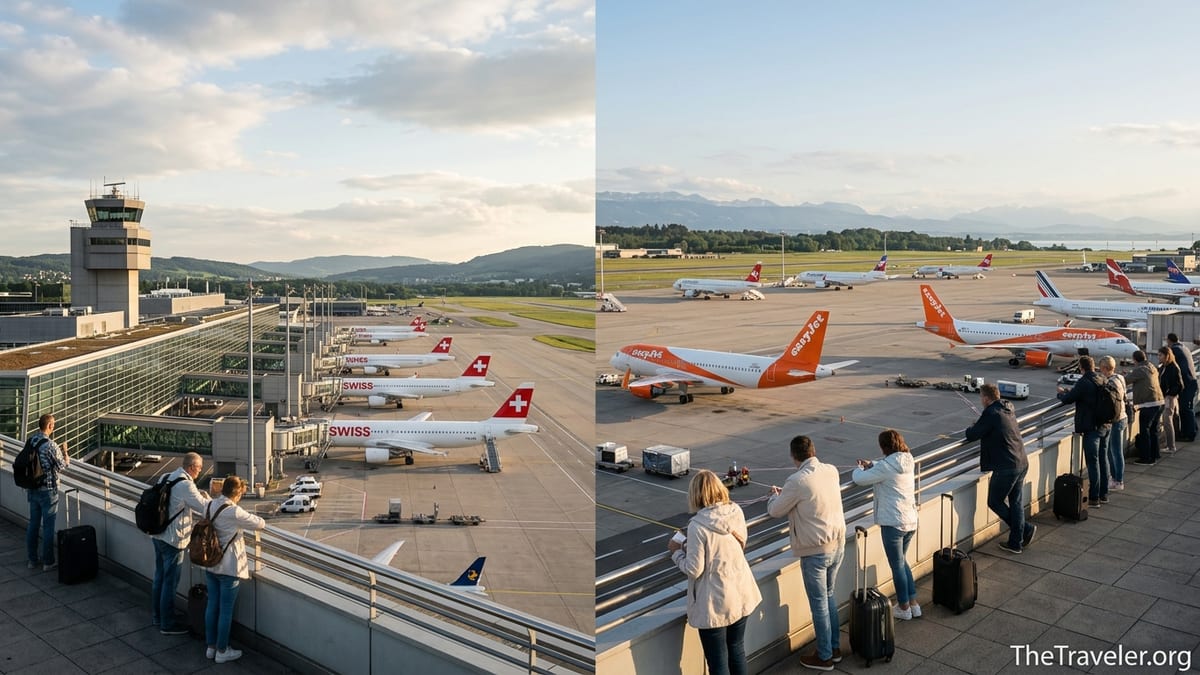
Overview: Two Gateways, Two Very Different Corners of Switzerland
Zurich Airport and Geneva Airport are Switzerland’s two main international gateways, yet they sit at opposite ends of the country and serve distinct travel patterns. Zurich Airport is the country’s largest hub, handling several million passengers a year and offering extensive long haul connections as well as dense domestic and European rail links. It is the primary base for Swiss International Air Lines and a major transfer point within Europe.
Geneva Airport, by contrast, is smaller and leans more toward point to point traffic, with a strong focus on Europe, North Africa and winter leisure routes. It is heavily used by low cost carriers and charter operators, especially in ski season, and has a reputation as one of the most convenient gateways to the French and western Swiss Alps.
For a first time visitor deciding between them, the choice often comes down to where you will spend most of your time. If you are targeting central and eastern Switzerland, cities like Zurich and Lucerne, or classic resorts such as Zermatt and St Moritz, Zurich Airport usually makes more sense. If your plans revolve around Geneva, Lausanne and the Lake Geneva region or French resorts like Chamonix and Morzine, Geneva Airport typically offers the most direct access.
There are exceptions, and in some cases airfares or specific airline preferences will override geography. But if you imagine Switzerland as a long east west corridor, Zurich anchors the German speaking northeast while Geneva sits at the French speaking southwest, and your airport choice frames which half of the country you will see most easily.
Flight Options and Airlines: Hub vs Point to Point
From a flights perspective, Zurich Airport functions as a classic full service hub. Swiss International Air Lines operates an extensive network from Zurich with long haul services to North America, Asia, the Middle East and parts of Africa, together with very frequent European flights. This hub structure means that travelers from cities like New York, Chicago or Montreal often find more nonstop or one stop options if they choose Zurich as their entry point, particularly outside peak winter season when Geneva’s long haul offering is more limited.
Geneva Airport still has solid connectivity, but it is more concentrated on European and Mediterranean destinations. It is an important base for easyJet, which runs a dense schedule to cities such as London, Paris, Lisbon and Barcelona. In winter, additional seasonal routes appear from both low cost and legacy airlines bringing skiers directly to Geneva from across the United Kingdom and northern Europe. If you are flying in from London on a budget carrier for a week in the Alps, there is a strong chance Geneva will offer the lowest fare and the most schedule choices.
Because Zurich is a larger intercontinental hub, it can be more forgiving if travel plans change. Missed connections are often easier to rebook thanks to multiple daily departures on core routes and extensive codeshare options. At Geneva, the schedule can be less dense on some city pairs, especially outside ski season. A traveler flying from a secondary US city, for example, might find that reaching Geneva requires two connections or an overnight layover, whereas Zurich might be available via a single same day connection through a major European hub.
For travelers who collect airline miles or prefer specific alliances, Zurich also tends to be friendlier to Star Alliance and oneworld itineraries, while Geneva’s heavy easyJet presence appeals to cost conscious travelers prepared to pay separately for bags and seat selection. When comparing the two, it is worth checking total journey time and schedule resilience, not just headline fares.
Airport to City Transfers: Zurich vs Geneva on the Ground
Both airports offer quick rail links into their respective city centers, and in each case the station is built directly into or under the main terminal. From Zurich Airport, frequent S Bahn and mainline trains reach Zurich Hauptbahnhof, the central station, in around 10 minutes, with departures roughly every 10 minutes at busy periods and a one way second class ticket typically costing under the equivalent of 10 US dollars. The trains run early and late, which makes it realistic to connect to first wave departures or arrive on evening flights without needing a taxi.
From Geneva Airport, the rail journey to Geneva Cornavin station in the city center is even shorter, around 7 minutes, with trains departing roughly every 12 minutes at peak times. A key perk here is that arriving passengers can usually obtain a free public transport ticket from machines in the baggage claim area, valid for about 80 minutes within the Geneva urban zone. That means your first train into town and any tram or bus connection to your hotel in central Geneva will not cost you anything extra.
Taxi fares from both airports into the city center are relatively high by international standards. A typical taxi ride from Geneva Airport to a downtown hotel can run to several dozen Swiss francs, with travel times that vary between 15 and 30 minutes depending on traffic. In Zurich, a taxi to the city center often costs even more than the train option, and with the rail link being fast and frequent, most visitors choose the train unless they are arriving very late at night or traveling with substantial luggage or mobility issues.
Overall, for pure airport to city transfer convenience, both airports score highly. Geneva offers a tiny edge on cost for hotel guests thanks to its free arrival ticket and the Geneva Transport Card often provided by hotels, which covers city public transport during your stay. Zurich offers slightly more frequent rail services and connects straight into Switzerland’s busiest rail hub, which is particularly attractive if you are continuing immediately by train to other parts of the country.
Connecting to the Alps: Which Airport for Which Mountains
For many visitors, the critical question is how easily each airport connects to the Alps. Zurich Airport sits close to the heart of the Swiss Federal Railways network and offers straightforward connections to many of the country’s most famous resorts. As an example, a typical rail journey from Zurich Airport to Zermatt, home of the Matterhorn, takes around 3.5 to 4 hours with a single change at Zurich Hauptbahnhof and again at Visp. Travelers heading to St Moritz can ride trains from Zurich via Chur and then continue on the scenic Albula line, sometimes incorporating part of the route used by the Glacier Express panoroma train.
The advantage of Zurich for these classic Swiss destinations is that rail connections are usually well timed and run several times per day, even outside high season. A traveler landing at Zurich mid morning can realistically be in resorts such as Engelberg, Davos or Arosa by mid afternoon using just rail and, where needed, short final bus or gondola links. For a multi resort itinerary in eastern or central Switzerland, Zurich often minimizes backtracking and opens up a wide web of rail choices.
Geneva Airport shines for access to the western and French Alps. Resorts in the Valais such as Verbier, Crans Montana, Nendaz and others are well served by trains and buses from Geneva. For example, to reach Verbier you can take an InterRegio train from Geneva Airport to Martigny, change to a local service to Le Châble and then continue the last leg by gondola or bus, with the total journey from the airport to the resort often around 2 hours. During winter weekends and some holiday periods, a dedicated Verbier Express train runs directly from Geneva Airport to Le Châble, simplifying the transfer even further.
For French resorts such as Chamonix, Morzine or Avoriaz, Geneva is one of the closest major airports. Numerous private and shared transfer operators run shuttles from the airport coach area directly to these resorts, particularly during ski season, sometimes as frequently as every 45 minutes on busy days. Travel time to Chamonix is typically about 1.5 hours by road, depending on traffic and weather, which makes long weekend ski trips practical, especially for travelers arriving from the United Kingdom or Benelux countries on early morning flights.
In simple terms, Zurich is usually the better choice for the Bernese Oberland, central Switzerland and the eastern Alps, while Geneva is superior for the Lake Geneva region, the Valais and many French resorts. If you plan a grand rail tour combining locations such as Lucerne, Interlaken, Zermatt and Montreux, it can even make sense to fly into Zurich and out of Geneva or vice versa, effectively turning your journey into a one way traverse across the country.
On the Ground Experience: Terminals, Services and Ease of Use
Travelers who care about airport experience will find both Zurich and Geneva modern and generally efficient, but there are subtle differences. Zurich Airport has a larger, more spacious airside area with multiple piers, an extensive shopping mall in the Airport Centre and a wide range of lounges. As a major hub, it is designed to handle substantial transfer traffic, and signage for connecting flights is prominent and clear. Walking distances can be longer than at Geneva, particularly when moving between remote gates and the main terminal, but moving walkways and a people mover help keep transit times reasonable.
Geneva Airport, while smaller, is compact and relatively easy to navigate. Most passengers use the main terminal, which can feel busy at peak times, especially on winter weekends when ski charters and low cost flights depart in waves. Check in and security queues can be longer during these surges, but the overall footprint is small enough that you rarely face the long internal walks that characterize some larger European hubs. For travelers who value simplicity and minimal airport time, Geneva’s scale can be a real advantage.
In terms of services, Zurich tends to offer a broader selection of shops, from Swiss watch boutiques and chocolate brands to fashion chains, along with a wide range of dining options that include both quick service and sit down restaurants. Geneva also has duty free and Swiss specialty stores, but with fewer outlets overall. At both airports, you will find practical amenities such as luggage storage, showers in selected lounges, Wi Fi access and rental car desks located within short walking distance of arrivals, although rental cars are often unnecessary given Switzerland’s rail network.
Families and travelers with reduced mobility usually find both airports manageable. Elevators connect rail platforms to terminal levels, and assistance services can be pre booked through airlines. Zurich may be slightly more comfortable for longer connections thanks to its greater choice of quiet seating areas and children’s play corners, while Geneva’s advantage is that everything is concentrated in a small space, reducing the need to change levels or traverse long corridors.
City Break Potential: Zurich vs Geneva as Destinations
Many travelers use their arrival or departure day for a short city break, and here again the two airports reflect very different urban characters. Zurich, reached by a 10 minute train ride from the airport, combines a well preserved old town with one of Europe’s most efficient modern transport systems. From Zurich Hauptbahnhof it is an easy walk to the Limmat River, the Bahnhofstrasse shopping avenue and the lakefront promenade. Visitors often spend an evening exploring the Niederdorf quarter, sampling Swiss dishes such as rösti and Zürcher Geschnetzeltes, or taking a short lake cruise if time allows.
Geneva, just 7 minutes by train from the airport, feels more international and slightly more relaxed. It is home to numerous international organizations, including the United Nations and the World Health Organization, and its lakefront is dominated by the Jet d’Eau fountain and views across to the Jura mountains. A traveler arriving midday can feasibly check into a hotel near Cornavin, use the Geneva Transport Card to ride trams to the Old Town and the Carouge district, and finish the day with dinner at a bistro overlooking Lake Geneva.
Both cities offer easy onward day trips. From Zurich, popular excursions include Lucerne, reachable in under an hour by train, and Rhine Falls near Schaffhausen. From Geneva, classic day trips run to Montreux and the Lavaux vineyards along the lakeshore, or to neighboring French towns such as Annecy by regional coach or train. Your choice of airport thus shapes not only which mountains are easiest to reach but also which lakeside or urban landscapes form the backdrop of your first and last days in Switzerland.
For travelers planning a pure city break of two or three nights, the decision often comes down to language and atmosphere preferences. Zurich is predominantly German speaking and has a more overtly financial and design oriented feel, while Geneva leans French speaking and blends diplomacy with a lakeside leisure mood. The airport to hotel transfer in either case is fast and predictable, making both viable for short stays without a car.
Costs, Practical Tips and When to Choose Each Airport
While Switzerland is not a low cost destination, understanding a few practical cost differences between the two airports can help you budget. Public transport from both airports into the city is relatively inexpensive compared with taxis, but Geneva’s free arrival ticket and hotel issued transport passes can reduce your out of pocket expenses for the first day or two. In Zurich, you will generally need to purchase a ticket or travel pass for airport trains and local trams, although tourists who plan to take several trains and boats often consider regional passes that bundle transport and museum entry.
Accommodation prices around Zurich Airport and Geneva Airport are broadly similar, with several international hotel brands clustered within a short shuttle bus ride or even within walking distance of the terminals. Nighttime arrivals who simply need a place to sleep before catching a morning train may prefer these airport hotels, while those eager to see the city immediately will likely head straight into town. It is worth checking whether your Geneva hotel participates in the scheme that provides the Geneva Transport Card, as this can save money on trams and boats during your stay.
When deciding which airport to choose, consider three main filters: where you will spend most of your time, which airlines and schedules work best from your home city, and how comfortable you are with surface travel after a long flight. A traveler from North America planning to visit Lucerne, Interlaken and Zermatt, for example, might prioritize Zurich because of the stronger long haul connections and the straightforward sequence of trains from the airport. Someone from London organizing a long ski weekend in Morzine might lean toward Geneva for its cheaper and more frequent low cost flights and short shared shuttle options to French resorts.
In some cases, mixed itineraries work beautifully. One practical strategy is to fly into Zurich, explore central and eastern Switzerland by train, then continue west through the Bernese Oberland and Valais and finally depart from Geneva. This kind of open jaw ticket can sometimes cost little more than a simple round trip and saves backtracking several hundred kilometers by rail. Conversely, if you find a significantly cheaper fare into one airport but your plans suit the other better, it is entirely possible to ride intercity trains between Zurich and Geneva in roughly three hours and reposition at the start or end of your trip.
The Takeaway
Zurich Airport and Geneva Airport both live up to Switzerland’s reputation for efficiency, but they serve different kinds of trips. Zurich is the larger intercontinental hub with stronger long haul connectivity and the best rail access to central and eastern Swiss resorts and cities. Geneva is the compact western gateway that excels for the Lake Geneva region, the Valais and many French Alpine resorts, with particularly strong appeal for European skiers and city breakers who value quick transfers and low cost flights.
If your plans focus on Zurich, Lucerne, the Bernese Oberland or eastern Alpine icons such as St Moritz and Davos, Zurich Airport is usually the better fit. If you are drawn to Geneva, Montreux, Lausanne, Verbier or Chamonix, Geneva Airport typically makes more sense. In both cases, you benefit from integrated rail stations, predictable transfers and a high standard of passenger facilities.
Ultimately, you rarely go badly wrong choosing either airport, but aligning your arrival point with your itinerary can turn a good trip into a great one. A few minutes spent comparing flight options, rail connections and resort geography before you book will pay off in extra hours by the lake, on the slopes or wandering cobbled old town streets instead of sitting on trains or in highway traffic.
FAQ
Q1. Is Zurich Airport or Geneva Airport better for first time visitors to Switzerland.
For a classic first trip that includes central Switzerland and big name resorts like Zermatt or the Bernese Oberland, Zurich Airport is usually more convenient because it connects directly into the country’s main rail hub.
Q2. Which airport is closer to the Alps.
Both are near the mountains, but Geneva is physically closer to many French and western Swiss resorts, while Zurich offers easier rail access to central and eastern Swiss resorts.
Q3. How long does it take to get from Zurich Airport to the city center.
Trains run roughly every 10 minutes and take about 10 minutes to reach Zurich Hauptbahnhof from the airport station located beneath the terminal.
Q4. How long does it take to get from Geneva Airport to the city center.
The train from Geneva Airport to Geneva Cornavin station takes around 7 minutes, with departures roughly every 12 minutes at busy times, and arriving passengers can usually ride it free with a special ticket.
Q5. Which airport is better for skiing in Verbier, Zermatt or the Valais.
For Verbier and many Valais resorts, Geneva often offers shorter overall travel times, especially when the seasonal Verbier Express runs, while Zermatt is accessible from both but slightly more straightforward from Zurich by rail.
Q6. Which airport is better for skiing in Chamonix and the French Alps.
Geneva is usually the best choice, with numerous shared and private shuttle operators running direct services from the terminal to Chamonix, Morzine and other French resorts.
Q7. Do both airports have good public transport links.
Yes, both Zurich Airport and Geneva Airport have integrated railway stations under or next to the terminals, with frequent trains to their city centers and onward connections across Switzerland.
Q8. Is one airport cheaper than the other for flights.
Geneva often has more low cost carrier options on European routes, which can mean cheaper fares, while Zurich may offer better value on some long haul itineraries because of its hub status and competition among full service airlines.
Q9. Can I fly into Zurich and out of Geneva on the same trip.
Yes, many travelers book open jaw tickets, arriving in Zurich and departing from Geneva or the other way around, which allows them to cross the country by train without backtracking.
Q10. Which airport should I choose if I want a short city break without visiting the mountains.
Both work well for city breaks, so it comes down to preference: Zurich offers a German speaking, design focused lakeside city, while Geneva provides a French speaking, international lakeside atmosphere with a compact historic center.