


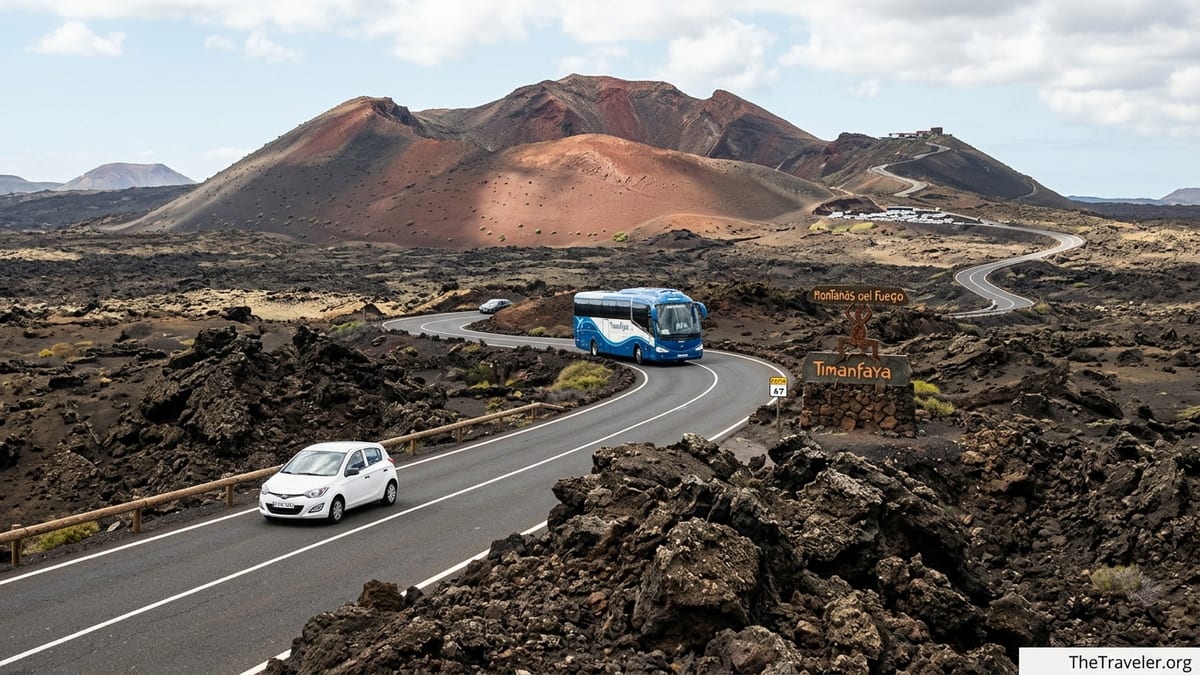
Timanfaya National Park sits in the stark lava fields of western Lanzarote, and every visit begins on the same spine of tarmac: the LZ‑67 road between Yaiza in the south and Mancha Blanca, near Tinajo, in the north. Whether you are driving yourself or relying on tours, taxis or buses, understanding how to reach this road and how access is managed on it will save time, stress and queues when you visit the Montañas del Fuego area.
Get the latest updates straight to your inbox!
Where Timanfaya Is and How Long It Takes to Get There
Timanfaya National Park lies in the municipalities of Yaiza and Tinajo, occupying a wide swathe of lava between these villages. The only road that directly serves the main visitor areas is the LZ‑67, which runs roughly north–south between Yaiza and Mancha Blanca, close to Tinajo. The Montañas del Fuego entrance and the Hilario Islet car park sit roughly midway along this road, surrounded by lava fields with no nearby settlements.
Driving distances on Lanzarote are modest, so most visitors can reach the park in 30 to 45 minutes once they are on the main roads. Typical approximate driving times in normal traffic are about 30 minutes from Puerto del Carmen, 35 to 40 minutes from Costa Teguise, 25 to 30 minutes from Playa Blanca, and around 30 minutes from Arrecife and the airport. These times assume direct travel without detours and can lengthen significantly at peak arrival times for Montañas del Fuego.
The island’s road network funnels traffic from the resorts along a small number of main routes before joining the LZ‑67. From the south, drivers usually approach via the LZ‑2 to Yaiza, then turn onto the LZ‑67 towards Montañas del Fuego. From Arrecife, Costa Teguise and the airport, the recommended route is usually via the LZ‑20 towards Tinajo and then onto the LZ‑67, often passing the Mancha Blanca Visitor Centre before continuing to the main gate.
Recommended Driving Routes from Lanzarote’s Main Resorts
From Puerto del Carmen, the route generally advised by park and tourism authorities is to take the LZ‑504 up to Tías, join the LZ‑2 towards Yaiza, then turn right onto the LZ‑67, which climbs gently into the lava fields and leads directly to the Montañas del Fuego entrance. This route keeps you on wide, well‑engineered roads for most of the journey before you enter the narrower volcanic section of the LZ‑67.
From Costa Teguise, a common recommendation is to drive the LZ‑14 to connect with the Arrecife ring road, then head out on the LZ‑20 towards San Bartolomé and Tinajo. Near Tinajo you join the LZ‑67 and can choose whether to stop first at the Mancha Blanca Visitor Centre, which sits directly on this road, or to continue south towards Montañas del Fuego. This approach keeps you away from the busier southern LZ‑2 corridor and is convenient for combining the park with central‑island sights.
From Playa Blanca, most drivers follow the LZ‑2 north to Yaiza, where the junction for the LZ‑67 is clearly signposted for Timanfaya and Montañas del Fuego. The gradient rises but remains moderate and the tarmac surface is generally good. From Arrecife and the airport, you can either follow the LZ‑2 west, then branch towards Yaiza, or take the LZ‑20 towards Tinajo depending on your wider itinerary and whether you plan to visit the Mancha Blanca Visitor Centre first.
In all cases, allow extra time if you are travelling in the middle of the morning, when most excursion coaches converge on the same junctions and queues can build at roundabouts around Yaiza and Tinajo. Leaving resort areas earlier in the morning or later in the afternoon can make the approach far smoother.
Road Conditions, Gradients and Parking at Montañas del Fuego
The LZ‑67 is a fully paved, two‑lane road but it feels relatively narrow compared with mainland highways. There are no hard shoulders and only limited places to pull over, so drivers should be prepared to follow the flow of traffic and stop only in signed lay‑bys or designated parking areas. The gradients are generally gentle to moderate, suitable for standard hire cars, but there are winding sections where speed limits drop and overtaking is discouraged.
Speed limits typically reduce as you enter the boundaries of the national park and in curves with restricted visibility. Mobile and fixed speed controls can be used on Lanzarote’s protected scenic roads, and enforcement has been a subject of local debate, so visitors should treat posted limits as firm rather than advisory. Slowing down also makes it easier to react to coaches braking ahead of you when queues start to form near the park gate.
At Montañas del Fuego, private vehicles currently park in designated car parks around the Hilario Islet area, where the restaurant, viewpoints and internal bus tour depart. Space is finite. On busy days, arrivals back up along the LZ‑67 while staff manage entry to the parking areas. It is prudent to allow an extra 20 to 40 minutes from the point where you first see tailbacks to the moment you are parked and ready to board the internal park bus or present your ticket.
Local authorities have been discussing and gradually implementing measures to limit the number of private vehicles on the LZ‑67 and around Montañas del Fuego. These measures are evolving, and visiting drivers should check the latest information shortly before travel to know whether any new caps, one‑way systems or mandatory waiting areas apply on their chosen date.
Shuttle Plans and Access Restrictions: What Is Changing
Since mid‑2026, island officials have been working on a broader mobility plan that includes reducing private car pressure around key protected landscapes, including Timanfaya. Public statements have referred to the introduction of shuttle or “lanzadera” services linked to the removal or reduction of some roadside parking areas, with the stated aim of improving safety and protecting scenery. While much of the early focus has been on nearby areas such as La Geria, the same discussions frequently mention Timanfaya as a future candidate for stricter vehicle management.
At the time of writing, detailed implementation inside the national park is in transition and may differ between seasons. Some proposals envisage visitors parking in specific reception areas and transferring by shuttle buses at peak times, particularly in high season and on days of very high demand. Others suggest seasonal or event‑based restrictions, where road closures or special traffic controls are activated during major local festivities or safety operations, which can also affect the LZ‑67.
Because these rules and pilot schemes have been changing through 2026 and may continue to do so, travellers should not assume that previous experiences or older guidebooks still apply. Before finalising your plans, check the latest guidance from official park and island channels or from your accommodation provider that same week. Confirm whether you can still drive directly to Montañas del Fuego at your chosen hour, where you are expected to park, and whether any shuttle transfers are compulsory during your visit window.
In practical terms, this uncertainty means allowing extra flexibility in your schedule. If a new shuttle regime is in operation, budget additional time to park, queue for the shuttle and complete the transfer before you access the internal bus tour inside the park.
Public Buses, Taxis and Tours: Visiting Without a Hire Car
The regular island bus network currently does not serve the entrance to Timanfaya National Park or the Montañas del Fuego car parks. You cannot simply take a scheduled public bus to the park gate and walk in. Official information indicates that while no public transport enters the park itself, several lines do run to the municipalities that surround it, particularly Yaiza and Tinajo, as well as nearby villages such as Mancha Blanca. From these points, you must continue by taxi, organised excursion or other arranged transport.
Because routes and seasonal services can change, any travel writer or visitor planning a trip should check directly with the island bus operator before publishing or relying on specific route numbers. Ask whether any new or trial services stop near the park boundary or the Mancha Blanca Visitor Centre and, if so, what walking distances and frequencies are involved. At the time of writing, the main pattern remains that public buses get you close, but not to the actual entrance, and a second leg by taxi or tour vehicle is still required.
Organised excursions are the simplest option for visitors without a car. Many tour operators and excursion desks bundle hotel or nearby pick‑up with the park visit, often combining Timanfaya with other island highlights such as wine country or coastal viewpoints. Pick‑ups typically follow fixed circuits through resort areas in the early morning, with travellers assigned to meeting points near their accommodation if direct hotel access is not possible. These tours usually include the internal bus circuit inside Montañas del Fuego and often cover the park entrance fee, so you do not need to arrange separate tickets or parking.
Taxis are another viable option, especially for couples or small groups. Recent published tariff examples suggest that a one‑way daytime taxi from Playa Blanca to Timanfaya might cost in the region of a few tens of euros, with some operators quoting indicative fares around the high 30‑euro mark for that journey, while aggregator estimates for Playa Blanca to the park fall in a similar price band. Costs from Puerto del Carmen, Costa Teguise, Arrecife and the airport tend to be broadly comparable or slightly higher depending on distance, time of day and waiting time. Travellers should treat any figures as approximate and always confirm the current fare guidance or book a fixed‑price service with a local company before travelling.
Cycling and Walking Access along the LZ‑67
In theory, cyclists can use the LZ‑67 to approach the park, and some keen riders do so as part of longer training rides that cross the lava fields between Yaiza and Mancha Blanca. The tarmac is generally smooth and gradients are manageable. However, this is a relatively narrow, exposed road with no shade, no segregated cycle lane and significant tourist traffic, including coaches and hire cars whose drivers may be unfamiliar with the route.
For casual visitors, particularly in summer heat or during the late morning rush when most excursions arrive, cycling this stretch is not generally recommended. Temperatures on the black lava can feel far higher than the air temperature, and there are very few safe spots to rest out of the sun. Strong crosswinds can also be a factor at times of year, making riding less comfortable and potentially hazardous.
Inside the national park boundary, there may be specific restrictions on cycling and walking along certain road sections to protect both visitors and fragile volcanic surfaces. Access within the core park is already tightly controlled, with regular visitors typically confined to guided routes and the internal bus tour. Anyone planning to cycle to or near the park should verify current rules with the park authorities in advance and avoid assuming that bikes are permitted beyond the public road or into internal park circuits.
Walking along the LZ‑67 as a means of access is strongly discouraged for similar reasons. Long distances without shade, lack of services and the mix of heavy and tourist traffic make it impractical and potentially unsafe for most visitors.
Best Times to Travel, Queues and On‑the‑Day Logistics
The experience of reaching Timanfaya varies greatly depending on the time of day. The busiest period is usually mid‑morning, when excursion coaches, hire cars and taxis converge on the Montañas del Fuego entrance from both Yaiza and Mancha Blanca. At these times, queues can extend along the LZ‑67 in both directions, with slow progress towards the parking area and internal bus boarding point.
To minimise waiting, independent drivers should aim to arrive close to opening time in the morning or later in the afternoon, after the main wave of tours has passed. Arriving earlier increases your chances of driving straight into the car park, boarding an internal bus with a shorter wait and enjoying views with fewer crowds at the main viewpoints. If you prefer a slower start, the late afternoon slot often offers softer light and a calmer atmosphere, although you must still factor in the park’s closing time.
Once you reach the Montañas del Fuego entrance, allow additional time for ticket control, possible queues for the internal bus tour and basic orientation. Even on relatively quiet days, it is sensible to budget at least 20 to 30 minutes from parking the car to actually beginning the internal circuit or scheduled activity. During peaks, this can extend further, particularly if new shuttle or staging systems are in place.
There are no fuel stations, shops or general services along the central stretches of the LZ‑67 or inside the core of the park. Fill your hire car’s tank before leaving the resort or main town, and carry sufficient drinking water and sun protection for all travellers. The lava surface reflects heat and light intensely, so hats, sunglasses and sunscreen are essential, even for short visits.
Troubleshooting: Closures, Weather and Safety Alerts
Access to Timanfaya can occasionally be affected by factors beyond normal visitor demand. On rare occasions, local authorities have temporarily closed stretches of the LZ‑67 or nearby roads during major events, religious processions or safety operations, which can divert or delay traffic to and from the park. Checking local news or asking your accommodation to confirm whether any planned closures coincide with your visit will help avoid surprises.
Weather can also play a role. Episodes of calima, when hot, dusty air from the Sahara reduces visibility and air quality, sometimes lead authorities to restrict or suspend certain outdoor activities across Lanzarote. In the past, strong winds, extreme heat or low visibility have occasionally prompted park managers to limit access to lookout points or to pause optional activities such as camel rides near the park’s boundary for safety reasons until conditions improve.
If you encounter roadblocks, official warnings or closures on the day, follow instructions from traffic police and park staff. They may redirect you to alternative viewing areas, adjust the timing of internal tours or ask you to wait until conditions are deemed safe. Keeping your schedule flexible, carrying extra water and food, and being prepared to reschedule the visit for another day if necessary will make these disruptions easier to handle.
For those relying on tours or pre‑booked taxis, monitor messages from operators on the morning of your excursion. Reputable companies typically adjust departure times or routes in response to official safety alerts and will inform guests if a postponement or cancellation becomes necessary.
Route Summaries and Choosing Between Car, Tour and Taxi
From Playa Blanca, the standard route is to follow the LZ‑2 north to Yaiza and then turn onto the LZ‑67 for the ascent into the lava fields and the Montañas del Fuego entrance. From Puerto del Carmen, you typically take the LZ‑504 to Tías, join the LZ‑2 towards Yaiza and again branch off onto the LZ‑67. From Costa Teguise, most drivers follow the LZ‑14 to Arrecife’s ring road, then the LZ‑20 towards Tinajo before joining the LZ‑67 near Mancha Blanca. From Arrecife and the airport, both the southern LZ‑2 route via Yaiza and the central LZ‑20 route via Tinajo are workable, depending on whether you plan to visit the Mancha Blanca Visitor Centre first.
Self‑drive remains the most flexible option for visitors comfortable with hiring a car. It allows you to choose your departure time, skirt around peak queues by arriving early or late, and combine Timanfaya with nearby sights at your own pace. The trade‑offs are the need to navigate unfamiliar roads, manage parking, monitor fuel and accept some uncertainty around evolving access rules on the LZ‑67.
Organised tours suit travellers who prefer a straightforward, low‑stress day. They typically cost more per person than a hire car when four people share, but they consolidate transport, park entry and the internal bus circuit into one package. Hotel or nearby meeting‑point pick‑ups remove the need to navigate or park, and experienced drivers handle any on‑the‑day traffic or access adjustments.
Taxis and on‑demand services fall somewhere in between. For solo travellers or couples making a single visit, a return taxi can be competitive with car hire once insurance and fuel are considered, especially for shorter stays. For families or groups, costs can add up quickly, particularly if the driver waits on site, so it is important to agree whether you will book a return pick‑up time or pay waiting charges. Whichever option you choose, the most important final step is to check the latest transport and access notices for Timanfaya shortly before travelling, so your route and timing match current rules on this remarkable volcanic landscape.