


Adolfo Suárez Madrid Barajas is one of Europe’s busiest hubs and a common connection point between the Americas, Europe and beyond. A layover here can feel confusing at first, with four terminals spread across different buildings and a maze of signs in Spanish and English. With a bit of planning though, you can turn even a short connection into a comfortable break, and a longer layover into a mini taste of Madrid itself.
Get the latest updates straight to your inbox!
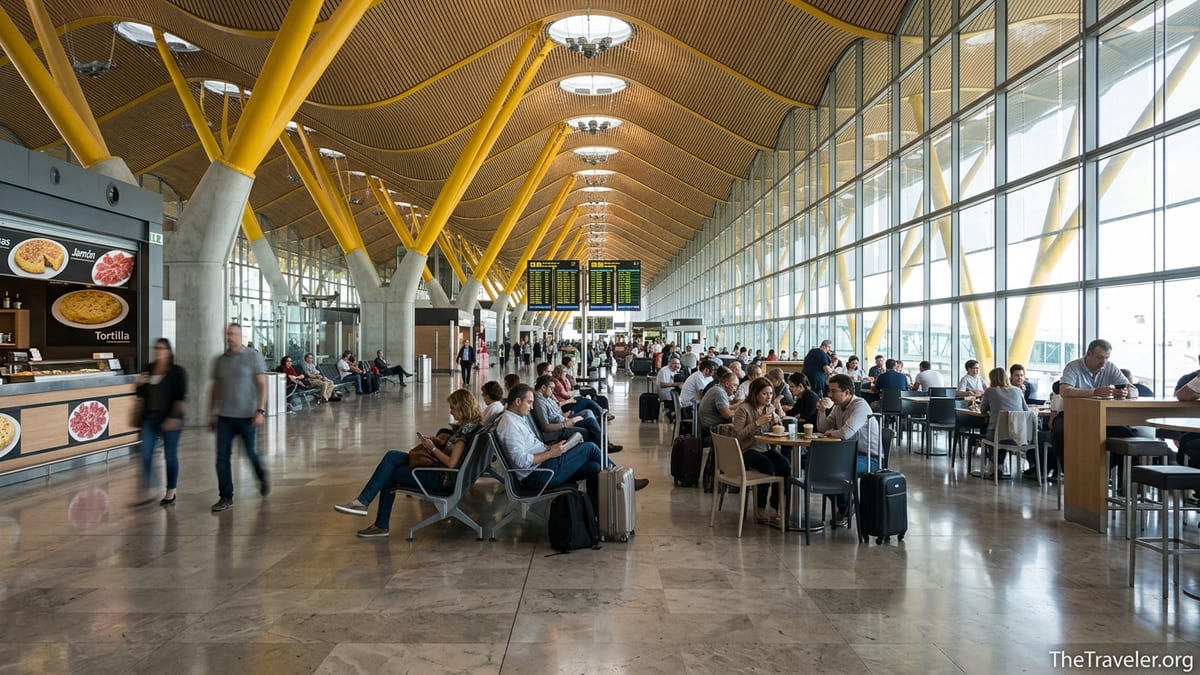
Understand the Layout and Plan Your Connection Time
Madrid Barajas Airport is divided into Terminals 1, 2, 3 and 4, but in practice you should think of it as two main terminal areas: the older complex (T1, T2, T3) and the newer Terminal 4, which itself is split into T4 (main building) and T4S (the satellite for many non Schengen and long haul flights). T4 and T4S are connected by an underground people mover train that runs airside, while transfers between T1–T3 and T4 require a landside shuttle bus and a new security check. This split matters when you judge whether you have time to relax, eat or leave the airport.
If all of your flights are on Iberia or other oneworld partners, you will almost certainly be in Terminal 4 and often connecting between T4 and T4S. In normal conditions, the transfer train between T4 and T4S takes about three minutes of riding time, but you should allow around 20 to 30 minutes in total once you include following the signs, waiting for a train and possibly clearing passport control if you are switching between Schengen and non Schengen flights. Real world reports from recent travelers suggest that a one hour protected connection within T4 and T4S is usually workable, but it can feel rushed in busy morning and evening banks, especially for non EU passport holders.
Swapping between the older terminals and T4 eats up more time. The free green airport shuttle bus that links T1, T2, T3 and T4 typically covers the route in 10 to 15 minutes, but you should budget at least 45 to 60 minutes once you include walking out to the bus stops, waiting for the next shuttle and then going back through security. If your itinerary is self booked on separate tickets, be more conservative and plan for 90 minutes or more, since any delay at passport control, baggage claim or security becomes your problem rather than the airline’s.
As a rule of thumb, anything under one hour is a pure “make the connection” stop where you should head straight to your gate, 2 to 4 hours is enough to enjoy the airport comfortably, and 6 hours or more opens up the possibility of a quick foray into Madrid city. Keep in mind that flight delays are not rare at a busy hub, so treat these rules as optimistic scenarios rather than guarantees.
Short Layovers: Smart Moves When You Have 1–3 Hours
On a layover of up to three hours, your priority should be making your next flight without stress. Once you know which terminal your onward flight leaves from and roughly how long your transfer will take, you can decide how much “free” time you really have. For example, if you land at T4S from New York with a scheduled 2 hour layover before a Schengen flight from T4 to Paris, you might realistically have around 60 to 75 usable minutes once immigration and the train transfer are done. In that window you can still freshen up, grab a decent meal and maybe shop for Spanish gifts.
For a quick reset, head for the larger restrooms in T4 near the main departures concourse or T4S near the central plaza, which tend to be less cramped than the tiny washrooms right at the gates. If you are desperate for a shower and do not have lounge access, your only realistic option inside the secure area is to buy a one time entry to a pay per use lounge that offers shower facilities in your terminal; this is common for several lounges in T4 and T4S. Expect to pay in the region of 35 to 50 euros for a stay of up to 3 hours that includes food, drinks, Wi Fi and shower use.
Eating well is entirely possible even on a tight schedule. In T4, you will find familiar international chains like Starbucks and McDonald’s mixed with Spanish brands. A coffee and pastry at a mid range café in the departures area will usually run around 4 to 6 euros, while a more substantial bocadillo sandwich and drink might cost 10 to 15 euros. Terminal 4 also hosts more upmarket options, which can be worthwhile if you have an hour to spare. For example, the presence of a Kabuki restaurant in T4 means you can get Japanese Spanish fusion sushi and small plates adapted to a “30 minute meal” format, which is ideal if you want something more interesting than fast food without risking your connection.
Shopping time on a short layover is best spent in the larger duty free stores near the main security exits. These stock Spanish wines, sherries and spirits, along with local brands of olive oil, jamón in vacuum packed form and tinned seafood like mussels and tuna. Prices on items such as a mid range Rioja can be competitive, often in the 8 to 15 euro range, and make for compact souvenirs that are easy to transport. Keep an eye on the boarding time on the screens: gates at Barajas can be a long walk, especially in T4, where some Schengen gates sit at the far ends of long corridors.
Making a Longer Layover Comfortable: Lounges, Showers and Sleep
Once your layover crosses the three hour mark, comfort becomes a priority. Madrid Barajas offers a mix of airline run and independent lounges across its terminals, and for many travelers a day pass is the easiest way to upgrade a long wait. In Terminal 4 and 4S, Iberia’s Premium lounges are the most extensive, but you generally need a business class ticket, elite status or oneworld membership to enter without paying. Travelers without status can instead look to pay per use lounges, which in recent years have charged roughly 35 to 45 euros for three hours, with discounts sometimes available through lounge access programs or bank cards.
The typical lounge experience at Barajas includes buffet food ranging from Spanish tortilla and cold cuts to salads and hot dishes at main mealtimes, along with a self service bar, quiet working areas and showers. On an overnight layover coming from Latin America to connect to an early morning European flight, many travelers treat a lounge visit as a chance to have a proper dinner or breakfast and a hot shower before sleeping on the next flight. If you are arriving during peak hours, look for the less obvious lounges that may be available in your terminal rather than the first one you see, as some of the main spaces can get crowded.
Sleeping in the public areas of Madrid Barajas is possible but not especially comfortable. Seating in T4 and T4S is modern but mostly made up of metal benches with fixed armrests that prevent lying down. Some travelers find quieter corners near the far end of certain gate areas, particularly late at night, while others choose to rest on the floor using their hand luggage as a pillow. Security patrols are used to people napping, though noise and bright lighting make genuine sleep difficult for more than an hour or two.
If you prefer a real bed, there are hotels within a short drive of the airport in the Barajas and Campo de las Naciones neighborhoods, many of which run free or low cost shuttles. A mid range chain hotel near the airport might cost between 80 and 150 euros per night depending on the season, and several sell day use rooms for significantly less. On a daytime layover of eight hours or more, booking a hotel for six hours to shower and sleep before returning for your next flight can be a good value tradeoff compared to spending money inside the terminal.
Storing Luggage and Traveling Light
Dragging multiple bags around for hours will quickly ruin any layover, especially if you are thinking about a quick trip into the city. Madrid Barajas has staffed left luggage facilities, known locally as consigna, where you can store suitcases and large items securely. These are located in the public arrivals level of Terminal 1 and Terminal 4, and they are generally open 24 hours a day. Services are operated by a specialist baggage company rather than the airport itself, and all bags are screened before storage.
Recent price lists indicate that standard bags cost around 6 euros for up to 2 hours and about 10 euros per piece for 24 hours, with multi day and weekly pricing available for longer stays. Oversized items such as sports equipment or unusually large suitcases are charged at a higher rate, often in the region of 15 euros per day for the first week. For example, if you arrive in the morning and will reconnect to another long haul flight late that night, you might pay roughly 10 euros to store a medium suitcase for the day while you take only a backpack with essentials into Madrid.
If all of this sounds too far from your gate, remember that the consigna facilities are landside. That means you must leave the secure zone, which will require another round of security screening before your next flight. This is usually worth it only when you either have a long layover or are planning to leave the airport anyway. For overnight layovers or multi day stops, some travelers also use private luggage storage services in central Madrid, which often partner with hotels or shops near Atocha and Puerta del Sol and charge around 5 to 7 euros per bag for the day.
Traveling light also matters at security. Madrid Barajas, like most major European hubs, periodically changes its security technology and rules. In recent years, newer scanners have at times allowed passengers to leave liquids and electronics in their bags, but these relaxations have later been rolled back to standard 100 milliliter liquid limits due to European regulations. To avoid delays, assume you will have to separate liquids into a clear bag and remove laptops or large electronics from your carry on, especially when re clearing security during a transfer between terminals.
Eating and Shopping: A Taste of Madrid Without Leaving the Airport
Food at Madrid Barajas ranges from basic fast food to higher end Spanish cuisine, with the best variety in Terminal 4. If your layover is at mealtime, try to lean into local flavors rather than defaulting to global chains. In T4’s main departures concourse, you can find tapas style outlets serving classics like tortilla de patata, croquetas and serrano ham, plus bakeries offering freshly baked napolitanas (chocolate filled pastries) and café con leche. Expect to pay around 3 euros for a coffee, 2 to 3 euros for a pastry and 7 to 10 euros for a plate of tapas.
For something more substantial, look for sit down restaurants inside the secure area offering menus del día, a fixed price daily menu that typically includes a starter, main course, dessert or coffee and sometimes a drink. While airport pricing is higher than in the city, you may still see lunch menus running around 18 to 25 euros. A glass of Spanish wine in a casual airport bar might be around 4 to 6 euros, while a draft beer is often slightly cheaper. At the newer Kabuki outlet in T4, prices reflect its restaurant pedigree, but you trade cost for the chance to eat chef driven fusion dishes that have been adapted to a tight airport schedule.
Shopping is designed to pull you in right after security. The main duty free areas stock big name cosmetics and perfumes alongside tobacco and spirits, but look beyond the global brands and you will find corners dedicated to Spanish products. Iberian ham and cured meats in vacuum sealed packs, Manchego cheese, extra virgin olive oil from regions like Jaén or Extremadura, and preserved seafood are all compact reminders of Spain. Packaged correctly, they usually meet most customs rules when flying within the European Union, though long haul travelers should check the import rules for their destination country.
Non food shopping leans heavily toward fashion and accessories, with Spanish high street brands that you might recognize from the city center, such as Zara or Massimo Dutti, represented in T4. Prices are broadly similar to downtown Madrid, though occasionally limited airport only promotions appear. If you need last minute travel essentials, there are several convenience style stores carrying phone chargers, European plug adapters, basic medicines and toiletries, which can be lifesavers if your luggage has gone missing in transit.
When You Have Time to Leave: Quick Trips into Madrid
If your layover is six hours or longer, and you hold the necessary entry rights for Spain, a quick escape into Madrid can be a highlight of your journey. The airport lies around 12 kilometers from the city center, and is connected by both metro and suburban train, as well as several bus lines and taxis. To decide whether it is worth leaving, subtract at least two hours from your total layover for formalities and the return to your gate. The time that remains is what you can realistically spend in the city.
The simplest public transport option that serves all terminals is Metro Line 8, which runs from the airport to Nuevos Ministerios in central Madrid. A one way trip from the airport typically takes around 25 to 30 minutes. Fares combine a standard metro ticket with an airport supplement, so in practice you can expect to pay in the region of 4.50 to 5 euros per ride, plus a small one time charge of about 2.50 euros for the reloadable Multi card if you do not already have one. From Nuevos Ministerios, you can connect to other metro lines to reach hotspots like Gran Vía and Sol.
An alternative from Terminal 4 is the Cercanías C1 commuter rail line, which runs directly to Chamartín station in roughly 20 minutes and Atocha station, near the historic center and the Prado Museum, in around 30 to 35 minutes. Ticket prices for Cercanías are generally a little lower than the metro for equivalent journeys, usually a bit under 3 euros one way. If your layover is centered on T4 and you are comfortable reading basic station signage, Cercanías can be the fastest and most comfortable way into the core of Madrid.
Taxi and app based rides are more expensive but more straightforward, especially if you have heavy luggage or are traveling with family. Madrid uses a flat fare from the airport to the central zone, which is often around 30 euros including airport surcharge but excluding any late night or public holiday variations. A ride to the city center typically takes 20 to 30 minutes depending on traffic. On a daytime layover of eight hours or more, pairing a taxi ride with a simple walking loop from Plaza Mayor through Puerta del Sol and back via the Royal Palace area gives you a memorable taste of the city before you return for your next flight.
Practical Tips for Stress Free Transit
A few practical habits can make even a chaotic layover feel more manageable. First, check your terminal and gate information on your airline’s app or the airport screens as soon as your plane lands. Gates in Madrid often change, and some long haul departures from T4S board from remote stands reached by bus, which adds extra time. Aim to be at your departure gate at least 30 minutes before boarding for European flights and earlier for long haul services, especially if you need to clear additional exit passport checks.
Second, do not underestimate walking distances. In T4, walking from security to the farthest Schengen gates can easily take 15 to 20 minutes at a normal pace, more if you are traveling with children or mobility issues. Moving walkways help, but they are sometimes crowded or out of service. If you need assistance, request wheelchair or mobility support from your airline in advance; this typically includes help with transfers between terminals.
Third, take advantage of free Wi Fi to re organize your travel plans. Madrid Barajas offers complimentary internet access throughout the terminals. Once connected, you can confirm hotel bookings, check onward train times from your destination airport or message contacts about changes. Many travelers use this time to download offline maps of Madrid or their final destination onto their phones, which can be invaluable if your next step after the layover involves navigating a new city.
Finally, think about local time and jet lag. If you are arriving from the Americas on an overnight flight that lands in the early morning, a bright, short walk around the terminal followed by a light breakfast and coffee can help you stay awake and adapt to European time. On the other hand, if you are leaving Europe for a long overnight sector, a quieter corner of the terminal or a paid lounge where you can dim the lights and rest may be more valuable than squeezing in one last errand.
The Takeaway
A layover at Madrid Barajas does not have to be a blur of queues and gate changes. Once you understand the basic layout of the terminals and how long transfers really take between T1–T3 and T4–T4S, you can make realistic decisions about whether to sprint, to relax or to venture into Madrid itself. Short connections reward focus and a bit of research on your specific route, while layovers of three hours or more are an opportunity to enjoy better food, a shower or even a nap in a nearby hotel.
With left luggage services in the arrivals halls, reliable metro and train links into the city and a growing range of lounges and restaurants in Terminal 4, the airport is steadily becoming friendlier to connecting passengers. Keep an eye on the clock, respect security and passport control bottlenecks, and try to build in a modest buffer for delays when you can. Treated as a flexible pause rather than a frustrating obstacle, your time at Madrid Barajas can make your overall journey more pleasant and, in some cases, surprisingly memorable.
FAQ
Q1. Is a 1 hour layover at Madrid Barajas enough to make a connection?
For protected connections on a single ticket within Terminal 4 and T4S, airlines sometimes sell 1 hour layovers and they usually work if flights are on time. That said, it leaves little margin for delays, long passport control lines or gate changes, so a 90 minute or longer layover is more comfortable, especially for non EU passport holders or transfers between the older terminals and T4.
Q2. How much time do I need to transfer between Terminal 1 or 2 and Terminal 4?
Allow at least 45 to 60 minutes for a transfer between the T1–T2–T3 complex and Terminal 4 if you already have your boarding pass and only carry on luggage. This includes walking to the shuttle bus, a 10 to 15 minute ride and another security check. If you must collect and re check bags on separate tickets, plan for 90 minutes or more to cover potential lines at baggage claim and check in.
Q3. Can I store my luggage during a layover at Madrid Barajas?
Yes. Staffed left luggage offices, known as consigna, operate in the public arrivals areas of Terminal 1 and Terminal 4. Recent price tables show that storing a standard suitcase typically costs around 6 euros for up to two hours and about 10 euros per bag for 24 hours, with higher rates for oversized baggage. These facilities are useful if you want to explore Madrid without dragging large bags.
Q4. Is it worth paying for an airport lounge during a long layover?
If your layover is three hours or more, paying for lounge access can be worthwhile, particularly on overnight or early morning connections. Typical pay per use lounge entry fees in Madrid Barajas fall in the 35 to 45 euro range for a stay of about three hours and usually include hot and cold food, drinks, Wi Fi and showers. Travelers often recoup part of the cost by eating a full meal in the lounge instead of buying separate food in the terminal.
Q5. How long does it take to go into Madrid city from the airport?
From the airport to central Madrid, the metro on Line 8 takes around 25 to 30 minutes to reach Nuevos Ministerios, while the Cercanías C1 train from Terminal 4 takes roughly 20 minutes to Chamartín and about 30 to 35 minutes to Atocha. Including walking and waiting time on each end, you should allow around one hour each way. That means a layover of at least six hours is advisable if you hope to spend two to three hours in the city.
Q6. How much does public transport from Madrid Barajas to the city center cost?
On the metro, expect to pay roughly 4.50 to 5 euros for a single trip from the airport once the special airport supplement is included, plus a one time charge of about 2.50 euros for the reloadable Multi card if needed. The Cercanías C1 train from Terminal 4 to central stations such as Chamartín or Atocha is usually slightly cheaper, often a bit under 3 euros one way. These prices can change over time, so always check the latest fare tables before traveling.
Q7. Are there showers available at Madrid Barajas for economy passengers?
There are no public pay per use shower cabins in the main terminal halls, but several airport lounges in Terminal 4 and T4S offer shower facilities. Economy passengers without elite status can access these lounges by purchasing a day pass or using a lounge membership program. If you are arriving from or departing on a long haul flight, booking a lounge with showers can be one of the most effective ways to freshen up during a layover.
Q8. Is it safe to sleep in Madrid Barajas Airport overnight?
Madrid Barajas is generally considered safe, with visible security and cleaning staff throughout the night, and many travelers do sleep in the terminals during long connections. That said, lighting is bright and announcements frequent, so true rest can be difficult. As with any public place, keep valuables close, use your bag as a pillow or footrest, and avoid leaving electronics unattended. For more privacy and comfort, an airport area hotel with a shuttle is a better choice.
Q9. Do I need to go through passport control on a layover in Madrid?
Whether you pass through passport control depends on where you are arriving from and where you are going. If you are entering or leaving the Schengen Area at Madrid, you will go through border checks, which can add significant time at peak hours. On a connection entirely within the Schengen zone, you usually skip passport control and only face security checks. Always follow the “Connecting Flights” and “Transfer” signs and be prepared with your passport and boarding pass in hand.
Q10. Can I leave the airport during a layover if my bags are checked through?
Yes, provided you have the right to enter Spain, your bags are tagged to your final destination and you leave enough time to come back through security. Many travelers with layovers of six to eight hours choose to store any carry on luggage they do not need in the airport consigna, then take the metro or train into the city for a walk and a meal. Just remember to be back at the terminal at least two hours before your next flight to allow for security and unexpected delays.