


More news on this day
Europe’s ambitious digital border overhaul is entering a turbulent phase, as the long delayed European Travel Information and Authorisation System (ETIAS) is now expected to affect most leisure travellers from the United Kingdom, United States and Canada from 2027, just as the new Entry/Exit System (EES) and reinforced Schengen checks are already generating queues, confusion and schedule disruptions at major airports.
Get the latest news straight to your inbox!
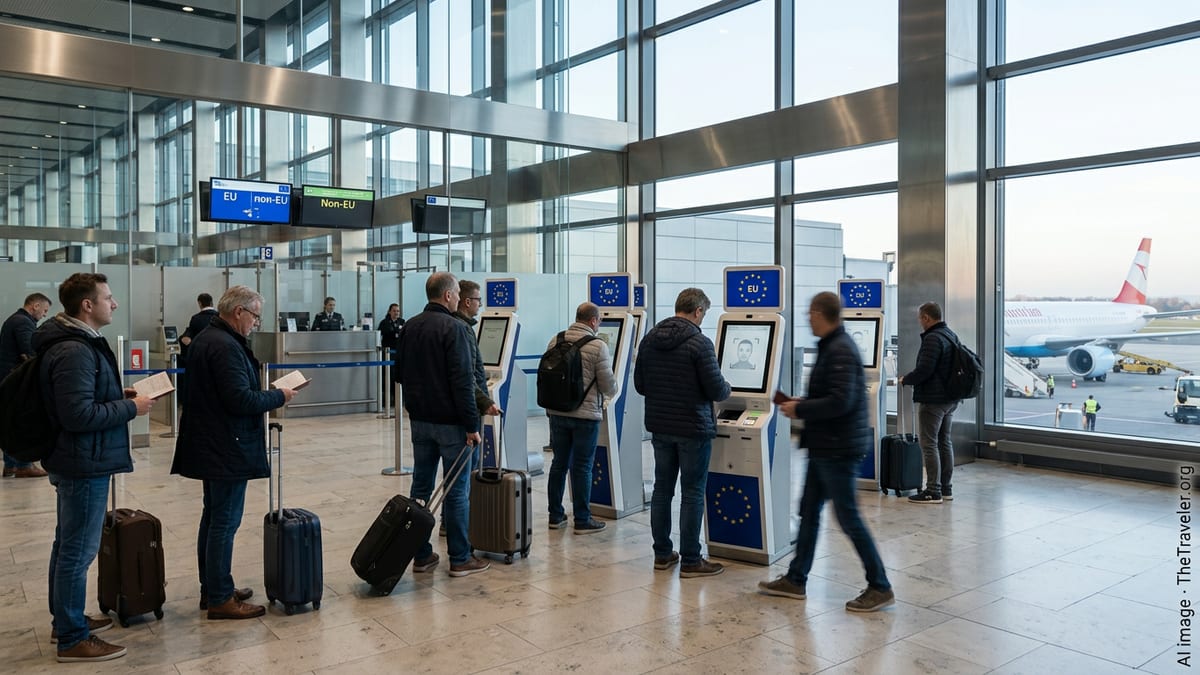
Digital border reboot collides with real world congestion
The European Union has spent the past decade designing a suite of interconnected databases and biometric tools intended to modernise Schengen border control, replacing manual passport stamps with automated checks. Central to this effort are the Entry/Exit System, which logs each crossing of non EU nationals, and ETIAS, a new pre travel authorisation for visa exempt visitors.
EES moved from testing to phased use in late 2025 and became fully operational at external Schengen borders in April 2026. Early experience at busy hubs has underlined both its promise and its immediate strain. The system captures fingerprints and facial images, records each entry and exit, and automatically flags overstays or document anomalies, but the extra steps at kiosks and inspection booths have lengthened processing times for many first time users.
Published assessments from EU institutions describe the digital shift as essential to tackling irregular migration and security risks, yet acknowledge that staffing levels, airport layouts and traveller readiness have not always kept pace with the technology. As a result, the infrastructure intended to smooth flows has, at least in the initial months, contributed to longer lines and missed connections during peak hours.
National border police forces and airport operators have responded by opening additional manual lanes, redeploying staff to assist confused passengers at EES kiosks and, in some locations, temporarily adjusting the balance between automated and staffed checks to ease bottlenecks.
ETIAS timeline slips again, with full impact pushed to 2027
Against this backdrop, the launch of ETIAS has shifted further into the future. Earlier plans envisaged the system starting as early as 2021, then 2023 and 2025. Guidance updated through 2025 and 2026 now places the opening of the ETIAS application platform in the last quarter of 2026, followed by a transition period before authorisations become de facto mandatory for most travellers.
Specialist immigration and travel briefings indicate that visitors from visa exempt countries, including the United Kingdom, United States and Canada, are unlikely to be required to hold ETIAS approval before boarding flights or ferries to Schengen destinations until sometime in 2027. During the initial roll out, border guards are expected to continue admitting eligible travellers without the new authorisation, while systems and air carriers adjust their checks.
The latest delay reflects the technical interdependence between ETIAS and EES. ETIAS relies on EES data, as well as connections to other large scale European databases, to pre screen travellers for security or migration risks. Each setback or complication in deploying the underlying infrastructure has therefore cascaded into revised ETIAS target dates and a more cautious approach to declaring the system fully in force.
For now, travellers from the UK, US and Canada remain under the existing regime, which allows short stays of up to 90 days in any 180 day period in the Schengen area without a visa, even as they must already pass through EES checks at many airports and land borders.
Schengen border pressures amplified by summer peaks
The Schengen area itself is undergoing change at the same time. Bulgaria and Romania joined the zone for air and sea borders in 2024, with further integration steps since, extending the reach of EES and putting additional pressure on shared external frontier points that now serve more member states.
State of Schengen reports released by the European Commission highlight persistent challenges ranging from staffing shortages to infrastructure gaps at certain land crossings and regional airports. As EES registration became mandatory, localised reports described long queues, particularly where facilities had limited biometric kiosks or where buses and flights arrived in concentrated waves.
This strain has intersected with a summer of high travel demand, as post pandemic tourism remains robust. Major hubs such as Paris, Amsterdam, Frankfurt and Barcelona have adjusted operations, yet anecdotal accounts from passengers and travel industry briefings describe early morning and late afternoon peaks where non EU passport holders can face waits far longer than advertised.
While the intent is that, once travellers are enrolled in EES, subsequent crossings will be faster, the majority of UK, US and Canadian visitors in 2026 are still encountering the system for the first time, limiting those efficiency gains in the short term.
New security layers reshape pre travel planning from the UK, US and Canada
The combination of EES and ETIAS will significantly change how travellers from visa exempt countries plan trips to continental Europe. ETIAS, which will function similarly to the United States ESTA or Canada’s eTA, will require an online application, payment of a fee, and prior electronic approval linked to the traveller’s passport before departure.
Information from European institutions and travel advisory platforms indicates that most applications are expected to be processed quickly, often within minutes, and that approvals will be valid for multiple trips over several years. Nonetheless, those with recent immigration issues, criminal records or data mismatches across systems may experience extra scrutiny or potential refusals.
For travellers in the United Kingdom, the impending EU requirements layer on top of the United Kingdom’s own electronic travel authorisation scheme, which is being extended to more nationalities. Canadian and American visitors will also need to align their Europe trips with existing US and Canadian electronic travel permissions if they connect through or return via those countries, creating a complex web of overlapping digital security regimes.
Travel associations and consumer advice outlets are already urging passengers to factor in added lead time before departure once ETIAS becomes operational, as failing to obtain an authorisation in advance could result in denied boarding by airlines rather than a simple conversation at the border.
Airports, airlines and travellers adapt to an evolving system
As Europe edges toward the 2027 moment when ETIAS is expected to be fully enforced, the aviation sector is recalibrating. Carriers have begun updating booking flows and check in systems to accommodate the eventual requirement to verify ETIAS approvals, in much the same way they now check for visas or other mandatory documents.
Airport operators are racing to refine passenger flows, expanding biometric zones and signage in multiple languages to explain the new procedures. Industry observers note that the first two or three peak seasons after full EES adoption will be critical in determining whether the promised efficiencies materialise or whether chronic congestion becomes a fixture at key gateways.
For individual travellers from the UK, United States and Canada, the immediate impact in 2026 is most visible at the border itself, in the form of longer queues and additional self service steps. The larger shift, however, will become apparent from 2027, when ETIAS moves from a background policy discussion to a practical requirement that must be addressed alongside passports, tickets and insurance.
Until then, publicly available information from EU bodies and travel industry analyses converge on a single message: the rules are changing, but not overnight. Careful monitoring of official guidance, coupled with extra time at airports and early adoption of new digital processes, will be essential as Europe’s border revolution gradually takes hold.