


The high speed Soko train between Belgrade and Novi Sad is fully operational in late 2026, but recent station and timetable changes mean that the journey looks quite different from its launch year. From October 19, 2026, almost all services on the modern Belgrade–Novi Sad–Subotica line follow a new stopping pattern, with fast Soko InterCity trains running to the new TPS Novi Sad stop and again calling at Petrovaradin, while slower and cheaper regional trains use a mix of Petrovaradin and TPS Novi Sad. Understanding these changes is now essential if you want to plan an efficient day trip or short break between the two cities.
Get the latest updates straight to your inbox!
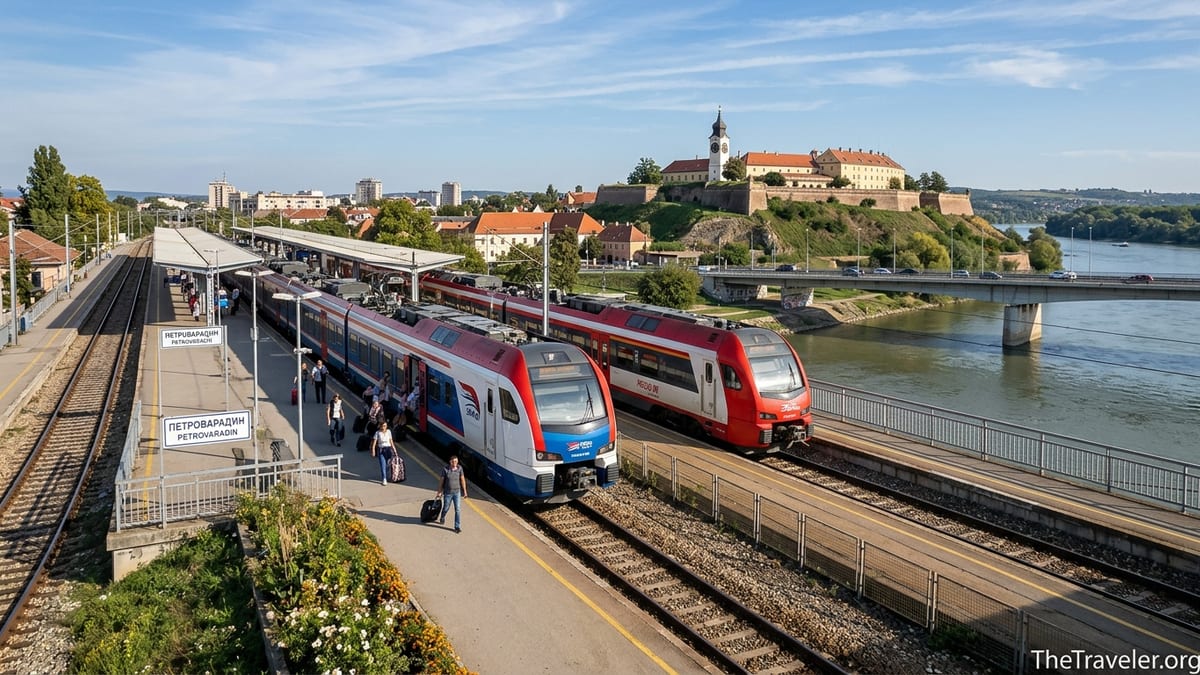
Soko and regional trains on the Belgrade–Novi Sad route
The core of the Belgrade–Novi Sad rail link is the Soko branded InterCity service operated by Srbija Voz. Under the timetable that took effect on October 19, 2026, Soko runs as an InterCity (IC) category train on the high speed line between Beograd Centar and Subotica, with Novi Sad as its main intermediate stop. Journey time from Beograd Centar (often called Prokop) to the new TPS Novi Sad stop is about 47 minutes, with around 39 minutes to Petrovaradin, according to current timetable summaries that consolidate official data.
Alongside Soko, Srbija Voz runs Inter Regio (IR), Regio Express (REx) and ordinary Regio (Re) services on the same corridor. Inter Regio trains run medium distance, connecting Belgrade with Subotica but stopping more often at regional stations such as Tošin Bunar and TPS Novi Sad. Regio Express and Regio trains are the slower regional options, serving more local stops and taking longer from Belgrade to Novi Sad, roughly from just over an hour upward depending on the pattern of intermediate stops.
As of November 2026, public timetable aggregators that track Serbia’s official schedule show multiple categories running each day between Beograd Centar and Novi Sad. A typical evening Regio Express departure from Beograd Centar to TPS Novi Sad may take around 1 hour 7 minutes, reflecting several intermediate stops that Soko skips. These slower trains are cheaper and can be useful during busy periods or when Soko departures do not suit your plans.
The important point for travelers is that “Soko” refers specifically to the high speed InterCity services branded with the falcon logo, while IR, REx and Re trains are standard regional electric units. When buying tickets online through the Srbija Voz system you should check both the train category (IC, IR, REx, Re) and the arrival station name, because that now determines where you actually arrive in the Novi Sad area.
New October 2026 stopping pattern: TPS Novi Sad and Petrovaradin
From October 19, 2026, Srbija Voz announced a change that restored Soko stops at Petrovaradin while maintaining existing calls at the new TPS Novi Sad stop. Official news statements and timetable-based guides confirm that all Soko InterCity trains now stop at Petrovaradin for passenger boarding and alighting, in addition to stopping at TPS Novi Sad. At the same time, all Inter Regio trains gained a regular stop at Tošin Bunar in New Belgrade, improving access to the high speed line for passengers staying on the western side of the capital.
TPS Novi Sad is a newly built stop on Rumenački put, roughly 4 kilometers from the traditional city center around Trg slobode. It sits on the high speed alignment west of the historic station and was initially used as a temporary terminal while works around the main Novi Sad station progressed. Various timetable notes earlier in 2026 even arranged replacement buses between Petrovaradin and Novi Sad, but by mid autumn 2026 that arrangement had ended and regular city buses and taxis became the main access options.
Current timetable summaries in English state clearly that under the October 19, 2026 schedule the Soko InterCity train takes about 47 minutes from Beograd Centar to TPS Novi Sad, calling at Tošin Bunar and Petrovaradin on the way. Cheaper Regio and Regio Express services still tend to be 15 to 25 minutes slower over the same distance, but they may offer more convenient boarding points in Novi Sad’s suburbs, especially for commuters.
Travelers should note that the long serving historic Novi Sad railway station is not currently the default arrival point for Belgrade trains. Depending on which departure you choose, you are most likely to arrive at TPS Novi Sad on Rumenački put, or at Petrovaradin on the eastern side of the Danube. This change is significant for visitors, because it alters how long it will take you to transfer from train to hotel or to the main tourist sights.
Understanding TPS Novi Sad, city buses and taxis
TPS Novi Sad is essentially a through stop on the high speed corridor, with modern platforms and basic passenger facilities rather than a grand terminal building. It lies on Rumenački put, a radial road in the western part of Novi Sad lined with warehouses, car dealerships and light industry. Travel planning forums and local discussions emphasize that the stop was never designed to be Novi Sad’s main showcase station. Instead, it serves as a functional access point to the fast line and as a backup during times when the main station is under reconstruction or partially closed.
The key to using TPS Novi Sad effectively is knowing the local bus connections. City transport information indicates that Novi Sad’s bus Line 4 operates a route labeled “Liman IV – Železnička stanica (Rumen. put)”, linking the new rail stop with the traditional city center along Bulevar oslobođenja and Jevrejska Street. In practical terms, this means that when you step off a Soko or regional train at TPS Novi Sad you can follow the signs for the city buses and board Line 4 toward the center and Liman districts. Journey time from TPS to Trg slobode via Line 4 varies with traffic, but travelers commonly report around 15 to 20 minutes.
Late 2026 reports from Novi Sad residents note that the earlier free shuttle bus coordinated by Srbija Voz between Petrovaradin and Novi Sad had already been withdrawn in October 2026. There is also no dedicated free shuttle from TPS Novi Sad into the city. That gap has made regular city buses and taxis the main onward options. A standard single bus ticket purchased from a kiosk or on board usually costs a modest amount in Serbian dinars; however, fare tables occasionally change, so you should check the latest amount on arrival.
Taxis are easy to find at TPS Novi Sad, particularly around the times when Soko trains arrive. Legitimate city taxis are metered and fares from TPS to the central square or the old town area are usually in the low four digit range in Serbian dinars depending on traffic and time of day. When a Soko arrival is crowded, expect a queue for cabs. If you are traveling in a small group or with luggage, the cost of a taxi divided between two or three people can be very reasonable compared with separate bus tickets.
Petrovaradin station and when it might be better
Petrovaradin station sits on the right bank of the Danube, across the river from Novi Sad’s historic center and directly below the dramatic Petrovaradin Fortress. Before the latest timetable changes, some Soko runs did not stop here at all, forcing passengers bound for the fortress or the eastern suburbs either to take slower Regio trains or to make complicated transfers. The October 19, 2026 timetable resolved much of this confusion by confirming that all Soko InterCity trains would once again stop at Petrovaradin.
For many tourists, this makes Petrovaradin an attractive arrival or departure point. If your main goal is to walk up to Petrovaradin Fortress, enjoy views of the Danube and then later continue to Novi Sad’s center, stepping off at Petrovaradin can save time and backtracking. Local travelers also point out that ordinary Regio and Regio Express services continue to stop at Petrovaradin, so if ticket prices on Soko are higher than you prefer, a slower train might still deliver you to the same very convenient station for fortress visits.
However, Petrovaradin is not ideal for every itinerary. To reach Novi Sad’s main pedestrian district and Trg slobode from Petrovaradin on foot, you will need to cross the Danube bridge, which takes roughly 25 to 30 minutes for a reasonably fit walker. There are also local buses and taxis linking Petrovaradin and the city center, though frequency can vary. Recent local discussions suggest that although Petrovaradin’s connectivity has improved since Soko reinstated its stops there, evening connections back to accommodation in other parts of Novi Sad may still require some planning.
For many visitors, the best strategy is to arrive from Belgrade on a Soko train that stops at Petrovaradin, explore the fortress and the riverfront, and then later use a bus or taxi to move across the river to the central square area. When returning to Belgrade, you can decide whether to board a Soko or Regio Express train from Petrovaradin again, or whether a departure from TPS Novi Sad better matches your schedule. Just ensure that when you book tickets online you select the correct origin and destination station names.
Belgrade Centre (Prokop) station and how to reach it
On the Belgrade side, almost all Soko trains originate or terminate at Beograd Centar, the modern “Prokop” station located in a cut just south of the city center. Prokop is not directly in the heart of the old town or the Savamala district, and first time visitors sometimes underestimate the transfer time. The station is roughly 2 to 3 kilometers from Republic Square and the main pedestrian street Knez Mihailova, on a hillside between the Autokomanda junction and the city center.
There is currently no Belgrade metro, so you will rely on city buses, trolleybuses or taxis to reach Prokop. Several city bus routes pass on nearby streets and have stops signposted for Beograd Centar. Exact lines and numbers change over time, but as of late 2026, travelers often use buses that connect Prokop with Slavija Square, the main railway yard direction and parts of New Belgrade. Transfer times range from around 10 minutes from Slavija to 20 minutes from Zeleni venac near the old town, depending on traffic conditions.
Many travelers prefer taxis for early morning Soko departures or late evening arrivals at Prokop. Licensed Belgrade taxis must display their company markings and use a meter. A ride from Prokop to Republic Square usually comes to a mid three digit amount in Serbian dinars in light traffic. From major tourist neighborhoods in Dorcol or around Skadarlija, taxi times are short but traffic congestion during rush hours can add expense, so add a buffer of at least 20 to 30 minutes before your train.
Prokop itself is functional but still feels incomplete in 2026, with parts of the station environs under construction and limited retail. There are basic ticket counters, vending machines and waiting areas, but you should buy snacks and drinks in the city beforehand if you prefer international brands or a wider selection. Elevators and escalators connect the concourse level with platforms, which helps travelers with luggage and those with limited mobility, but the layout can be confusing, so allow a few extra minutes the first time you use the station.
Tickets, prices, seat reservations and classes
Soko InterCity trains use modern double deck or single deck electric units with reserved seating. Official product descriptions and international rail documentation note that for InterCity Soko, seat reservations are mandatory. When you purchase a ticket through the official Srbija Voz online booking system or mobile app, your seat assignment is included in the fare and appears on your digital ticket. This system helps avoid overcrowding on popular departures, but it also means that popular commuter times can sell out in advance.
By contrast, Inter Regio, Regio Express and ordinary Regio trains on the same corridor generally do not require seat reservations. You buy a ticket for the route and then board any train of that category at the time you choose, subject to its capacity. This flexibility comes with a trade off: during busy weekday peaks, some regional trains can be very full, especially between Belgrade and Novi Sad, and you may need to stand for part of the journey.
Exact fares change with periodic tariff updates, so it is best to check current prices directly in the official online booking system shortly before travel. As an indicative pattern visible in late 2026 bookings, a second class Soko ticket between Beograd Centar and TPS Novi Sad typically costs more than a comparable Regio Express fare on the same route, reflecting the faster travel time and compulsory reservation. First class options are available on Soko and on some Regio Express services, offering more space, quieter cars and at seat power sockets. Digital purchase discounts or promotional fares sometimes appear for specific trains or off peak hours, especially if you buy via the Srbija Voz website or app rather than at a station counter.
For budget conscious travelers, it can make sense to use Soko in one direction and a regional train in the other. For example, you might pay for a morning Soko departure from Beograd Centar that guarantees a swift, comfortable arrival in Novi Sad, then return in the evening on a cheaper Regio Express train from Petrovaradin or TPS Novi Sad when you are less pressed for time. If you hold an Interrail or Eurail pass valid in Serbia, documentation confirms that Soko can be used but requires a supplementary reservation, whereas regional trains can generally be boarded without one.
Onboard comfort, luggage, accessibility and bicycles
Soko trains are some of the most modern in the Srbija Voz fleet. The Stadler KISS and CRRC “Tiger” sets used on the route offer air conditioned interiors, electronic information displays and a choice of first and second class seating. The second class decks feel similar to other contemporary European regional trains, with two plus two seating, overhead luggage racks and some larger spaces near doors for bulky bags. First class cars or sections have wider seats and a bit more legroom, which can be appreciated on longer runs to Subotica but is less crucial on the short hop between Belgrade and Novi Sad.
Luggage facilities on Soko include classic overhead racks, vertical shelves at car ends and multi purpose spaces near the doors on the lower deck where large suitcases can be parked. Official descriptions of the Stadler KISS based Soko sets note that these areas can be reconfigured to hold either luggage or bicycles by folding certain racks. As on most European trains, you keep valuable items like laptops and passports with you at your seat. For regional REx and Re services, rolling stock is usually Stadler Flirt 3 or similar electric multiple units with air conditioning and a single wide aisle, again with overhead racks and some larger luggage bays at car ends.
Accessibility is a mixed picture. New high speed stations and stops such as TPS Novi Sad are built with elevators and ramps, and the modern Soko and regional units have low floor sections at some doors, designated spaces for passengers using wheelchairs and accessible toilets. However, older secondary stations and certain platform sections at Petrovaradin and Prokop may require climbs on stairs or use of sloped paths. The official guidance on transporting bicycles in Serbia states that bicycles are allowed on Soko and on domestic electric multiple unit trains, but only through doors marked with bicycle symbols and within multi purpose areas.
More detailed rules specify that on Soko trains, spaces for bicycles are located in all cars in the area where luggage racks are installed on the lower level. The lower rack folds down to make space for bikes and conductors can accept up to about 8 bicycles per Soko set if the space is otherwise unused. On other modern Soko branded sets built by CRRC, capacity is lower, around 2 bicycles. Conductors make the final decision based on crowding, and when trains are very busy they may refuse additional bikes. There is usually an extra fee for bicycle transport in domestic traffic, so ask about this surcharge when buying your ticket.
For travelers with mobility needs, it is advisable to choose departures that use the most modern rolling stock and to allow extra time at stations. If you require assistance boarding or alighting, consider contacting Srbija Voz customer service in advance. When in doubt, a regional train that spends more time at each station can sometimes be easier to board than a fast Soko with short dwell times, even if the overall journey is slightly longer.
Sample day trip itinerary and costs from Belgrade
A realistic day trip from Belgrade to Novi Sad using the October 2026 timetable might start with a mid morning Soko departure from Beograd Centar. After taking a city bus or taxi from your accommodation to Prokop, you board a Soko InterCity bound for Subotica that stops at Petrovaradin and TPS Novi Sad. Suppose you leave around 9:00 or 10:00 in the morning. In roughly 39 minutes you can alight at Petrovaradin, step out of the station and walk uphill to the fortress for panoramic views of the Danube and the city skyline.
After exploring Petrovaradin Fortress, visiting the courtyards and perhaps taking a coffee break at one of the terraces, you can walk across the river into Novi Sad’s center. The stroll across the bridge and through the riverside park takes about 30 minutes. By early afternoon you reach Trg slobode, admire the Cathedral and explore the pedestrian zone along Zmaj Jovina and Dunavska Street. Lunch in a mid range restaurant in the center, including a main dish and a drink, will usually cost a moderate amount in dinars per person, with higher prices right on the main square and slightly lower prices in side streets or the Liman neighborhoods.
For the return to Belgrade, you have several options. One is to take a city bus, such as Line 4, from the central area back to TPS Novi Sad and then board an evening Soko to Beograd Centar, enjoying a fast and comfortable journey back in around 47 minutes. Another is to make your way back to Petrovaradin and catch a Regio Express or Soko departure from there, depending on the time and fare you prefer. When calculating total costs, add together the city transport to Prokop in Belgrade (bus or taxi), the Soko or regional train fare in each direction, urban buses or taxis in Novi Sad, your meals and any paid entry to exhibitions at Petrovaradin or museums in Novi Sad.
As an approximate budget example for one adult in late 2026 using standard fares, you could expect to spend for the day: a mid range return Soko or Soko plus regional combination ticket in the low to mid four digit range of Serbian dinars, two or three city bus rides in each city costing a few hundred dinars in total, and meals and coffee in the range of one to two thousand dinars depending on where and what you eat. This kind of day trip is therefore very affordable by Western European standards, while still providing fast and comfortable travel between the two cities.
If you prefer to minimize costs further, you could replace one or both Soko legs with Regio or Regio Express services, at the expense of longer travel time and more crowded cars. Conversely, choosing first class on Soko both ways and using taxis instead of buses at each end raises comfort and speed, while still keeping the entire day’s transport and meal costs broadly within what many visitors would consider a reasonable excursion budget.
Two day overnight option and side trip to Sremski Karlovci
Staying overnight in Novi Sad allows for a slower pace and an additional excursion. One popular option is to add a side trip to Sremski Karlovci, the small town famous for its baroque architecture and wine cellars, located southeast of Novi Sad along the same rail line toward Belgrade. Regional trains between Novi Sad or Petrovaradin and Sremski Karlovci usually take around 10 to 15 minutes and are covered by the same Regio or Regio Express categories discussed above. Before setting out, you should check current timetables in the Srbija Voz system or via timetable aggregators, since local train frequencies can change between seasons.
A two day itinerary might look like this. On day one, take a mid morning Soko from Beograd Centar and alight at Novi Sad, either at TPS with a short bus ride into the center or at Petrovaradin followed by a walk across the river. Check into a hotel or guesthouse near the pedestrian zone, enjoy lunch and spend the afternoon exploring the old town, Danube Park and the riverside promenade. In the evening sample one of Novi Sad’s bistros or wine bars before returning to your accommodation.
On day two, use a regional train from Novi Sad or Petrovaradin to Sremski Karlovci, ideally aiming for a morning departure to maximize your time. Spend a few hours wandering the main square, visiting churches and perhaps tasting local bermet wine in one of the cellars. Lunch in Sremski Karlovci is generally cheaper than in the very center of Novi Sad, and you can then return by train to Novi Sad in the afternoon to collect your luggage before catching a late afternoon or evening Soko back to Belgrade.
Cost wise, you will add one night of accommodation in Novi Sad, a couple of short regional train legs for the Sremski Karlovci excursion and additional meals. Mid range hotels or private apartments in central Novi Sad typically price rooms per night in the mid to upper four digits or low five digits of Serbian dinars depending on season and quality. Train fares for the short Novi Sad or Petrovaradin to Sremski Karlovci segment are relatively low compared with the intercity portion, making the side trip a good value addition to a two day itinerary.
Accessibility, construction, timetable changes and final verdict
The Belgrade–Novi Sad–Subotica high speed line is still evolving, and changes in station usage and stopping patterns have been frequent since its launch. The October 19, 2026 timetable that reinstated Soko stops at Petrovaradin and added Inter Regio calls at Tošin Bunar is the latest in a series of adjustments prompted by ongoing construction and passenger feedback. Station works around the old Novi Sad railway area, plus the relatively remote location of TPS Novi Sad, mean that travelers need to pay closer attention than usual to station names when booking and to local transfer options when planning their arrival.
For passengers with mobility needs or heavy luggage, these changes can have practical consequences. A stop at TPS Novi Sad may offer modern high platforms and elevators but require a bus or taxi ride of several kilometers to reach your hotel, while arriving at Petrovaradin brings you close to the fortress but still leaves a bridge crossing and some gradients if your accommodation is in the center. On the Belgrade side, Prokop’s partially finished surroundings and hillside location can create challenges for those who prefer level access. When possible, consider daytime arrivals and departures to make orientation easier, and allow extra time for station navigation.
When comparing Soko, regional trains and intercity buses, Soko is clearly the fastest and most comfortable option between Belgrade and Novi Sad, with around 47 minutes of travel time from Prokop to TPS Novi Sad and high quality rolling stock. Regional Regio and Regio Express trains cost less, run slightly slower and offer more flexibility without compulsory reservations, but can be crowded and may not always align with ideal sightseeing times. Intercity buses between Belgrade and Novi Sad remain a viable alternative, especially for travelers who prefer direct city center to city center links without the need to navigate Prokop or TPS Novi Sad, though they are subject to road traffic and cannot match Soko’s speed.
Overall, for most international visitors in late 2026, Soko will be the preferred choice at least in one direction, especially if comfort, reliability and a fixed seat are priorities. Regional trains work well for cost conscious travelers or those whose accommodation happens to be near one of the suburban stops. Buses fill a niche where rail access points are inconvenient, but they no longer offer a time advantage on the core Belgrade–Novi Sad corridor. Whatever you choose, the most important practical step is to verify the current timetable close to your travel date, confirm whether your train uses TPS Novi Sad or Petrovaradin, and plan your local bus or taxi connections accordingly.