


Few waterfronts in Europe are as instantly recognizable as Nice’s Promenade des Anglais. Stretching for around seven kilometers along the Bay of Angels, it looks simple at first glance: a ribbon of palm trees, blue chairs and pebbled beaches. Yet most visitors walk a random stretch near their hotel and leave without ever seeing its best viewpoints. With a little planning though, you can experience the Promenade from every angle: sea level, rooftop, hilltop and even from the air as you land. This guide explains exactly how to do it.
Get the latest updates straight to your inbox!
Understanding the Layout of the Promenade
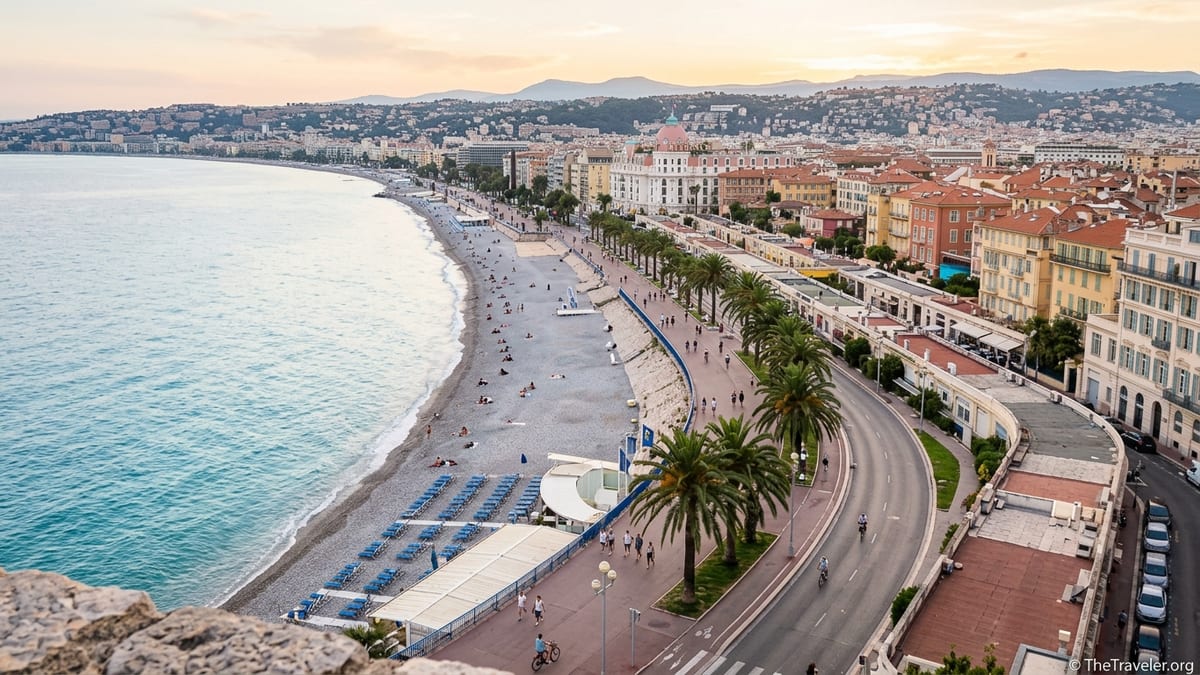
Getting great views on the Promenade des Anglais starts with understanding its shape. The promenade runs roughly west to east along the Baie des Anges, from near Nice Côte d’Azur Airport and Parc Phoenix in the west to the foot of Castle Hill, where it becomes the Quai des États-Unis. For orientation, think of three main zones: the western airport stretch with wider pavements and fewer crowds, the central hotel strip around the Negresco and pedestrian beaches, and the eastern curve by Old Nice and Castle Hill where the bay forms its most photogenic arc.
Because the promenade follows a very gentle curve, your perspective on the bay changes as you move along it. Near the airport, you look straight along the open coast with planes taking off and landing behind you. Around the Negresco area, you are in the heart of postcard Nice, backed by grand Belle Époque hotels and cafés. Closer to Castle Hill, the curve of the bay tightens and you begin to see the whole sweep of the city, with the orange rooftops of Old Nice gathering at the eastern end. Knowing this helps you choose which sections to prioritize, especially if you only have one day.
In practical terms, the promenade is fully walkable from end to end, but most visitors focus on the central five-kilometer segment between roughly the airport-adjacent Aéroport / Promenade area and the Rauba Capeu sundial at the base of Castle Hill. Public buses and the tram network make it simple to access different sections, so you are not obliged to walk everything in one go. That flexibility is key to planning a day that focuses on viewpoints rather than just distance.
Another important detail: there are three parallel layers of experience. Closest to the road are the hotels and apartments with balconies that catch sunset light. Between the buildings and the beach sits the promenade itself with its cycle lane, benches and famous blue chairs. Finally, below the road on a lower level are the beach clubs and public beaches. Shifting between these three levels throughout the day will give you markedly different vantage points without ever leaving the area.
Arriving in Style: First Views from the Airport End
If you arrive by air in daylight, your first breathtaking view of the Promenade des Anglais may actually be from the airplane window as you descend over the Baie des Anges. Once you are on the ground at Nice Côte d’Azur Airport, you can turn this into a seamless coastal introduction by heading directly to the sea-facing side of Terminal 1 or Terminal 2 and following the signs to the tram and bus platforms. From here, you are essentially steps away from the western start of the promenade.
For a scenic first ride, many visitors choose the city bus that runs along the seafront from the airport area toward central Nice, currently marked as line 12+ serving the Aéroport / Promenade stop and then following the waterfront toward Place Masséna. Tickets are typically inexpensive and can be bought from ticket machines at stops or via the Lignes d’Azur mobile app, making this one of the most budget-friendly coastal tours you can take on your arrival day. Sitting on the right-hand side of the bus as you head into town gives you uninterrupted views of the sea, beach and the entire length of the promenade unfolding ahead of you.
If you prefer to begin on foot, you can simply walk from the Aéroport / Promenade stop toward the sea and step directly onto the promenade. The western section near Parc Phoenix and the shopping center Cap 3000 is much quieter than the central strip. This makes it ideal if you want an early-morning or late-afternoon stroll without crowds. Looking east from here, you see the curve of the bay with the city growing denser in the distance, and on clear days the hills of the backcountry make a hazy backdrop behind the buildings.
Cyclists and runners often base themselves on this western stretch because the cycle path is broad and relatively uncluttered. It is also a practical area to rent a bike or e-bike from one of the private operators whose docks and parking spots are visible all along the promenade. Starting your first ride here and heading toward the city center allows you to stop at viewpoints as you go without fighting through dense pedestrian traffic from the outset.
The Iconic Center: Negresco, Blue Chairs and Beach Clubs
The core of the Promenade des Anglais, and the part most visitors recognize instantly from photographs, stretches roughly between the Boulevard Gambetta intersection and the Jardin Albert 1er. Here you find the most concentrated cluster of grand hotels, beach clubs and the city’s famous blue chairs, or chaises bleues, lining the seafront. This is where the classic postcards and magazine spreads of Nice are usually shot, so it is essential not to rush through it.
One of the strongest viewpoints in this central zone is in front of the Hotel Negresco, a Belle Époque landmark with a pink dome that has become an emblem of the city. Stand on the seaward side of the promenade opposite the hotel and look back toward it in the late afternoon. The sun will be dropping toward the west over the sea, but the hotel facade still catches soft light, and the line of palms and blue chairs frames the building perfectly. If you walk a little further east or west, you can angle your shot to include a stretch of the beach and the distant curve of the bay behind the dome.
Another excellent angle is from one of the public beaches at roughly mid-bay. Several of the private beach clubs between the Negresco and the Opéra area allow outside visitors to have a drink or lunch on their terraces facing the water. Even if you do not want to pay for a full-day lounger, budgeting for a single drink in the late afternoon gives you access to a low, eye-level view of the promenade with the city rising above it. From this angle, the blue chairs and the palm-lined road feel like a stage set with the sea as your foreground.
For a quick, relaxed panorama without leaving the level of the promenade, settle into one of the blue chairs near the Jardin Albert 1er. This small park marks the transition between the central promenade and the area that begins to curve toward Old Nice. In late afternoon and early evening, locals gather here to sit, chat and watch the light shift over the water. If you sit facing west as the sun sets, you will see the silhouettes of palm trees and joggers cut across the golden path on the water, a scene that feels like the distilled essence of the Riviera.
Climbing to Castle Hill for the Classic Bay of Angels Panorama
No viewpoint along the Promenade des Anglais rivals the sweeping panorama from Castle Hill, known locally as the Colline du Château. Rising above the eastern end of the promenade where it becomes the Quai des États-Unis, this 19-hectare park offers elevated lookouts over the entire bay, the old port and the terracotta rooftops of Old Nice. To reach it from the promenade, follow the seafront east until the broad curve ends at the distinctive Rauba Capeu area, marked by a large modern sundial sculpture.
From near Rauba Capeu, you will see signs pointing to the ascenseur, the public elevator that rises partway up the hill. In high season the elevator can involve a short wait, but it is free and spares you the steepest part of the climb. Alternatively, you can take the stepped paths that begin either from near the seaside or from the streets of Old Nice behind. The walk up takes around ten to fifteen minutes at a steady pace and quickly rewards you with glimpses of the bay through pine trees and old stone walls.
The classic viewpoint is from the main terrace that looks west over the Baie des Anges and the full length of the Promenade des Anglais. Morning light illuminates the city, but for most visitors the late afternoon and sunset hours are the most memorable here. As the sun drops toward the horizon, the curve of the bay catches layers of color, from pale blue near the shore to deeper indigo further out. The orange roofs of Old Nice glow against the sea and you can trace the palm-lined promenade almost to the airport in the distance. Photographers often use a wider lens in this spot to include both the drop to the sea and the arc of the bay.
Do not rush back down after your first photo. A path from the main terrace leads around the hilltop toward the port side, where a different terrace looks east over the harbor and the coastal cliffs beyond. While this view does not show the promenade directly, it offers context for the geography of Nice and helps you understand how the city sits between the sea and the surrounding hills. When you descend, consider taking a different route, emerging either back at Rauba Capeu for a low-level sunset walk, or into the narrow streets of Old Nice for dinner before an evening stroll along the promenade.
Hidden Angles: Rauba Capeu, Rooftops and Side Streets
One of the most photographed ground-level viewpoints along the waterfront is the Rauba Capeu area, just east of where the official Promenade des Anglais becomes the Quai des États-Unis. Here, a small concrete platform projects slightly seaward, holding a large sculptural sundial. Stand with your back to the sculpture and face west and you get a near-perfect curved view of the promenade, with Castle Hill rising above Old Nice on your right. Late afternoon is particularly dramatic here, when the sun sets roughly in line with the bay. In summer, it can be crowded with photographers, so arriving a little before golden hour helps you claim a good spot.
Rooftop terraces provide another layer of perspective that many visitors overlook. Several hotels and bars along or just behind the promenade have rooftop spaces that open to the public in the afternoon or early evening, often requiring only the price of a drink. For example, a mid-range hotel one block back from the sea may have a rooftop plunge pool and bar with a side-on view of the promenade and bay. From this height, you can frame the blue chairs and traffic from above while still feeling connected to the street life below. If you are planning a special evening, it can be worth calling ahead to confirm opening times, as rooftop spaces sometimes close in shoulder seasons or during private events.
Some of the most atmospheric perspectives on the promenade come from the side streets that connect it to the rest of the city. Around the central stretch, streets such as Rue de France and side lanes near Rue Meyerbeer lead from the tram corridor down toward the sea. Walking these narrow channels and emerging suddenly onto the open light of the promenade creates a powerful sense of arrival. It is also an effective way to photograph the contrast between everyday city life and the theatrical openness of the seafront, particularly in late afternoon when the sun low over the sea throws long shadows along the side streets.
Finally, do not ignore the viewpoints that appear after rain or on days with mixed weather. When the pavement is wet and clouds break to reveal bands of light over the sea, reflections on the stone slabs of the promenade can double the impact of the scene. Locals out for a quick walk with umbrellas, cyclists gliding through puddles and the neon of hotel signs beginning to glow all combine into unexpectedly cinematic images. These less obvious moments often yield some of the most memorable photographs and impressions of the promenade.
Moving Along the Promenade: Walking, Cycling and Public Transport
Because the Promenade des Anglais is long and lined with viewpoints, how you move along it shapes what you actually see. Walking remains the simplest choice. At a relaxed pace with stops, most visitors can comfortably cover the most interesting central segment between the Gambetta area and Rauba Capeu in an hour or two, taking time to sit on the blue chairs and detour down to the beach. Comfortable footwear matters more than distance on this flat route, as the surface is hard and the sun strong in summer.
Cycling gives you the ability to sample multiple viewpoints in a single outing, from the airport end to the Old Town curve. The dedicated cycle lane runs along the seaward side of most of the promenade, clearly marked and usually separated from pedestrians. You can rent standard bikes and e-bikes from private rental shops near the seafront, often for a half-day or full day at prices that are competitive compared with taxi fares for similar distances. When planning a ride, remember that beach clubs and café terraces offer natural stopping points. Lock your bike at official racks on the upper level of the promenade before heading down to the beach or into a café.
Public transport is another powerful tool for viewpoint hunters. The tram network connects the airport area, city center and main train stations, while bus routes such as 12+ run directly along sections of the promenade itself. A day pass covering trams and buses typically costs roughly the same as a couple of single tickets, so if you know you will be hopping off and on to reach different viewpoints, it is generally good value. Ticket machines at main stops near the promenade, including the Masséna and Jean Médecin tram corridors, make it straightforward to buy passes using coins or cards, and the Lignes d’Azur mobile app allows you to purchase and store digital tickets on your phone.
A useful strategy is to mix these modes over the course of a day. For example, you might take the tram or bus from your accommodation to the western airport end in the morning, then walk or cycle back toward the center, stopping for lunch near the Negresco. In the late afternoon, ride a bus or tram closer to Rauba Capeu and Castle Hill for elevated sunset views, then wander back through Old Nice to reach the tram line home. Planning in this way ensures you experience the promenade from multiple perspectives without exhausting yourself or spending heavily on taxis.
Timing Your Visit for the Best Light and Atmosphere
On the Promenade des Anglais, timing may be as important as location when it comes to experiencing the best viewpoints. Early morning, late afternoon and the blue hour after sunset each transform the promenade in distinct ways. If you only have one day in Nice, structuring your time around these natural shifts in light will help you see the area at its most beautiful and least crowded.
Early morning, especially outside high summer, is the quietest time. Joggers, dog walkers and residents heading to work largely have the promenade to themselves. The light comes from behind the city, illuminating the hills and buildings while the sea remains a soft, milky blue. This is an ideal time for wide shots from the central promenade or mid-bay beaches, where the line of hotels and palm trees stands crisp against the sky. If your hotel serves breakfast on a terrace or balcony facing the sea, consider stepping out before eating to catch this calm, reflective mood.
Late afternoon into sunset is when the promenade feels most like the Riviera fantasy many travelers imagine. The sun drops toward the open sea in the west, casting long shadows across the pavement and setting the blue chairs and palm trunks aglow. Central viewpoints near the Negresco, the blue chair rows by Jardin Albert 1er, and the Rauba Capeu platform all come into their own during this period. It is also the best time to be on Castle Hill or a rooftop bar, as the angle of the light accentuates the curve of the bay and paints the terracotta rooftops of Old Nice in rich tones.
After sunset, the blue hour and early night offer a final set of viewpoints worth seeking out. Hotel facades light up, the Ferris wheel that sometimes graces the Place Masséna area glows over the trees, and the promenade itself shifts from beach scene to evening promenade in the classic Mediterranean sense. Reflections from streetlights glitter on the water, and long-exposure photos capture trails of car lights along the curve of the road. Even if you are not carrying a camera, an after-dinner stroll from Old Nice toward the central promenade allows you to experience the city at its most romantic and atmospheric.
The Takeaway
Visiting the Promenade des Anglais without missing its best viewpoints is less about luck and more about a handful of deliberate choices. Understand the layout of the bay, use the airport end and central stretch as distinct experiences, and never skip the climb or elevator ride up to Castle Hill. Balance ground-level moments on the blue chairs with rooftop drinks and side-street arrivals. Let public transport and bike rentals extend your reach so you can see more than the few blocks outside your hotel.
Most importantly, pay attention to timing. A single day that begins with a quiet sunrise walk near the airport end, continues with a mid-morning coffee near the Negresco, pauses for a beach-level lunch, and culminates with sunset from Rauba Capeu or Castle Hill will give you a far richer impression than any hurried midday dash along the pavement. With this approach, the Promenade des Anglais becomes not just a famous street you check off, but a series of layered viewpoints and moods that anchor your entire stay in Nice.
FAQ
Q1. How long does it take to walk the full length of the Promenade des Anglais?
For most visitors, walking the main seven-kilometer stretch at a relaxed pace with photo stops takes about two to three hours. Many people choose to focus on the central five kilometers between the airport-adjacent area and Rauba Capeu and then use public transport to connect the rest.
Q2. Where is the single best viewpoint over the Promenade des Anglais?
If you have time for only one panoramic view, head to the main terrace on Castle Hill overlooking the Baie des Anges. From there you can see the entire curve of the promenade, Old Nice and the distant airport, especially striking at sunset on clear days.
Q3. Is it better to see the promenade at sunrise or sunset?
Both are rewarding but in different ways. Sunrise offers calm, cool conditions with soft light on the city, ideal for quiet walks and wide shots. Sunset usually delivers warmer colors over the sea and a livelier atmosphere, making it perfect for views from Rauba Capeu, Castle Hill or rooftop terraces.
Q4. Can I explore the best viewpoints without renting a car?
Yes, and in fact a car is more of a hindrance along the promenade due to limited parking and traffic. You can easily reach all major viewpoints on foot, by tram, by bus and, if you wish, by rented bicycle or e-bike. Day passes for local public transport are generally affordable and convenient.
Q5. Are there good viewpoints that do not require climbing many stairs?
Several excellent viewpoints are accessible with minimal effort. The Rauba Capeu platform at the eastern end is almost at street level and offers a classic curved view of the bay. The blue chairs near Jardin Albert 1er also provide open sea vistas without any climbing. To reach Castle Hill with fewer stairs, you can use the public elevator from near the seafront.
Q6. What is the best way to combine cycling and viewpoints on the promenade?
A practical plan is to rent a bike near the central promenade, ride west toward the airport end for long, open views, then return toward the city with planned stops near the Negresco, Jardin Albert 1er and Rauba Capeu. Lock your bike at official racks when you want to explore beaches, rooftop bars or climb Castle Hill on foot.
Q7. How crowded does the promenade get in peak season?
In July and August, the central promenade around the Negresco and Old Nice can become very busy, especially late afternoon and evening. Viewpoints like Rauba Capeu and the blue chair rows fill quickly at sunset. To avoid heavy crowds, aim for early mornings, shoulder seasons such as May, June or September, or the quieter western sections closer to the airport.
Q8. Are there specific spots that are especially good for photography?
Yes. Key locations include the seafront opposite the Hotel Negresco, the blue chairs near Jardin Albert 1er, the Rauba Capeu sundial platform and the main Castle Hill terrace. Rooftop terraces in hotels just behind the promenade can also deliver strong side-on perspectives. Varying your height and angle at these spots will give you a diverse set of images.
Q9. Can I enjoy the promenade’s viewpoints on a tight budget?
Absolutely. Many of the best viewpoints are completely free, including Castle Hill, Rauba Capeu, the blue chairs, and all public sections of the beach. Walking, using an inexpensive tram or bus day pass, and perhaps treating yourself to one drink at a rooftop bar are enough to experience the full range of perspectives without spending heavily.
Q10. Is it safe to walk along the promenade at night?
The Promenade des Anglais is generally well lit and busy into the evening, especially around the central and Old Nice sections. As in any city, normal precautions apply: keep valuables secure, stay on well-lit routes and be aware of your surroundings. Many visitors and locals enjoy evening strolls here, particularly during warmer months.