


Few seaside boulevards are as instantly recognizable as Nice’s Promenade des Anglais, the long curve of pavement and palm trees tracing the Bay of Angels. If you are planning a trip to the French Riviera, chances are you are wondering whether this famous waterfront walk is worth carving time out of a tightly packed Nice itinerary. The short answer: yes, for most travelers it deserves a central place in your plans, but how much time you spend and when you go can make the difference between a quick photo stop and a genuinely memorable Riviera experience.
Get the latest updates straight to your inbox!
What Exactly Is the Promenade des Anglais?
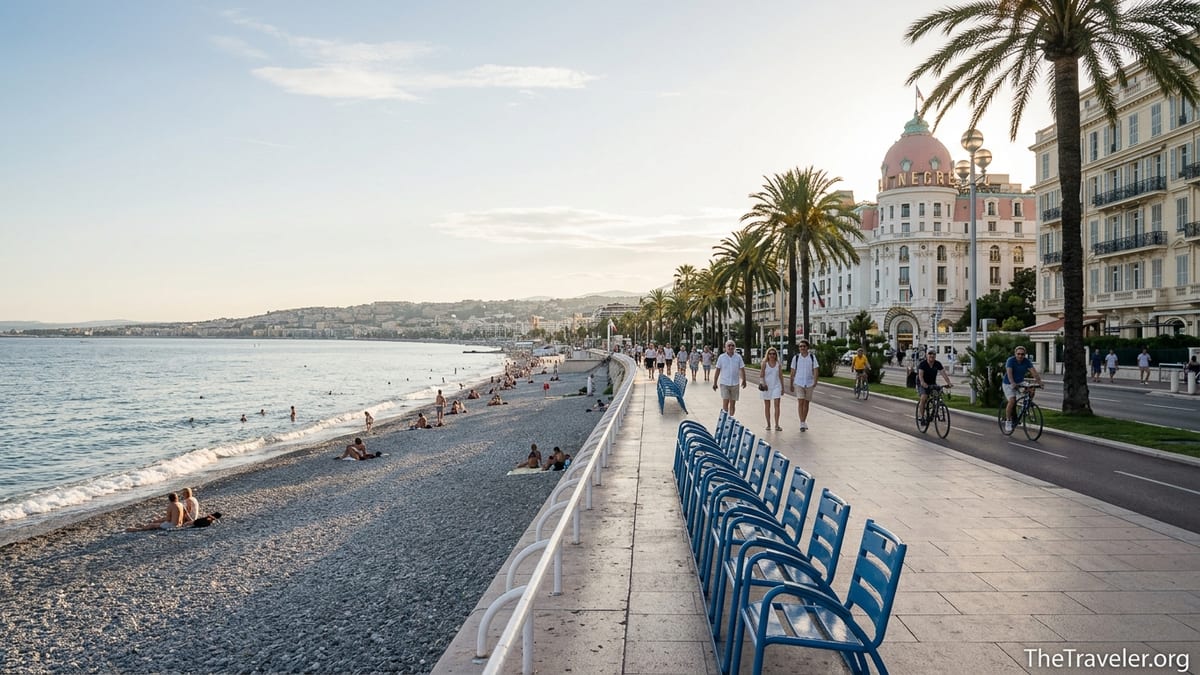
The Promenade des Anglais is a roughly 7 kilometer seafront boulevard running along Nice’s Baie des Anges, from near Nice Côte d’Azur Airport in the west to the historic heart of the city by Castle Hill in the east. On one side you have pebble beaches and the Mediterranean; on the other, grand hotels, Belle Époque facades and apartment buildings. The wide pedestrian walkway, separate cycle lane and broad traffic lanes make it both a major artery for the city and its most iconic public space.
Originally laid out in the 1820s as a simple coastal path financed by wealthy English winter visitors, the promenade has grown into the city’s emblem. It featured prominently in Nice’s inscription as a UNESCO World Heritage site focused on “Nice, Winter Resort Town of the Riviera,” and in 2024 it even hosted the final stage of the Tour de France instead of the usual Champs Élysées in Paris. Today, it functions as a shared living room for locals and visitors: a place to jog at sunrise, push a stroller in the afternoon, or watch the sky turn pink behind the silhouette of the Negresco hotel at dusk.
You will also hear locals shorten the name affectionately to “la Prom” and talk about meeting “by the blue chairs.” Those iconic metal seats facing the sea are scattered in clusters along the waterfront. Sit in one for five minutes and you quickly understand why this simple strip of pavement has become one of the most photographed places in southern France.
Reasons It Absolutely Belongs on Most Nice Itineraries
The first and simplest argument in favor of adding the Promenade des Anglais to your Nice trip is that you will encounter it anyway. If you take the tram or a taxi from the airport to the city center, you are likely to drive along part of it. If you stay anywhere near Old Town, Masséna or the beachfront, it becomes the obvious route for walking between neighborhoods. Rather than treating it as something to check off, it makes sense to weave it into your days as the backdrop for your movements through the city.
From a practical standpoint, the promenade is one of the best free experiences in Nice. You can stroll for an hour at sunset without spending a cent, maybe stopping at a kiosk for a 3 to 4 euro ice cream or an espresso, and still feel you have soaked up real Riviera atmosphere. A couple staying in an average midrange hotel a block behind the promenade might easily spend 300 to 350 euros per night on accommodation in high season, but access to the sweeping sea views and the lively public space out front costs nothing.
It is also one of the few places where you get a genuine cross-section of local life. At 7 am on a weekday you will see office workers power-walking in sneakers, retirees on bicycles, and students cutting across to the tram stops. By late afternoon, families spill out with scooters and rollerblades. Around 9 pm in July, the same stretch of pavement turns into a kind of open-air catwalk, with groups heading to dinner at the brasseries near Place Masséna or to the terrace bars in the Negresco and Palais de la Méditerranée hotels. That mix of everyday routine and holiday atmosphere is hard to find if you only wander the lanes of Vieux Nice.
What You Can Actually Do Along the Promenade
Many first-timers imagine the Promenade des Anglais as a place to walk, snap a photo and move on. In reality, you can easily turn it into a half or full day’s program, especially from late spring to early autumn. One classic pattern looks like this: start near Castle Hill in the morning, walk west along the promenade, swim at a public beach, have lunch at a beach restaurant, then continue strolling or cycling all the way toward the airport before looping back by tram or bus.
The beaches that line the promenade are a mix of public stretches and private beach clubs. Public areas such as Opéra Plage or Centenaire Beach are free to access, though you may want to rent a sun lounger and umbrella from a nearby private concession for comfort on the pebbles. Day rentals typically run around 25 to 35 euros per person in high season for a front-row chair and parasol at a place like Blue Beach or Ruhl Plage, including access to changing cabins and showers. For travelers used to sandy beaches, the pebbles can be a surprise, so those padded loungers are more than just a splurge.
If you prefer to stay dry, there is a continuous cycle lane running the length of the promenade. Several bike rental shops just off the seafront offer classic city bikes or e-bikes by the hour. A basic city bike might cost around 15 to 20 euros for a half day, while an electric bike can run 30 to 40 euros. Renting for an afternoon will let you cover the entire stretch, detour into neighborhoods like the Carré d’Or, and still have time for an ice cream stop at one of the gelato counters near Place Masséna.
Best Times of Day and Year to Experience It
Nice is blessed with more than 300 sunny days per year according to local tourism boards, which means the Promenade des Anglais is rarely empty. Yet timing your visit can dramatically change how you perceive it. In peak summer, from late June to late August, midday temperatures regularly climb above 30 degrees Celsius. On those days, the promenade becomes almost blinding around noon, with little shade and intense glare off the sea. Walking a long distance at that hour can feel punishing rather than pleasant.
The most rewarding times of day are early morning and late afternoon into sunset. Between 7 and 9 am you will find cooler air, fewer crowds and softer light. Joggers and dog walkers dominate, and you can usually find an empty blue chair to watch the gradient of blues along the Baie des Anges. In the evening, especially from about 7:30 pm onward in July, the heat softens and the light turns golden, giving the facades of the Belle Époque hotels a warm glow. Many travelers plan their first full afternoon in Nice so that they can watch their inaugural Riviera sunset from somewhere between the Negresco and the Jetée promenade.
Seasonally, the promenade is pleasant almost year-round. In January and February, when hotel rates drop noticeably compared with August, you can still walk in a light jacket under blue skies much of the time. The promenade also hosts events at various times of the year: Carnival parades in February traditionally pass near the seafront, and road races or cycling events sometimes use sections of the boulevard. If your visit coincides with a major event, you might find parts of it closed to car traffic, which often makes it even more enjoyable for pedestrians and cyclists.
How Much Time to Budget in a Typical Nice Itinerary
How much time you should allocate to the Promenade des Anglais depends on the length of your stay in Nice and your interests. For a short one-night stopover, carving out 60 to 90 minutes for a sunset stroll from the eastern end near Rauba Capeu to around the Negresco, with a quick drink on a terrace, will give you the essence of the promenade without eating your entire evening. Many visitors arriving by train drop their bags, walk down Avenue Jean Médecin to Place Masséna, then continue straight to the sea for exactly this circuit.
If you have two or three full days in Nice, it is worth devoting at least half a day to exploring the promenade more thoroughly. That might mean a morning walk followed by a few hours at a private beach club, or renting bikes and riding from Old Town almost to the airport, stopping at different sections of the waterfront to see how the atmosphere changes. For travelers staying a week or more, the promenade tends to become part of everyday rhythm: a morning jog before heading inland to hilltop villages like Èze, or a late evening walk after a day trip to Monaco or Antibes.
Think of the promenade not as a single activity but as a flexible framework. You can pair it with a visit to the Masséna Museum, housed in a villa just off the seafront, or with a climb up Castle Hill for panoramic views back over the whole arc of the bay. Families might time a playground stop in the nearby Promenade du Paillon park so that kids get their run-around time away from the road, then rejoin the seafront for ice cream or a casual dinner.
Pros, Cons and Who Might Skip It
For most travelers, the positives of visiting the Promenade des Anglais outweigh the downsides. The views, the sense of place and the chance to mingle with locals make it a near-essential part of understanding Nice. It is also highly accessible: the surface is flat and smooth, good for wheelchairs and strollers, and there are frequent access points down to the beach level, some with ramps. Benches and the famous blue chairs provide regular resting spots, which is particularly helpful for older visitors or anyone who tires easily.
There are, however, some drawbacks to consider. Traffic noise can be noticeable, especially closer to the city center where several lanes of cars run right beside the walkway. If your idea of a seafront stroll is total tranquility, the constant background hum may disappoint you. The lack of shade along much of the promenade means strong sun exposure in summer; visitors with sensitive skin or small children need to be diligent about sunscreen, hats and timing. In high season, certain stretches in front of major hotels become very busy, and crossing between the pavement and the beach sometimes involves waiting at traffic lights.
A small subset of travelers might decide not to prioritize the promenade. If you strongly prefer wild, natural landscapes to urban waterfronts, you might find your time better spent on the coastal path between Nice and Villefranche-sur-Mer, or at the Cap de Nice trails, where the coastline feels more rugged. Similarly, if you have only a few hours in the city and are mainly interested in art and history, focusing on the Matisse and Chagall museums plus a quick look at Old Town could make more sense, treating a glimpse of the promenade as incidental rather than a central objective.
Making the Most of the Promenade on Different Budgets
One of the appeal points of the Promenade des Anglais is that it scales well to different travel budgets. At the budget-friendly end, a couple or solo traveler can pack a picnic from a supermarket on Avenue Jean Médecin, pick up a baguette and cheese for under 10 euros, and eat on the stones of a public beach while watching planes glide into the nearby airport. Afterward, they can walk as much or as little of the promenade as they like, using Nice’s tram to get back to their accommodation for 1.70 euros a ride with a rechargeable transit card.
Midrange travelers might choose a hotel one or two blocks behind the promenade, where nightly rates are generally lower than seafront properties but you are still only a three minute walk from the water. They could then allocate part of their budget to a day at a private beach club, a sundowner cocktail at the Negresco’s bar, or bike rentals for the afternoon. A typical end-of-day scene might be leaving a rented lounger around 6 pm, rinsing off in the beach showers, strolling eastward as the city lights switch on, then cutting back into town for dinner in Vieux Nice.
At the splurge end, some travelers treat the promenade as the view they are paying for. A room with a balcony overlooking the bay in a landmark hotel like the Negresco or the Hyatt Regency Palais de la Méditerranée can easily cost several hundred euros per night in July or August. From that vantage point, the promenade becomes something you experience even when you are not on it: the sound of waves and traffic rising together, the sight of joggers in the morning and twinkling streetlights at night. Deciding whether that is “worth it” depends on how much you value waking up to a Mediterranean sunrise just by opening your curtains.
The Takeaway
When you strip away the postcard images and Instagram posts, the reason the Promenade des Anglais endures in traveler itineraries is simple. It is where Nice’s geography, history and daily life intersect in the clearest way. You see the curve of the bay, the legacy of winter resort architecture and the contemporary mix of locals and visitors all in the space of a short walk. For many people, their mental picture of “Nice” after a trip is less a specific museum or church and more a memory of light, sea and movement along this ribbon of stone.
Is it worth adding to your Nice itinerary? For almost every traveler, yes. Even a 30 minute stroll at sunset will give you a feel for the city that you cannot get by staying inland. With more time, you can layer in beaches, bike rides, terrace drinks and side visits to nearby parks and viewpoints, using the promenade as your anchor. The key is to match your visit to your energy level and interests, and to be realistic about sun and crowds in high season.
If you plan at least one unhurried moment here, whether on a blue chair at dawn or with an ice cream in hand after dinner, the Promenade des Anglais is likely to earn its place not just on your itinerary, but in the small collection of travel memories that stay with you long after you leave the Riviera.
FAQ
Q1. How long does it take to walk the full length of the Promenade des Anglais?
Walking the entire 7 kilometer stretch at a relaxed sightseeing pace with photo stops usually takes between 1.5 and 2 hours one way. Many visitors choose to walk a shorter central section, such as from Castle Hill to the Negresco, which takes about 30 to 40 minutes.
Q2. Is the Promenade des Anglais safe to visit at night?
The promenade is generally well lit and busy until late in the evening, especially in summer, and most travelers report feeling comfortable walking there at night. As in any city, it is wise to stay in well populated areas, keep valuables out of sight and avoid overly isolated stretches in the very late hours.
Q3. Are there public toilets along the promenade?
There are a few public toilet facilities along or near the promenade, some of which charge a small fee for entry. In practice, many visitors plan restroom breaks around cafés, beach clubs and bars where a drink purchase gives them access to facilities.
Q4. Can you swim directly from the Promenade des Anglais beaches?
Yes, you can swim from the pebble beaches that line the promenade during the main season, when lifeguards often monitor designated bathing areas. The water gets deep quite quickly and the stones can be slippery, so water shoes and caution when entering or exiting the sea are sensible.
Q5. Is the promenade suitable for wheelchairs and strollers?
The main walkway is flat, wide and paved, which makes it generally suitable for both wheelchairs and strollers. Access down to the beach is more variable, with some ramps and some stair-only sections, so travelers with mobility concerns may want to plan their route using the more accessible entry points.
Q6. Do I need to book beach clubs along the promenade in advance?
In high season, advance reservations for private beach clubs can be helpful, particularly on weekends and for front-row loungers. Outside of peak summer or on weekday mornings, it is often possible to walk up and find a spot without a prior booking.
Q7. Are there places to rent bikes or scooters near the promenade?
Yes, several rental shops in streets just behind the promenade offer bicycles and sometimes electric scooters by the hour or day. Prices vary, but many visitors find that renting for a half day gives enough time to ride the seafront and explore some nearby neighborhoods.
Q8. What should I wear for a walk along the Promenade des Anglais?
Comfortable walking shoes or sandals are important because the distances can be longer than they appear on a map. In summer, lightweight clothing, a hat, sunglasses and sunscreen help protect against strong sun, while in cooler months a light jacket or windbreaker is usually sufficient for the sea breeze.
Q9. Is it worth staying in a hotel right on the promenade?
Staying in a seafront hotel offers rewarding views and the convenience of stepping directly out onto the promenade, which many travelers consider a highlight of their trip. However, prices and noise levels can be higher than in streets a few blocks back, so budget and sensitivity to traffic sounds should guide your choice.
Q10. Can I easily combine the promenade with other Nice sights in one day?
Yes, the promenade connects conveniently with Old Town, Place Masséna, the Promenade du Paillon park and the path up to Castle Hill. A common day plan is to explore Vieux Nice in the morning, relax or swim along the promenade in the afternoon, then return to the seafront for sunset views before heading to dinner.