


I thought I knew what waited for me inside Sagrada Família. I had seen the postcards, the drone shots and the timelines claiming that, after more than 140 years of construction, Barcelona’s impossible basilica was finally reaching its full height. But the moment I stepped through the heavy doors and into Gaudí’s forest of light, the experience felt nothing like the solemn, shadowy cathedral interior I had imagined. It was brighter, quieter, more orderly and somehow more human than I expected from one of the world’s most visited churches.
Get the latest updates straight to your inbox!
The First Steps Inside: From Building Site to Finished Forest
If you last saw Sagrada Família only from the outside, especially in older photos with cranes crowding the skyline, the transformation in 2026 is startling. The central Tower of Jesus Christ has reached its full 172.5 meters, and the landmark that dominated news reports of construction delays has subtly shifted identity into a working basilica that simply happens to be the tallest church in the world. Yet the greatest surprise still waits inside.
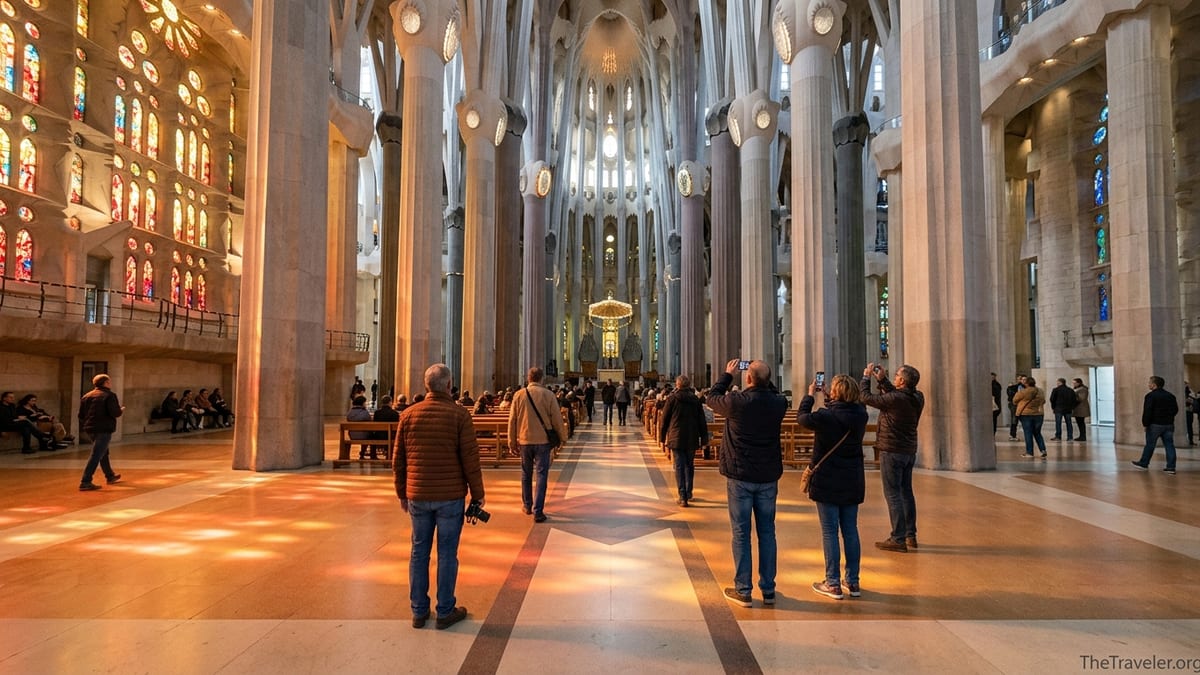
Crossing the threshold from the street, I braced for the usual gloom of a historic European cathedral: heavy stone, incense, pockets of neon-bright stained glass floating in an otherwise dim shell. Instead, the nave felt like stepping into a pale, sunlit grove. Slender columns in cream and soft gray rise like tree trunks, then branch into stone canopies that dissolve into the ceiling. The floor is clear, almost startlingly uncluttered. Visitors move in a steady, hushed flow, phones up, necks craned, but the space absorbs the crowd more like a public park than a packed tourist attraction.
The other surprise is the sense of completeness. For decades, guidebooks described Sagrada Família as the ultimate work-in-progress, defined by scaffolding and tarps. In 2026 the interior feels cohesive and resolved, from the polished stone underfoot to the finished organ pipes gleaming at the altar. The church is not entirely “done” in an official sense, with work still continuing on the Glory façade and surrounding urban plans, but when you stand in the central nave, there is no longer any doubt that you are inside a finished sacred space rather than an ambitious construction site.
Light That Moves: How the Stained Glass Rewrites the Mood
The element that most overturned my expectations was the light. From outside, the stained glass windows read as decoration. Inside, they behave like living weather. Gaudí oriented his basilica so that morning light pours through cool-toned windows in blues and greens, while the afternoon sun blazes through sunset panels in oranges and deep reds. If you linger for more than an hour, you can literally watch the color temperature of the interior change as the sun arcs across the sky.
On my visit, I booked a timed ticket for 9:30 a.m., expecting to dodge the midday crowds. Instead, I walked into a wash of gentle, aquatic light along the Nativity side of the nave. Columns near the eastern windows were lit in a gradient from sea green at the base to sapphire near the vaults, as if the stone itself had been dyed by the Mediterranean. People stood silently in the colored pools on the floor, the way they might linger in front of a painting at the Museu Picasso, but here the artwork moved around them.
Returning a second time at 4:00 p.m. a few days later, I found a completely different interior. The Passion façade windows were burning in molten amber and crimson, casting a warm glow across the pews and turning the ceiling into a canopy of reflected sunset. What had felt like a contemplative, almost icy calm in the morning became a wave of warmth in the afternoon. It is worth planning your ticket time around the light you want: morning for soft blues and a slightly quieter atmosphere, late afternoon for drama and saturated color that photographs beautifully without heavy editing.
Practicalities That Change the Experience
Another thing that felt very different from my expectations was how organized and time-structured the visit was. In theory, Sagrada Família is a church you can “pop into.” In practice, especially in 2026, it works more like a tightly managed museum with entry slots, security checks and clear visitor flows. Buying a ticket at the door on a busy June weekend is now more wishful thinking than realistic plan. Tickets for popular hours routinely sell out days ahead, and guided tours in English and French can disappear even earlier in peak season.
Base entry for a self-guided visit in 2026 typically starts in the mid-20s in euros for adults, with modest discounts for students and seniors, and free or heavily reduced entry for children and local residents. Adding a guided tour usually raises the total by several euros per person, while tower access adds another substantial supplement on top, making a full experience with guide and tower closer to the 40 to 50 euro range for many visitors. Third-party resellers sometimes bundle skip-the-line access and transport from hotels and cruise terminals, but these packages can cost significantly more than booking directly. It is worth checking that your confirmation clearly states an official entrance time and includes the Basilica itself, as some cheaper offers focus only on the exterior and museum.
The airport-style security at the entrance also shapes your first impression. Bags go through scanners, and larger items are discouraged. The line moves quickly, but it is not the romantic “open door to the faithful” entry many imagine. Once inside, though, the management decisions pay off. Capacity caps mean you can still find quiet pockets beneath side chapels or in the central nave aisles, even on a Saturday. Audio guides and app-based tours cut down on shouted explanations, so the overall acoustic signature is soft conversation and camera shutters rather than the echo chamber of raised voices that plagues many mass-tourism monuments.
Expecting Medieval, Finding Modern
Like many visitors, I arrived expecting the familiar language of European cathedrals: side altars loaded with gilded saints, worn stone floors polished by centuries of feet, dim chapels flickering with candles. Instead I found a space that feels intensely contemporary without losing its spiritual gravity. The vaults soar in geometric patterns that echo natural forms more than historical precedent. The columns shift from polygonal at the base to circular at the top, dissolving the line between engineering necessity and sculptural play.
Perhaps the most surprising detail is how sparse the interior feels in terms of traditional decoration. The central nave has relatively few statues and hardly any of the heavy baroque ornament that defines churches in Rome or Seville. The drama comes from light, proportional play and acoustics. During a short organ rehearsal on the afternoon of my second visit, the sound rose into the vaults and returned not as a muddy echo but as a clear, sustained resonance that filled the space without overwhelming conversation-level speech below.
For travelers used to Instagram-driven expectations, the contrast between phone screen and lived experience can be jarring. The iconic shots tend to punch up the color saturation, making the glass look almost neon and the columns impossibly white. In person, the palette is softer and more nuanced, and the most affecting views are often the quieter ones: a single shaft of light catching dust in midair, or the way the color on a visitor’s white shirt shifts from blue to gold as they walk down the nave.
Looking Up, Then Looking Down: Towers and the Crypt
Many visitors imagine that a ticket with tower access will mean sweeping 360-degree panoramas from the very highest point of the basilica. The reality is more modest but still memorable, and it affects how the whole interior experience feels. In 2026, tower visits typically operate on timed slots linked to your main entry, with a separate elevator access and a short, often narrow descent by staircase. The climbs are not suitable for anyone with serious mobility limitations or vertigo, and families with small children should think carefully before booking. The views are framed through stone openings and latticework, not the open-air rooftop platforms some travelers expect.
From the Nativity towers, you look out over the Eixample grid and down onto the familiar postcard view of the basilica’s older façade, rich with sculptures of animals, angels and dense biblical scenes. From the Passion side, the city spreads towards the Mediterranean, and you can sense how the new central tower has changed Barcelona’s skyline, lifting the basilica above rows of apartment blocks and office towers that once dwarfed its earlier stages of construction. More surprising than the views, perhaps, is how intimately you experience the building’s skin: tiles, mosaics and sculpted details are suddenly at arm’s length rather than telescope-distance.
Back at ground level, the crypt offers another kind of surprise. After the light and height of the main nave, descending into the lower level feels like moving back in time. Here the scale contracts, the ceilings lower, and the atmosphere darkens into something closer to the 19th-century churches Gaudí grew up with. Pilgrims still visit his tomb, marked simply, and small groups kneel in quiet prayer. For all the architectural spectacle above, this more conventional sacred space can be where visitors feel the human story most directly: a local architect hit by a tram in 1926, buried beneath a building that, at the time of his death, existed mostly as a dream.
Managing Crowds, Preserving Silence
One of my biggest fears before visiting was that the basilica would feel like a theme park: choked with tour groups, dominated by selfie sticks and raised voices, stripped of any sense of reverence. The reality is more complex and more hopeful. Yes, Sagrada Família is busy. On summer weekends, nearby cafés on Carrer de Mallorca and Carrer de Provença fill with day-trippers clutching tickets on their phones, and the metro platforms at Sagrada Família station pulse with rolling suitcases and stroller wheels. But once inside the church itself, a fragile but real quiet reigns, preserved by design choices as much as by visitor etiquette.
Clear signage in multiple languages asks for silence in certain zones, and staff gently redirect anyone trying to set up tripods or block circulation for extended photo shoots. There are roped-off pews specifically reserved for personal prayer, and the central section of the nave is occasionally closed entirely during liturgical events, something that can surprise tourists who did not realize regular Masses still take place here. The trade-off is worth it. To watch a Vatican delegation or local parish celebration unfold beneath the completed central tower in 2026 is to understand that this is not just a monumental sculpture but a living church.
Outside, however, the commercial sprawl is impossible to ignore. Souvenir stands crowd the corners of the adjacent squares, selling everything from magnetized miniatures of the basilica to Gaudí-inspired lizards nearly identical to those at Park Güell. Restaurants nearby advertise “Gaudí menus” priced for one-off visitors; better value often lies a few blocks away on quieter side streets where set lunches for locals undercut the tourist strip by several euros. Accept the bustle as part of the pilgrimage, but do not be afraid to step away from the immediate orbit of the basilica when you need a break from the noise.
How 2026 Changes the Story
Visiting in 2026 adds a layer of historical drama that I had not fully appreciated when I booked my ticket. This is the centenary year of Gaudí’s death, and it is also the year when the tallest tower, crowned with its walkable cross, finally reached its full height. The cranes that were once as iconic as the spires themselves are either gone or retreating, and Barcelona has just watched the Pope bless the completed central tower in a ceremony that drew tens of thousands of people to the streets.
Inside, exhibitions and signage lean into this narrative. Panels in the museum under the basilica explain the timeline of recent construction: how the Evangelist towers around the central spire were finished in the early 2020s, how advances in 3D modeling and CNC stone-cutting accelerated work that would have taken another century with 19th-century tools, and how the remaining work on the Glory façade and surrounding urban interventions will continue into the 2030s. The message is clear. If you ever wanted to see Sagrada Família at the exact moment it crossed from improbable project to completed monument, this decade is it.
For travelers, that means two conflicting realities. On the one hand, demand has never been higher. Package tours from cruise ships arrive by the coachload, and hotels across the city report spikes in visitors timing their trips to the tower’s inauguration. On the other hand, the cranes that once obstructed every photo of the façade are being dismantled, and you can finally stand in the nave or in the surrounding streets and see Gaudí’s vertical lines without the visual noise of heavy machinery. Whether you are making a pilgrimage of faith, architecture or simple curiosity, 2026 offers a once-in-a-lifetime balance between living construction story and finished icon.
The Takeaway
Walking inside Sagrada Família in 2026 felt nothing like the experience I had rehearsed in my imagination. I expected dust, scaffolding and the distracted chaos of a site still under heavy construction. Instead I found a finished interior that functions as a coherent, carefully managed sacred space, flooded with moving color and shaped by a level of acoustic and spatial control that few historic cathedrals can match. I expected a moody, medieval atmosphere; I found a luminous forest of stone that owed as much to modern engineering and natural geometry as to Gothic precedent.
Most of all, I expected to feel like a tourist among tourists. Instead, at unexpected moments, the building’s layered history cut through the crowd. A shaft of afternoon light falling on Gaudí’s tomb in the crypt. The murmur of pilgrims lighting candles near the Nativity façade. The quiet intake of breath from strangers as organ chords unfurled beneath the completed central tower. For all its ticketing systems and timed entries, Sagrada Família still manages to deliver something stubbornly resistant to photographs and statistics: the shock of standing inside a human dream that took more than a century to solidify into stone and glass.
FAQ
Q1. Do I need to buy Sagrada Família tickets in advance in 2026?
Yes, advance purchase is strongly recommended, especially from spring through autumn and on weekends. Timed entries for late morning and mid-afternoon often sell out days ahead, and tower visits and guided tours can fill even earlier.
Q2. What is the best time of day to see the light inside Sagrada Família?
For soft, cooler tones and a slightly calmer atmosphere, aim for early morning entries before 10:00 a.m., when light filters through the blue-green Nativity windows. For dramatic warm colors that photograph vividly, choose late afternoon slots between about 3:30 and 6:00 p.m., when the Passion façade glows in oranges and reds.
Q3. How much should I budget for a visit in 2026?
Plan on paying in the mid-20s in euros for a standard adult self-guided ticket, with small discounts for students and seniors. Adding a guided tour and tower access can bring a full visit for one adult into the 40 to 50 euro range, not including extras such as audio guides or printed materials.
Q4. Are the towers worth the extra cost and effort?
The towers offer memorable, if not fully panoramic, views of Barcelona and a close look at the basilica’s sculpted exterior. However, access involves elevators plus narrow staircases and is not ideal for those with mobility issues, strong vertigo or very young children. If you value architectural detail and unique vantage points, the upgrade is worthwhile.
Q5. Is Sagrada Família finally finished in 2026?
The interior and central tower are effectively complete, and the basilica has reached its planned maximum height. Some exterior elements, particularly the Glory façade and certain urban interventions around the church, remain under construction and are expected to progress into the 2030s.
Q6. Can I attend Mass, or is it only for tourists?
Yes, regular religious services are held, including Sunday Mass and occasional special liturgies. Parts of the nave may be closed to general sightseeing during these times, and access can be redirected through specific entrances, so it is wise to check schedules and arrive early if you wish to attend.
Q7. What should I wear inside Sagrada Família?
Visitors are asked to dress respectfully, with shoulders and knees covered and no beachwear, swimwear or clothing featuring offensive slogans. While the enforcement is generally polite, you may be refused entry or asked to adjust your attire if it does not meet the guidelines.
Q8. How long does a typical visit take?
A self-guided visit to the basilica interior and museum usually takes between 60 and 90 minutes. If you add a tower visit and spend time in the crypt, plan for around two to three hours in total, not counting coffee breaks or time spent in the surrounding streets and squares.
Q9. Are there good places to eat nearby that are not tourist traps?
Immediate surroundings are dominated by tourist-focused cafés and restaurants. For better value and a quieter atmosphere, walk several blocks into the Eixample grid, where neighborhood bars and bistros offer set lunches and evening tapas at more local prices.
Q10. Is Sagrada Família suitable for children?
Yes, many families visit, and the vivid colors and unusual forms can be captivating for children. However, tower visits have age and height restrictions, and the general expectation of silence in the nave means it is helpful to plan shorter, focused visits with breaks outside so younger visitors do not feel overwhelmed.