


South Africa can be one of the most rewarding destinations on the planet for solo travelers, with dramatic coastlines, safari experiences, world-class food and rich culture. It is also a country where inequality and crime are real factors, especially in big cities. Staying safe here is less about being paranoid and more about being prepared, informed and a little streetwise. This guide breaks down how solo travelers can navigate South Africa confidently, using real-world examples from Cape Town, Johannesburg and other hubs so you know what to look out for and how to respond.
Get the latest updates straight to your inbox!
Understanding Safety in South Africa: Context, Risk and Reality
South Africa’s crime statistics are high compared with many countries, and headlines can be intimidating. Yet millions of international visitors still travel here each year, and the vast majority complete their trips without serious incident. Tourist experiences tend to be concentrated in safer pockets such as Cape Town’s Atlantic Seaboard, the Winelands, major safari reserves near Kruger National Park, and business districts like Sandton and Rosebank in Johannesburg. What most incidents involving visitors have in common is opportunistic crime: pickpocketing, bag theft, card fraud and a handful of recurring scams in busy urban areas.
The risk profile for a solo traveler is different from that of a local resident. As a visitor, you are unlikely to be involved in targeted or gang-related crime, but you may stand out as unfamiliar with local norms. In Cape Town’s city center, for example, travelers frequently report being approached by “overly helpful” strangers at ATMs or on Long Street at night, where the main concerns are distraction theft and drinks being spiked rather than violent robbery. In Johannesburg, solo travelers typically base themselves in well-policed neighborhoods like Sandton or Rosebank and use ride-hailing apps to avoid isolated streets, especially after dark.
It helps to think of South Africa’s safety landscape as highly localized rather than uniformly dangerous. Within a few kilometers you might move from a tourist-friendly waterfront mall with visible security and CCTV to an informal settlement with very different risk dynamics. As a solo traveler you do not need to see everything. You can have a rich, authentic trip while intentionally focusing on areas that are better lit, better policed and better set up for visitors, and by joining vetted tours when you want to explore beyond those zones.
The most important mindset shift is to see safety as part of your trip planning rather than something you think about only after landing. Booking accommodation in the right neighborhood, understanding how transport works, and learning how scams operate in South African cities will do more for your security than any gadget. The goal is not to eliminate risk entirely, which is impossible anywhere, but to reduce the chances of being the easiest target on the street.
Planning Before You Go: Visas, Money and Smart Itineraries
Before booking flights, check your government’s current travel advisory for South Africa and read it alongside on-the-ground reports from recent travelers. Official advisories often highlight crime levels and protests, but they can lag behind local improvements in specific areas. If you are a first-time solo traveler to the country, consider an itinerary that spends more nights in Cape Town, the Garden Route or the Winelands, combined with a safari in a well-established private reserve, and fewer nights on your own in downtown Johannesburg or Durban.
For many nationalities, South Africa offers visa-free entry for short tourism stays. Others require a visa obtained in advance. Whatever your status, border officials may ask for proof of onward travel, accommodation bookings and sufficient funds. Having printed or easily accessible digital confirmations for your first few nights in Cape Town or Johannesburg, plus a simple outline of your route, helps both with immigration and your own safety, since you are not trying to arrange basics while jet-lagged in an unfamiliar airport.
From a security perspective, how you manage money matters as much as where you stay. Card fraud and “permit” scams involving fake card readers have been reported in central Cape Town, where con artists posing as security staff steer tourists to what looks like an official payment device mounted on a wall. In reality it clones the card. To reduce this risk, travel with at least two cards from different banks, keep one locked in your hotel safe, and use contactless payments or mobile wallets in reputable establishments rather than inserting your card into outdoor or portable devices offered by strangers.
When designing your route, avoid building in long, unstructured layovers where you will be wandering around transport hubs with luggage. For example, if you land in Johannesburg late at night and have a domestic flight to Cape Town the next morning, it is safer and less stressful to book a nearby airport hotel with a dedicated shuttle than to travel into the city and back after dark. Similarly, if you plan to take the popular coastal drive along the Garden Route, aim to arrive in smaller towns like Knysna or Plettenberg Bay before sunset so you are not navigating unfamiliar roads at night.
Choosing Where to Stay: Safer Neighborhoods and Accommodation Types
Where you sleep will shape your entire safety experience. In Cape Town, solo travelers often feel most comfortable staying in neighborhoods such as the V&A Waterfront, Green Point, Sea Point, Tamboerskloof or Gardens. These areas have a visible security presence, better lighting and plenty of cafes, restaurants and supermarkets within easy walking distance during the day. By comparison, the central business district can feel more intense after dark, with fewer tourists on the streets and more aggressive hustling around some bars and clubs.
In Johannesburg, Sandton and Rosebank are common bases for first-time visitors. Both have large shopping centers with secure parking, business hotels used by airline crews, and reliable access to ride-hailing services. Many solo travelers choose chain hotels or well-reviewed guesthouses in these districts because they offer 24-hour reception, controlled access and front desks that are used to helping visitors arrange safe transport. Budget travelers often opt for design hostels in Maboneng or Braamfontein, but if you do, check the most recent reviews specifically for comments about walking at night and security.
Be cautious with private rentals found through social media or informal listings. There have been real cases in Cape Town where travelers wired deposits for apartments advertised on Facebook or classified sites, only to discover on arrival that the address did not exist or the unit was already occupied. Even on reputable platforms, fake listings can appear for high-demand areas such as Camps Bay or the V&A Waterfront, often with prices far below market rate for sea-view apartments. If an eight-guest luxury condo is advertised for the price of a modest guesthouse room, treat it as a red flag.
Once checked in, treat your room as a semi-public space rather than an invulnerable bubble. Store your passport, backup card and most of your cash in a room safe or, if unavailable, in a locked packing cube hidden away from obvious surfaces. Do not leave laptops, cameras or bags visible from windows or laid out near the door. In smaller guesthouses, ask how the front door is secured and whether keys are tagged with room numbers. If anyone calls your room claiming to be from reception and asking you to “confirm your card details because the payment did not go through,” hang up and call or walk down to the front desk yourself instead of giving information over the phone.
Street Smarts in Cities: Walking, Nightlife and Common Scams
Most safety issues for solo travelers arise in city environments rather than on safari. In Cape Town this typically means the CBD, the corridor between the V&A Waterfront and Sea Point, and nightlife strips like Long Street and Kloof Street. In Johannesburg, it is busy downtown streets, minibus taxi ranks and certain parts of the inner city. The baseline advice applies everywhere: keep your phone out of sight when not in use, avoid wearing expensive watches or visibly branded camera bags, and walk with purpose so you do not appear lost and distracted.
Be especially wary of anyone who tries to move you away from a busy area under the pretense of helping. One recurring scam near Cape Town’s tourist belt involves men in security-style uniforms claiming you need a “permit” to walk down a street or access a viewpoint. They then direct you to an ATM or a wall-mounted device to pay. Tourists have reported being charged the equivalent of hundreds of euros for fake permits or having their card cloned. The simple rule: there are no legitimate fees to walk down public streets or promenades. If someone insists otherwise, decline and leave.
Other common interactions are designed to distract you. In both Cape Town and Johannesburg it is normal to encounter people selling small items, asking for donations for a “school project” or telling emotional stories about needing taxi money for a funeral or a sick relative. While some are genuine, these situations can be used for pickpocketing if you open your backpack, take out your wallet or let someone stand very close while you search for coins. It is acceptable to say a polite but firm “no thank you” and continue walking. If someone is persistently matching your pace, change direction and step into a shop, cafe or hotel lobby.
In nightlife areas, the risk shifts towards drink tampering and theft rather than street robbery. Travelers have described situations in which they accepted shots from friendly strangers on Long Street, later waking up with their phone and bank cards missing. Protect yourself the way you would in any big party city: buy your own drinks, keep them in your line of sight, and avoid leaving with someone you just met, especially if you have been drinking heavily. Consider carrying only one bank card and limited cash on nights out, leaving your passport and backup funds locked up at your accommodation.
Moving Around Safely: Taxis, Ride-Hailing, Buses and Self-Drive
Transport choices have a significant impact on your safety as a solo traveler. In Cape Town and Johannesburg, ride-hailing apps such as Uber and Bolt are widely used by locals and visitors. They are often safer than hailing an unmarked taxi on the street, provided you follow basic precautions: confirm the license plate and driver name on your app before getting in, share your live trip with a friend or relative, and sit in the back seat. At Cape Town International Airport, there have been reports of scammers posing as e-hailing drivers in the arrivals hall who offer to “help” by booking a ride on their own phone or by taking you to an unofficial payment terminal at the end of the trip. To avoid this, order your ride yourself using airport Wi-Fi, meet the driver at the signed ride-hailing pickup zone, and pay only through the app or in cash you hand directly to the driver.
Stories from recent travelers highlight another pattern at major airports: fake or unregistered airport taxis that quote a vague price upfront and demand an inflated amount on arrival. One U.S. visitor reported being charged the equivalent of nearly two thousand euros for an 18-minute ride from Cape Town’s airport to the city center after accepting a ride from a tout who approached them in the terminal. To sidestep this, use only official airport taxis from a signed desk, pre-book a shuttle through your hotel, or stick with app-based services where the fare estimate is shown beforehand.
Public transport is a mixed picture. The modern MyCiTi bus network in Cape Town connects the airport with downtown and several suburbs and is generally considered safe during the day, with security cameras and card-based payment. In contrast, informal minibus taxis, which are a backbone of local commuting, can feel chaotic for visitors and have been involved in serious traffic accidents. Long-distance buses between major cities are used by budget travelers, but when possible, choose reputable companies with good safety records, daytime departures and clear seat reservations rather than the cheapest option advertising on handwritten boards at roadside ranks.
Self-driving is popular, especially along the Garden Route and in Kruger-area reserves, but roads can be unpredictable. South Africa has experienced high-profile crashes involving overloaded or poorly maintained vehicles on rural highways. If you rent a car, choose a well-known international or established local rental company, insist on seatbelts that work in every seat and avoid driving at night in rural areas where street lighting is minimal and animals sometimes wander onto the road. In cities, keep doors locked, windows up at traffic lights, and bags placed out of sight, ideally on the floor rather than on empty seats where they can be grabbed through a window.
Protecting Your Money, Cards and Digital Identity
For solo travelers, financial security is as important as physical safety. Card cloning and ATM fraud are recurring issues in South Africa, particularly in tourist-heavy areas. One well-documented scam in Cape Town involves “helpers” at ATMs who distract you with questions or instructions, then swap your card or observe your PIN. Another more recent twist uses stand-alone card terminals presented as necessary to pay for a street permit, parking, or an e-hailing trip. Victims often only realize days later that their card has been charged multiple times or used abroad.
Adopt conservative habits around payments. Withdraw cash only from ATMs inside banks, large supermarkets or shopping centers during business hours, and refuse all assistance from strangers at machines. If an ATM looks damaged or has loose plastic parts, choose another. Cover your hand when entering your PIN. In shops and restaurants, request that the card machine be brought to you and keep sight of your card at all times. Where possible, pay with a credit card rather than a debit card, since credit cards typically have stronger protection against unauthorized transactions and do not give fraudsters direct access to your current account.
Digital scams extend beyond the street. South Africa’s own financial intelligence authorities have warned about holiday-related frauds, such as fake accommodation sites, bogus airline ticket sellers and “too good to be true” safari deals that ask for payment via instant bank transfer. To protect yourself, book flights and long-haul bus tickets through recognizable operators or established travel agencies, and avoid clicking payment links sent via messaging apps by unknown numbers. If you need a local SIM card, buy it from a major network store in a mall and be cautious about linking it to mobile banking apps without strong passwords and two-factor authentication.
Finally, treat your phone as your most valuable item after your passport. It likely holds your boarding passes, banking apps, and copies of important documents. Use a screen lock, enable “find my device” tracking before you travel, and store digital scans of your passport, visa and insurance separately in secure cloud storage. If your phone is snatched, being able to log into your accounts quickly from a hotel computer or a backup device can make the difference between an inconvenience and a crisis.
Solo-Specific Strategies: Meeting People, Setting Boundaries and Trusting Your Instincts
Traveling alone in South Africa does not mean you must be isolated. Many solo visitors describe Cape Town in particular as sociable and easy to navigate, with opportunities to meet others on wine tours in Stellenbosch, group hikes on Table Mountain, or shared safaris in private reserves near Kruger. Hostels in Green Point or Gardens, as well as social guesthouses and co-working cafes, can provide ready-made communities. Organized day tours to attractions like Cape Point, Robben Island or Soweto offer a way to experience more complex urban or township environments with local guides who understand the dynamics on the ground.
At the same time, solo travelers, especially women and LGBTQ+ visitors, benefit from clearer personal boundaries. In bars or social settings, locals may be curious and friendly, but you are never obliged to share where you are staying, your room number, or your full itinerary with new acquaintances. When someone you have just met insists on walking you home, picking you up in their car, or taking you to an “insider” spot far from your accommodation, it is reasonable to decline and arrange your own transport via a trusted app instead.
Trusting your instincts is vital in a country where situations can change quickly. If a neighborhood feels emptier than you expected, if a group of people is watching you too closely, or if your Uber driver wants to deviate from the route without explanation, you are allowed to step away. That might mean turning back towards a busier street, asking to be dropped at a petrol station rather than your original address, or choosing not to visit a viewpoint at sunset if the access road feels isolated. Countless travelers have avoided problems simply by acting early on a vague sense that something is “off.”
Solo travel can also be emotionally taxing after a negative incident, even a minor one like a pickpocket attempt. If something happens, give yourself permission to pause your plans for a day, talk it through with someone at your accommodation or back home, and, if needed, adjust your route to places where you feel calmer, such as coastal towns like Hermanus or smaller Winelands villages. Feeling safe and present is more important than ticking every box on an itinerary.
If Things Go Wrong: Emergencies, Police, Clinics and Consular Help
Even with the best preparation, mishaps can occur. Knowing how to respond will reduce both risk and stress. In South Africa, the general emergency number from a mobile phone is 112, which can route you to police, ambulance or fire services depending on your location. There are also specific numbers for the South African Police Service and private medical services, which your hotel or tour operator can provide. In major cities and on highways, you may see private security vehicles and control room numbers posted; while they are not a replacement for the police, they can sometimes respond faster to incidents like break-ins or roadside assistance.
If you are the victim of a theft or scam, your first priority is to secure your identity and finances. Call your bank to block compromised cards as soon as possible, even before going to a police station. Many South African banks have 24-hour international hotlines; save the numbers in your phone and on paper before you travel. Next, file a police report at the nearest station. The process can be slow and bureaucratic, but a case number will be essential for insurance claims and, in some cases, for your embassy to issue an emergency travel document if your passport was stolen.
For medical issues, major cities have private hospitals and clinics that meet international standards, particularly in suburbs like Claremont and Sea Point in Cape Town or in Sandton and Rosebank in Johannesburg. Treatment can be expensive without insurance, which is why comprehensive travel cover that includes emergency evacuation is strongly recommended. In safari areas and smaller coastal towns, you may initially be treated at a local clinic or general hospital and then transferred if needed.
Your embassy or consulate cannot act as a private security service, but they can be an important resource. They can advise which hospitals or lawyers English-speaking travelers typically use, contact family on your behalf in serious emergencies, and, if necessary, help replace travel documents. Before departure, register your trip if your country offers a traveler enrollment program. During your stay, keep embassy contact details saved offline. In high-stress situations in a foreign legal system, having an official representative who understands local procedures can make a difficult experience more manageable.
The Takeaway
South Africa is neither the terrifying landscape of some headlines nor a risk-free playground. It is a complex country with deep social challenges and extraordinary natural and cultural riches. As a solo traveler, your experience will be shaped less by luck and more by preparation, choices and awareness. Staying in well-located accommodation, using reputable transport, handling your money carefully and recognizing common scams will go a long way toward keeping you safe.
Equally important is how you move through the country: with confidence but not complacency, curiosity tempered by boundaries, and flexibility to change plans when situations feel uncomfortable. Spend time in neighborhoods that feel vibrant rather than edgy, join guided experiences when exploring more challenging areas, and lean on the local knowledge of hotel staff, guides and long-term residents.
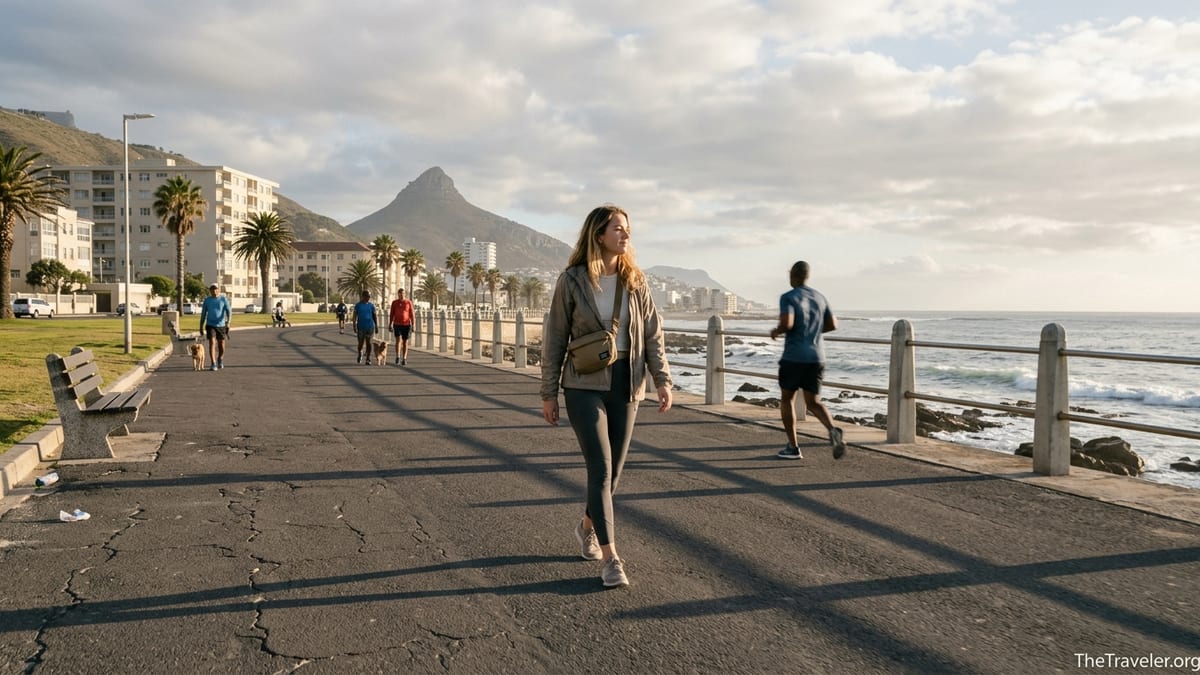
Thousands of solo travelers walk Cape Town’s Sea Point Promenade at sunset, sample Johannesburg’s food markets and set off before dawn on safari game drives every week without incident. By combining realistic expectations with practical safeguards, you can be one of them. South Africa will still demand your attention and respect, but it can repay that with some of the most memorable travel days you will ever have.
FAQ
Q1. Is South Africa safe for solo female travelers? South Africa can be safe for solo women who take precautions similar to those used in other big cities: choosing secure neighborhoods, avoiding walking alone at night, using reputable ride-hailing services, and setting firm boundaries in social settings. Many women report positive trips in Cape Town and on safari, but it is sensible to be more cautious in inner-city Johannesburg and late-night bar districts.
Q2. Which areas of Cape Town are safest to stay in as a solo traveler? Solo travelers often feel most comfortable in areas such as the V&A Waterfront, Green Point, Sea Point, Gardens and Tamboerskloof, which have better lighting, visible security and plenty of amenities. The central business district can be fine by day but is less recommended for first-time visitors to walk around late at night.
Q3. Is it safe to use Uber or Bolt in South Africa? Ride-hailing apps are widely used and generally considered safer than street taxis when basic precautions are followed, such as checking the license plate, sharing your trip and meeting drivers at official pickup points. Avoid accepting rides from people who approach you inside terminals claiming to be Uber or Bolt drivers but who are not booked through your app.
Q4. Can I walk around at night in South African cities? It depends on the neighborhood. In well-trafficked areas like the Sea Point Promenade in early evening or around major malls in Sandton, walking can feel comfortable. In quieter downtown streets, industrial areas and around taxi ranks, walking at night is riskier. As a solo traveler, it is usually better to take a registered taxi or ride-hailing car after dark.
Q5. How common are scams targeting tourists? Scams are common in tourist zones, though most involve small financial losses rather than violence. Typical schemes include fake permits, overly helpful ATM assistants, inflated taxi fares and emotional stories used to solicit money. Knowing these patterns and refusing offers of unsolicited help will significantly lower your chances of being targeted.
Q6. Is self-driving safe in South Africa for a solo traveler? Many visitors safely self-drive, especially on well-traveled routes like the Garden Route and in major safari areas. The main risks are traffic accidents, night driving on poorly lit rural roads and opportunistic theft from parked cars. Renting from reputable companies, driving in daylight and keeping valuables out of sight make self-driving much safer.
Q7. Do I need travel insurance for South Africa? Comprehensive travel insurance is strongly recommended. Private medical care, emergency evacuation, and replacing stolen items or missed flights can be very expensive without coverage. Choose a policy that includes medical treatment, evacuation, theft and trip interruption, and keep policy details accessible both digitally and on paper.
Q8. Are safaris and national parks safe for solo travelers? Well-managed safari lodges and national parks are generally very safe and used to hosting solo guests. The main rules are to follow ranger instructions, stay inside vehicles during game drives unless told otherwise, and respect animal distances when self-driving. Camps and lodges typically have clear safety briefings on arrival.
Q9. How should I carry money and valuables day to day? Carry only what you need for that day: one card, modest cash and a copy of your ID, keeping your passport and backup funds locked at your accommodation. Use a small crossbody bag worn in front or a zipped pocket, and avoid counting cash in public. In cars, keep bags on the floor rather than on visible seats.
Q10. What should I do if I feel unsafe in a situation? Trust your instincts and act early. Move to a busier, better lit area, enter a shop, restaurant or hotel lobby, and arrange trusted transport away from the situation. If necessary, call local emergency numbers, your accommodation or your embassy for advice. It is always acceptable to leave an interaction or change plans to prioritize your safety.