


Tell a woman she is thinking about traveling alone and the script often starts before she can finish the sentence. Friends send links to worst-case news stories. Relatives warn that “it’s not safe for women out there.” Social media piles on with cautionary tales. Yet at the very same time, millions of women are boarding planes, trains and night buses alone every year and returning with nothing more dramatic than a full camera roll and a longer reading list. The gap between the fear that surrounds women’s solo travel and the reality on the ground has rarely been wider. It is time to look at what actually happens when women travel alone, and why blanket warnings about danger do more harm than good.
Get the latest updates straight to your inbox!
The Reality Behind the Fear Narrative
If you only listened to the loudest voices, you might assume that solo travel as a woman in 2026 is an extreme sport. Yet the market is expanding, not shrinking. Travel industry data suggests that a clear majority of organized solo travelers today are women, and many tour operators now design entire product lines around solo female guests, from small-group hiking in Portugal to food-focused city breaks in Vietnam. These companies are not responding to a fringe; they are responding to demand from women who are already traveling alone and doing so repeatedly.
Academic research echoes this picture of complexity rather than constant catastrophe. Recent studies of solo female travelers in regions as different as Asia, Africa and Europe find that women do perceive heightened risks, particularly around harassment and unwanted attention, but also report experiences of competence, confidence and empowerment that grow with each trip. In other words, risk is present yet managed. Many women describe learning to evaluate neighborhoods in Rome the same way they evaluate a bar near home: by reading the room, checking exits, judging how people treat each other and leaving if instincts say something is off.
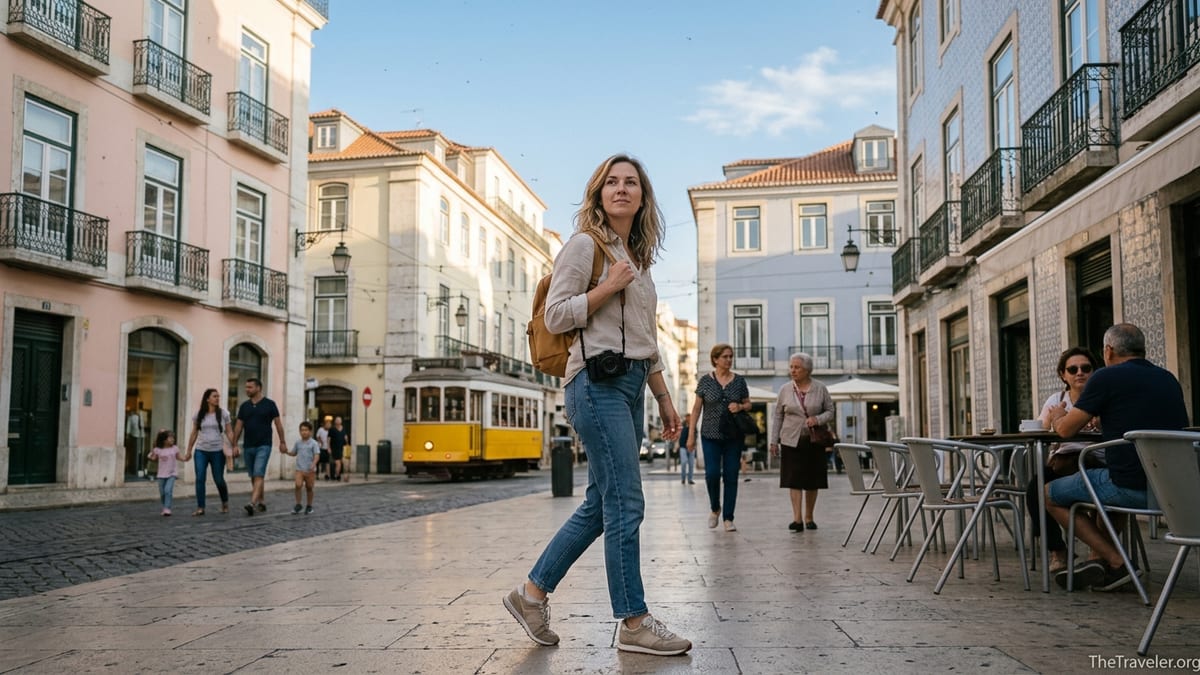
Day-to-day experiences on the road often look more mundane than the headlines suggest. A woman riding Japan’s Shinkansen alone from Tokyo to Kyoto may spend more time deciding between a bento box or a station bakery sandwich than worrying about safety. A solo traveler in Lisbon might be focused on whether her 24-hour transit card covers the ferry to Cacilhas, not on the idea that every stranger is a threat. When something does feel uncomfortable, it is usually in familiar ways: a man sitting too close on a tram, a catcall on a busy street, a pushy vendor who will not take no for an answer. Unpleasant, yes. Constant and universally dangerous, no.
The crucial point is not that risk is imaginary. It is that the narrative sold to women at home often erases the tools they already use in their daily lives. Most women are already experts at scanning a subway car at midnight, choosing a rideshare pick-up spot with good lighting or deciding when to pay extra for a taxi instead of walking. Those same skills transfer remarkably well to crossing a piazza in Florence or navigating a metro platform in Seoul.
How Constant Warnings Limit Women’s Freedom
The insistence that solo travel is inherently dangerous for women is not neutral advice. It shapes who feels entitled to occupy public space far from home. Young women in particular describe being told that traveling alone is irresponsible unless they wait until marriage, travel with a male partner or stick strictly to sanitized “resort bubbles.” The message beneath the warnings is clear: movement is safe when supervised and suspect when self-directed.
That message can have tangible consequences. A 28-year-old teacher in Chicago might postpone a dream trip to Mexico City after hearing relatives describe the city as “too dangerous for a girl alone,” even if she already navigates an urban commute after dark. A woman in her 50s, recently divorced in London, may be told that backpacking Southeast Asia solo is “a young woman’s game,” despite the fact that many guesthouses in Chiang Mai or Hoi An today are full of women her age who decided not to wait for the perfect travel companion.
There is also a financial cost to treating women as permanently at risk. Fear often pushes travelers into costly choices that have little to do with actual safety. Booking a private car for every airport transfer in cities like Copenhagen or Singapore, where public transport is both safe and efficient, might double a trip budget without materially changing risk. Paying a single supplement for an expensive resort in Bali because “you can’t trust hostels” can crowd out experiences that might matter more, such as a local cooking class, a guided hike or an extra night in Ubud.
Finally, constant warnings can erode confidence in women’s own judgment. When a woman who has successfully moved across countries for work or navigated late-night shifts in hospitality is told that a solo weekend in Montreal is reckless, what she hears is that her own risk calculations are not trusted. Over time, that erosion can make it harder to say yes not only to travel, but to job opportunities and life changes that also involve stepping into the unfamiliar.
Danger at Home, Danger Abroad: A More Honest Comparison
Conversations about solo female travel often isolate “abroad” as if it were an entirely different danger category from everyday life. Yet many women will tell you that the most unnerving experiences they have had with harassment or assault have happened close to home: on a familiar bus route, in a neighborhood bar, or at a party where they knew half the guest list. In online communities for women who travel solo, there are countless accounts of backpackers who have ridden overnight trains across Europe or taken shared taxis in Central America without incident, only to experience their worst scare walking home from work in their own city.
This does not mean that foreign destinations are automatically safer. It means that “home” is not automatically safe either. A woman from New York who feels comfortable taking the E train at 11 p.m. on a weekday after glancing around the platform and standing near other passengers is already performing the same risk assessment she might use in Barcelona’s metro or on a tram in Melbourne. The idea that travel transforms everyday caution into unacceptable danger ignores how women already navigate risk in places they know well.
Looking at specific destinations makes this even clearer. Take Tokyo, regularly described by travelers as one of the most comfortable cities in the world for women moving alone at night, thanks to late-running trains, well-lit streets and women-only cars on some commuter lines. Or consider Helsinki, which consistently scores highly in global safety rankings and where a woman can often walk back to her city-center hotel at midnight in summer twilight alongside joggers and cyclists. These places are not free of crime, but the picture is more nuanced than a blanket “unsafe for women” label.
On the other hand, destinations with reputations for danger can contain safer micro-environments when approached thoughtfully. In Mexico City, for example, solo women often report feeling at ease in neighborhoods such as Condesa or Coyoacán, where leafy streets, cafés and co-working spaces stay busy into the evening. Many use official taxi ranks at metro stations or trusted rideshare apps rather than hailing a car off the street. The point is not that one city or neighborhood is risk-free, but that danger is rarely uniform across an entire country. Women are capable of understanding that reality and planning accordingly.
What the Research and Real Travelers Actually Say
Beyond anecdotes, research on women’s solo travel paints a picture of a group that takes safety seriously but refuses to be defined solely by fear. Studies from universities in Europe and Asia over the past decade have documented how solo female travelers negotiate risk in ways that reflect both gendered expectations and personal agency. Interviewees often describe adapting their dress, altering their routes or timing, and avoiding certain venues at night in order to feel more in control, while still pursuing experiences they value such as street food, nightlife or hiking.
Recent work on African and Asian solo female travelers has also challenged the tendency to treat “the solo female traveler” as a single, Western figure. Women from Nairobi to New Delhi are traveling alone within their own regions and beyond, often balancing cultural expectations about modesty or family obligations with their desire to see the world. One Kenyan traveler might plan a week in Cape Town timed to coincide with a women-only group hike up Lion’s Head, while a Malaysian woman might structure a solo rail trip through Europe around cities with visible Muslim communities where she expects to find halal food more easily.
Meanwhile, travel companies are quietly adjusting their offerings in response. International small-group tour operators now routinely advertise trips that cater specifically to women traveling without partners, such as walking holidays in Spain’s Sierra Nevada, food tours in Oaxaca or sailing itineraries in Greece. These trips are often structured so that women can book solo, share rooms with other women by choice, and still enjoy time away from the group. Their popularity illustrates that large numbers of women have moved past debating whether they are “allowed” to travel alone and are focused instead on how to do it in ways that feel supportive and sociable.
On the ground, practical tools are also evolving. Many women mention relying on map-based apps that crowdsource neighborhood-level safety perceptions, alongside standard crime statistics. Others join city-specific group chats or online forums for solo female travelers where members share real-time tips on which hostels in Medellín have a genuinely respectful culture, which Bangkok rooftop bars feel comfortable for a woman alone and how much a taxi from the train station in Florence should cost at midnight. These informal information networks can be more precise than generic government advisories and often paint a more balanced picture than alarmist headlines.
Real-World Scenarios: What Solo Safety Actually Looks Like
Consider a 32-year-old woman from Toronto landing in Lisbon for a week of remote work and city walks. She chooses a guesthouse in the central Baixa district with strong reviews from other solo women, paying a little more for a private room in a building with a staffed reception rather than the cheapest dorm bed. On her first night, she joins a small-group food tour that winds through Mouraria, using it both to learn how to recognize legitimate tascas and to note which streets feel lively after dark. For late returns, she takes a licensed taxi from a main square instead of wandering back through confusing side lanes. None of these decisions eliminate risk, but they turn a vague sense of danger into specific, manageable choices.
Or picture a 24-year-old engineer from Mumbai backpacking through Eastern Europe. In Budapest she shares a six-bed female dorm in a central hostel and keeps her passport and most of her cash in a belt under her clothes on transit days, storing only a day’s spending money in an easily accessible wallet. She books a daytime train to Vienna rather than the cheapest night option after hearing that it can be rowdy on weekends. She buys a local SIM card so she can check tram routes and call a ride if she misses the last metro. These are not radical precautions; they are modest adjustments, similar to avoiding certain streets near home late at night.
There are also countless examples of women traveling solo in places often portrayed as intimidating, and doing so with deliberate yet relaxed routines. A teacher from Brisbane might spend two weeks in Mexico, starting in Mexico City, then heading to Puebla and Oaxaca by intercity bus. She might choose a mid-range hotel near Oaxaca’s Zócalo with a front desk open 24 hours, sign up for a mezcal tasting with a reputable tour company rather than through a street tout, and use registered taxis or rideshare apps for trips after dark. During the day, she explores markets and museums on foot, blending into the crowds of families and tourists.
Even when things go wrong, the outcome is often inconvenience rather than catastrophe. A solo traveler in Rome might have a wallet lifted in a crowded tram, then spend half a day canceling cards and visiting a police station, grateful for the backup credit card locked in her luggage. Another in Bali might twist an ankle stepping off a scooter, then rely on travel insurance to cover a clinic visit and a few days of taxis instead of walking. These stories can be annoying and expensive, but they also demonstrate that not every negative incident is an existential threat to a woman’s safety simply because she is alone.
Building a Practical Safety Toolkit Without Surrendering Freedom
Rejecting the idea that solo travel is always dangerous does not mean ignoring risk. It means approaching safety in the same pragmatic way you might approach planning your budget or choosing a flight. Most experienced solo women travelers rely on a blend of preparation, technology and personal boundaries that allows them to feel present on the road rather than perpetually on guard.
Accommodation is often the first line of defense. Seasoned solo travelers pay close attention to recent, detailed reviews from other women, not just star ratings. They look for mentions of well-lit entrances, 24-hour reception, secure baggage storage and staff who take complaints about harassment seriously. Many are willing to spend extra for a centrally located guesthouse or hotel in cities like Athens, Buenos Aires or Hanoi so they can walk to dinner and back without crossing deserted areas or relying on late-night transport.
Transport choices form the second layer. In cities with extensive public transit, such as Berlin, Taipei or Montreal, solo women often use trains and buses freely during the day while switching to licensed taxis or app-based rides at night. Some set personal rules: no empty metro cars after 11 p.m., no unregistered taxis off the street, or always sitting near the driver on intercity buses. Technology helps here too. Map apps make it easier to avoid wrong turns down quiet alleys, while translated address screens or pre-saved phrases reduce the need to pull out an expensive phone on the street.
The final layer is behavioral: the small decisions that add up to feeling in control. Many women mention keeping headphones off or volume low when walking at night so they can stay aware of their surroundings, limiting real-time social media posts that reveal their exact location, and having a prepared exit phrase to leave uncomfortable conversations. Others adopt tiny scripts such as casually mentioning that they are meeting friends soon, even if they are not, when a stranger becomes too persistent. None of this is unique to travel, but on the road it takes on added significance and can make the difference between feeling constantly anxious and quietly confident.
Challenging Who Gets To Move Freely
When we tell women that solo travel is irresponsible or unsafe by default, we are also sending a subtler message about who is allowed to take up space in the world. Historically, men’s journeys have been framed as adventures or quests, while women’s movements have been scrutinized through the lens of propriety and risk. The young man hitchhiking through Patagonia is adventurous; the young woman taking the bus between Bariloche and El Chaltén is often described first as “brave,” a word that can carry a hint of accusation as well as admiration.
For women from marginalized communities, the layers multiply. A Black woman from the United States planning a solo trip through Europe may have to weigh not only gendered safety concerns but also racism and the way she is perceived by authorities. A visibly queer or trans woman mapping out a journey in Eastern Europe or parts of Asia might spend extra time researching local attitudes and seeking out queer-friendly spaces. Yet many such travelers still choose to go, often building their own networks through online forums, local meet-ups and identity-specific travel groups that center their experiences rather than treating them as edge cases.
It is also worth noticing how economic interests sometimes intersect with fear narratives. Luxury resorts, all-inclusive packages and cruise lines all have an incentive to present the outside world as unpredictable while their controlled environments are marketed as the only safe way to see a country. That does not mean these options are bad. For some women, a resort in Playa del Carmen or a cruise around the Greek islands is exactly the restful, low-stress escape they want. The problem arises when this model becomes the default assumption for women’s safety, implicitly suggesting that independent movement through markets, bus stations and city streets is beyond their competence.
The counter-narrative emerges most clearly in the stories women tell each other. In community spaces online, you are more likely to see practical posts about where to find a women-run guesthouse in Fez, how to dress comfortably yet respectfully in Amman’s downtown, or which neighborhoods in Medellín feel relaxed for evening walks, than dire proclamations that women should not travel there at all. These conversations do not deny that harassment or discrimination exists; they simply refuse to let fear be the sole organizing principle.
The Takeaway
Solo travel for women involves real risks, just as commuting home after dark, going on first dates or living alone in a city involve real risks. The difference is that solo travel asks women to concentrate those calculations in unfamiliar environments, where the stories they have been told about what is safe or unsafe may not match reality. When those stories lean heavily on fear, they can keep women from experiences that would otherwise expand their sense of what they are capable of and where they belong.
None of this is an argument for throwing caution to the wind. It is an argument for being as specific about risk as possible. Instead of saying “It’s not safe for women to travel alone,” we can say, “Research neighborhoods in Naples before booking, avoid unlicensed taxis at the airport, and trust your instincts if a situation feels wrong.” Instead of warning a woman off solo travel entirely, we can ask what kind of support or information would help her feel more confident, whether that is joining a small-group tour for part of the trip, choosing destinations known for strong public transport and low street harassment, or starting with a long weekend in a nearby city.
Ultimately, the most powerful rebuttal to the idea that solo travel always leads to danger is the quiet, ordinary reality of millions of women who pack a bag, scan a boarding pass and return home safely every year. They navigate crowded souks in Marrakech, subway transfers in Seoul and mountain trails in the Dolomites with the same combination of wariness and wonder they apply to their lives at home. Their stories are not about the absence of risk, but about the presence of agency. When we stop telling women that being alone automatically makes them victims-in-waiting, we make more space for those stories to be heard.
FAQ
Q1. Is it ever truly safe for a woman to travel completely alone?
Absolute safety does not exist, at home or abroad. For women who prepare thoughtfully, choose destinations that match their comfort level and trust their instincts, solo travel can be no more dangerous than many routines they already manage in daily life, such as commuting after dark or living alone.
Q2. Which destinations tend to feel most comfortable for first-time solo female travelers?
Experiences vary, but many first-time solo women report feeling especially at ease in cities with strong public transport and walkable centers, such as Tokyo, Copenhagen, Lisbon, Dublin, Singapore and Canadian cities like Vancouver or Montreal. The key is not a magic list, but finding places where infrastructure and culture align with how you like to move through a city.
Q3. How can I talk to family who insist that solo travel is too dangerous for me?
It often helps to move the conversation from general fear to specific plans. Share details about your chosen neighborhood, accommodation, arrival time, travel insurance and how you will stay in touch. Explaining concrete steps, such as using registered airport taxis or avoiding certain areas at night, shows that you are taking safety seriously rather than dismissing their concern.
Q4. Are hostels safe for solo women, or should I always book private hotels?
Both can be safe, depending on the property. Many solo women enjoy hostels that offer female-only dorms, secure lockers and 24-hour staff. Others prefer budget hotels or guesthouses for privacy. Reading recent reviews from other women, checking location and weighing the trade-off between social atmosphere and personal space will guide the right choice for your trip.
Q5. What are some practical safety habits women use when traveling alone?
Common habits include sharing itineraries with someone at home, arriving in new cities during daylight when possible, using licensed taxis or ride-hailing apps at night, keeping valuables in a money belt or lockbox, avoiding real-time location posts on social media and having prepared exit phrases to leave uncomfortable interactions.
Q6. How do race, sexuality or religion change the solo travel experience for women?
Women who are Black, Brown, visibly queer, trans or from religious minorities often face additional layers of scrutiny or discrimination. Many still travel solo but rely more heavily on identity-specific forums, local community recommendations and detailed research on local attitudes. Their experiences are not uniform, yet they underline the importance of centering diverse voices in conversations about solo travel.
Q7. Is joining a small-group tour “cheating” if I want to travel solo?
No. Many women combine independent days with small-group tours or day trips, especially in places where language barriers or remote locations add stress. A food tour in Oaxaca, a group hike in the Dolomites or a guided city walk in Marrakech can provide social connection and local insight while still giving you plenty of solo time.
Q8. How can I handle unwanted attention or harassment without escalating a situation?
Responses depend on culture and context, but common approaches include ignoring minor comments, using firm but polite refusals, moving closer to families or women in public spaces, stepping into a shop or café, or addressing staff or bystanders directly if someone crosses a line. Having a few practiced phrases in the local language for “please leave me alone” or “I need help” can also be reassuring.
Q9. Do I need to avoid nightlife entirely as a solo female traveler?
Not necessarily. Many women enjoy concerts, bars or late dinners alone abroad, but they often adjust how and where they go out. Choosing venues close to their accommodation, limiting alcohol, watching drinks being poured, arranging secure transport home in advance and leaving at the first sign of discomfort are common strategies that balance enjoyment with caution.
Q10. What should I do if something does go wrong while I am traveling alone?
If you experience theft, harassment or an emergency, seek a safe public place first, such as a hotel lobby, café or busy shop. Contact local emergency services if needed, then your embassy or consulate for serious incidents. Inform your accommodation, use backup cards or cash you have stored separately and lean on travel insurance for medical or logistical support. A difficult incident does not mean you made a mistake by traveling; it means the systems around you need to work as they should.