


More news on this day
Across North America, travel providers are rapidly fusing virtual reality experiences with artificial intelligence driven insights, reshaping how trips are imagined, planned and experienced long before a boarding pass is issued.
Get the latest news straight to your inbox!
From Brochure To Immersive Preview
Virtual reality, once treated as an entertainment novelty, is emerging as a strategic tool for North American travel brands seeking to influence where and how people travel. Airlines, tourism boards and destination marketers are increasingly using immersive previews that allow travelers to step into aircraft cabins, hotel rooms or landmark districts virtually before committing to a booking, according to industry reports and recent product launches.
VR driven “try before you fly” experiences are being positioned as a way to reduce booking friction, especially for higher priced long haul trips. Publicly available material from aviation and tourism consultancies indicates that virtual walkthroughs of cabins and airport terminals can help set expectations on comfort, layout and services, while destination focused experiences spotlight signature attractions, seasonal events and even crowd levels at different times of year.
North American training and infrastructure investments are also reinforcing this shift. A growing number of carriers and regulators are working with VR simulation providers for pilot and crew training at facilities in the United States, and analysts note that these same content pipelines can be adapted over time to create consumer facing experiences that mirror real flight operations and geographic landscapes.
State and provincial tourism agencies are experimenting with immersive storytelling around major events and natural phenomena, from eclipses and aurora viewing to national park itineraries. Recent award citations for tourism campaigns highlight the role of VR activations in driving social media engagement and longer trip research sessions, particularly among younger travelers who are more likely to use headsets and mixed reality devices at home.
AI Trip Planners Become North America’s Default Travel Concierge
While VR reshapes inspiration, artificial intelligence is rapidly taking over the mechanics of planning itself. Over the past year, a wave of North America based travel platforms have rolled out conversational AI planning tools that synthesize live pricing, historical demand patterns and user preferences into suggested itineraries within minutes.
Metasearch brands have introduced dedicated AI modes that sit on top of their existing flight and hotel datasets, turning what were once static filters into dynamic back and forth dialogues. Publicly available feature descriptions indicate that these tools can accept natural language prompts such as a budget, travel window and preferred climate, then surface cities, sample itineraries and booking options that match those constraints. Industry comparisons published in early 2026 describe these tools as among the first to combine GenAI interfaces with real time inventory at North American scale.
Online travel agencies in the United States are going further by testing agentic AI systems that can maintain context across an entire planning journey. Press materials from large North American brands describe multi modal assistants that blend mapped recommendations, image rich inspiration and live availability. These systems can adjust when a traveler changes airports, shifts a date or adds a companion, while also handling routine tasks such as rechecking fares or suggesting alternatives after a cancellation.
Independent reviewers tracking the AI travel sector report that North America hosts a disproportionate share of the most used AI planners, with rankings for 2026 showing many of the top tools headquartered or heavily focused on the United States and Canada. These assessments cite strong access to airline and accommodation data, deep venture funding and a consumer market already accustomed to digital booking as key advantages.
Airports And Airlines Turn To Spatial And Predictive Intelligence
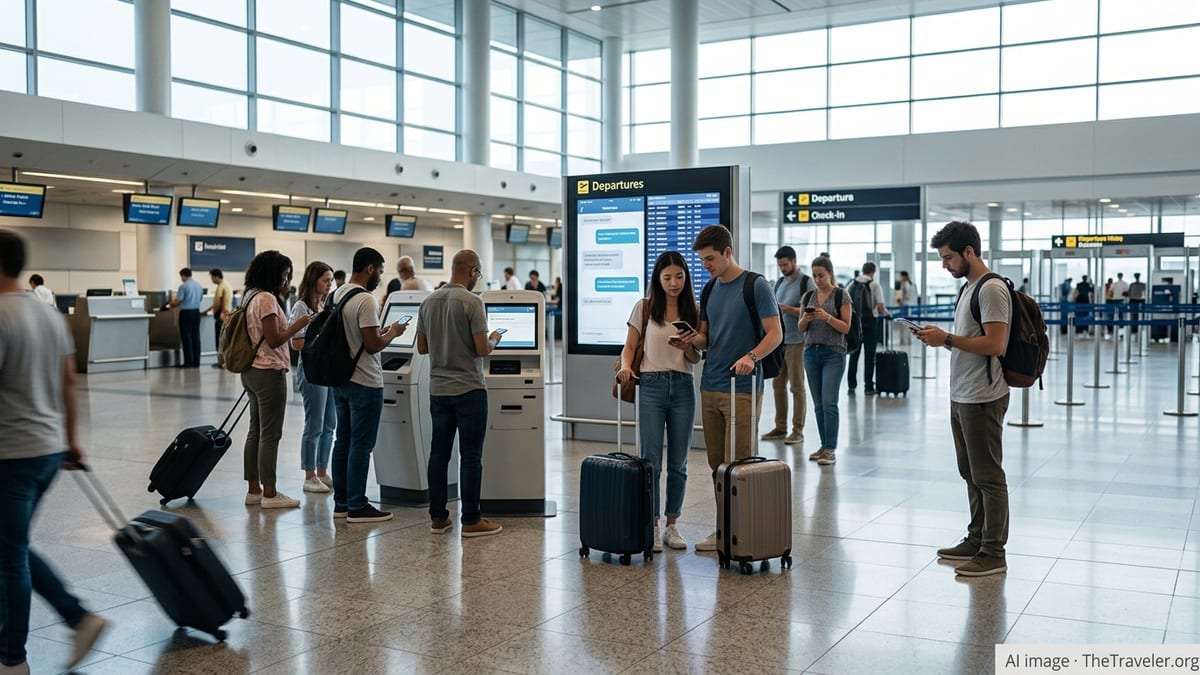
On the operational side, airports and airlines across North America are deploying AI to manage passenger flows and provide in journey assistance that increasingly resembles a digital concierge. In the United States, major carriers have announced generative AI tools to rebook disrupted passengers more efficiently by analyzing schedule options and downstream impacts on entire networks.
Airports are beginning to pair these predictive systems with spatially aware virtual assistants. One prominent example is Miami International Airport, which recently introduced conversational agents with geo spatial intelligence across web, mobile, kiosks and holographic displays, using indoor mapping technology to help passengers navigate terminals, locate services and receive context specific information. Public material from the technology providers indicates that this is one of the first large scale deployments of such an agentic AI platform in a North American hub.
Consulting studies on aviation digitization point to a broader trend in which AI supports biometric check in, baggage tracking and customer service automation. While many of the most visible pilots launched before 2026, follow up analyses describe a maturing ecosystem where digital identity, analytics and AI combine to reduce wait times and personalize messages, even for travelers who never directly interact with a chatbot.
These developments are subtly reshaping traveler expectations. When disruptions occur, passengers in North America are increasingly encountering automated yet personalized rebooking suggestions and proactive notifications. For many itineraries, this represents the first tangible experience of AI “decision making” on their behalf, beyond simple recommendation engines.
Tourism Boards Use Data To Steer Demand And Sustainability
Beyond individual trips, tourism organizations in the United States, Canada and Mexico are using AI enhanced analytics to understand and steer visitor flows. Industry outlooks for 2025 and 2026 describe how destination marketing organizations are layering visitor surveys, mobile location data and booking trends with machine learning models to predict demand spikes, identify under visited regions and test the impact of new campaigns in near real time.
Some of these strategies intersect directly with VR deployments. When a state tourism office launches an immersive experience tied to a specific natural event or scenic byway, AI tools are used to monitor how search interest and bookings respond, which markets show the strongest engagement and whether visitors are extending stays beyond marquee attractions. Award submissions from North American destinations emphasize VR as a way to disperse demand by showcasing less familiar towns, trails and cultural venues.
Consultancies tracking global travel technology note that North America’s regulatory environment, investment capacity and deep base of tech talent have accelerated experimentation with both AI and immersive media. At the same time, publicly available surveys suggest that travelers are increasingly aware that AI tools may recommend popular or sponsored options by default, prompting calls for transparency about data sources, ranking criteria and privacy practices in order to maintain trust.
As these systems evolve, tourism boards and travel companies are also using AI to test sustainability scenarios, such as modeling how route changes, seasonality campaigns or capacity limits might redistribute demand. Analysts say the combination of granular data and predictive modeling is starting to influence infrastructure planning and marketing calendars across North American destinations.
Blurring The Line Between Virtual And Physical Journeys
The convergence of VR and AI is beginning to blur the boundary between trip planning and the trip itself. VR previews informed by real operational data and AI generated content can make pre travel research feel like a lightweight version of the eventual experience. Meanwhile, in destination tools that remember traveler preferences over time can adjust recommendations in response to weather shifts, local events or changing group dynamics.
Emerging academic work on AI assistants for travel and geospatial intelligence suggests that the most impactful systems will unite language, maps and real time data into single interfaces, replacing today’s patchwork of search, booking and navigation apps. Experimental platforms described in recent research combine conversational planning with interactive maps, allowing users to reshape routes, lodgings and activities visually while the AI recalculates implications for time and budget.
For North America, where domestic and regional travel markets are large and competition is intense, the race to integrate VR and AI is as much about differentiation as efficiency. Travel providers are betting that the ability to let customers “step into” a destination virtually, then hand off to a smart assistant that manages logistics and adapts on the fly, will become a defining feature of the next era of global tourism.
As the technology matures, the region’s experiments in immersive previews, agentic planning tools and geo aware assistants are likely to set expectations far beyond its borders, effectively rewriting key rules of global travel from airport concourses, innovation labs and headset screens across North America.