


More news on this day
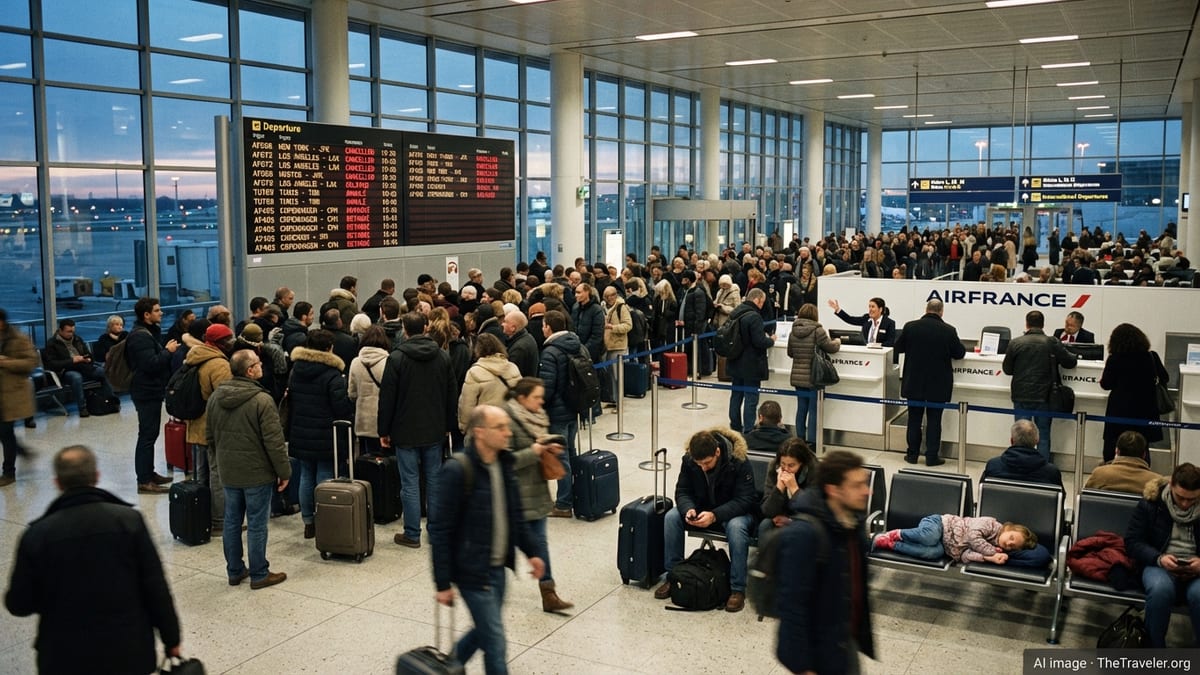
Passengers across France and several major European hubs faced a new wave of air travel disruption as Air France, British Airways, KLM, Lufthansa, Emirates and easyJet collectively recorded 472 delayed flights and 12 cancellations, leaving many travelers stranded in Paris, Amsterdam, Frankfurt and other cities.
Get the latest news straight to your inbox!
French Airports at the Center of Widespread Disruption
Publicly available operational data and aviation tracking services indicate that French airports, particularly Paris Charles de Gaulle and Paris Orly, have again emerged as focal points for disruption, with knock-on effects spreading across the wider European network. The latest figures show hundreds of delayed departures and arrivals involving leading European and Gulf carriers, as well as a cluster of cancellations that have forced passengers to rebook at short notice.
Reports from aviation analytics platforms highlight that Air France and its partners have been among the most affected, with delayed services on both European and long haul routes, including transatlantic connections. The concentration of flights through Paris means that localized disruption can rapidly affect passengers not only traveling to and from France, but also those using the city as a transfer point.
Industry overviews point to a mix of causes behind the delays at French airports, ranging from en route air traffic flow restrictions to airport congestion and weather-related constraints. While the precise breakdown varies by carrier and airport, the outcome for passengers has been similar: extended waiting times at departure gates, missed connections and late arrivals into already crowded hubs.
Operational performance summaries compiled for major European gateways show that France has ranked among the most affected states for air traffic management delays in recent weeks. That pattern has now translated into a concentrated spike in late-running services that has rippled across multiple airlines and alliance networks.
Amsterdam, Frankfurt and Other Hubs Feel the Knock-On Effects
The disruption in French airspace and at Paris airports has not been contained within national borders. According to recent travel disruption coverage and airport statistics, Amsterdam Schiphol and Frankfurt Airport are among the non-French hubs now reporting significant numbers of delayed flights connected to French operations, either as origins, destinations or overflight points.
KLM, Lufthansa and their partner airlines have experienced schedule pressures on routes linking Amsterdam and Frankfurt with French cities such as Paris, Nice, Lyon and Bordeaux. These connections play a crucial role in feeding long haul networks to North America, the Middle East, Africa and Asia, meaning that a delay on a short European sector can cascade into missed or retimed intercontinental departures.
Tracking data and passenger-facing disruption reports from earlier episodes this year suggest that, when constraints appear in French airspace, Amsterdam and Frankfurt often see increased reactionary delays as aircraft and crew rotate through the network. The present wave of disruption appears to be following a similar pattern, with relatively small timetable gaps allowing little margin to recover from earlier late arrivals.
Other regional gateways, including Brussels, Rome and various secondary French airports, have also reported elevated levels of late running in recent weeks, underscoring how a disturbance at one or two core hubs can quickly become a continent-wide challenge for airline operations and passengers alike.
Major Carriers Struggle to Keep Schedules on Track
The latest disruption has highlighted the vulnerability of even the largest and most experienced carriers when faced with a combination of airspace constraints and congested hubs. Operational statistics and performance reports compiled by airport operators and independent analysts show that Air France, British Airways, KLM, Lufthansa, Emirates and easyJet have all recorded notable spikes in delay incidents this season.
Air France and KLM, with their intertwined hubs at Paris Charles de Gaulle and Amsterdam Schiphol, have been particularly exposed as they manage dense short haul schedules feeding high-demand long haul departures. Reactionary delays, ground handling bottlenecks and air traffic restrictions have each played a role in extending turnaround times and pushing back departure slots.
Lufthansa and British Airways, operating extensive networks into and over French airspace, have also reported higher-than-usual delay tallies on services linking Germany and the United Kingdom with France and onward European destinations. For long haul carriers such as Emirates, which rely on punctual European feeder flights to connect travelers through Gulf hubs, even a modest delay rate in France can translate into missed connections and the need to rebook passengers on later departures.
Low cost operator easyJet, a significant presence at multiple French airports and key bases such as Amsterdam and other regional hubs, has faced its own challenges balancing high aircraft utilization with limited slack in the schedule. When an aircraft or crew is held up by an earlier delay in France, subsequent rotations across several countries can be affected, contributing to the cumulative total of 472 delays reported across the affected airlines.
Passengers Face Long Queues, Missed Connections and Limited Options
For passengers caught up in the disruption, the operational details are often less important than the immediate impact on their journeys. Reports compiled by travel news outlets and passenger rights organizations describe long queues at check in and transfer desks, crowded boarding areas and uncertainty over estimated departure times as airlines work to recover their schedules.
Travelers connecting in Paris, Amsterdam and Frankfurt have been especially vulnerable to missed onward flights, as delays on inbound European segments shorten or erase minimum connection times. In some cases, passengers heading to long haul destinations have had to accept overnight stays, rerouting via alternative hubs or significant changes to their arrival times.
Consumer advocacy platforms emphasize that, under European air passenger regulations, travelers on many of these delayed or cancelled flights may be entitled to assistance, rerouting and, in some circumstances, financial compensation. However, the process often requires passengers to retain boarding passes and disruption notifications, and in some cases to submit claims after travel is complete.
In the short term, publicly available guidance suggests that affected passengers should monitor airline apps and airport information screens, arrive early where possible, and consider building longer connection times into itineraries that pass through France and nearby hubs during periods of heightened disruption.
Data Points to Structural Strain Ahead of Peak Summer
The concentration of 472 delays and 12 cancellations across a cluster of major airlines in France and neighboring hubs is being interpreted by analysts as a warning sign for the peak summer travel period. Network operations reports from European aviation bodies already indicate that average delays per flight have been edging up, with weather, airspace constraints and staffing limitations all contributing.
Recent overviews of European traffic patterns show that carriers such as easyJet, Air France, KLM, Lufthansa and British Airways are operating at or near pre-pandemic volumes in many markets, while Gulf carriers including Emirates continue to add capacity on key long haul routes. With airports such as Paris Charles de Gaulle, Amsterdam Schiphol and Frankfurt ranked among the continent’s busiest, even a minor disruption can quickly escalate when load factors are high.
Industry observers note that structural factors, including limited spare capacity in air traffic control systems and tight staffing at some airports, are likely to persist throughout the season. While airlines are adjusting schedules and adding operational buffers where possible, the latest episode of disruption shows that margins remain slim, and passengers can expect further periods of irregular operations.
Travel industry coverage suggests that, for now, the most practical response for travelers is careful planning and flexibility. Booking earlier flights in the day, allowing generous connection windows, and keeping close track of airline communications may not eliminate the risk of disruption, but can help reduce the chances of being left stranded when delays ripple through the European network.