


Choosing between Hurghada and Sharm el‑Sheikh for a family holiday on the Red Sea is less about which resort is "better" and more about how your children will actually get into the water. A hotel described as "beachfront" might sit on soft sand with ankle-deep shallows, overlook a coral shelf where swimming is only possible from a jetty, or front a rocky shoreline that is beautiful but awkward for toddlers. This guide compares real swimming conditions, costs and logistics in Hurghada and its bays versus the main districts of Sharm, to help parents match a short Red Sea break to their family’s needs.
Get the latest updates straight to your inbox!
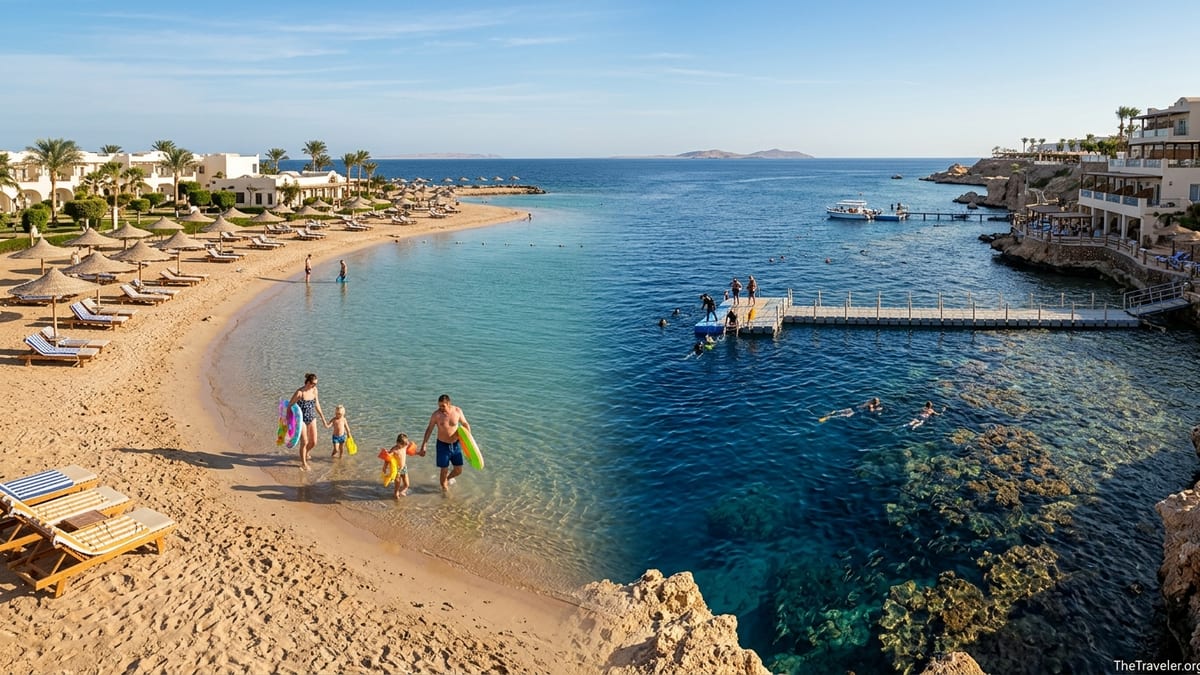
Beachfront Reality: Sand, Reef Shelves and Jetties
The most important distinction for families is how you enter the sea. Around Hurghada, many hotels sit on broad sandy beaches with a gradual slope, which suits paddling, inflatables and non‑swimmers. Travel guides updated in 2026 consistently describe Hurghada’s shoreline as smoother and more classically “beach holiday” in style, with long stretches of sand and shallow water in front of large all‑inclusive resorts rather than coral walls dropping into deep water close to shore.
In Sharm el‑Sheikh, a significant number of resorts are built on top of fringing reef. The hotel may advertise a sandy sunbathing area, but the actual waterline can be rocky or carpeted in living coral, so swimming is usually from a floating pontoon that takes you straight to deep water. This is spectacular for confident swimmers and snorkellers because the reef begins almost at once, yet it is intimidating and impractical for toddlers or anyone who simply wants to stand. Recent Red Sea family checklists stress that “Reef from jetty only” or “no natural sandy entry” are common notes for Sharm properties, especially around Sharks Bay, Ras Um Sid and parts of Nabq.
Both destinations have exceptions. Some Sharm bays, including sections of Naama Bay and Sharm el‑Maya, offer genuinely sandy entry with only scattered coral. Conversely, certain Hurghada and Makadi Bay resorts sit on partial reef plateaus where seagrass or coral patches appear underfoot at low tide. Because descriptions such as “private beach” or “lagoon access” are imprecise, families should look at recent guest photos and wording such as “knee‑deep lagoon ideal for children” or “jetty to swimming area over reef” rather than relying on generic marketing.
Family Districts Around Hurghada: From Town Beaches to Soma Bay
The greater Hurghada area stretches along the mainland coast and includes satellite resort zones such as Sahl Hasheesh, Makadi Bay and Soma Bay. Central Hurghada itself has older hotels and in‑town beaches, often with breakwaters and mixed sand quality, but offers short transfers from Hurghada International Airport, usually 10 to 20 minutes by taxi or hotel shuttle. Families who value quick access and lower prices often base themselves here, then take boat trips to offshore reefs for clearer water and fish life.
Sahl Hasheesh, around 25 minutes south of the airport, is a master-planned bay with a long promenade and a sweeping, shallow sandy shoreline. Many resorts front wide beaches where children can wade out over a sandy bottom before any coral patches appear. Parents on recent trips highlight that most swimming is possible directly from the beach, while better coral is reached on organised snorkelling trips or from small house-reef jetties at specific hotels.
Makadi Bay, slightly further south, combines family all‑inclusive resorts with a mix of sandy and coral‑fringed entry. Official descriptions for well‑known properties here emphasise “gently sloping sand” and “protected bay” alongside house reefs used for dive‑centre training. The bay is recognised by the Egyptian tourism authorities for sandy beaches and clear water, which makes it a middle ground: easy enough for paddling, but with more fish and coral close by than central Hurghada.
Soma Bay, roughly 45 to 50 minutes from Hurghada airport, is quieter and more exposed to wind. It appeals to families who kite‑surf or windsurf, and reviews from visitors with younger children note expansive shallow flats and clear lagoons, but also remark that offshore or cross‑shore winds can pick up in winter and spring. Several large all‑inclusive properties line South Soma with on‑sand entry, while snorkelling usually involves either walking along the shore to reefier corners or joining a boat.
Sharm’s Bays: Naama, Sharks, Nabq and the House‑Reef Question
Sharm el‑Sheikh is a more compact resort concentrated around separate bays. Naama Bay is the original strip and still the most walkable, with a curved sandy beach used by multiple hotels and beach clubs. Families based here often report the easiest direct sand entry in Sharm, at the cost of somewhat less intense coral right off the shore. The location suits parents who want short strolls to cafes and evening promenades without using taxis every night.
Sharks Bay, a short drive north toward the airport and the Soho Square entertainment area, is heavily developed with midrange to high‑end resorts. Many advertise stunning house reefs and extremely clear water. In practice, a lot of these shorelines sit on coral ledges, so the hotel provides one or more floating pontoons where swimmers drop straight into several meters of water. This suits older children who are comfortable in lifejackets with masks and fins, but it is not a wading beach and is occasionally closed during rough weather or if authorities restrict access after marine incidents or to protect damaged coral.
Nabq Bay, further north, features long, shallow reef flats that extend far out from the shore. Families frequently comment that the views are beautiful but that you may walk several hundred meters on a jetty before reaching swimmable depth. The area also catches more wind, which is attractive for kite‑surfing but can create small chop and currents at the reef edge. For small children who mainly use pools and only occasionally visit the sea, this may still work well, yet it is less convenient for spontaneous paddling compared with Hurghada’s sandy lagoons.
Other Sharm districts such as Hadaba and Ras Um Sid sit atop cliffs and terraces with steps down to platforms or small coves. They are famous among divers and snorkellers because the reef walls drop rapidly into blue water with abundant fish and, in marine parks such as Ras Mohammed and the Strait of Tiran, regular encounters with bigger pelagic species. For a family that prioritises underwater scenery and has water‑confident teenagers, these zones can be outstanding, but they require more supervision and are rarely ideal as “first sea” experiences for toddlers.
Swimming Conditions, Seasons and Snorkelling vs Sand
Water temperatures on Egypt’s Red Sea coast are swimmable year‑round, with winter sea temperatures in the low twenties Celsius around both Hurghada and Sharm. However, air temperatures and wind matter for comfort. Winter months around January and February often bring stronger north winds and cooler evenings. Sharm, on the Sinai side, can feel slightly more sheltered in some bays, yet exposed districts like Nabq and Soma Bay near Hurghada are known among sailors and kite‑surfers for their reliable breezes.
For inexperienced swimmers, the critical questions are water depth underfoot, current exposure and access control. In Hurghada’s main bays, shallow sandy shelves break waves and create waist‑deep zones where children can stand. Currents still exist, especially around reef heads, but in‑resort swimming is mostly in gently shelving water. Around Sharm’s reefy bays, drop‑offs and channels can funnel stronger flows, which is why many jetties have posted rules such as red flags, time limits or bans on entering the water when conditions are rough. Parents regularly mention that house‑reef ladders may be closed for parts of a windy day, which can be frustrating if you rely on them for swimming.
Snorkelling quality is where Sharm usually wins. The reefs at Ras Mohammed and in the Strait of Tiran are world‑renowned for colourful coral, dramatic drop‑offs and schooling fish, and many hotels have house reefs that see a constant stream of snorkellers each morning. Hurghada has attractive reefs too, but the best are typically visited by boat, such as around Giftun Island and other offshore spots. Families must decide whether they prefer “snorkelling from the jetty” with deeper water beneath, or “play on sand most of the day, then snorkel from a boat” as a separate activity.
For small children, the best compromise is often a sandy‑entry resort with good pool and play facilities, combined with a half‑day snorkel trip that offers shallow, sheltered stops. In Hurghada this might mean a cruise to one of the sandbar islands off the coast, where boats anchor in turquoise waist‑deep water. In Sharm, family‑oriented glass‑bottom or semi‑submarine boats from Naama Bay or the Old Market district let non‑swimmers see coral and fish without getting wet, while more confident members of the family join guided snorkel sessions at the surface.
Flights, Transfers and On‑the‑Ground Transport
From European departure points, both Hurghada and Sharm el‑Sheikh currently have regular direct charter and low‑cost flights in winter, Easter and summer seasons. Availability fluctuates by country and year, but many UK, German, Italian, Polish and central European airports schedule weekly or multiple weekly services to both destinations. Package tour brochures for the 2025–2026 seasons show Hurghada sometimes receiving slightly more flights as it also serves El Gouna and the southern bays, but Sharm remains one of Egypt’s busiest leisure airports.
Transfer times are an important difference. Hurghada’s main hotel strip begins just a few kilometres south of the runway, so taxi or pre‑booked car journeys to in‑town resorts often take around 15 minutes. Sahl Hasheesh and Makadi Bay are typically 25 to 35 minutes, and Soma Bay about 45 to 60 minutes depending on traffic and hotel location. In Sharm, Naama Bay is around 15 to 20 minutes from the airport, Sharks Bay 10 to 15 minutes, and Nabq around 20 to 30 minutes along the coast road. Shared coach transfers arranged by tour operators can take longer due to multiple hotel stops.
Recent price examples from local transfer providers and tour companies suggest that a private one‑way car transfer for a family from Hurghada airport to a nearby resort starts in the range of 15 to 25 US dollars, rising to roughly 30 to 40 dollars for Soma Bay. In Sharm, similar private transfers to Naama or Sharks Bay are often quoted around 20 to 30 dollars. Pre‑booked hotel cars are usually more expensive than local companies, but can include meet‑and‑greet and child seats on request. Many operators say they can provide child seats if requested in advance, yet families sometimes report that seats are basic or in limited supply, so bringing a compact travel booster for older children remains prudent.
Metered taxis exist in both cities but are not always used consistently, and ride‑hailing apps operate in limited ways. For predictable pricing and safer installations for children, pre‑arranged transfers via your tour operator or hotel are generally preferred. Within the resort areas themselves, many families simply walk or use hotel shuttles, especially in Naama Bay and Sahl Hasheesh where promenades and pedestrian zones are well developed.
Resort Facilities: Water Parks, Kids’ Clubs and Heated Pools
Hurghada and its bays have become major hubs for large, water‑park‑style all‑inclusive resorts. Several well‑known chains near Makadi Bay and along the main Hurghada strip market dozens of slides, lazy rivers and splash zones suitable for different ages. Tour operator brochures and recent guest reviews highlight that many of these complexes include separate toddler areas with very shallow water and shade sails, supervised kids’ clubs from about age 4, and evening shows such as mini‑discos and small‑scale theatre productions inside the hotel grounds.
Sharm el‑Sheikh also offers sizeable water parks, particularly in Nabq and Sharks Bay, and a number of five‑star properties around Soho Square and the plateau above Sharks Bay run structured kids’ clubs with organised activities. However, several travel comparisons note that Sharm’s overall feel is slightly more grown‑up and, in many cases, a touch more expensive than comparable mass‑market Hurghada options targeting European package families. In practical terms, a midrange four‑star with waterslides in Hurghada might price close to a simpler or smaller pool complex in a similar Sharm property at popular times.
Heated pools are vital for winter holidays from December to February. Resort descriptions for 2025–2026 show more and more properties in both regions advertising at least one heated pool, but the details vary. Some only heat a smaller quiet pool rather than the main slide area, and “heated” may target around 24 to 26 degrees Celsius, which can still feel cool on windy days. Families travelling in winter should check whether the children’s pool or slide pool is heated, not just whether the hotel mentions one heated pool somewhere on site.
Room types also matter for budgets. Many Red Sea resorts offer “family rooms” or “two-bedroom family suites” that are essentially two connected bedrooms or a large room with sliding doors. Local rate sheets from 2026 show that these units usually price a modest percentage above a standard double when part of an all‑inclusive package, and they are heavily used by tour operators packaging two adults and two children.
Excursions and Realistic Costs for a Short Stay
Families rarely spend every day inside the resort. Around Hurghada, one of the most popular outings is a day or half‑day trip by boat to the islands and reef systems near Giftun Island. Excursion operators in 2026 commonly advertise combined snorkelling and beach days that include boat transfer, basic equipment and lunch. Public price lists suggest approximate rates in the range of 25 to 50 US dollars per adult for simple group trips, with discounts or half‑price for children, plus marine park or “island” fees collected separately at the marina, which can add roughly 5 to 10 dollars per person.
In Sharm, headline excursions include boat trips to Ras Mohammed National Park and the Tiran area, glass‑bottom or semi‑sub boats from Naama Bay, quad‑bike rides in the desert, and in some cases pilgrim or sunrise trips to Mount Sinai. Standard group snorkelling boat excursions to Ras Mohammed with equipment and lunch are often advertised between about 35 and 70 dollars per adult, again with reduced child rates, plus park fees collected at the port or baked into the ticket. Age restrictions are usually more about safety on the boat and in the water than formal rules; operators often accept children from around 3 or 4 years up, but may ask that young children remain on board with a supervising adult during snorkel stops.
Shorter, non‑swim options are widely available in both resorts. Glass‑bottom boats and mini‑submarine rides tend to price somewhere in the region of 15 to 35 dollars per adult for 1 to 2 hours, while simple city tours, old‑town visits and evening shows may be cheaper but involve more walking in the heat. Because these are open markets, families frequently negotiate on‑the‑spot prices or book via hotel reps at a premium for convenience and perceived safety.
For a three‑ or four‑night stay, many families choose just one major excursion like a boat day, plus perhaps a short glass‑bottom boat ride or desert buggy outing. When budgeting, it is useful to think in terms of one “headline day” per trip costing perhaps 150 to 250 dollars total for a family of four, once transfers, park fees, tips and small extras are included, rather than just the base brochure price.
Worked Family Budgets: Two and Seven Nights
Prices fluctuate by country, operator and date, but recent tour brochures, sample hotel rate sheets and package adverts for the 2025–2026 seasons give broad ranges that can anchor planning. For a budget‑conscious family of four on a short winter break of two or three nights in Hurghada, off‑peak January packages combining charter flights, shared transfers and a three‑star or lower four‑star all‑inclusive resort might appear from roughly 900 to 1,200 US dollars in total from nearby European markets. Adding one simple group boat trip, basic visa or entry fees where applicable, and airport snacks could raise this to somewhere around 1,100 to 1,400 dollars.
A midrange all‑inclusive one‑week package at a family‑focused four‑star in Hurghada or Makadi Bay around spring shoulder periods such as March or after Easter often prices closer to 1,800 to 2,500 dollars for the same family, including flights and transfers from large departure hubs, based on tour‑operator brochures. A similar‑quality property in Sharm at the same time of year may be slightly higher, for instance 2,000 to 2,800 dollars, especially if it features a strong house reef and a larger water park. In both cases, budgeting an extra 300 to 500 dollars for a week to cover visa or entry stamps for adults if required, a major boat or desert trip, marine park fees, and incidental expenses is sensible.
Higher‑end beachfront stays show a wider gap. Seven nights in a deluxe five‑star in Sahl Hasheesh, Soma Bay or an upmarket part of Hurghada on an all‑inclusive or full‑board basis, including charter flights, can reach from roughly 3,000 dollars for older‑stock rooms up to 4,500 dollars or more for peak summer or Easter weeks according to recent European tour price examples. In Sharm, especially in well‑known five‑star clusters around Soho Square, Naama Bay’s upper tier or select house‑reef resorts, high season packages for a family suite with premium all‑inclusive can push well beyond 4,000 dollars for a week and, at Christmas and New Year, significantly higher.
Independent travellers booking flights and hotels separately sometimes beat these package prices, particularly in shoulder seasons, but then need to add private transfers and excursions individually. Visa costs vary by nationality and policy changes: some visitors benefit from fee waivers or Sinai‑only stamps for Sharm, while others pay a standard Egyptian entry visa at the airport. Because these rules and prices change, families should check their embassy and official government travel pages close to the time of booking and add the resulting cost into their total.
Health, Food, Sun and Accessibility Considerations
Both Hurghada and Sharm el‑Sheikh host international‑standard private hospitals and clinics that work closely with major travel insurance providers. For non‑emergency issues, hotel doctors and local clinics can arrange consultations and prescriptions. Parents report that common concerns include minor stomach upsets, ear infections from pool and sea water, and sunburn. Travel insurers typically expect families to pay smaller bills locally and reclaim costs later, so carrying a credit card and keeping itemised receipts is important.
Food safety in large all‑inclusive resorts is generally reasonable, but buffet dining inevitably carries some risk of “holiday tummy.” Choosing freshly cooked items, encouraging children to drink bottled water, and moderating rich or spicy foods in the first days can reduce issues. Both Hurghada and Sharm stock international baby foods, nappies and familiar snacks in supermarkets, though prices for imported brands are often higher than at home. Parents of very young children who rely on specific formulas or allergy‑safe products usually prefer to bring sufficient supplies from home.
Sun exposure on the Red Sea is intense year‑round. Midday UV levels in summer are especially strong, so shade and protective clothing are as important as sunscreen. Families of all ages benefit from long‑sleeved rash vests or swim shirts, broad‑brimmed hats, and regular indoor or shaded breaks, particularly during the first days. Many resorts now feature shaded children’s pools and playgrounds, but loungers in full shade around the main pool can still be limited in busy weeks.
Accessibility varies widely between individual hotels. Some newer builds in Hurghada’s bays and in Nabq or Sharks Bay include ramps, lifts and wider paths; older properties around central Hurghada and Naama Bay may have more steps and uneven surfaces. Reef‑based resorts with cliff‑side layouts often rely on staircases or long sloping ramps to reach jetties. Families travelling with pushchairs or limited‑mobility relatives should look for clear confirmation of lift access to the beach level, presence of pool hoists where needed, and room locations close to central facilities to reduce walking in the heat.
Which Destination Wins for Your Family?
For toddlers and preschoolers whose main priorities are sandcastles, paddling and splash‑park fun, Hurghada and its bays usually come out ahead. The prevalence of gently shelving sandy beaches, very short transfers to in‑town resorts, strong availability of water‑park‑style hotels and slightly lower price points in many seasons all work in favour of mainland Hurghada, Sahl Hasheesh, Makadi Bay and Soma Bay. Within Hurghada, the most toddler‑friendly zones are typically those with lagoons and verified sandy entry directly in front of the hotel.
For families with older children and teenagers who love snorkelling and are at ease in deep water from a jetty, Sharm el‑Sheikh often delivers a more exciting underwater experience. House reefs at well‑chosen hotels, plus day boats to Ras Mohammed and Tiran, provide easy access to dramatic coral and marine life. Bays such as Sharks Bay and Ras Um Sid appeal strongly to this group, provided everyone understands and respects reef safety rules and supervises younger swimmers closely at jetty ladders.
For winter warmth with heated pools and a mix of reef viewing and simple beach days, the decision is closer. Both destinations offer sunshine, but some families lean toward Sharm for slightly more dramatic scenery and toward Hurghada for reliably easy beach access on cooler, windier days. When short transfer time is the decisive factor, central Hurghada and Naama or Sharks Bay in Sharm are broadly similar, while more distant zones like Soma Bay and Nabq add 30 to 60 minutes of driving.
On overall value, especially once flights, transfers, visas, marine park fees and a couple of excursions are added, Hurghada tends to edge ahead for budget and midrange all‑inclusive family holidays, particularly outside peak festive periods. Sharm el‑Sheikh, meanwhile, commands a premium for its reefs and Sinai setting and shines for families with teens and strong swimmers. Framed this way, there is no universal winner, but there is usually a clear match: choose Hurghada if your youngest child’s enjoyment depends on soft sand and shallow water, and choose Sharm if your family’s highlight will be looking down from a jetty into deep, coral‑rich blue.