


The quiet woods and farm fields around Petersburg, Virginia, saw some of the most decisive and protracted fighting of the American Civil War. From June 1864 to April 1865, Union forces pressed a grinding siege against Confederate defenses that ultimately cut Richmond’s lifelines and forced Robert E. Lee’s army into retreat. Today, Petersburg National Battlefield and nearby Pamplin Historical Park preserve key sections of this campaign and help visitors understand how trench warfare, supply lines and the lived experience of common soldiers shaped the war’s final year. For travelers who care deeply about Civil War history, these two sites form the core of any visit to the Richmond–Petersburg front.
Get the latest updates straight to your inbox!
Why the Siege of Petersburg Still Matters
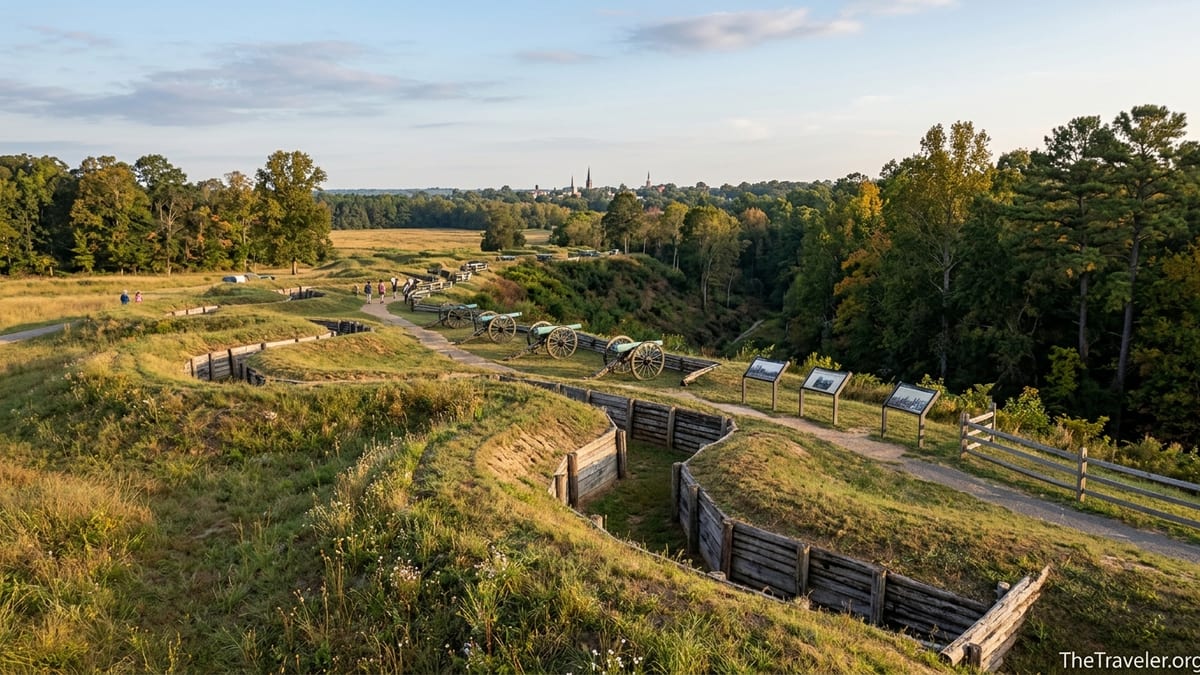
The Siege of Petersburg was not a single battle but a ten month campaign in which Union forces targeted railroads and roads feeding Richmond through this crucial logistics hub. After earlier failures to storm the Confederate capital directly, Ulysses S. Grant shifted strategy and tried to strangle it by cutting supply lines around Petersburg, then Virginia’s second largest city and a vital rail center. Trench systems extended for miles, foreshadowing the industrial, positional warfare more often associated with the First World War.
By April 1865, persistent pressure on the Confederate flanks and the collapse of defensive positions west and southwest of the city forced Lee to abandon both Petersburg and Richmond. The retreat toward Appomattox began here, and the surrender followed days later. Petersburg’s fields and ravines thus mark the final unraveling of the Confederacy. For modern visitors, these landscapes are not just backdrops for famous generals but places to explore how infrastructure, logistics and ordinary soldiers’ endurance decided the conflict’s outcome.
Because fighting spread over such a wide area, the story is now told through a network of preserved sites. The National Park Service manages Petersburg National Battlefield, which includes multiple units around the city. Just to the southwest, Pamplin Historical Park, a privately run complex that includes part of the decisive “Breakthrough” battlefield and the National Museum of the Civil War Soldier, offers a complementary and often more immersive perspective. Together they let you move from campaign overview to ground-level experience over one or two well planned days.
Understanding Petersburg National Battlefield Today
Petersburg National Battlefield covers about 2,700 acres in several distinct units that ring the modern city. According to current National Park Service information, the park is organized around four main areas: the Eastern Front, the Western Front, Five Forks Battlefield and General Grant’s Headquarters at City Point. A 16 stop signed driving tour links these units in a roughly 33 mile route, allowing visitors to trace how the siege tightened from initial assaults to the final breakthrough.
The park’s primary visitor contact point for battlefield touring is the Eastern Front Visitor Center southeast of downtown Petersburg. This is where most visitors start their visit, watch an orientation film, view introductory exhibits and pick up maps. From there, an auto route loops through key positions including the site of the Battle of the Crater and the lines attacked during Fort Stedman. Additional contact stations and exhibits exist at City Point in Hopewell, overlooking the James River, and at Five Forks Battlefield to the southwest, reflecting the campaign’s wide reach across central Virginia.
Recent National Park Service planning documents indicate that Petersburg National Battlefield does not charge a standard individual entrance fee during normal operating hours, although special use permits or after hours activities may involve separate costs. Because fee structures can change, visitors should always confirm details on the park’s official site shortly before traveling. America the Beautiful passes are typically honored at federal fee areas, but they are not required if general entry is free at the time of your visit.
Planning Your Visit: Hours, Closures and Accessibility
The Eastern Front Visitor Center usually operates daily except for major federal holidays such as Thanksgiving, December 25 and January 1. Typical core hours fall in the late morning to late afternoon range, with longer opening times in peak seasons and shorter in winter. Outlying units like Five Forks and City Point are open for battlefield touring during daylight hours, with visitor contact stations staffed on a more limited schedule. Because seasonal shifts and staffing can alter exact opening and closing times, it is wise to check current hours in the month of your visit. Information in this guide is based on official sources updated through November 2026 and should be verified closer to travel.
Like many historic landscapes, Petersburg National Battlefield balances preservation with access. Several walking trails on the Eastern Front interpret specific engagements, including the opening attacks on Petersburg, the Battle of Fort Stedman and the Battle of the Crater. Current park advisories note that a section of the Poor Creek Trail between Gracie’s Salient and Fort Haskell is closed indefinitely for safety reasons, so trail options are somewhat modified. Other paths and tour stops remain open, offering short walks from parking areas to earthworks and interpretive signs.
Accessibility has improved in recent years, though terrain can still be challenging in wooded areas. Visitor centers at the Eastern Front and City Point have accessible parking and restrooms, and exhibits are designed with wheelchair users in mind. Some wayside exhibits are located on relatively level surfaces near parking pullouts, which helps visitors with limited mobility experience the lines without long hikes. However, not all earthworks or ravines can be reached on paved or graded paths. Travelers who rely on mobility devices should consult the park’s latest accessibility information and may find it helpful to call ahead with specific questions before finalizing their itinerary.
Driving the Battlefield: Routes, Time Needs and Ranger Programs
A focused visit to the Eastern Front can be done in roughly two to three hours, including time at the visitor center, driving the core loop and stopping at several positions. Visitors deeply interested in the Crater and trench systems may want half a day or more to walk additional trails, photograph earthworks and revisit key stops. If you plan to add the Western Front and Five Forks Battlefield, a full day at Petersburg National Battlefield is realistic, especially if you also include City Point for its port and headquarters story.
The typical driving sequence for those starting at the Eastern Front Visitor Center is to follow the marked tour stops in numerical order. Early stops focus on the initial June 1864 assaults, then lead to the Crater battlefield, later assaults and Confederate counterattacks. Interpretive signs and preserved artillery line the route, and many stops feature short walking paths that lead to viewpoints over ravines and entrenchments. The Western Front and Five Forks, reached by public roads that loop southwest of Petersburg, introduce visitors to the flanking operations and final April 2, 1865 breakthrough that forced Confederate evacuation.
Ranger talks and guided programs vary by season. In busy spring and autumn months, the park often offers scheduled talks at the Eastern Front Visitor Center or at iconic locations such as the Crater. Summer may see additional programs, including living history weekends or special anniversary events, while winter schedules tend to be lighter. Because offerings change year to year, travelers should look for the latest calendar of events about one or two months before visiting and remember that any listed times are subject to change. Self guided touring remains the default and most reliable way to experience the battlefield.
Pamplin Historical Park: Private Battlefield & Immersive Museum
Southwest of central Petersburg, Pamplin Historical Park preserves a significant portion of the April 2, 1865 “Breakthrough” battlefield along with an expansive interpretive complex. Unlike the National Park Service site, Pamplin is privately operated and not part of the federal park system. It has its own admission fees, passes and hours that are entirely separate from Petersburg National Battlefield. America the Beautiful passes are not accepted here, and visitors should budget for tickets specifically for Pamplin.
Current information from the park indicates that Pamplin Historical Park charges a per person admission fee with reduced rates for seniors, military members and children. Exact prices are adjusted periodically, so prospective visitors should verify current amounts, any family packages and whether multi day or group discounts are available. Seasonal hours also vary, with longer opening schedules in spring through fall and more limited days in the late fall and winter shoulder seasons. The park notes that hours, scheduled programs and facility availability are subject to change, particularly around holidays or inclement weather.
For most travelers, the centerpiece is the National Museum of the Civil War Soldier, which uses immersive exhibits, multimedia and personal narratives to tell the story of the average enlisted man rather than only generals and campaigns. Surrounding the museum are preserved earthworks, walking trails, reconstructed features and historic homes that together form a coherent battlefield landscape. Because everything sits within one managed property, visitors can move easily between indoor galleries, outdoor trenches and period structures in a compact area.
Experiencing Pamplin: Museums, Earthworks and Living History
Pamplin Historical Park was designed to be deeply experiential. The National Museum of the Civil War Soldier places visitors in the role of an individual soldier whose story is followed by audio guide through galleries, artifacts and re created environments. Exhibits address recruitment, camp life, combat, medical care and the difficult return home. This focus on personal stories and sensory engagement can be especially effective for international visitors or family members less familiar with American Civil War chronology.
Beyond the museum, the park encompasses extensive preserved Confederate earthworks and the terrain of the Union breakthrough on April 2, 1865. Marked trails take visitors along the lines where assaults hit the fortifications, while wayside panels interpret unit positions and tactical decisions. Historic structures, including plantation era homes and outbuildings, explore the civilian side of the conflict, enslaved labor and the transformation of the landscape over time. For many battlefield enthusiasts, Pamplin’s combination of well preserved fieldworks and curated storytelling makes it one of the most illuminating Civil War sites in the region.
Living history and special programs are another Pamplin highlight. On typical operating days, staff and volunteers may offer scheduled talks or short demonstrations, though full scale reenactments and large living history weekends are usually reserved for specific dates on the park’s events calendar. Annual events can include anniversary programs around early April to mark the breakthrough or themed weekends focusing on soldier life, weapons or civilian experiences. As of verification in November 2026, these activities remain subject to change year to year, so potential attendees should confirm exact dates and formats before planning a trip around any single event.
Petersburg National Battlefield vs Pamplin Historical Park
Although they cover overlapping stories and even adjacent ground, Petersburg National Battlefield and Pamplin Historical Park feel quite different in practice. Petersburg National Battlefield is a federal park with a broad mandate to preserve and interpret multiple phases of the nine and a half month siege, from City Point’s logistical hub to the far flanks at Five Forks. Much of the experience involves driving between dispersed units, walking out to trenches and reading wayside exhibits in a relatively undeveloped landscape. The interpretive tone tends to be traditional and documentary, with ranger talks deepening the narrative on busier days.
Pamplin Historical Park, in contrast, places most of its storytelling inside a concentrated, privately managed campus. It focuses on a shorter time frame and a smaller slice of the siege, but goes into greater depth on the soldier’s perspective and the April 2 breakthrough itself. Indoor museum experiences and reconstructed environments are central, making the site more weather resilient and accessible for visitors who might tire on long battlefield walks. Because it charges admission and operates under private management, Pamplin can also invest in multimedia exhibits and frequent living history that differ from typical National Park Service offerings.
For families and mixed interest groups, these differences matter. Children and non experts may engage more immediately with Pamplin’s hands on elements and narrative audio tours, then appreciate Petersburg National Battlefield more once they have a framework for the siege. Dedicated battlefield students, on the other hand, will likely value the open terrain and authentic scale of the national park as the essential canvas, using Pamplin to delve into details of soldier life and the defining breakthrough attack.
One or Two Days in Petersburg: Suggested Itineraries
Travelers can visit both sites in one long day, but many enthusiasts prefer to allocate at least a day and a half if schedules allow. For a single day focused on highlights, a practical sequence is to begin in the morning at Petersburg National Battlefield’s Eastern Front Visitor Center, spend three to four hours on the core driving loop with emphasis on the Crater and Fort Stedman areas, then drive to Pamplin Historical Park for an afternoon and early evening visit. This order introduces the siege at campaign scale before narrowing into the breakthrough story and the soldier’s experience.
With two days, you can slow the pace and cover more ground. One popular approach is to devote most of Day One to Petersburg National Battlefield, starting again at the Eastern Front but continuing onward to the Western Front, then driving out to Five Forks Battlefield and finally up to City Point in Hopewell. This loop traces the siege tightening around the city and shows how control of rivers and railroads shaped strategy. Day Two can then center on Pamplin Historical Park for a full, unhurried day in the museum, historic homes and earthworks, with time for lunch on site or in nearby Petersburg.
If you must choose only one site, your priorities should guide you. Visitors primarily interested in the large scale military campaign, troop movements and the relationship between Petersburg and Richmond should prioritize Petersburg National Battlefield. Those especially drawn to personal stories, immersive exhibits and the climactic April 2 breakthrough may prefer Pamplin. Many Civil War travelers ultimately conclude that the two are complementary rather than interchangeable, and plan return visits to see what they missed the first time.
Where to Stay and How These Sites Fit the Wider Richmond–Petersburg Front
Petersburg sits roughly 23 to 25 miles south of Richmond, and in routine traffic the drive between downtowns takes about 30 to 40 minutes by car. That gives visitors flexibility in choosing a base. Staying in Petersburg or nearby Dinwiddie places you closer to both Pamplin Historical Park and the national battlefield’s Eastern and Western Fronts, which can be attractive if your itinerary is siege heavy. It also gives easier access to additional local Civil War sites such as Blandford Church and the historic Old Towne area, as well as to City Point and Hopewell to the northeast.
Richmond, on the other hand, offers a broader range of hotels, restaurants and museums while still keeping Petersburg within day trip range. From Richmond you can link Petersburg with the many Civil War sites around the former Confederate capital, including battlefields from the Peninsula and Overland campaigns, city hospitals and river fortifications. Travelers with several days in the region may choose to spend at least one night in Richmond for its cultural attractions and another near Petersburg for proximity to the southern battlefields.
Whichever base you choose, it is worth considering traffic on Interstate 95, which can be heavy and unpredictable between Richmond and Petersburg, especially at rush hours and during holiday weekends. Some visitors prefer to time their battlefield touring midday and early afternoon, traveling between cities in the late morning or early evening when congestion is less severe. Allow generous buffer time in your schedule and avoid planning tight back to back timed entries or guided tours on opposite sides of the metropolitan area.
Getting There, Driving Routes and Transportation Limits
For most visitors, especially those arriving from elsewhere in the United States, a private vehicle remains the most practical way to reach and tour Petersburg’s Civil War sites. Petersburg lies at the junction of Interstates 95 and 85, which connect it north to Richmond and Washington and south to North Carolina and the wider Southeast. From Richmond, drivers typically follow I 95 south toward Petersburg, then exit onto local routes such as Wythe Street or Crater Road for the Eastern Front, or use I 85 and U.S. 460 or U.S. 1 and Boydton Plank Road to approach Pamplin Historical Park and the National Museum of the Civil War Soldier.
Public transportation options to the battlefields are limited. Intercity trains and buses serve the Petersburg and Hopewell area, and local transit agencies operate regional bus lines, but routes and stops do not consistently deliver visitors directly to battlefield parking areas. Walking from distant bus stops along high speed roads is generally not recommended. Travelers without cars may find that private battlefield tour companies based in Richmond or custom rides arranged through taxis and rideshare services are the most realistic alternatives. As these services and routes can change quickly, visitors should confirm details in the weeks before travel.
Parking at both Petersburg National Battlefield units and Pamplin Historical Park is generally free and located adjacent to visitor centers and major tour stops. Lots vary in size but are designed to accommodate standard passenger vehicles and small buses. In busier seasons, especially around major anniversaries, some lots may fill temporarily at popular overlooks or museums, so arriving early in the day is advisable if you have a tight schedule. RV travelers should verify in advance where oversized parking is permitted and whether any restrictions apply near narrow tour roads.
Making the Most of Your Civil War Petersburg Visit
Ultimately this guide is intended to help you answer three practical questions. First, should you visit one or both of Petersburg’s major Civil War sites. Second, how much time should you allocate to each. Third, how should you structure your days to experience the history without feeling rushed or overwhelmed by logistics. For travelers with strong interest in the Civil War and at least a full day in the area, visiting both Petersburg National Battlefield and Pamplin Historical Park provides the most complete picture, marrying large scale campaign understanding with vivid human stories.
As a planning baseline, consider Petersburg National Battlefield a half to full day destination, depending on how many units you include, and Pamplin Historical Park a solid half to full day in its own right. Visitors pressed for time might allocate a morning to the Eastern Front and a concentrated afternoon to Pamplin. Those with more flexible schedules can spread the experience across two days, adding Five Forks, City Point and other Richmond–Petersburg sites for a richer understanding of the war’s endgame.
However you arrange your itinerary, build in time for quiet reflection. Walking the preserved earthworks at sunrise or standing along the ravines near the Crater or the Breakthrough fields at Pamplin allows the landscape itself to speak. With thoughtful planning and realistic time expectations, Petersburg’s battlefields and museums reward visitors with both a sharper grasp of Civil War strategy and a deeper appreciation of the individuals whose lives were reshaped on these grounds.