


I thought I knew what to expect from a big European hub. Then I flew through Adolfo Suárez Madrid Barajas Airport, and within a few hours it managed to surprise me in ways both pleasant and mildly stressful. From the striking architecture of Terminal 4 to the reality of changing terminals on a tight connection and working out the best way into the city, this airport turned out to be far more complex, efficient and occasionally confusing than I had imagined.
Get the latest updates straight to your inbox!
The First Shock: It Feels Like Two Different Airports
The first surprise hit me the moment I landed in Madrid: Barajas does not feel like a single airport. It feels like two. On paper there are four passenger terminals, T1 through T4, plus the satellite building T4S. In practice, you have one cluster made up of T1, T2 and T3, and a completely separate world in T4 and T4S, located several kilometers away. Official guides even describe Barajas as having two hubs, one in T4 and one spread across T1–T3.
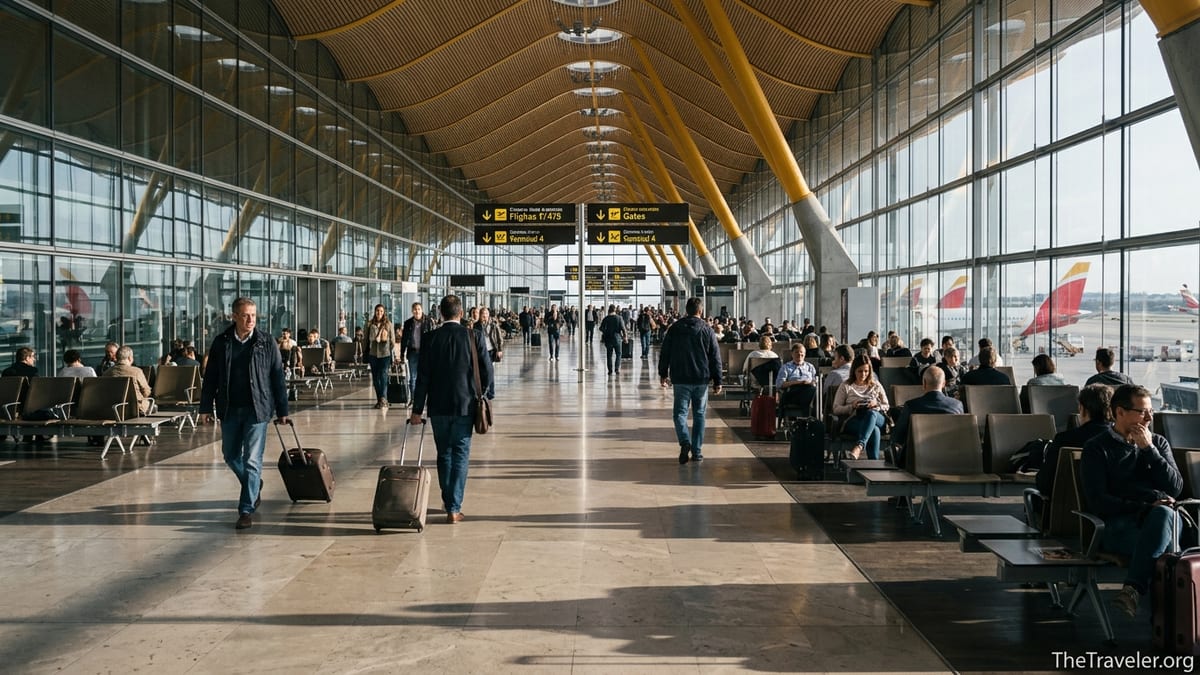
When I arrived on a low cost European carrier into T1, the building felt like many older terminals on the continent: functional, slightly retro, with low ceilings and long corridors. Later that day, my long haul departure on Iberia left from T4S, the satellite of T4, which could not have been more different. Designed by Estudio Lamela and Richard Rogers, the T4 complex is full of glass, pale wood and undulating ceilings that bathe the space in natural light. Walking into it for the first time felt less like entering an airport and more like stepping into a modern museum or a high design train station.
This split personality matters because it affects everything from how you transfer to how you plan your time. If you are flying within Europe on a carrier based in T1–T3, and then connecting to a long haul Iberia or oneworld flight in T4S, you will need to change not just gates but entire terminal clusters. That was my case, and it changed my perception of what a “short” connection means in Madrid.
Transfers: The Reality Behind Those Connection Times
Like many travelers, I trusted the booking engine when it sold me a connection of just over two hours from a Schengen arrival in T2 to a non Schengen departure in T4S. On paper it looked fine. In reality, the process was a relay race through several systems: baggage reclaim, landside transfer, new check in, security, passport control and an internal train.
After landing in T2 and collecting my bag, I had to find the free green Airport Shuttle bus that links T1, T2, T3 and T4. The ride itself is not long, around 7 to 10 minutes between the clusters in light traffic, but it still means waiting on the curb, loading luggage and dealing with a full bus of passengers who are equally anxious about their connections. One passenger I spoke to on the bus had just come off a domestic flight from Málaga and was also rushing to T4S for a flight to Latin America; both of us were quietly watching the clock.
Once at T4, there is another step many first timers do not expect: the extra journey to T4S. Long haul non Schengen flights generally leave from the satellite, which you reach via an underground automated people mover from the main T4 building. The ride takes only about 4 minutes, but there is passport control just before it. On my trip, there was a short queue for the EU e gates and a longer one for manual checks, and that 15 to 20 minute wait was what made my connection feel tight.
Speaking with other travelers at the gate, the consensus was clear: Madrid is manageable for transfers, but you should be generous with your connection times if you are changing terminal clusters or crossing the Schengen border. People who had done T2 to T4S several times suggested aiming for at least 90 minutes as an absolute minimum on a single ticket, and closer to two and a half hours if you are on separate tickets and have to check in again.
T4’s Architecture: Beauty With Practical Surprises
When my shuttle finally dropped me off at T4, the first impression washed away some of the transfer stress. The terminal is striking: a high ceiling of ribbed panels in soft yellows and reds, slim tree like pillars, and huge glass walls that pull in daylight even on an overcast afternoon. It reminded me of the first time I walked into the newer terminals in Munich and Zurich, but with a warmer Mediterranean palette.
What surprised me was how the design affected my mood and sense of orientation. After the more closed in feel of T1–T3, the open sightlines in T4 made it instantly easier to read the space. You can see security from check in, and once through, you often have a clear visual line to the commercial area and the direction of your gate. For a long haul passenger about to spend 10 or 12 hours on a plane, this sense of calm and order really mattered.
However, beauty comes with some quirks. The signage, while abundant, uses a lot of icons and color codes that may not be intuitive if you are tired. I watched more than one traveler walk toward the wrong pier because they confused the H and J gate areas. It reminded me that even the best designed terminals need truly simple wayfinding, and in Madrid you should double check the gate letter rather than only the number.
Another practical surprise was how many services had been upgraded in recent years. Power outlets were abundant in most seating areas, and many included USB C ports, a small but significant detail if you forgot your adapter. The airport has also been investing in sustainability, from solar power installations to low energy lighting, and you can see the results in the newer fixtures and daylight focused design. It does not feel experimental, just quietly efficient.
Security, Border Control and The E Gate Surprise
Security in Madrid had been described to me as “average European” in terms of wait times, but my experience varied between terminals. In T1, early on a weekday morning, I cleared security in around 15 minutes. Families with strollers and a couple of large tour groups slowed the lines, but there were enough lanes open that no one seemed particularly anxious. The set up is standard: trays, laptops out, liquids in a clear bag.
In T4, particularly for non Schengen flights, the story was different. When I arrived for an afternoon departure, the security queue looked long but moved steadily, helped by staff actively directing passengers to free lanes. It took roughly 20 minutes to pass through, which is in line with what many recent travelers report. What surprised me more was passport control before the train to T4S. For EU and some other European passport holders, automated e gates handled the majority of traffic. On my transit day, that line moved quickly, often processing small waves of passengers in under 10 minutes.
For non EU passports, however, the manual control queue was noticeably slower. A family from the United States in front of me in T4S told me they had waited nearly half an hour in the morning peak. Agents were thorough but polite, asking routine questions about length of stay and onward travel. The surprise for many was that this passport control happens before boarding the train to T4S, not at the gate, which means you have to allow time for it even if your boarding pass seems to say “gate closes in 25 minutes.”
The technology itself felt up to date. Automatic boarding gates scanned mobile boarding passes without issue, and there were separate fast track lanes for eligible passengers. The impression was of an airport that has quietly modernized many of its processes without turning the experience into a confusing maze of machines.
Dining, Lounges and A Few Unexpected Food Finds
Airports are often forgettable when it comes to food, but Madrid surprised me in two ways. The first was the range of recognizably Spanish options among the international chains. Even in the older T1–T3 complex, I noticed tapas style bars serving tortilla, croquetas and simple bocadillos rather than only generic sandwiches. Prices were in line with other large European hubs: a coffee for just under 3 euros, a basic sandwich around 6 to 7 euros, a plate of tapas reaching 10 euros or more.
The real revelation was in T4. The departures area after security feels almost like a small food hall. Alongside familiar global brands you find Iberian ham counters, bakeries with proper ensaimadas and napolitanas, and sit down restaurants offering arroz dishes and seafood. One new arrival is a branch of a well known Madrid based Japanese fusion group in T4, where travelers can sit at the counter for a quick plate of sushi or an elaborate tasting menu if they have time between long haul flights. On my transit, I settled for a mid range tapas bar near the H gates and paid around 15 euros for a glass of Rioja, a ración of croquetas and a small salad, a fair price for airport dining considering the setting.
Lounges are another area where Barajas punches above its weight. Iberia operates several lounges in T4 and T4S, and the two I visited offered generous buffets with Spanish staples like tortilla and jamón alongside international dishes, self pour wine and cava, showers and plenty of quiet workspace. Even in busy afternoon banks of departures, seating remained available. In the older T1–T3 complex, the generic contract lounges are more modest, with simpler buffets and fewer amenities, but they still provided a welcome place to recharge devices and find calm away from the main concourse.
If you are not eligible for lounge access, it is still worth wandering a bit to find quieter seating zones. In T4S, walking to the far end of a pier near the higher numbered gates often revealed clusters of empty seats and large windows with long views of the runways, perfect for plane spotting and resetting after a hectic transfer.
Getting Into Madrid: Better Than I Expected
Leaving the airport for the city center can be the most stressful part of any arrival, especially when you are jet lagged and trying to make sense of an unfamiliar transport map. Here Madrid delivered one of the most pleasant surprises of my trip. Despite the airport’s size and complexity, the options into the city are straightforward and relatively affordable.
From T4, the Cercanías commuter trains on lines C1 and C10 connect the airport directly with major rail hubs like Chamartín and Atocha. The trip to Atocha takes around 25 to 30 minutes, and a one way ticket is typically in the range of 2.60 to just under 3 euros, depending on the exact fare structure in effect. The platforms are in the lower levels of T4, accessed by escalators and elevators, and departures are frequent enough that I never saw more than a 15 minute gap on the board.
The metro is the other rail option. Line 8 runs from the airport stations at T1–T3 and T4 down to interchange points like Nuevos Ministerios, where you can connect to other metro lines that fan out across central Madrid. Because of the airport supplement, a single ticket for this route usually costs between about 4.50 and 5 euros. Travel times are in the 30 to 40 minute range to many central stops. What surprised me is how clear the signage is for the metro in each terminal; large purple “Metro” symbols guide you down to the platforms, and ticket machines can be operated in multiple languages.
Then there are the road options. Official white taxis with a diagonal red stripe offer a flat fare from the airport to anywhere within central Madrid’s inner ring road. Recent travelers consistently report that this fare is set at 33 euros, luggage included, and the ride to areas like Gran Vía or Puerta del Sol usually takes 20 to 30 minutes outside rush hour. For late night arrivals, tired families or visitors nervous about navigating public transport on the first try, this predictable taxi fare is one of the airport’s biggest conveniences.
For budget conscious travelers, the bright yellow Exprés Aeropuerto bus runs between the terminals and central locations such as Cibeles and Atocha. The journey typically costs just a few euros and takes 30 to 40 minutes depending on traffic. On one of my days in Madrid, I rode this bus back to the airport from the city, and the combination of luggage racks, clear stop announcements and early morning views of the skyline turning pink made it far more pleasant than I had expected from an airport bus.
Little Details That Make a Big Difference
Beyond architecture, transfers and transport, Barajas surprised me in a series of small ways that do not show up on airline booking engines. One was how close the airport sits to the city. At roughly 12 kilometers from the center, you can look out of the plane window on approach and already pick out recognizable neighborhoods, stadiums and even the Cuatro Torres business area. This proximity translates into shorter ground journeys than many travelers are used to from other European capitals.
Another detail was how the airport has started planning for its next chapter. Spanish airport operator Aena has approved a major investment program for 2027 to 2031 that includes expanding T4 and T4S and creating a new unifying building for T1, T2 and T3. The goal is to boost capacity while improving how the older terminals connect. As a passenger today, you will not yet see construction everywhere, but you can already sense the ambition: Barajas is positioning itself as an even larger gateway between Europe and Latin America, and between Europe and parts of Africa and the Middle East.
On a practical level, I appreciated how many signs and announcements were bilingual in Spanish and English, and sometimes trilingual when airline staff added their own messages. Staff at information desks were generally willing to switch languages, and I overheard helpful explanations in French, Italian and Portuguese while waiting in line. For nervous first timers, that level of linguistic flexibility removes a layer of anxiety.
Finally, there was the simple matter of cleanliness and maintenance. Restrooms in both the older and newer terminals were in better condition than I often see in similarly busy hubs, and cleaning staff were visibly present. Seating areas in T4 in particular felt well cared for, with trash collected promptly and very little clutter. None of this is glamorous, but when you are halfway through a long day of travel, it is exactly what you notice.
The Takeaway
Flying through Madrid Barajas left me with a more nuanced view of what a major European hub can be. It is at once sprawling and surprisingly accessible, architecturally ambitious in T4 and stubbornly old school in T1–T3, efficient in many of its processes yet still capable of stressing you out if you underestimate transfer times between terminal clusters.
If you are planning a trip that takes you through Madrid, the main lessons from my journey are simple. Treat T1–T3 and T4–T4S as almost separate airports when planning connections. Build in time for the shuttle bus, security and passport control if you are switching between them or crossing the Schengen border. Take advantage of T4’s natural light, food options and lounges if you can, and do not be afraid to choose the Cercanías or metro over a taxi if you want to save money and still reach the city center quickly.
Most of all, expect an airport that reflects Madrid itself: energetic, a little chaotic around the edges, but also warm, practical and evolving. What surprised me most was not a single dramatic moment, but how these pieces added up to an experience that, with a little preparation, I would happily repeat.
FAQ
Q1. How much time do I really need to transfer between terminals at Madrid Barajas?
For a same terminal Schengen to Schengen connection, 60 to 75 minutes is generally comfortable. If you must change between the T1–T3 cluster and T4 or T4S, especially when crossing the Schengen border or collecting and rechecking bags, aim for at least 90 minutes on a single ticket and closer to two hours or more on separate tickets.
Q2. What is the easiest way to get from Madrid Barajas Airport to the city center?
The most straightforward option for many travelers is the flat fare taxi, currently around 33 euros to central Madrid, taking roughly 20 to 30 minutes in light traffic. For a cheaper ride, the Cercanías commuter train from T4 or Metro Line 8 from T1–T3 and T4 get you into the city in about 25 to 40 minutes for just a few euros.
Q3. Are T1, T2 and T3 connected inside the building, or do I need a bus?
T1, T2 and T3 sit in the same general complex and are connected airside and landside by corridors, so you can usually walk between them without taking a bus. The free Airport Shuttle bus becomes necessary when you need to move between this T1–T3 cluster and the separate T4 terminal.
Q4. How long does it take to get from T4 to T4S?
T4S is linked to T4 by an underground automated people mover. The actual ride takes about 4 minutes, but you should factor in extra time for walking, waiting for the next train and clearing passport control for non Schengen flights. In practice, plan on 15 to 25 minutes from main security in T4 to your gate area in T4S.
Q5. Is Madrid Barajas a good airport for overnight layovers?
Madrid is reasonably well suited for overnight layovers. Several airport hotels sit a short shuttle ride from the terminals, and public transport or taxis make it easy to spend the evening in central neighborhoods like Huertas, Malasaña or La Latina before returning. Inside the airport, seating is adequate but not designed for sleeping, so most travelers prefer a hotel for anything more than a very late or very early connection.
Q6. Are there good food options if I have a long wait at the airport?
Yes. T4 and T4S in particular offer a wide range of restaurants and cafes, from tapas bars and Iberian ham counters to international chains and a few higher end spots. Prices are typical for a major European hub, but the availability of recognizably Spanish dishes makes it easier to enjoy a decent meal during a layover.
Q7. How reliable are the security and passport control waiting times?
Waiting times vary by time of day and terminal, but most travelers report security taking between 10 and 30 minutes. Passport control for non EU passengers before the T4S train can add another 10 to 30 minutes during peaks. To reduce stress, arrive at the airport at least two hours before European flights and three hours before long haul departures, especially if you need to check bags.
Q8. Which terminal do Iberia and low cost airlines usually use?
Iberia and most of its oneworld partners typically operate from T4 and T4S, particularly for long haul and many European routes. Many low cost or non aligned carriers, along with some Star Alliance and SkyTeam members, use the older T1–T3 complex. Always check your booking or boarding pass, as the terminal you use will shape your transfer and transport options.
Q9. Is public transport from Madrid Barajas safe for solo travelers at night?
Public transport in Madrid, including the airport metro and commuter trains, is generally considered safe, though you should take normal precautions against pickpocketing. Late at night, services run less frequently and some lines reduce operations, so many solo travelers opt for the fixed fare taxi after midnight for simplicity and peace of mind.
Q10. Are there facilities for families, such as play areas and baby rooms?
Yes. The airport offers family oriented facilities including baby changing rooms, designated family lanes at security during busy periods, and some small play areas in selected terminals, especially in T4. While not every gate area has dedicated children’s spaces, most families find it manageable to locate quieter corners where kids can move around before boarding.