


Adolfo Suárez Madrid Barajas Airport is one of Europe’s busiest hubs, and its sprawling layout can surprise first-time visitors. With four main terminals, a satellite building and multiple transport links, working out where you actually need to go for your flight is not always obvious. This guide breaks down how the terminals work, which airlines use each one, and how to move between them so you can get to the right place without last minute panic.
Get the latest updates straight to your inbox!
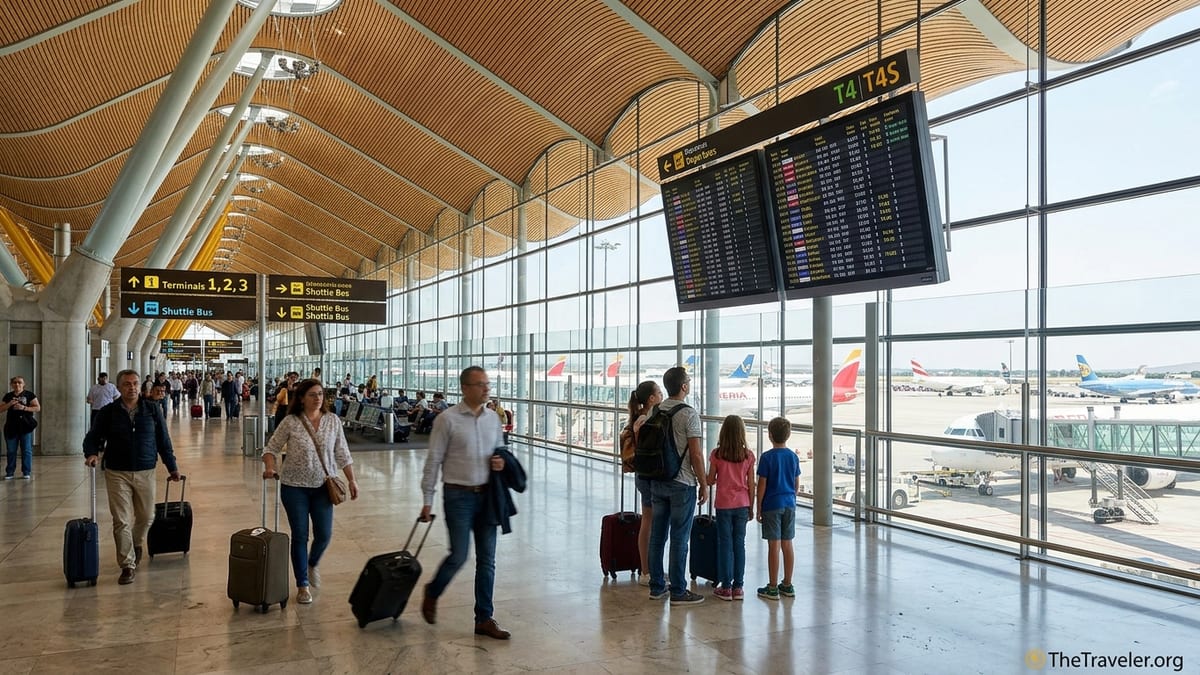
Understanding Madrid Barajas: The Big Picture
The airport officially has four passenger terminals named T1, T2, T3 and T4, plus a satellite building known as T4S. In practice, T1, T2 and T3 form one large connected complex on the southern side of the airfield, while T4 and its satellite T4S are separate buildings on the northern side. For travelers, this means that changing between T1, T2 and T3 is mostly a matter of walking, but moving from any of those to T4 requires using a shuttle bus or other transport.
Each terminal has a slightly different profile. T1 handles a mix of international and some non-Schengen flights, T2 is heavily focused on European and Schengen services, and T3 is a smaller area mainly used for regional and some charter operations. T4 is the flagship, much newer terminal designed around Iberia and its Oneworld partners, with T4S serving as the main international and long haul pier connected to T4 by an underground people mover.
For most passengers the crucial point is that your airline and route usually determine your terminal automatically. You do not choose your terminal in Madrid in the same way you might choose a station in a city. Instead, your boarding pass and the screens in the terminal list your airline, destination, and the check in area or zone. Knowing in advance whether you are flying from the T1–T3 complex or from T4/T4S will save you time when you arrive at the airport by taxi, metro or bus.
Signage throughout the airport consistently uses a color and letter code system alongside the terminal number. Departures boards will show a combination like “T4S, Gate S25” or “T2, Gate D62.” Once you understand that S indicates the T4 satellite and letters A through F correspond to gate zones within the T1–T3 complex, the airport layout becomes easier to read at a glance.
Which Airlines Use Which Terminal
Airlines at Madrid Barajas are grouped by alliances and route types, and that is the most reliable way to work out where you need to go. Iberia and most Oneworld carriers, including British Airways, American Airlines, Qatar Airways and LATAM, generally operate out of T4. Long haul flights and many non-Schengen services with these airlines depart from T4S, while much of their European and domestic traffic uses the main T4 building.
SkyTeam and Star Alliance airlines are concentrated in the older terminals. Airlines such as Air Europa and Air France, along with Lufthansa and several other European carriers, typically operate from T1 or T2 for many of their routes. Low cost airlines are also split: for example, easyJet services commonly use T1, while other budget carriers may use T1 or T2 depending on their specific agreements and route structures. The precise allocations can change over time, so the best confirmation is always your booking or airline app shortly before you travel.
If you are connecting between two flights on Iberia or between Iberia and another Oneworld airline, there is a strong chance that both flights will use T4/T4S, which simplifies your connection. On the other hand, if you are flying into Madrid from North America with a carrier like American Airlines into T4S and connecting onward on a low cost airline booked separately that operates from T1, you will need to plan extra time to transfer between the T4 side of the airport and the older terminals.
In some cases, airlines may operate from more than one terminal or have special arrangements for certain routes. Seasonal charter flights, wet lease operations or changes in airline partnerships can mean that a carrier temporarily appears in a different terminal. This is why, when you receive your mobile boarding pass, you should check not only the departure time but also the clearly printed terminal number and any mention of “satellite” or “T4S” for long haul services.
Domestic, Schengen and Non Schengen: How It Affects Your Terminal
Whether your flight is domestic within Spain, within the Schengen Area, or to a non Schengen country affects where in the airport you will actually depart, even if the airline stays the same. Many domestic flights on Iberia, such as a Madrid to Barcelona or Madrid to Bilbao route, usually use the main T4 building and Schengen gates. By contrast, an Iberia service from Madrid to New York will typically depart from T4S, which is the satellite terminal reached by underground people mover after you clear security and passport control in T4.
For carriers based in T1 and T2, Schengen flights such as an Air France service to Paris or a Lufthansa service to Frankfurt will tend to use Schengen gate areas logged as zones B, C or D in the T1–T2–T3 complex. A non Schengen departure to a destination like London, Casablanca or Istanbul might use another zone designed for additional checks. When you pass through security, follow not only the terminal number but also the gate zone letter on your boarding pass and on the screens, as walking between distant zones can add ten to fifteen minutes to your journey.
Arriving passengers from non Schengen countries such as the United States, Mexico or many parts of Latin America will pass through passport control before accessing the main concourses. If you are connecting from one non Schengen destination to another on the same airline group, you might still be routed through the satellite T4S area, but detailed directions for transfer passengers are displayed when you leave your aircraft. It is safe to assume that any itinerary involving border control and a change of building, for example from T4S to T1, will require more time than a straightforward Schengen to Schengen connection within the same terminal.
When planning your schedule, remember that security and border formalities vary by time of day. A 07:00 domestic departure to a popular Spanish business destination may see long lines in T4 even though the flight never leaves the Schengen Area. Similarly, late evening non Schengen departures clustered around a bank of long haul flights can make the passport control area at T4 busy. Allowing an extra fifteen to thirty minutes beyond what an airline lists as the minimum connection time is wise if you are unfamiliar with the airport.
Getting Between Terminals: Shuttle, Metro and Walking
Madrid Barajas provides a free shuttle bus that links all the main terminals 24 hours a day. The shuttle connects T1, T2, T3, T4 and, for eligible passengers in transit, T4S. Buses are typically scheduled to run every few minutes during busy periods, and the journey between the T1–T3 complex and T4 often takes around ten minutes in light traffic. The shuttle buses are painted green and clearly marked, and stops are located just outside the arrivals and departure levels, with overhead signs in Spanish and English indicating the route and next terminal.
Practical experience from frequent travelers shows that a transfer from T1 to T4, including waiting for the bus, can easily consume 25 to 40 minutes door to door once you factor in walking to the stop, loading luggage and moving through security again at the new terminal. If you are connecting on separate tickets, for example landing on a low cost carrier in T1 and then catching an Iberia long haul from T4, planning at least two and a half to three hours between flights is sensible to account for this transfer plus any delays at baggage reclaim and passport control.
Within the T1–T3 complex, most movements can be done on foot. The departure halls of T1, T2 and T3 are connected inside the security area, and gate zones A through F are signposted overhead with color coding to show approximate walking times. It is common for a traveler to check in at T2 for a European flight, pass through security, and then walk ten to fifteen minutes to a gate in another zone. The corridors are broad and fully indoors, but if you are traveling with small children or have reduced mobility, consider requesting assistance from your airline to minimize long walks.
For getting to and from the city, Metro Line 8 stops at two stations serving the airport. The Aeropuerto T1 T2 T3 station, adjacent to T2, handles the southern complex, while a separate Aeropuerto T4 station directly underneath T4 serves that terminal. Trains from central Madrid at Nuevos Ministerios usually reach the airport in roughly 15 to 20 minutes, with one stop for T1–T3 and the next for T4. If you arrive by metro at the wrong station, you can either ride back one stop or use the shuttle bus above ground, but in most cases it is quicker and easier to head directly to the right stop from the city.
Inside T4 and T4S: What “Satellite” Really Means
Terminal 4 is the airport’s most modern building, known for its high wooden ceilings and abundant natural light. It houses large check in zones for Iberia and its Oneworld partners, extensive security lanes and a mix of Schengen and non Schengen departure gates. Departure sequences typically start with check in and bag drop in T4, then security screening, followed by a split: Schengen passengers stay in T4, while most non Schengen and long haul passengers pass through passport control and board an automated underground train to the satellite terminal T4S.
The T4 to T4S people mover is fully within the secure area and runs frequently, with the ride itself taking just a few minutes. However, walking from your gate in T4, passing passport control and descending to the train platform can add another 10 to 15 minutes depending on queues. On arrival at T4S, you may still face a walk to the farthest gates, as the satellite is laid out in long concourses serving high capacity aircraft. If you have a tight connection within T4S, do not linger in shops near the train exit; instead, follow the overhead screens straight to your assigned gate and only relax once you are close by.
On arrival into T4S from a non Schengen country, signs route eligible connecting passengers either back onto the train toward T4 or through passport control into Spain. Airline staff are present at key junctions during busy connection waves, especially for large intercontinental flights arriving from North and South America. If you are connecting from an Iberia long haul flight in T4S to another Iberia or Oneworld service in T4 or T4S, your boarding pass usually includes detailed transfer instructions with estimated walking and train times between your arrival and departure gates.
For many travelers, the main confusion is assuming that T4 and T4S are side by side in the same building. In reality, you cannot walk between them; the underground train is mandatory, and that short ride means you must build an extra margin into your timetable. A common example is a Madrid to Buenos Aires flight departing from T4S with boarding starting 45 minutes before departure. If you arrive at the T4 security checkpoint exactly 45 minutes before the flight, you are already cutting it very close because you still need to clear security, passport control and take the train out to the satellite.
Realistic Connection Times and Common Itineraries
Connection times at Madrid Barajas vary considerably depending on whether you stay within a single terminal group or cross the airport. A typical Iberia to Iberia connection entirely within T4, for example Madrid to Seville followed by Madrid to Paris, may be feasible in 60 to 75 minutes under normal conditions. You clear security only once, remain airside and simply walk between gates. Airlines often sell such connections with even shorter official minimum times, but giving yourself at least an hour is more comfortable, especially if your inbound flight is slightly delayed.
By contrast, a connection involving a change from T4S to T1 or T2, particularly on separate tickets, requires far more time. Imagine arriving from Miami into T4S at 09:30 and holding a separate low cost ticket from T1 at 12:25. You would need to disembark, clear passport control, possibly collect checked baggage, take the automated train to T4, find the shuttle bus, ride to T1, check in again, pass through security and reach your gate. Travelers who have undertaken this journey report that it can take well over 90 minutes, and that is without unexpected queues or delays. In such a case, a three hour margin is a safer target than the bare two hours shown on some ticketing websites.
Even movements entirely within the T1–T3 complex require realistic allowances. A Schengen arrival into T2 followed by a non Schengen departure from a distant zone in T1 can still involve clearing passport control, walking through long corridors and, at busy times, waiting in security lines. If you are transferring with checked luggage on a single ticket, the airline will usually route your bag automatically, but you are still responsible for getting yourself to the correct gate on time. Leaving at least 90 minutes between such flights is prudent unless you are an experienced traveler very familiar with Madrid Barajas.
Travelers with reduced mobility, families with small children, or anyone carrying bulky sports equipment should allow extra time on top of standard connection margins. The airport has elevators, moving walkways and assistance services, but distances between gates and bus stops can still feel long. If you know in advance that you will need help, contact your airline or the airport to request assistance at least 48 hours before travel, so that staff can meet you at the aircraft door and guide you directly through the most efficient route between terminals.
How to Confirm Your Terminal Before You Travel
The most reliable way to confirm your terminal at Madrid Barajas is to check your airline’s own communication within 24 hours of departure. Mobile boarding passes issued by major carriers specify the terminal clearly beside the departure time and gate information. For example, an Iberia mobile pass might display “MAD T4S” for a long haul service, while a low cost carrier might show “MAD T1” in the same line. Airline apps often send updates if a flight is reassigned to a different terminal or gate on the day of travel.
Online travel agencies and booking confirmation emails usually list the terminal as well, but these details can become outdated if the airport or airline shifts operations between buildings. If you booked many months in advance, verify the terminal again a few days before travel directly with the airline rather than relying solely on the original confirmation. When in doubt, you can also use the departure search on the airport’s official website or information screens in the city check in facilities, where available, to cross check where your flight is departing.
For arrivals, terminal allocation is equally important when planning your onward journey. Taxi drivers at Madrid Barajas will ask which terminal you are heading to when you depart from the city, and local buses and coaches sometimes pick up at specific terminals only. For example, some intercity buses or shared shuttle services depart exclusively from T4; if your inbound flight lands at T1, you must budget time for the internal shuttle or metro to reach that pick up point.
In the hours before your flight, airport information screens in metro stations, rail hubs and major bus interchanges around Madrid often display terminal information for the next departures. If your flight is not yet listed, assume your booking details are correct but remain alert to notifications from your airline. Terminals rarely change at the last minute, but gate reassignments inside the same building are more common, especially during busy travel periods or when weather and air traffic control restrictions affect schedules.
The Takeaway
Madrid Barajas is a large, busy hub, but it becomes manageable once you understand its basic structure. T1, T2 and T3 form one connected southern complex, while T4 and its satellite T4S serve Iberia and its partners on the northern side. Most of the time your airline and route automatically determine your terminal, and your boarding pass is the key document that tells you exactly where to go.
Getting between terminals is straightforward but not instant. The free shuttle bus, the metro and the underground people mover between T4 and T4S all work well, provided you allow sufficient time. Tight connections that involve changing buildings, clearing passport control or collecting and rechecking luggage should be approached cautiously with generous buffers, especially if you are on separate tickets or traveling at peak times.
By checking your terminal before you travel, understanding whether you are using the T1–T3 complex or T4/T4S, and knowing how long it realistically takes to move around the airport, you can reduce stress and spend more time enjoying Madrid or relaxing before your flight. A few minutes of planning pays off in smoother transfers, fewer rushed sprints through long corridors, and a better overall experience at one of Europe’s key aviation gateways.
FAQ
Q1. How do I know which terminal my flight leaves from at Madrid Barajas?
Your airline’s mobile boarding pass and app are the most reliable sources, since they are updated if operations move between terminals. You can also confirm on the airport’s departure boards and information screens on the day of travel.
Q2. Can I walk between Terminals 1, 2 and 3?
Yes. T1, T2 and T3 are connected inside the main building via long corridors and shared security areas. Walking between them is common, though it can take ten to fifteen minutes depending on your starting point and gate zone.
Q3. How do I transfer between the T1–T3 complex and Terminal 4?
Use the free green shuttle bus that runs 24 hours a day between all terminals. Stops are signposted outside arrivals and departures. Allow at least 25 to 40 minutes for the full process of walking to the stop, waiting, riding and then clearing security again in the new terminal.
Q4. What is T4S and how do I get there?
T4S is the satellite terminal mainly used for long haul and non Schengen flights of Iberia and its Oneworld partners. After security and passport control in T4 you take an underground automated train to T4S. The ride is short, but you should still budget extra time for walking and queues.
Q5. Is a 1 hour connection at Madrid enough?
A 1 hour connection can be workable for a same airline, Schengen to Schengen connection within a single terminal, especially in T4. However, any connection involving T4S, a change of terminal group, passport control or baggage collection should ideally have at least 90 minutes to 3 hours, depending on complexity.
Q6. Which terminal does Iberia use at Madrid?
Iberia is based at Terminal 4. Many domestic and European flights depart from the main T4 building, while most long haul and non Schengen services operate from T4S, the satellite terminal reached by underground train from T4.
Q7. Do low cost airlines all use the same terminal in Madrid?
No. Some low cost carriers typically operate from T1 or T2, while others may have different arrangements. Because allocations can change over time, always check the terminal shown on your booking confirmation and boarding pass rather than assuming all budget airlines use a single building.
Q8. How does the metro serve the different terminals?
Metro Line 8 from central Madrid has two airport stations. Aeropuerto T1 T2 T3, located near Terminal 2, serves the southern complex. Aeropuerto T4, underneath Terminal 4, serves the northern side. If you get off at the wrong station, you can ride the metro one stop or use the free airport shuttle bus to reach your correct terminal.
Q9. What should I do if my connecting flights are on separate tickets?
Leave a generous time buffer, often three hours or more if you must change terminals, collect luggage and check in again. Treat the connection as if you were ending one trip and starting another, since airlines generally will not protect you on a separate ticket if your first flight is delayed.
Q10. Is assistance available if I have reduced mobility or heavy luggage?
Yes. The airport and airlines provide assistance services, including wheelchairs and guided transfers between gates and terminals. Request this through your airline at least 48 hours before travel so staff can meet you at your arrival point and help you navigate the airport efficiently.