


Adolfo Suárez Madrid Barajas is one of Europe’s busiest hubs, and at peak times its terminals can feel overwhelming. The airport’s network of VIP lounges offers a welcome escape, whether you are connecting on a long‑haul flight, traveling for work or simply want somewhere quieter than the public gate areas. This guide walks you through the best lounges across all terminals, how to access them, what they cost when paying at the door and what to realistically expect once you step inside.
Get the latest updates straight to your inbox!
How Madrid Barajas Lounges Work
Madrid Barajas groups almost all common-use lounges under the Aena VIP brand, which means that whether you are flying on a low-cost carrier or in economy with no airline status, you can still buy access if there is space. As of mid‑2026, the airport lists seven Aena VIP lounges spread across Terminals 1, 2, 3, 4 and the T4S satellite: Cibeles, Puerta de Alcalá, Puerta del Sol, Plaza Mayor, Neptuno, Retiro and Gran Vía. On top of these, Iberia operates two premium lounges in Terminal 4 for its own customers and those of oneworld partners.
The Aena lounges share a fairly consistent formula: buffet-style cold and hot snacks, self-service drinks including wine and beer, strong Wi‑Fi, business desks or quiet corners, and showers in some locations. Access is available through airline business-class tickets, elite status, various credit cards, lounge networks such as Priority Pass or DragonPass, and straightforward pay-per-use at the door if capacity allows. A standard walk‑up ticket bought through Aena’s own system typically costs around 48 euros for an adult at most lounges, rising to just over 51 euros at some of the larger or more premium locations, with cheaper child rates also listed.
There are a few constraints to keep in mind. Stays are usually capped at around three hours before departure, and staff will often check your boarding pass to make sure you are departing from the correct terminal or zone, especially when Schengen and non‑Schengen areas are separated by passport control. At very busy times, such as weekday mornings for business flights or Sunday evenings for leisure returns, capacity limits mean walk‑up access and even some lounge program entries can be temporarily restricted.
Choosing the “best” lounge in Madrid depends on your airline, terminal and schedule. Someone on an early-morning Schengen hop to Paris from Terminal 4 will have a different ideal lounge than a late‑night non‑Schengen departure to Latin America from T4S. The sections below break down the standout options in each part of the airport and highlight what they are like in practice.
Best Lounges in Terminal 4 and T4S
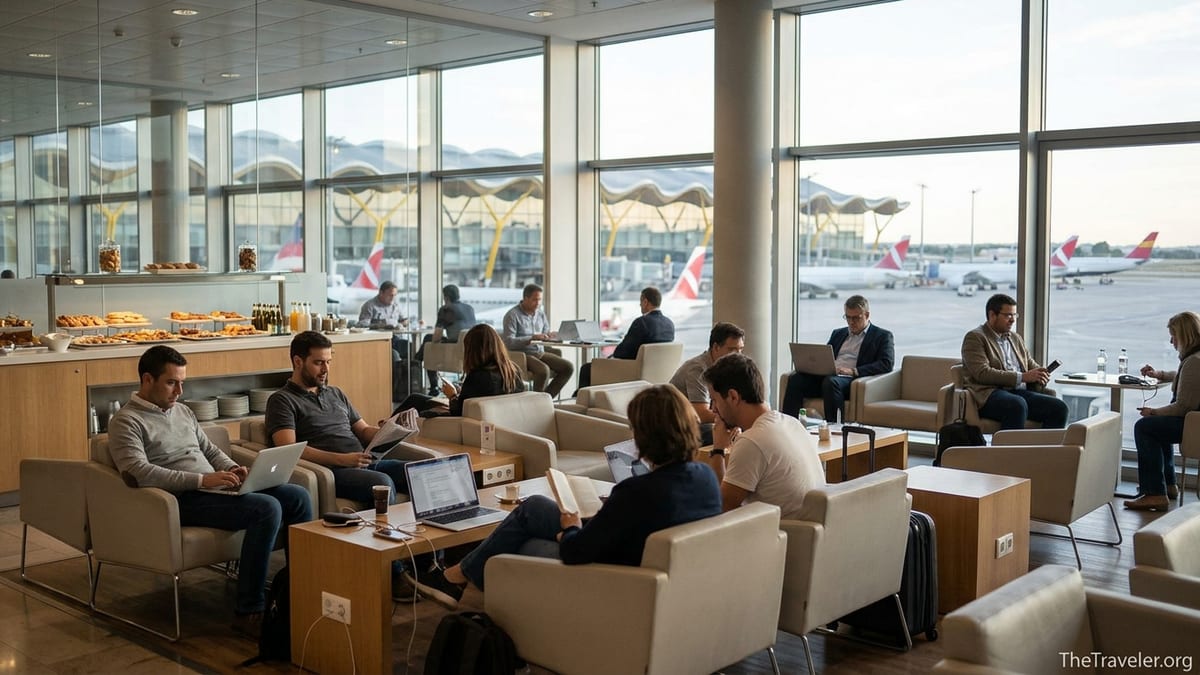
Terminal 4 is the main home of Iberia and most oneworld carriers at Madrid, and it offers some of the strongest lounge experiences in the airport. In the main T4 building, the Aena Plaza Mayor VIP lounge serves Schengen departures. Located airside on Level 1, close to the central commercial area, Plaza Mayor is popular with both airline-invited guests and lounge program members. Travelers report a broad cold buffet with items like Spanish cheeses, charcuterie, salads and pastries, along with a rotating selection of hot dishes at mealtimes. Coffee machines, soft drinks and a self‑service bar with wine and spirits are standard, and large windows provide natural light and decent runway views.
For non‑Schengen and many long‑haul flights departing from the T4S satellite, the Neptuno and Gran Vía VIP lounges are the key Aena options. Both are located airside in the satellite building and are designed for longer waits, with a mix of armchairs, dining tables and workstations. Prices booked through Aena’s official channels are usually a little higher than in older terminals, around the low‑50‑euro range for adults. That higher price is reflected in a slightly wider food selection, including hot dishes at lunch and dinner, plus showers that are a real advantage if you are connecting after an overnight flight.
Alongside the Aena spaces, Iberia’s own Dalí lounge in T4 and Velázquez lounge in T4S are reserved for Iberia and oneworld premium passengers and elites. Iberia recently invested in refurbishments and continues to position these as flagship spaces, with more substantial hot meals, tended bars at busy times and dedicated quiet areas. You generally cannot buy your way into these lounges unless you hold the qualifying ticket or status, so they are not an option for the average economy passenger, but they are worth knowing about if you are considering using points or upgrades on Iberia long‑haul flights.
If you are flying from T4 to a non‑Schengen destination, check carefully whether your flight departs from the main T4 building or from the T4S satellite. The underground train transfer between them is fast but still adds time, and you do not want to be relaxing in Plaza Mayor in T4 only to realize you still have to clear passport control and ride out to T4S to board. In practice, most long‑haul flights to the Americas and many to the Middle East use T4S, meaning Neptuno or Gran Vía will be the more convenient choice.
Top Picks in Terminals 1, 2 and 3
While Terminal 4 gets most of the design headlines, many travelers will still depart from Terminals 1, 2 or 3, particularly on non‑Iberia airlines and low‑cost carriers. The Cibeles VIP lounge in Terminal 1 is the main option for non‑Schengen flights from that part of the airport. Located airside on the upper level of the departures area, Cibeles is one of Aena’s larger lounges and caters to a broad mix of passengers, from full‑service carriers heading to the Americas and Africa to budget airlines serving the UK and beyond. Expect a busy but functional space with a buffet of snacks, sandwiches, soups and a few hot dishes at peak times, plus self‑service drinks and reasonably fast Wi‑Fi.
Terminals 2 and 3, which broadly handle Schengen flights and some domestic services, are anchored by the Puerta de Alcalá and Puerta del Sol VIP lounges. Puerta de Alcalá, on the upper floor of T2’s Schengen departures area, is branded as a SkyTeam lounge in some marketing materials because it hosts passengers from airlines like Air France and KLM, but it remains an Aena‑operated space and welcomes eligible passengers from multiple access channels. Travelers often highlight its quieter corners and a good balance between business facilities and more relaxed seating. Puerta del Sol, serving T3’s Schengen area, offers a similar mix of food and drinks but tends to be a little more compact, which can matter at busy holiday times when gates are crowded.
From a purely comfort‑per‑euro perspective, many frequent flyers rank Puerta de Alcalá as one of the best deals in the older terminals. The walk‑up price via Aena is usually just under 50 euros for adults, and if you access it with a lounge program membership tied to a credit card, you effectively get a mid‑range international lounge with full meals for the cost of your annual card fee. Compared with paying 15 to 20 euros for a sit‑down meal and drink at a busy terminal restaurant, a couple traveling together may find good value in spending a similar total through lounge access, especially if they have a two‑ or three‑hour wait.
If your itinerary involves a tight connection between Schengen and non‑Schengen flights in these terminals, keep the passport control lines in mind. For example, arriving on a domestic flight into T2 and departing on a long‑haul non‑Schengen flight from T1 may limit the time you can practically spend in Puerta de Alcalá before you need to head over to Cibeles and clear exit controls. In such cases, some travelers prefer to choose whichever lounge is closest to their next gate rather than chasing the “best” space on paper.
Access Options, Prices and Real‑World Value
For travelers without airline status or a premium ticket, the most straightforward way into Madrid’s VIP lounges is to pay at the door or pre‑book through official channels. Aena’s own listings show adult entry prices around 48 euros for most lounges, with slightly higher adult rates, above 51 euros, at some T1 and T4/T4S locations and reduced child rates typically in the 20 to 25 euro band. These prices usually include up to three hours’ stay, unlimited food and drink, Wi‑Fi, and access to showers where available. Families with older children sometimes find that paying the child rate for teenagers gives them a quiet space to rest before or after a long‑haul flight at a cost comparable to a full meal out in Madrid’s city center.
Many international travelers instead rely on lounge memberships bundled with premium credit cards. Programs such as Priority Pass and DragonPass partner with several Aena lounges at Madrid, including Cibeles, Puerta de Alcalá, Plaza Mayor and others, although the exact list can change as contracts are updated. While card issuers often market these memberships as offering “unlimited” access, the reality at busy airports like Madrid is more nuanced. During peak times, staff may temporarily turn away some membership guests when the lounge is close to capacity, or they may prioritize airline‑invited business‑class passengers over walk‑up program entries.
In practice, this means you should not assume that holding a lounge card automatically guarantees you a seat during rush hour. Travelers have reported afternoon and evening periods at Barajas when lines formed outside certain lounges and those with generic lounge cards were asked to wait, even though published opening hours and basic access rules suggested they should be allowed in. If you are counting on lounge access to shower or feed small children after a long flight, it is wise to plan a backup option, such as a nearby restaurant or a quieter seating area in the public terminal.
Corporate travelers and those looking for a more curated experience can also consider Aena’s premium services. At Madrid, these packages bundle fast‑track security with personal assistance and, in some cases, private transport between aircraft and terminal plus access to dedicated premium lounges. Prices vary depending on the level of service, but a typical arrival or departure meet‑and‑assist package can cost well into the hundreds of euros for a small group. For most travelers, this is more of an occasional splurge than a regular solution, but it can be justified for important business trips, elderly relatives traveling alone or complex itineraries with short connections.
Amenities, Food and What to Expect Inside
Once inside, Madrid’s Aena lounges share a common baseline of facilities. Seating ranges from armchairs and sofas to bar‑style seating and basic workstations with power outlets. Many lounges, particularly in T4 and T4S, have floor‑to‑ceiling windows that let in natural light and offer views of aircraft taxiing, which can make a long wait feel less claustrophobic. Wi‑Fi is generally strong and more reliable than the public airport network, making it easier to download streaming content or join video calls before boarding.
Food options tend to follow the time of day. In the morning, you can usually expect pastries, bread, cereals, yogurts, fruit and simple hot items such as eggs or Spanish omelette, depending on the lounge. Around lunchtime and into the evening, buffets expand to include salads, cold cuts, cheeses, sandwiches and at least one or two hot dishes like pasta, rice or stews. Vegetarian choices are normally available, though vegan and allergy‑specific labeling can be inconsistent, so anyone with dietary restrictions should check ingredients carefully and be prepared to supplement with snacks from the main terminal if needed.
Drink selections are generous by European standards. Self‑service coffee machines, soft drinks and juices are joined by Spanish red and white wines, bottled beer and basic spirits with mixers. Higher‑end offerings such as cava or branded liquors may appear in some lounges, particularly those used by full‑service carriers, but it is best not to count on premium labels. As always, airport staff reserve the right to refuse further alcohol to any guest who appears intoxicated, and lounge dress and behavior policies typically expect a standard of decorum above that of the public gate areas.
Additional amenities vary by lounge. Showers are more common in T4 and T4S than in the older terminals and are usually offered free of charge on a first‑come, first‑served basis, with reception handing out towels and toiletries. Some lounges like Plaza Mayor advertise small meeting rooms or quiet zones where you can take a confidential phone call or work without interruption. However, these spaces can be fully booked at popular business travel times, and booking them in advance is not always possible on a one‑off ticket.
Strategies to Make the Most of Your Lounge Time
Given the three‑hour stay limit and occasional capacity crunches, a bit of planning goes a long way at Madrid Barajas. A practical strategy is to aim to enter the lounge about two hours before your scheduled departure, which leaves time for a proper meal and some relaxation without cutting it too close for boarding. If you hold a membership such as Priority Pass and your flight leaves during a known peak window, arriving slightly earlier than the rush and heading straight to the lounge after security can improve your chances of getting in without a wait.
It also pays to choose the lounge closest to your departing gate, even if another one has slightly better online reviews. For example, a traveler connecting from a domestic flight in T4 to a non‑Schengen departure in T4S might be tempted to stay in Plaza Mayor because of its larger food selection, but in reality they will need to leave earlier to clear passport control and ride the underground train to T4S. Neptuno or Gran Vía, while perhaps marginally less impressive in some respects, will be more convenient and less stressful when boarding time approaches.
If you are traveling as a family, check in advance whether your particular lounge program or airline ticket covers accompanying guests and children. Some credit‑card‑linked memberships include free access for one guest, while others charge a per‑person fee that can quickly add up. In that scenario, it might be more economical to pay directly for one adult through the Aena system and use a lounge card for the other, or to decide that only the most tired members of the group will use the lounge while others explore the terminal.
Finally, remember that Madrid’s public areas have improved over recent years. Terminals, especially T4, feature a growing mix of branded restaurants, coffee shops and retail outlets, including Spanish and international chains. If you find your chosen lounge full or are turned away because of a temporary block on membership access, it is still possible to piece together a reasonably comfortable wait in the main terminal, particularly if you seek out quieter gates away from major junctions and food courts.
The Takeaway
Madrid Barajas offers a broad network of lounges that can turn a long wait into something closer to a relaxed pause, provided you understand how access works and which spaces best match your itinerary. In Terminal 4 and its satellite, Plaza Mayor, Neptuno and Gran Vía are the key Aena lounges for most travelers, while Iberia’s Dalí and Velázquez lounges serve the airline’s own premium customers. Across Terminals 1, 2 and 3, Cibeles, Puerta de Alcalá and Puerta del Sol provide solid comfort and amenities for both Schengen and non‑Schengen flights.
Prices for pay‑per‑use access are not trivial but can represent fair value compared with dining and drinking in the public areas, especially if you make full use of the included food, beverages and Wi‑Fi over a multi‑hour layover. Lounge memberships from credit cards and airline status can soften the blow further, but they are no guarantee of entry at the busiest times. By combining up‑to‑date information on which lounges sit in which terminals with a realistic view of how full they can get, you can make smart decisions that leave you better rested and more productive before your flight.
Whether you prioritize a quiet corner with a power outlet, a hot shower after a redeye or a glass of Spanish wine while watching aircraft movements, there is likely a lounge at Madrid that fits your needs. A bit of pre‑planning, flexibility and a willingness to adapt if your first choice is full will help ensure your time at one of Europe’s major hubs is measured in comfortable hours rather than stressful minutes at a crowded gate.
FAQ
Q1. Which is the best overall lounge at Madrid Barajas for most travelers?
The Plaza Mayor VIP lounge in Terminal 4 and the Puerta de Alcalá lounge in Terminal 2 are often regarded as the best all‑round options, thanks to their size, natural light and solid food and drink selection. For non‑Schengen long‑haul flights from the T4S satellite, Neptuno and Gran Vía are strong choices.
Q2. How much does it cost to access a Madrid airport lounge if I pay myself?
Walk‑up prices through official channels generally sit around 48 euros for most Aena lounges, rising to just above 51 euros for some larger or more premium locations. Children typically pay a reduced rate in the low‑20‑euro range, and stays are usually limited to about three hours.
Q3. Are the Madrid lounges worth it for a short layover?
For layovers of less than 90 minutes, the value is questionable once you factor in walking time and the possibility of queues at the door. For waits of two to three hours, especially around meal times, the combination of food, drinks, Wi‑Fi and a calmer environment often makes lounge access worthwhile.
Q4. Can I use a lounge in a different terminal from where my flight departs?
In theory you can move between some terminals, but in practice security, passport control and transit times make it risky. Staff may also deny entry if your boarding pass shows a different terminal or zone, particularly between Schengen and non‑Schengen areas. It is usually best to choose a lounge in the same terminal from which your flight departs.
Q5. Do Madrid Barajas lounges accept Priority Pass and similar cards?
Several Aena lounges in Terminals 1, 2, 3 and 4 partner with programs such as Priority Pass and DragonPass, especially Cibeles, Puerta de Alcalá and Plaza Mayor. However, acceptance can be temporarily restricted at busy times when lounges reach capacity, so carrying a card does not always guarantee entry.
Q6. Are there showers in Madrid airport lounges?
Showers are available in some of the larger lounges, particularly in Terminal 4 and the T4S satellite. Usage is typically free on a first‑come, first‑served basis, with towels provided at reception. If a shower is important to you, ask staff when you check in to be added to any waiting list.
Q7. What time do the lounges open and close?
Opening hours vary by lounge, with many operating from early morning into late evening to match flight schedules. Some spaces in T4 and T4S align closely with Iberia’s long‑haul bank of departures. If you have an early‑morning or very late‑night flight, check the specific lounge’s hours before relying on it.
Q8. Can I bring guests or family members into a lounge with me?
Guest policies depend on how you access the lounge. Business‑class tickets and airline elite status often include at least one guest, while credit‑card‑linked memberships may charge a per‑guest fee. Children are generally allowed but may count toward your guest allowance, so it is important to verify your specific card or ticket conditions.
Q9. Is there a dress code in Madrid airport lounges?
Dress codes are usually described as smart casual. Sportswear, beachwear and very worn clothing may be frowned upon, and staff can refuse entry to anyone whose appearance or behavior is considered inappropriate. In practice, clean, casual travel clothes are accepted in most cases.
Q10. Do I need to book a lounge in advance at Madrid Barajas?
Advance booking is not strictly required but can be useful during peak holiday seasons or busy business‑travel days. Pre‑purchase through official channels does not always override capacity limits, yet it can speed up entry and provide some reassurance that your access has been accepted and paid for before you arrive.