


The Lithuanian side of the Curonian Spit is reached only by ferry from Klaipėda, and the details matter. Foot passengers, cyclists and drivers use different terminals, pay different fares and, once ashore, face separate environmental and national park fees. Planning a smooth day or two here means understanding how the Old and New Ferry terminals work, how buses and bike routes connect Smiltynė with Juodkrantė and Nida, and where dune protections limit where you can actually walk and photograph.
Get the latest updates straight to your inbox!
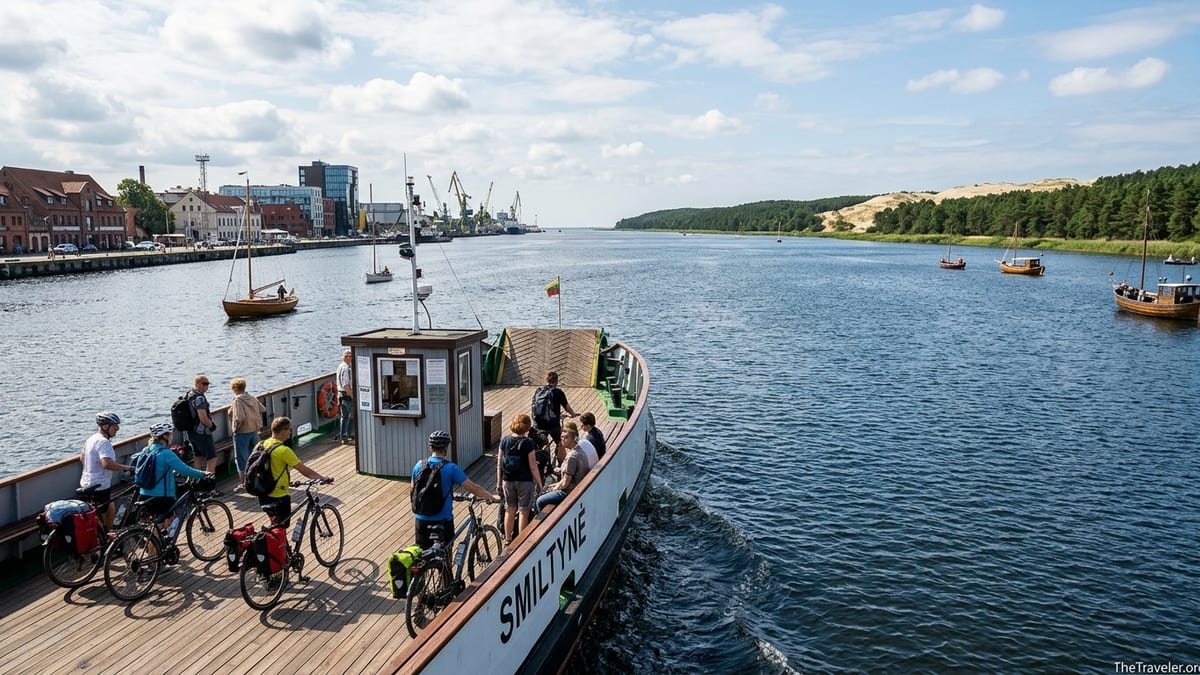
Understanding the Klaipėda–Curonian Spit Ferries
All travel to the Lithuanian section of the Curonian Spit begins with Smiltynės perkėla ferries across the Curonian Lagoon. Passenger ferries for walkers and cyclists leave from the Old Ferry Terminal at Šiaurinis ragas in central Klaipėda, while vehicles use the New Ferry Terminal on Nemuno street. The crossing itself is short, usually around ten minutes, and runs year-round, with sailings at least every 30 to 60 minutes in the middle of the day according to the latest combined ferry timetable published by Klaipėda city in 2026.
Foot-passenger tickets on the Old Ferry are inexpensive. Recent local transport overviews report that a single adult ticket costs a few euros each way and that simple bicycles are carried for a small surcharge, often roughly equivalent to a child ticket. Return tickets are normally not mandatory and most travelers simply buy a one-way crossing from the ticket machines or kiosk in Klaipėda, then pay again on the Smiltynė side when they come back. The short distance and frequent departures make it realistic to arrive at the terminal without a reservation, but in peak July and August weekends you should still allow extra time for lines.
The New Ferry Terminal is different because it is designed for motor vehicles and freight. Car drivers pay more than foot passengers and must respect dedicated queues and restricted sailings for trucks carrying hazardous cargo, which appear in timetables as specific departures reserved for such vehicles. In high season there can be waits, particularly on Saturday mornings when many visitors enter Neringa for weekend stays. Crucially, the ferry fare for a car and its passengers covers only the lagoon crossing. It does not include the separate environmental entry charge collected by Neringa municipality once you reach the Curonian Spit road.
One quirk to note is that work is ongoing around parts of Klaipėda’s waterfront in 2026. The Sea Museum has advised that road access to the Old Ferry approach is periodically diverted because of reconstruction near Danės street, although the ferry itself continues to run from the same Old Terminal. Travelers arriving by car or taxi into Klaipėda should watch for temporary detour signs when heading for the Old Ferry to avoid delays reaching their sailing.
Environmental, National Park and Trail Fees
Neringa municipality charges an environmental entry fee for motor vehicles entering the Curonian Spit by road. This is collected at a checkpoint beyond the New Ferry in Smiltynė, not in Klaipėda, and is separate from both the ferry fare and the Curonian Spit National Park visitor ticket. Guidance compiled from Lithuanian motoring organizations in 2026 notes that all standard cars pay a daily or multi-day tariff, with higher prices in peak summer and discounts or exemptions for some electric vehicles and residents. Exact tariffs change periodically, so drivers should check current rates close to travel, but the key point is that this is a local environmental tax, not a road toll and not avoidable if you enter by car.
Once on the Spit, visitors are encouraged to buy a Curonian Spit National Park visitor ticket. The park administration currently sells a pass that costs about one euro and remains valid for five days across all Lithuanian state parks, with a small portion counted as an administration fee. This ticket is separate again from the vehicle entry charge and is relevant both for car visitors and for those who arrive by bike, bus or on foot. It can be purchased at visitor centres such as those in Nida and other park offices.
The most specific additional fee relates to the Nagliai (Naglių) Nature Reserve educational trail between Juodkrantė and Pervalka. This is a tightly protected area of so-called Dead Dunes where free wandering is not allowed. The Curonian Spit National Park administration published 2026 Nagliai trail prices confirming that adults pay 5 euros and children less, and that payment at the onsite ticket booth is card-only. Opening hours vary by season and the official notice for 2026 explicitly sets different visiting periods to regulate visitor flows, with tickets generally sold only until one hour before closing.
Other famous dune viewpoints such as Parnidis Dune near Nida do not require a separate trail fee beyond the park ticket, but are covered by strict access rules. Signs and fences mark where walking is allowed, and rangers actively discourage stepping onto unmarked dune slopes. It is important to understand that these layered charges serve different goals: the ferry charge funds transport, the Neringa entry fee supports local infrastructure, the national park ticket helps conservation across multiple parks, and the Nagliai trail fee finances intensive management of one fragile reserve.
Buses and Getting Around Without a Car
Travelers who come across as foot passengers or cyclists at Smiltynė are not stranded. Buses run along the single main road that connects Smiltynė with Juodkrantė, Pervalka, Preila and Nida. Current transport summaries and local media articles from 2026 indicate that the route is operated by companies such as Kautra and that in summer there are more frequent services, often close to hourly in the middle of the day between Smiltynė and Nida, with reduced schedules outside peak season.
Tickets for the Smiltynė–Nida bus can be bought from the driver or via Lithuanian intercity bus platforms, with recent travel reports in autumn 2026 quoting around 8 euros for the full Smiltynė–Nida trip. Shorter rides to Juodkrantė cost less. Buses stop near the Smiltynė ferry landing, so after disembarking from the Old Ferry you simply follow the crowd a short distance to the bus stop in the adjoining parking area. In Nida, buses terminate at the compact bus station, upgraded with new waiting facilities and information boards in 2026.
Outside summer, service levels drop and timetable information can be more confusing. Travelers checking online bus search tools for September and October 2025, for example, reported fewer visible departures even though local charts showed additional seasonal buses. By late 2026, regional public-transport portals provide integrated views where you can filter for buses and ferries on your target date. For independent visitors, it is wise to check exact times a few days before travel and plan at least one backup connection, especially if you want to return to Klaipėda the same day.
In practice, arriving without a car is workable for both day-trippers and overnight visitors. One realistic example: take a mid-morning ferry from Klaipėda, board the next bus to Juodkrantė for a few hours at the Hill of Witches and the lagoon promenade, then continue by a later bus to Nida for the evening before catching the last bus back to Smiltynė and a late ferry. Those wanting more flexibility can combine bus legs in one direction with cycling or walking segments in the other, using the bus primarily to bridge longer gaps.
Cycling the Curonian Spit: Routes, Conditions and Rentals
The Curonian Spit is one of Lithuania’s iconic cycling areas, with a dedicated path running much of the way between Smiltynė and Nida. Lithuania Travel materials describe around 63 kilometres of continuous cycling route for this Nida–Smiltynė section. Parts of the route are smooth asphalt, especially near settlements and popular beaches, while other stretches use crushed gravel or forest paths that can be slower after rain. The trail weaves between pine forest, lagoon shore and occasional dune viewpoints, crossing small wooden bridges and skirting protected areas.
For most visitors, cycling the entire route in one direction in a day is ambitious but realistic, provided they are comfortable riding 60 to 70 kilometres. Doing the full length both ways in “a few hours” is not. Wind from the lagoon or Baltic Sea can be strong, affecting speed significantly, and frequent stops for viewpoints, cafés or brief swims quickly add time. A reasonably fit recreational cyclist might budget at least five to six hours of actual pedalling for one direction with short pauses, plus transfer time at each end. Attempting a return trip in one day would push the ride beyond 100 kilometres, which is too much for many holiday cyclists.
More manageable are shorter segments anchored on ferry and bus connections. A common independent plan is to rent a bike in Klaipėda, take it onto the Old Ferry, then cycle only as far as Juodkrantė, roughly 20 to 25 kilometres one way depending on your exact route and detours. You can then either cycle back to Smiltynė or ride further south and catch a bus to return. Other travelers prefer to base themselves in Nida, renting bicycles or e-bikes there and cycling north to Preila, Pervalka and the edge of Nagliai before turning back, which offers varied scenery in a 30 to 40 kilometre round trip.
Bicycle hire is available in Klaipėda near the Old Ferry, in Juodkrantė and in Nida. Typical tourist-oriented rental points provide city bikes and mountain bikes by the hour or day, and in Nida and Juodkrantė several operators have added e-bikes to their fleets as of 2025 and 2026. Prices vary, but visitors can expect a standard bike for a modest daily fee and e-bikes for more. Rental shops generally allow you to take bikes on the passenger ferry at no extra arrangement beyond the standard bike ferry charge, but it is sensible to confirm closing times so that you can return your bike the same day.
Smiltynė, Juodkrantė and Nida: How the Experiences Differ
Smiltynė is the immediate gateway town opposite Klaipėda. For many locals it functions as an easy city beach escape: a quick ten-minute ferry ride, a short walk through forest and you are on the Baltic Sea shore. The area combines long sandy beaches, the Lithuanian Sea Museum and Dolphinarium and simple forest walking trails. Infrastructure is basic once you leave the museum complex, with limited shops or dining options, which keeps Smiltynė feeling like a half-day or beach-focused stop rather than a village where most visitors stay overnight.
Juodkrantė, about halfway down the Lithuanian stretch of the Spit, feels more like a traditional resort. It stretches along the calm Curonian Lagoon with a waterside promenade lined by wooden houses and small hotels, and is backed by pine-covered dunes. Its signature attraction is the Hill of Witches, an open-air sculpture trail in the forest where wooden carvings reinterpret Lithuanian folk tales. Visitors can stroll up from the main road and spend one to two hours following the looping path among trees and sculptures before descending to the lagoon for coffee or ice cream. Juodkrantė’s Baltic Sea beach is accessible by paths over the dunes and is quieter than those near Klaipėda.
Nida at the south end of the Lithuanian section is the most developed and atmospheric base for longer stays. The old fishing village core along the lagoon is lined with brightly painted wooden houses, some preserved as examples of traditional architecture with distinctive blue and brown facades and decorated gables. There are more guesthouses, apartments and small hotels than in other villages, plus restaurants, art galleries and the well-known Nida Art Colony. From Nida you can reach the Baltic beach via several paths and stairs over the dunes, and you are close to Parnidis Dune with its viewing platforms and a large stone sundial overlooking the lagoon and Russia’s Kaliningrad region.
For short visits, Smiltynė suits Klaipėda-based beachgoers, Juodkrantė appeals to travelers who like a quieter promenade-and-forest setting, and Nida works best for those willing to stay at least one night and explore deeper into the park. Distances between the settlements are long enough that trying to “see everything” in one rushed day from Klaipėda is possible but tiring. Choosing one village as a focus, with a brief stop in another, often leads to a more enjoyable experience.
Protected Dunes, Photography and Access Rules
The Curonian Spit’s famous dunes are under intense environmental pressure. Official park information emphasizes that visitors must remain on marked paths and viewing platforms. Walking on open dune slopes destabilizes the sand, damages fragile plants and increases erosion, and fines can be issued for rule violations. On popular dunes such as Parnidis, fencing and clearly laid boardwalks show where access is allowed. This means that many dramatic dune ridges you see in postcards are not legally reachable for close-up shots, especially in the Nagliai Nature Reserve where entry is restricted to the designated educational trail only.
In Nagliai, the 2026 regulations specify defined visiting seasons and daily opening hours. The trail typically operates daily in the main summer months and reduces hours or closes entirely in some off-season periods or in severe weather, both to protect the terrain and for safety. Tickets are only sold until one hour before closing and only by card, which has real implications for photographers. You need to time your visit so that you can walk the loop while the light suits your needs, but you cannot stay on the dunes after official closing even if sunset is later. Planning ahead with sunrise and sunset times and using other viewpoints outside the reserve for off-hours photography is therefore important.
Even outside dedicated reserves, some dune paths or beach accesses can be temporarily closed after storms or strong winds. Sand drift may bury stairs or expose tree roots, leading park staff to close sections until maintenance is done. Serious landscape photographers should build redundancy into their shot lists, identifying multiple potential vantage points in case one trail is closed. Walking off trail to “get the shot” not only risks fines but also contributes directly to the visible scarring that has prompted increasing restrictions in recent years.
For casual visitors, the rules mean accepting that your best views will come from platforms, not untouched crests. The upside is that these marked spots are often positioned carefully to reveal sweeping perspectives of both the lagoon and the Baltic Sea. Combining Parnidis Dune at Nida, the Hill of Witches hilltop clearings and selected Baltic beach entrances near Juodkrantė or Smiltynė gives a varied portfolio without breaching any conservation rules.
Sample Itineraries and Realistic Budgets
A realistic one-day independent itinerary from Klaipėda focuses on either Smiltynė and Juodkrantė or Juodkrantė and Nida, not all three. One practical example is to take a morning Old Ferry from Klaipėda as a foot passenger with a rented bike. Budget around 3 to 5 euros per person for the return ferry with bike surcharge. Cycle south through forest and along the cycling path to Juodkrantė, pausing for beach detours and lagoon views. Spend midday at the Hill of Witches and lunch in Juodkrantė, then either cycle back to Smiltynė for an evening ferry or catch a bus north from Juodkrantė to Smiltynė if tired, spending roughly 3 to 5 euros for the shorter bus ride. Add a park visitor ticket of about 1 euro per person and simple meals, and a solo traveler might spend around 30 to 50 euros in total for transport, bike hire and food, excluding any museum entries.
An active cycling-focused itinerary uses a point-to-point approach. For instance, stay overnight in Klaipėda, rent a higher quality touring bike or e-bike in town for 20 to 40 euros per day depending on type, then catch the first Old Ferry. Cycle the full 60-plus kilometres to Nida at an unhurried pace, taking breaks at Juodkrantė, the Nagliai educational trail (adding the 5 euro trail entry) and scenic beaches. In Nida return your bike to a rental partner there if using a company that supports one-way rentals, or stay the night and cycle partial segments back the next day. Accommodation in Nida in 2026 typically spans from modest guesthouses at roughly 50 to 80 euros per night out of peak season to significantly higher rates in July and August.
A relaxed two-day plan might start with an afternoon ferry from Klaipėda, a bus straight to Nida and a stroll around the old fishing quarter and lagoon promenade. After dinner in Nida, overnight in a mid-range guesthouse. On day two, rent simple bikes locally for perhaps 10 to 20 euros each and ride to Parnidis Dune in the morning, then along quieter stretches of the cycle path toward Preila. You could continue to Nagliai for the educational trail if time and opening hours allow, then catch an afternoon or early evening bus back to Smiltynė and the ferry. Including return ferries, two bus legs, two days of bike rental for a couple, a park ticket, Nagliai trail entry and one night in a mid-range room, a rough budget might land in the 200 to 300 euro range for two people outside the very peak of summer.
Car-based visitors should add the New Ferry fees and Neringa vehicle entry charge. In high season a round-trip ferry plus environmental entry for a family car can reach several tens of euros, and parking in Nida or Juodkrantė may incur additional hourly or daily charges, especially close to beaches and the village centres. Balancing this, self-driving offers the freedom to combine short hikes and beach stops at otherwise inconvenient points, but it is not necessary for those content with cycling and buses.
Climate, Swimming and Accessibility Considerations
The Curonian Spit’s Baltic beaches are long, sandy and generally clean, but water temperatures are cool by southern European standards. In July and August, surface temperatures often reach the high teens or low twenties Celsius, which many locals find comfortable for swimming but can feel chilly to visitors used to warmer seas. Wind and currents can create strong waves on exposed days. Lifeguard posts operate on the main bathing beaches near Smiltynė, Juodkrantė and Nida during the formal summer season, and flags or notice boards indicate swimming conditions and any jellyfish or algae alerts.
Weather in this maritime region changes quickly. A warm sunny morning can give way to cool fog or showers by afternoon, and wind exposure is a constant factor both on the beaches and on the cycling path. Light layers, a waterproof shell and sun protection are all essential, even for day trips. The sand itself is fine and pale, reflecting sunlight strongly, so hats and sunglasses are advisable. For cyclists, exposed stretches alongside the lagoon or sea can feel significantly cooler or hotter depending on wind direction.
Accessibility varies by location. Smiltynė’s main ferry landings and Sea Museum complex have paved access and ramps, making them feasible for visitors with limited mobility, although reaching the open Baltic beach usually involves stairs or sandy paths over low dunes. In Juodkrantė and Nida, lagoon promenades are flat and paved, but dune viewpoints such as Parnidis involve climbs on steps or sloping paths. The Nagliai educational trail includes boardwalk segments and sand, which can be challenging for wheelchairs or strollers. Public buses offer basic step access rather than full low-floor accessibility on every vehicle, though newer buses introduced in 2026 are gradually improving this.
Families with small children may find combining short bus rides with focused time in one village more comfortable than attempting long bike rides. Bringing or renting child seats or trailers for bikes is possible from some rental shops in Klaipėda and Nida, but these should be reserved in advance in peak season. For all visitors, planning for cool water, strong sun reflection and shifting wind conditions will make time on the Spit’s beaches and trails more pleasant and safer.
Who the Curonian Spit Suits Best
For day trippers based in Klaipėda, the simplest recommendation is to focus on Smiltynė and, if you have enough time and energy, add Juodkrantė. A combination of morning beach time, a visit to the Sea Museum or Dolphinarium, and an afternoon stroll or short cycle segment along the forest trails offers plenty for a single day. Those happy to commit to slightly longer travel can make Juodkrantė their main goal for the Hill of Witches and quieter beaches, returning to Klaipėda by evening bus and ferry.
Families benefit from choosing just one or two main stops rather than trying to see the whole Spit in one sweep. Smiltynė and Juodkrantė together work well: ferries are short and fun, beaches are easily accessed, and the Hill of Witches offers children an imaginative forest walk. Staying overnight in Nida adds charm and reduces the rush, but raises costs and travel time. When budgeting, families should factor in ferry fares, at least one park visitor ticket per person and any vehicle entry and parking charges if driving.
Cyclists will get the most out of the Curonian Spit by planning point-to-point rides with realistic distances. A single-day Smiltynė–Juodkrantė–Smiltynė loop suits casual riders, while stronger cyclists can tackle Smiltynė–Nida one way and return by bus with bikes loaded underneath or on racks if permitted. The key is to respect wind conditions and allow time for stops at viewpoints and attractions like Nagliai. E-bikes expand possibilities but still require attention to battery range and charging opportunities in villages.
Nature photographers should center their plans around official vantage points such as Parnidis Dune platforms, selected Baltic beach entrances and the Nagliai educational trail in its open seasons. They must accept that some dune crests are off-limits and that Nagliai’s card-only fee and regulated hours dictate shooting windows. Building in time for backup locations and embracing changing weather, from misty mornings over the lagoon to golden light on forest paths, will be more productive than chasing forbidden angles. In all cases, staying on marked paths and respecting fragile dune closures is not just a rule but a contribution to preserving one of the Baltic region’s most distinctive landscapes.