


More news on this day
India’s Ministry of External Affairs (MEA) has described the worsening security situation in the Red Sea and threats to maritime navigation as “totally unacceptable,” as published coverage highlighted renewed concerns about attacks and instability near one of the world’s most important sea corridors.
Get the latest news straight to your inbox!
What the MEA statement signals and why it matters
Published coverage from New Delhi on September 18, 2026 tied the MEA’s comments to heightened tensions around the Red Sea and the Bab al-Mandeb strait, a narrow chokepoint connecting the Red Sea to the Gulf of Aden and onward to the Arabian Sea. The remarks also referenced concern over strikes and threats impacting Saudi Arabia, alongside broader risks to regional security and freedom of navigation.
The MEA framing is notable because it links two overlapping problems: physical attacks and coercive threats against vessels, and the broader operational risk that comes when shipping corridors are treated as leverage in regional conflict. Even when commercial ships are not directly hit, the perception of danger can be enough to trigger diversions, schedule disruptions, and higher costs that ripple into passenger travel markets.
While the statement originated in an Indian government briefing, it fits within a wider pattern of international warnings urging de-escalation and protection of civilian shipping in the Red Sea and Gulf of Aden region, according to publicly available statements from multilateral bodies.
Red Sea instability is reshaping travel, cruising, and air routes
For travelers, the most immediate impact is usually indirect: itinerary changes and price pressure caused by disrupted logistics. The Red Sea sits alongside some of the region’s most visited gateways, including Egypt’s Suez Canal corridor and resort areas, Saudi Arabia’s west coast ports, and routes that connect Europe with South Asia. When security risks rise, shipping operators may avoid the area, sometimes rerouting around southern Africa, which can extend transit times and complicate supply planning.
Those knock-on effects can reach airline operations as well, particularly for flights crossing adjacent airspace or relying on certain navigation procedures. The aviation industry has documented growing concern about navigation disruptions and interference events across parts of the Middle East and Eastern Mediterranean, a separate but compounding hazard that can increase crew workload and limit routing flexibility.
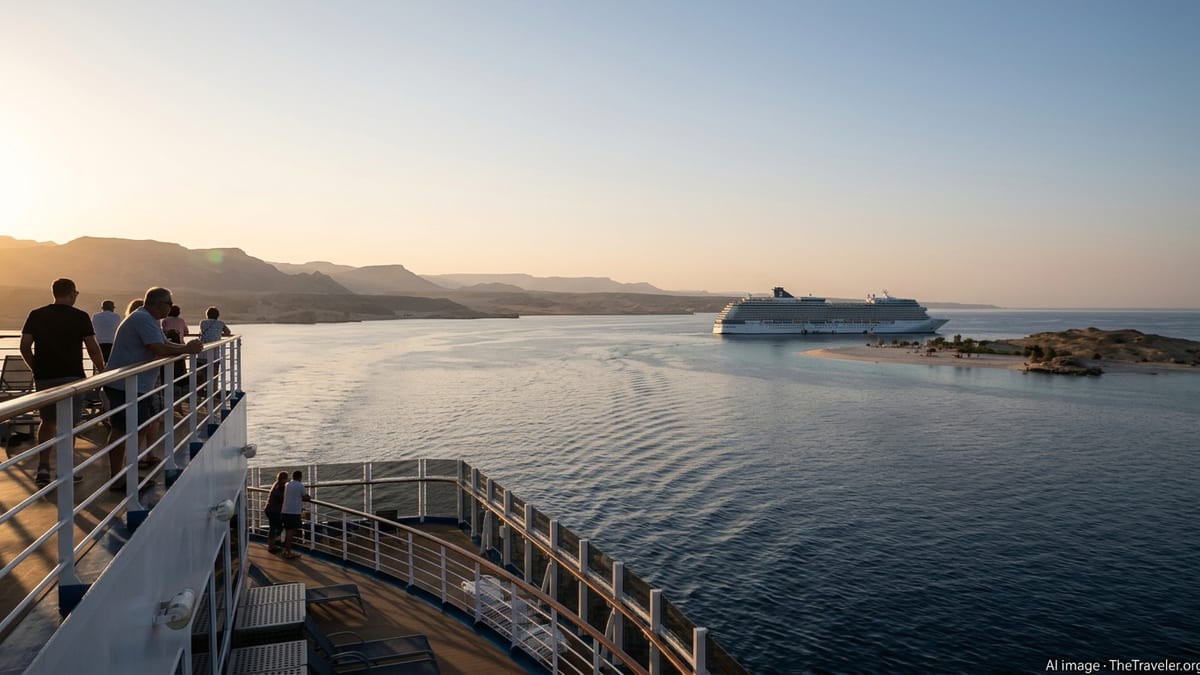
Cruise and ferry planning can also be affected. Even when passenger ships are not in the immediate threat zone, operators consider regional risk levels, port-call advisories, and insurance requirements when building itineraries months in advance. That can mean fewer Red Sea-adjacent calls, more sea days, and an increased tendency to keep schedules concentrated in lower-risk basins.
Navigation threats are not only about missiles: interference and alerts add another layer
Security risk in the Red Sea is not limited to visible kinetic attacks. Published guidance and safety alerts in recent months have emphasized that electronic interference can create hazards for both maritime and aviation navigation, particularly when satellite-based positioning is unreliable.
In the maritime sector, public incident-reporting channels have cataloged reports of GNSS and GPS disruptions in and around the Red Sea, including jamming and suspected spoofing that can produce incorrect positions. These issues do not automatically mean a vessel is in imminent danger, but they can undermine situational awareness in congested waters and increase the risk of close-quarters incidents, especially at night or near coastal traffic separation schemes.
In aviation, regional safety bodies have circulated alerts about an increase in GNSS interference reports across parts of the region, noting that disruptions can occur even where formal advisories are uneven. In practical terms, that can lead operators to rely more heavily on alternative navigation aids and procedures, and it can influence whether certain routes are preferred during periods of elevated risk.
Global calls to protect freedom of navigation continue
The MEA’s “totally unacceptable” wording aligns with broader international messaging that emphasizes the principle of freedom of navigation and the need to protect commercial vessels and crews. International maritime institutions have publicly condemned attacks on shipping in the Red Sea area and urged an end to actions that endanger seafarers and disrupt trade.
Separately, publicly available UN messaging in recent weeks has urged de-escalation and restraint regarding threats and attacks against commercial vessels, reflecting ongoing concern that renewed pressure on the corridor could widen regional instability.
For travelers, these diplomatic signals matter because they often foreshadow practical shifts in risk advisories, insurance posture, and carrier contingency planning. Even without formal passenger travel restrictions, elevated maritime risk can still impact fuel markets, freight reliability, and the cost base for airlines and tour operators over time.
What travelers can watch next as the situation evolves
Travelers planning itineraries that connect through Red Sea-adjacent hubs, or that rely on time-sensitive shipments (such as expedition cruises, dive liveaboards, or tours dependent on imported equipment), may see schedule padding and more conservative routing decisions during spikes in tension. These changes can appear first as minor timetable updates, longer layovers, or revised port calls rather than outright cancellations.
From a practical standpoint, the most reliable indicators tend to be official navigation advisories and safety notices, plus airline operational updates that reflect route adjustments. For air travel, government-issued airspace advisories and operator bulletins can also shape decisions about flight paths over the Eastern Mediterranean, the Red Sea, or the Arabian Sea, particularly when military activity and identification risks are highlighted in ongoing notices.
The MEA’s latest remarks underscore how quickly the Red Sea can shift from a background trade corridor into a front-page security issue. For now, published coverage points to continued diplomatic pressure and elevated vigilance, with the travel sector watching for further advisories that could translate geopolitical risk into day-to-day itinerary changes.