


More news on this day
IndiGo, India’s largest airline by market share, is quietly preparing a radical step up in comfort as it develops a new Airbus A350 business class that is expected to blend long-haul luxury with the sharp pricing that helped build its low-cost dominance.
Get the latest news straight to your inbox!
A Widebody Bet That Redefines IndiGo’s Image
IndiGo’s move into the Airbus A350 family marks a decisive shift from its origins as a strictly low-cost, single-class carrier. Publicly available fleet data shows that the airline has now committed to 60 A350-900 aircraft, building on an initial order for 30 widebodies announced in April 2024 and a follow-on deal in October 2025. Deliveries are scheduled to begin from 2027, positioning IndiGo for a new phase of long-haul growth from key Indian hubs.
Industry reporting indicates that the exact A350 cabin layout has not yet been formally disclosed. However, the airline has confirmed that these aircraft are intended for long-range missions linking major Indian metros with Europe, East Asia, Australia and potentially North America. That mission profile makes a dedicated business class cabin, with lie-flat seats and upgraded service, increasingly likely as IndiGo seeks to compete head-on with full-service rivals.
The decision to pursue a bespoke A350 interior is already reshaping perceptions of the brand. For more than a decade, IndiGo’s model centred on a single, high-density economy cabin and a no-frills approach. Moving to a dual- or three-class widebody equipped with full business class seating would represent the airline’s most significant product evolution to date.
A successful launch of the A350 could also influence IndiGo’s positioning in future alliance or partnership discussions. A true long-haul business class would make the carrier a more attractive partner for global airlines seeking Indian feed, particularly on flights to secondary cities beyond Delhi and Mumbai.
From Bare-Bones to Lie-Flat: A Cabin Under Development
While IndiGo’s existing product on narrowbody aircraft focuses on extra-legroom economy rather than a traditional premium cabin, the A350 platform opens up new possibilities. Aviation analysts point to market norms on comparable A350-900 operators, where 30 to 40 lie-flat business class seats arranged in a 1-2-1 configuration are common, supported by premium economy and standard economy sections. IndiGo is widely expected to follow a similar blueprint rather than attempt an all-economy layout.
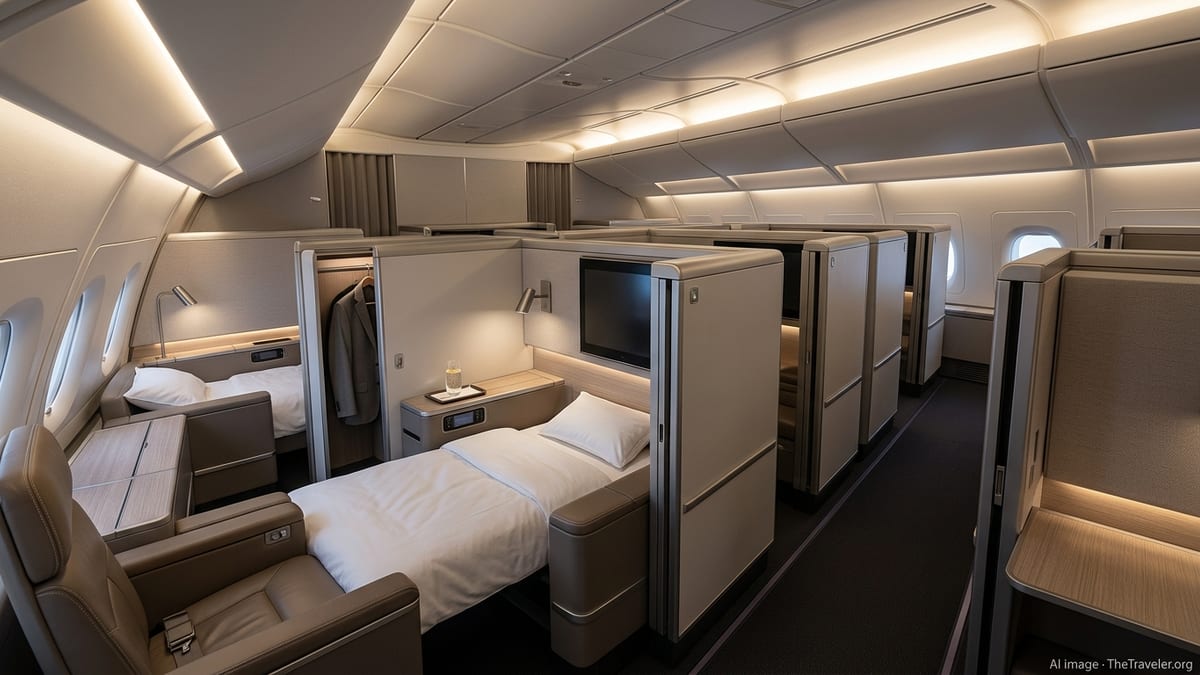
Reports indicate that IndiGo is working with seat manufacturers and design houses to craft a configuration that balances comfort with efficiency. On long-haul A350s, many airlines now opt for forward-facing, all-aisle-access business class suites, often with privacy doors, larger IFE screens and ample storage. IndiGo is understood to be targeting a modern, high-density but fully lie-flat solution instead of the more basic recliner-style seats sometimes used on regional routes.
The business class under development is also expected to include a significant upgrade in soft-product elements compared with IndiGo’s current offering. Even without specific details announced, industry expectations centre on enhanced bedding, elevated meal service and priority ground handling that align with long-haul standards. For an airline known primarily for punctuality and low costs, these additions would mark a distinct move up the value chain.
At the same time, IndiGo is likely to preserve its operational simplicity wherever possible. Observers expect the airline to standardise the A350 cabin across most routes, avoiding multiple sub-fleets or one-off configurations that can complicate scheduling and increase costs.
Value-Driven Luxury for India’s Long-Haul Travellers
The defining question for Indian travellers is how IndiGo will translate its cost-conscious DNA into a premium cabin that still feels like good value. India’s outbound long-haul market is growing rapidly, but it remains price sensitive, with many passengers willing to forego full-service frills in exchange for competitive fares.
By introducing a carefully optimised A350 business class, IndiGo is positioned to target premium leisure and small-business customers who aspire to lie-flat comfort but are highly aware of ticket prices. Analysts suggest that the airline may pitch its product as “smart luxury,” emphasising core comfort features such as the seat, sleep quality and reliable connectivity, while keeping non-essential frills restrained to maintain sharper pricing.
Competition in this segment is intensifying. Air India’s re-fleeting with A350s and upgraded 787s is reshaping expectations for Indian flag-carrier service, while Gulf and Southeast Asian hubs continue to attract Indian travellers with polished premium cabins and extensive networks. IndiGo’s brand strength within India and its reputation for on-time performance give it a platform, but the A350 business class must deliver a truly differentiated experience at a compelling fare level.
For many travellers, the value proposition will be measured seat by seat: direct aisle access, seat width, pitch, privacy and inflight entertainment quality will be closely scrutinised against competitors. If IndiGo can offer a modern lie-flat product with intuitive design and consistent service at lower average fares, it may succeed in expanding the premium market rather than merely poaching from existing full-service carriers.
Cabin Layout Choices and the Emerging Role of Premium Economy
Beyond business class, IndiGo’s A350 layout decisions will have major implications for the broader cabin experience. Industry comparisons suggest that a three-class arrangement featuring business, premium economy and economy has become the standard among many A350-900 operators serving long-haul routes. Premium economy, typically in a 2-4-2 configuration with extra legroom and enhanced amenities, has proved particularly attractive to India’s fast-growing middle class.
A number of analysts expect IndiGo to adapt its existing “extra legroom” concept into a more formal premium economy product on the A350, potentially branded to align with its current fare families. This would allow the airline to monetise demand from travellers who want more comfort than standard economy but do not justify the cost of a full business class seat, especially on leisure-heavy routes to Europe and Asia-Pacific.
Seat count is another critical variable. Some operators have squeezed close to 350 or more seats onto A350-900s, but early expectations around IndiGo’s orders point to a more balanced approach that leaves room for a substantial premium cabin. A medium-density configuration with 30 to 40 business class seats, a modest premium economy cabin and a large but not ultra-tight economy section would align with the airline’s ambitions to offer both reach and comfort.
Whatever layout IndiGo ultimately selects, the A350’s relatively quiet cabin, higher humidity and larger windows are likely to represent a noticeable upgrade for Indian travellers accustomed to older widebodies or dense single-aisle aircraft on long sectors.
Timelines, Expectations and What Comes Next
With the first A350 deliveries slated for 2027, IndiGo still has time to fine-tune its business class concept and respond to evolving market conditions. The next two years are expected to bring more clarity as the airline locks in suppliers, finalises seat models and begins cabin certification and training programs.
Industry watchers anticipate that IndiGo will gradually reveal elements of the new product, starting with visuals of the seat shell and cabin mood lighting, followed by details on inflight connectivity, entertainment and service design. Given IndiGo’s historical focus on operational reliability, attention will also turn to how the airline plans to maintain fast turnarounds and high utilisation on long-haul aircraft that inherently operate more complex schedules.
The strategic stakes are significant. If the A350 business class succeeds in combining modern luxury with IndiGo’s trademark attention to cost, it could set a new benchmark for value-oriented premium travel from India. Conversely, a misstep on comfort or pricing could leave the airline squeezed between full-service competitors at the top end and aggressively priced low-cost rivals on shorter routes.
For now, the development of IndiGo’s A350 business class stands as one of the most closely watched projects in Asian aviation. As cabin details emerge and the first aircraft move through assembly, Indian travellers will gain a clearer picture of how the country’s largest airline intends to redefine long-haul flying in a market where expectations are rising as quickly as demand.