


More news on this day
Severe disruption at Cairo International Airport on June 9 triggered a wave of delayed and cancelled services involving Egypt Air, Emirates, British Airways and Air Cairo on routes linking Egypt with London, Paris, Dubai, Riyadh and Istanbul, raising fresh concerns over the resilience of one of the region’s most important aviation hubs.
Get the latest news straight to your inbox!
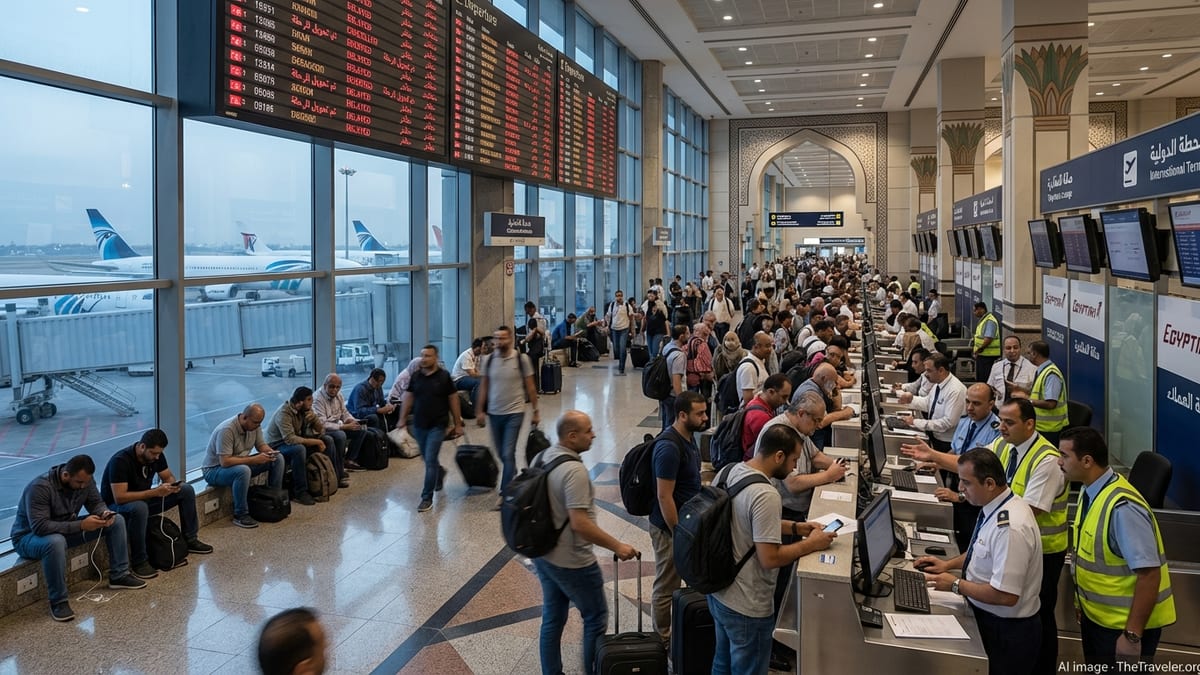
Dozens of Flights Affected in a Single Day of Turbulence
Publicly available flight-tracking data and regional aviation reports indicate that operations at Cairo International Airport suffered significant disruption on June 9, with a total of 67 flights reportedly delayed and at least two services cancelled across a web of routes connecting Egypt with Europe and the Gulf. The pattern of disruption centered on services to and from major cities including London, Paris, Dubai, Riyadh and Istanbul, placing renewed spotlight on Cairo’s role as both a national gateway and a critical transfer point for North Africa and the Middle East.
The disturbance involved multiple carriers, notably Egypt Air and Air Cairo on Egypt-centered routes, as well as long-haul and regional connections marketed or operated in cooperation with Emirates and British Airways. Operational data suggests that delays ranged from minor schedule slippages to multi-hour hold-ups, with some departures from Cairo pushed back repeatedly and onward connections forced into missed or misaligned itineraries.
While the exact operational triggers for the June 9 disruption have not been fully detailed in official dispatches, recent weeks have seen a volatile regional backdrop, including lingering airspace constraints and schedule reshuffles affecting Dubai and other Gulf hubs. The latest episode at Cairo appears to have amplified that pressure, concentrating a high volume of delays into a short window and stranding passengers across several continents.
Pressure Mounts on Egypt’s Flag Carrier and Local Operators
Egypt Air, as the dominant tenant at Cairo International Airport, carried a substantial share of the disruption burden. Historical data from similar recent events has shown that the airline often accounts for the majority of irregular operations at the airport, and early tallies for June 9 again point to Egypt Air being at the center of the turbulence, alongside its regional partner Air Cairo on secondary and feeder routes.
Available timetables and performance trackers show that Egypt Air’s network from Cairo to Gulf cities such as Dubai and Riyadh, as well as to European destinations including London and Paris, remained under strain during the day, with a number of departures flagged as late or rescheduled. Air Cairo, which feeds traffic into Cairo from regional markets, also faced schedule disruption, compounding missed connections for travelers relying on same-day onward flights via the Egyptian capital.
The disruption comes on the heels of earlier periods in 2026 where Egypt Air and other regional carriers operating through Cairo reported clusters of delays and cancellations linked to aircraft availability, congestion and regional airspace issues. Aviation observers note that recurring episodes of concentrated disruption threaten to undermine confidence in Cairo as a reliable hub, particularly among transit passengers who depend on tight connection windows.
Ripple Effects Felt in London, Paris, Dubai, Riyadh and Istanbul
The June 9 turmoil in Cairo did not remain confined to Egypt’s borders. Flight-monitoring services and schedule updates show knock-on effects at London and Paris, where services operated by or in partnership with Egypt Air and British Airways experienced delays, slot changes and equipment substitutions. These disruptions complicated travel plans for passengers connecting between Europe, North Africa and the wider Middle East.
In the Gulf, Dubai and Riyadh felt particular pressure. Dubai has been operating under a patchwork of suspended and reduced schedules by several international airlines in recent weeks, and the latest irregularities on Cairo-linked services added another layer of uncertainty for passengers using the city as a transfer point. In Riyadh, where traffic flows to and from Cairo are typically heavy, delayed arrivals and departures fed into broader congestion at peak times.
Istanbul also appeared among the affected nodes, with services linking the Turkish metropolis and Cairo experiencing delays that reverberated through already busy summer schedules. Aviation analysts note that these five cities form a crucial backbone of Egypt’s international connectivity, so any sustained disruption on these routes carries outsized implications for tourism flows, business travel and diaspora links.
Travelers Face Missed Connections and Uncertain Rights
For passengers, the practical impact of the June 9 disruption has been long queues at transfer desks, extended waits in departure halls and, in some cases, overnight stays when onward connections became unviable. Reports from traveler forums and social media posts suggest that some customers struggled to obtain clear rebooking options following cancellations or severe delays, particularly where itineraries involved multiple carriers or codeshares.
The situation also revived questions about compensation and care obligations under different regulatory regimes. For itineraries touching the European Union or the United Kingdom, consumer advocates point out that air passenger rights rules may entitle affected travelers to assistance or financial redress in cases of long delays or cancellations, depending on the circumstances and the operating carrier. For routes outside those jurisdictions, passengers are more dependent on individual airline policies and contractual conditions of carriage.
Travel advisory platforms are urging passengers booked on upcoming flights between Cairo and London, Paris, Dubai, Riyadh or Istanbul to monitor airline apps and airport information screens closely, and to confirm any tight connections well in advance. Industry commentators suggest that travelers build in longer layover buffers when routing through Cairo in the coming days, as operational knock-on effects can persist even after the most acute disruption has passed.
Strategic Concerns Over Cairo’s Reliability as a Regional Hub
The latest wave of delays and cancellations has intensified debate about Cairo International Airport’s resilience at a time when Egypt is seeking to expand tourism, attract investment and position itself as a key transit point between Africa, the Middle East and Europe. The airport is already one of the busiest in Africa, and sustained irregular operations raise questions about infrastructure capacity, contingency planning and coordination among airlines.
Analysts note that the combination of regional airspace volatility, high demand on core trunk routes and aging fleet segments in parts of the regional industry can produce sudden spikes in disruption when even small operational issues arise. In such a context, a single day featuring dozens of delayed flights and multiple cancellations is seen as a stress test for Cairo’s systems and for the airlines that rely on the airport as their primary hub.
There is growing discussion among travel industry stakeholders over whether airlines serving Cairo need to review schedules, add additional slack into turnaround times or adjust fleet deployment to better absorb shocks. Some observers argue that without such adjustments, the pattern of recurring “travel chaos” days risks becoming a regular feature of peak travel seasons, with potential long-term consequences for Egypt’s reputation as a convenient and dependable gateway.